


 SHARE:

Compared with the rest of Canada, Albertans are richer. And quite a bit less satisfied with their lot in life.
Those two well-established facts seem at odds with each other, but income data reveals a possible explanation.
Albertans continue to have the highest incomes among all provinces. But they’re also earning significantly less than they were at their peak. This may get at the fundamental disconnect in the national conversation about Alberta’s sense of frustration.
From the outside, people look at the wealth in Alberta and wonder what there is to complain about. Within the province, however, the story feels quite different for longtime Albertans who have lived through an extended downward trajectory unlike anywhere else in the country.
I’ve lived most of my adult life in Alberta, but I grew up in Manitoba and still regularly visit family there. The financial disparity between the two provinces is apparent. I love Manitoba, but when I return it’s impossible not to notice there’s just a lot less money there. I’ve heard the opposite observation from Manitobans who visit me in Calgary and take note of the BMWs and Mercedeses in the city’s parking lots.
The story feels different from within Alberta. Many residents came of age, built careers or bought homes during a period of remarkable economic growth. From the early 1990s to the mid-2010s, inflation-adjusted average market income (that is, income from employment, investments, etc.) in the province grew by 64 per cent. In Calgary, specifically, it nearly doubled.
Twenty years of sustained and rapid growth have a way of entrenching expectations within the psyche of an individual — and the culture of a place. Economic growth became part of Alberta’s identity.
Then came the 2014-16 oil-price crash, and things have never really been the same.
Today, while average market incomes in Alberta remain high compared with those in other provinces, they are well below their peak after accounting for inflation. This is true for both mean and average real incomes, which are down 11 per cent from peak, and median real incomes, which have declined by 13 per cent.
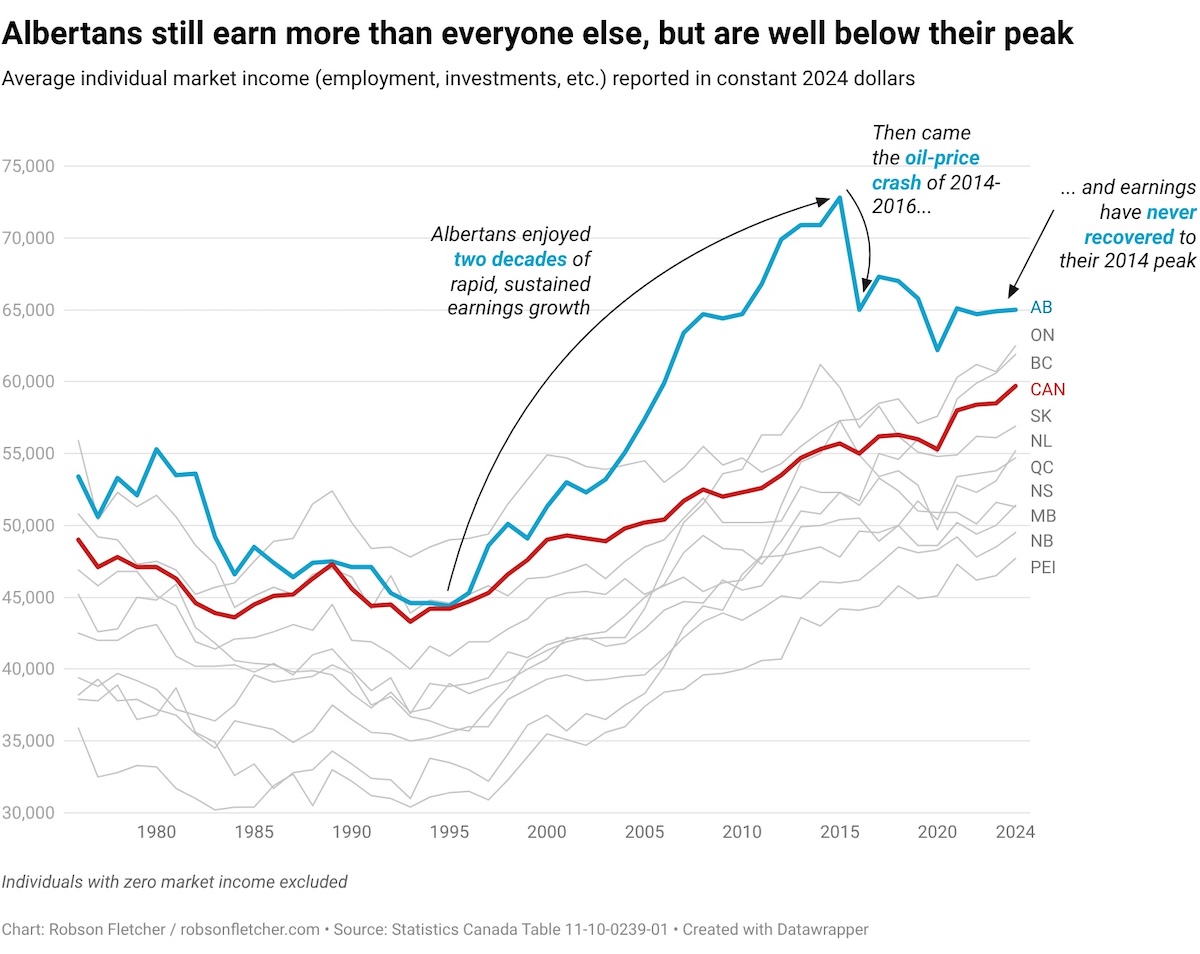
What’s worse is the sustained change in trajectory. Alberta has now seen a full decade of income decline and stagnation. It’s a complete turnaround from the ever-upward path of the previous 20 years. This represents a profound shift, not only in many Albertans’ finances but also in their expectations about what life in the province was supposed to look like.
Of course, this doesn’t explain every grievance in the province. But it does provide some context about how a place like Alberta can be objectively well off while its residents still feel a deep sense of economic disappointment. They are comparing themselves today not with other provinces, but with a past version of their own province that they still remember.
Most of the country has not experienced this same decline. In British Columbia, Ontario, Quebec and the Maritimes, average market income, even when adjusted for inflation, has never been higher. (Of course, it might not feel that way for many folks struggling daily with the cost of housing, fuel and groceries, but remember these are average figures; an aggregate divided by a population doesn’t reflect the individual experience of every person within that population.)
Manitoba, Saskatchewan and Newfoundland and Labrador have seen declines from their peaks as well, but not as large as Alberta’s.
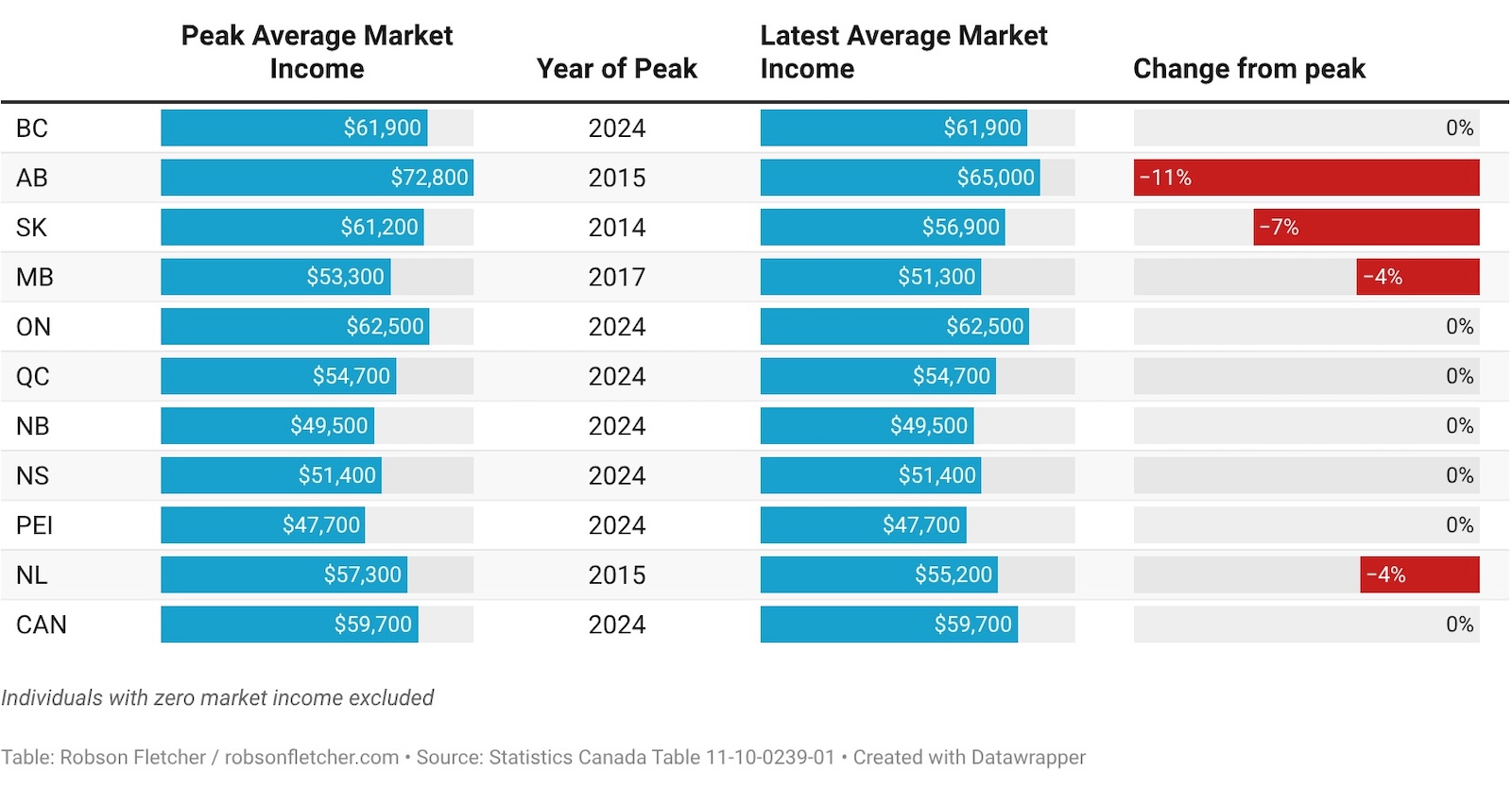
This is just one economic measure. But there are plenty more telling the same story. Charles St-Arnaud, chief economist with Servus Credit Union (formerly with Alberta Central), provided a long list of similar data points in a report last year, including:
- Alberta’s GDP per capita at 10 per cent below its 2014 peak, and only marginally above its 2004 level
- An employment rate that has “significantly underperformed” the rest of the country, with particularly heavy declines in employment prospects for both younger and older men
- The largest decline in purchasing power (real disposable income per capita) of any province over the past decade
Seen through this lens, it’s not surprising that Albertans reported the lowest life satisfaction in Statistics Canada’s latest Canadian Social Survey. As Alex Bierman, a sociology professor with the University of Calgary, told Global News when the survey data was released: “Life satisfaction is essentially the extent to which our lives meet what we expect for our lives and hope for our lives.”
The province’s wealth is readily visible to non-Albertans. Manitobans may justifiably find it hard to sympathize with Albertans’ complaints when they see so many expensive cars in Calgary parking lots. What’s harder to see from the outside is the deep frustration, even disillusionment, that can come from watching the future you expected for your own life — and for the place you call home — slip out of reach.
This highlights the importance of looking at different kinds of data together. In this case, long-term economic data can help us make sense of recent public-opinion data and better understand how two things can be true at once: Alberta can still be a relatively prosperous place by Canadian standards, while many Albertans can still feel like they’ve lost ground. ![[Tyee]](/design-article.thetyee.ca/ui/img/yellowblob.png)
Read more: Labour + Industry, Alberta










Tyee Commenting Guidelines
Please note that email notifications for replies are not currently working due to a software issue which may be resolved in a future update.
Comments that violate guidelines risk being deleted, and violations may result in a temporary or permanent user ban. Maintain the spirit of good conversation to stay in the discussion and be patient with moderators. Comments are reviewed regularly but not in real time.
Do:
Do not: