



 SHARE:
There are few things more frustrating than loving someone who doesn’t seem to love you back. Except, perhaps, being told that you don’t love someone as much as they love you.
That’s the dynamic many Albertans feel they have with the rest of Canada, and vice versa.
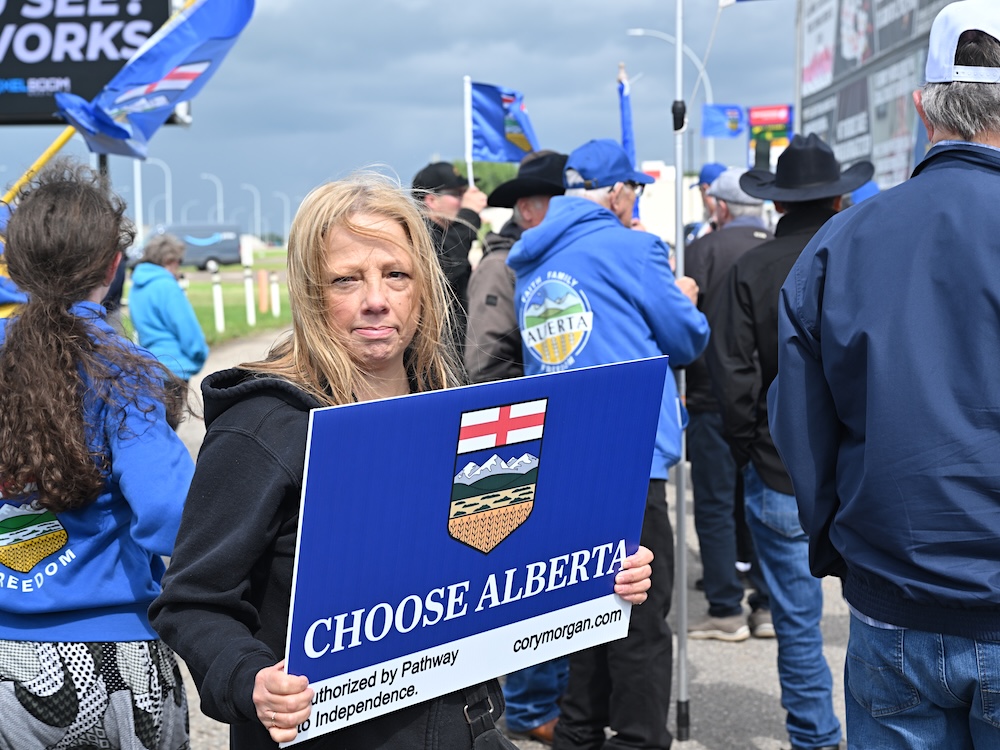
Most Albertans harbour a sense that the province is not treated fairly by the federal government, that it does not get its fair share of attention or support, that its contributions are taken for granted, that its complaints are dismissed and that its biggest desires are thwarted.
Those feelings have declined noticeably since the 2025 federal election, particularly among New Democrats, but they remain a defining feature of Alberta politics heading into this month's referendum on separation.
Some Albertans express this alienation as anger, others as quiet resignation. But many express it as something more complicated: a desire to be seen, understood and appreciated by the country they love.
That is why the language of family and romance comes so easily to debates about Confederation. It reflects how many Albertans experience Canada — less as a contract among governments than as a relationship among provinces.
In these ways, much of Alberta sees itself as the jilted lover of Confederation.
From this perspective, Alberta has been loyal to the rest of the country. Alberta has worked hard to contribute to the family’s prosperity, helping to power the national economy, fill the federal treasury and welcome Canadians here to build better lives.
Yet when Alberta has needed something in return — another pipeline, a hand up when bad times hit, a little gratitude, a little room to move — it feels like Canada is unsupportive.
At times, this feeling manifests as a belief in being taken for granted. This includes the sense that other family members are not pulling their own weight when it comes to economic development, preferring to rely on wealth distributed from west to east. In this way, Alberta’s emotional identity has always contained a touch of martyrdom.
Every region has its complaints. But Alberta has elevated grievance to the level of a civic religion.
To grow up in Alberta is to absorb, almost by osmosis, a familiar litany of wrongs: the national energy program, equalization, pipeline delays, environmental regulation, Senate seats, federal indifference, Laurentian elitism. Federal governments have too often treated the province as a problem to be managed, a cash cow to be milked or a caricature to be mocked.
Not all Albertans feel like the jilted lover of Confederation. Across the province and, yes, across the spectrum, most Albertans feel their province is undervalued in Confederation. Most. But not all.
Other Albertans may not share the sentiment that Albertans are getting as raw a deal as their leaders contend. They may prefer to call Alberta the “problem child,” “spoiled child” or “resentful son” of Confederation.
But those judgments don’t make the alienation any less mainstream.
This grievance-based culture is attractive to far-right movements. It can be mobilized, monetized and weaponized by people who have an interest in sowing division.
In these ways, separatist politics does not simply express Alberta’s hurt. It amplifies it, hardens it and then offers departure as the only measure of self-respect.
Based on this, the separatists’ preferred metaphor is far darker. In speeches, memes, podcasts and comment threads, Alberta is cast explicitly as the abused spouse of Confederation. Alberta is exploited, battered, trapped and finally brave enough to escape. This is a grotesque analogy, not least because it borrows the language of intimate partner violence to describe being subject to federal environmental regulations.
Nonetheless, the separatists’ abuse metaphor transforms disappointment into danger, recasting federalism from a difficult relationship into a violent one.
To be clear, that is not how most Albertans understand their relationship with Canada. For them, the deeper emotion is not hatred or fear. It is longing.
This does not make the separatists’ threats any less harmful. Anyone who has lived in a relationship governed by ultimatums knows how corrosive they become. The person who constantly threatens to leave may be expressing pain, but they are also exercising power. They make everyone else manage their feelings and leave little room for others’ emotions. They turn ordinary conflict into emergency. They force the relationship to revolve around the possibility of their departure. Over time, that dynamic does damage whether anyone leaves or not.
It also obscures responsibility. Abused or jilted, if Alberta is always the victim, then Alberta never has to ask how it contributes to the relationship it says it wants to repair. It never has to ask whether its demands are clear, whether its expectations are realistic, whether it is intentionally or subconsciously keeping the grievances alive. Martyrdom can feel noble from the inside, but from the outside it often looks like emotional blackmail.
So what does a partner do with a jilted lover? And what can that martyr do to prevent the feelings of unrequited love from taking over the relationship or becoming a full-blown victim complex?
To find answers, we draw on our respective expertise in political science and relationship science, as well as conversations with additional relationship experts — counsellors, therapists, mediators and scholars of attachment and conflict — about how people navigate family dynamics defined by resentment, unrequited love, threats of departure, and martyrdom.
These perspectives do not map perfectly onto constitutional politics. Provinces are not people. Governments are not spouses. Confederation is not a marriage, no matter how often we talk about its bargains, compromises, betrayals and vows.
Like all analogies, this one has limits. Couples therapy cannot fix fiscal federalism any more than attachment theory can build a pipeline. No counsellor can help renegotiate the division of powers (although it would be refreshing to see them try).
Still, political communities tell stories about themselves through intimate language because politics is never only about institutions. It is also about belonging. And this is where relationship research is helpful.
Psychologists often draw a distinction between two types of relationships.
First, exchange relationships are governed by balance sheets: who contributed what, who owes what and whether benefits are being distributed fairly.
Communal relationships operate differently. They are rooted in recognition, care, responsiveness and the feeling that one's needs matter to the other party.
Much of Alberta's political discourse is expressed in exchange terms. But the emotional force of those arguments often comes from somewhere deeper. Beneath the complaints about transfers, pipelines, regulations and representation lies a more communal question. Does Alberta matter to Canada?
That distinction helps explain why rational debates over facts rarely resolve Alberta alienation. In close relationships, disputes about money, effort or fairness are often not only about the transaction itself. They are also about what the transaction symbolizes. People want evidence that they are seen, valued and taken seriously, not just evidence that the dollars out equal the dollars in.
A common theme among relationship experts is that behaviour and belief are grounded less in facts and more in emotions. That can make the dynamic seem irrational — not in the pejorative sense, but in the sense that approaching a relationship challenge with “hard evidence” is unlikely to work when facts are filtered through motivated reasoning, confirmation bias and a deeper communal injury — the feeling of not being seen, valued, understood or responded to with care.
A reminder. Confederation is not a marriage, and it would be a mistake to treat it as a purely communal relationship. It is also an exchange-based arrangement involving distributions of wealth and power.
This means emotional recognition cannot fully substitute for institutional reform, nor vice versa. Albertans’ concerns about federal policy cannot be resolved simply by making them feel better. But neither can those emotional pains be resolved entirely through policy fixes. Political disputes become emotionally charged because they are interpreted as signs of whether Alberta is a valued member of the federation.
Seen this way, Alberta alienation is being sustained by a mismatch between exchange expectations and communal expectations. An effective response therefore requires re-establishing a sense of institutional fairness and relational recognition. Alberta needs to know that its voice matters not simply because of what it contributes, but because it belongs.
This, in turn, requires moving from surface grievances to examining the deeper needs many Albertans feel are going unmet. What emotions underpin Albertans’ sense of feeling jilted? For many people, these anxieties are rooted in a sense of threat, loss or vulnerability (as projected by separatists through their abuse metaphor) or a lack of belonging and connection (the jilted lover analogy).
Our Common Ground research offers some clues, as do comparisons with similar political cultures in the U.S. Rust Belt and coal country and the United Kingdom’s industrial heartland.
At the surface, this alienation appears as a feeling of “being left behind” in the face of globalization.
Livelihoods and ways of life that were once seen as honourable have, in less than a generation, been eliminated by migration, outsourcing and automation. Jobs in the primary resource sectors have proven particularly vulnerable, although this feeling of relative deprivation and status loss is not confined to the oil and gas industry. Results from our Viewpoint Alberta surveys show that the feeling is pervasive across most of the province and the political spectrum.
That said, the clearest articulation of these concerns has come from the populist far right, which is where the separatist movement draws its strength.
Many separatists and “Freedom Convoy” supporters are animated by a sense of individual and collective status loss. Political entrepreneurs have tapped into these grievances by cultivating in-group solidarity and out-group resentment, often invoking a reconstructed past and promising to restore pride, autonomy and freedom to those who feel diminished.
In Alberta, these sentiments have been intensified by pressures on the oil and gas industry, whose fortunes are deeply embedded in the province’s political culture. Alberta is, in many ways, one big “company town.” Threats to the resource sector are internalized by many Albertans, even those only indirectly connected to it, as attacks on the province as a whole.
Separatist and Freedom Convoy leaders have channelled this resentment toward the federal government (and former prime minister Justin Trudeau in particular), portraying them as responsible for robbing Albertans of honour, prosperity and respect. This has fuelled backlash politics that promise to restore Alberta’s prestige nationally and globally while establishing more traditional values here at home.
But the feeling of “falling behind” other Canadians, previous generations or one’s own expectations of community and self is not, itself, an emotion. As one relationship expert explained to us, “it is the story they tell themselves. It’s a narrative that sits on top of an underlying emotion — fear.”
When dealing with someone experiencing fear, it is important not to invalidate the emotion. Doing so only strengthens the feeling of being disconnected. Rather, acknowledging the sense of fear can be an important first step.
This is made more challenging, however, by the tendency of people to deflect from their real emotions by projecting the opposite. In the case of Albertans experiencing fear over falling behind, this means they typically project bravado and strength, making it difficult for a willing partner to connect authentically with the underlying anxiety.
Instead, it may help to shift the focus away from the unwanted emotion the person is trying to suppress (fear) toward the one they want to experience. Working with the person to understand which of those sorts of feelings they wish to achieve can help identify effective solutions.
If a person signals to you that they are experiencing unrequited love, for instance, you might discover that they are fearful of disconnection or loneliness. Rather than delve into those feelings that they are working hard to hide, you may ask them what’s missing in your relationship. Is it a sense of hope and belonging? Is it one of calmness and trust? From there, you can build a common sense of how best to achieve that new set of emotions.
For many separatists and frustrated federalists, the fear beneath Alberta alienation is not simply fear of Ottawa, environmental regulation or economic change. It is fear of further diminishment — of losing status, belonging, control, influence and recognition in a country many Albertans believe they have helped build but that no longer seems to value them in return.
The emotions being sought, then, are not merely anger’s release, but security, confidence, pride, stability, trust and a renewed sense of being seen and valued.
The best way to achieve those emotions is through recognition without indulgence: taking Alberta’s grievances seriously, acknowledging the fear of being left behind (and potentially our role in generating that emotion) and creating practical forms of respect, voice and partnership that restore a sense of agency without promoting victimhood.
The worst way of addressing these feelings is to weaponize the fear, as separatists have done: recasting disappointment as abuse, compromise as humiliation and departure as the only path to dignity. That approach may offer temporary relief, but it only deepens the underlying insecurity by making Alberta’s self-worth continually dependent on grievance, threat and rejection rather than on belonging, reciprocity and shared responsibility.
In practical terms, how do we deal with the Albertans in our lives who see their province as the jilted lover of Confederation?
We should approach our interactions with a mix of empathy, curiosity and firm boundaries. The goal is not to talk them out of their feelings, disprove their sense of reality, mock their grievances or overwhelm them with facts about equalization, pipelines or federal spending.
It is to acknowledge the emotion without accepting the narratives built on top of it.
That means saying, in effect, I hear that you feel Alberta has been taken for granted and I can see how you came to that view; I understand why that would produce anger and resentment; but I do not accept that separation is the only way of restoring dignity or that leaving Canada is a useful way of resolving those feelings.
Instead, the best way to resolve the feelings of fear about being left out or left behind is to reinforce Albertans’ sense of leadership in Confederation.
What would it take for Alberta to feel like it was leading, once again? This doesn’t mean meeting a list of demands or achieving specific policy outcomes. Those make for poor, or at least incomplete, goals.
Systems are what actually ensure progress, so we should turn our minds to ways of making sure that even if many Albertans don’t get everything they want out of federal policy, most feel that the system itself is meeting their deeper emotional needs for trust, belonging and confidence.
Lead Not Leave is working with Albertans to develop those systems-level changes.
But neither can federalists indulge the fantasy that every grievance is proof of mistreatment, or that every threat to leave deserves appeasement. We must establish boundaries. There is a difference between recognition and capitulation; between saying “I hear you” and agreeing that the relationship is abusive or that the whole system needs to change.
Those bent on improving the federation must avoid rewarding the people most invested in perpetuating the damage. But they must avoid ignoring the very real fear and resentment underneath the martyrdom and jiltedness.
The challenge facing federalists is not simply to convince Albertans that Confederation benefits them. It is to demonstrate that Alberta belongs, that its concerns matter and that its future remains interwoven with Canada's future.
In relationship terms, that means moving beyond scorekeeping toward mutual responsiveness and trust.
No federation guarantees every province gets everything it wants. Just like a good relationship, a well-functioning federation is one where disagreements do not automatically become evidence of rejection and all partners can feel like valued members of the family they helped build. ![[Tyee]](/design-article.thetyee.ca/ui/img/yellowblob.png)
Read more: Alberta










Tyee Commenting Guidelines
Please note that email notifications for replies are not currently working due to a software issue which may be resolved in a future update.
Comments that violate guidelines risk being deleted, and violations may result in a temporary or permanent user ban. Maintain the spirit of good conversation to stay in the discussion and be patient with moderators. Comments are reviewed regularly but not in real time.
Do:
Do not: