

 SHARE:
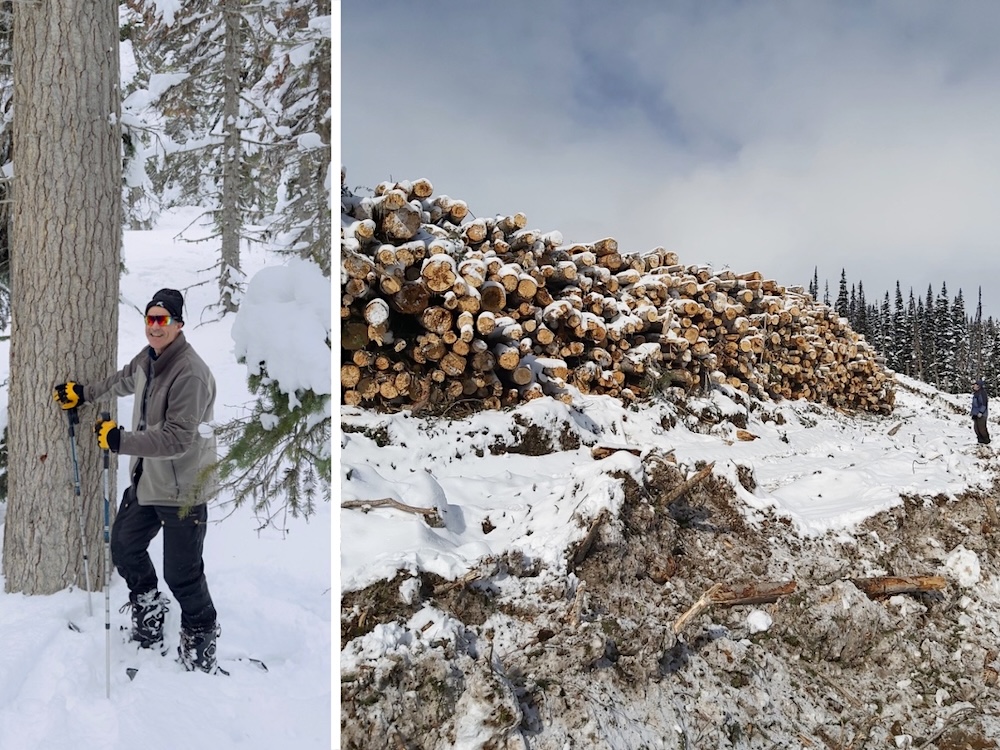
On an early April morning this spring, Len Vanderstar drove away from his home in Smithers heading for a distant clearcut.
About 20 kilometres out of town, he turned onto a gravel road and began to climb out of the Bulkley Valley toward Babine Mountains Park.
About an hour later, he arrived at his destination: a 109-hectare patch of land that had once been a forest of 250-to-300-year-old trees. The forest was now gone after it had been logged following an auction by BC Timber Sales, an arm of British Columbia’s Ministry of Forests.
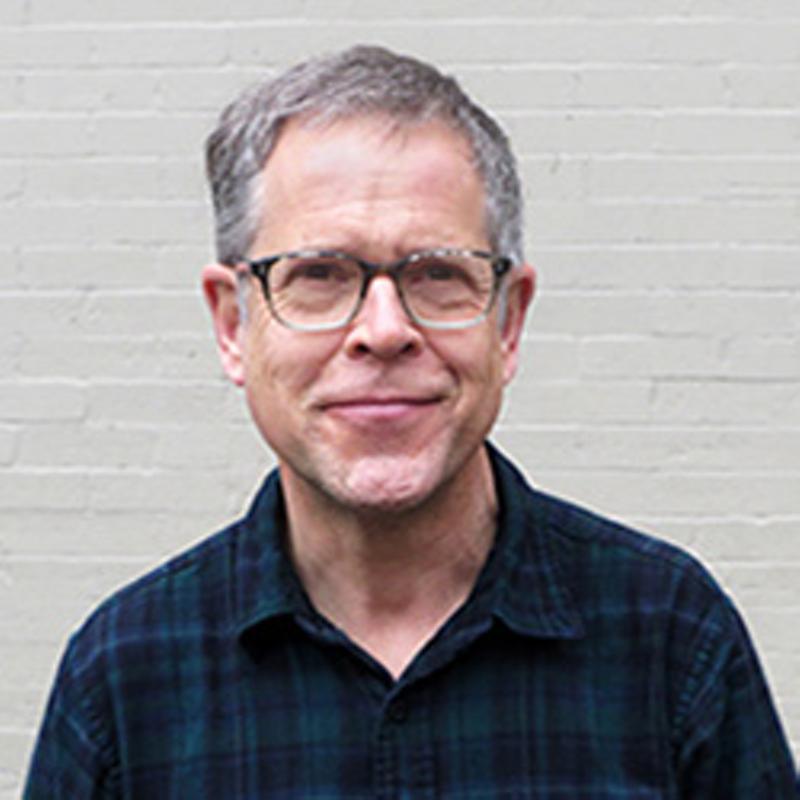
Vanderstar is a retired professional forester and professional biologist who worked in various capacities for the B.C. government before retiring. Physically fit, he spends long stretches of time in the backcountry and is actively engaged in environmental and conservation efforts.
After he started work as a public servant in the late 1980s, Vanderstar witnessed a steady progression of logging, with companies extracting much of their trees from forests at middle and low elevations.
But that logging caused the companies to run short of commercially attractive trees close to town — a pattern repeated elsewhere. Now, timber companies are pushing more and more into the hinterland in search of trees to cut down. Often that means going higher up mountains.
Logging such forests may keep the forest industry in timber, but Vanderstar believes that the price paid will be even deeper ecological, social and economic pain ahead.
‘Twice the area disturbed’
The higher one goes up a mountain, the smaller the trees are. But those trees may be centuries old.
“These are very slow-growing sites,” Vanderstar said. “You can hardly count the trees’ rings because the trees are so slow-growing.”
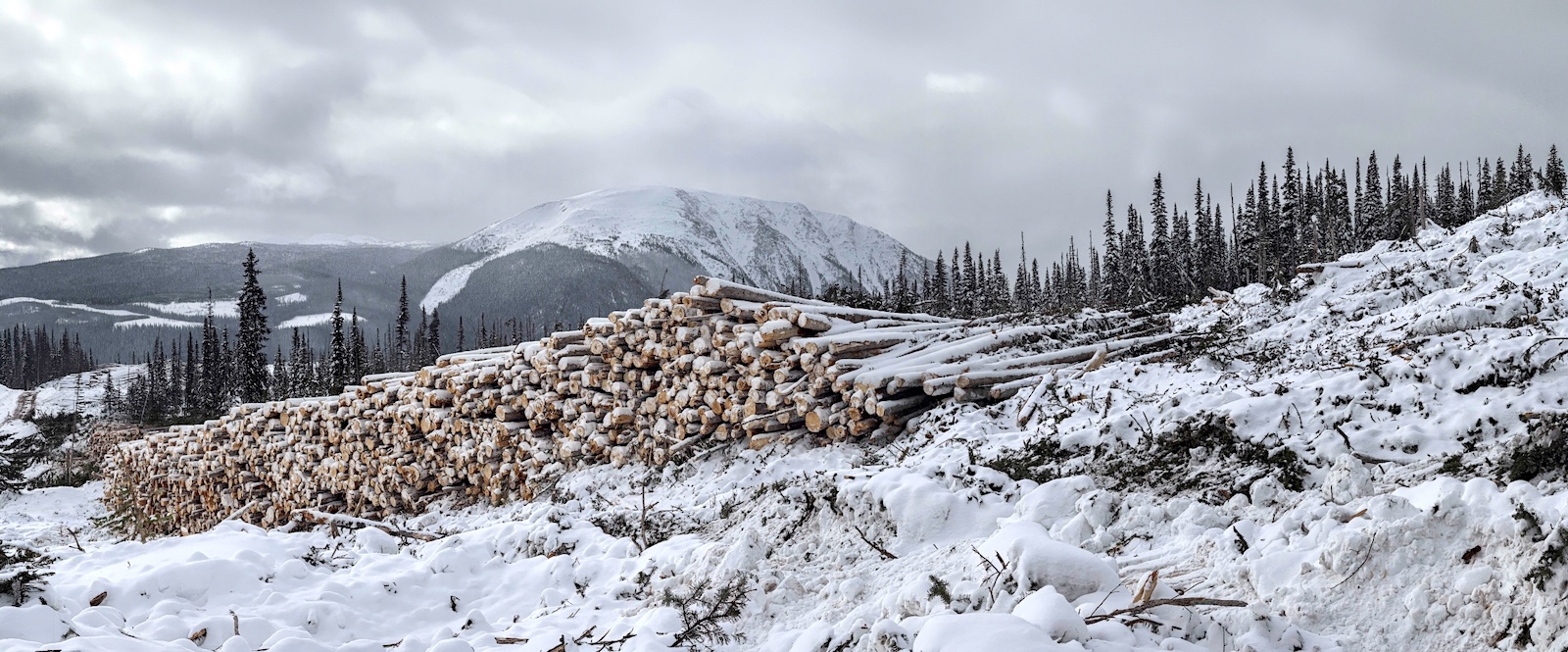
To deliver enough logs to keep mills operating, companies must sometimes log twice the number of such trees at higher elevations than would need to be felled in forests at or close to valley bottoms.
Twice the number of trees means “twice the area disturbed,” Vanderstar said. Building logging roads farther up mountains also increases risks of landslides.
The clearcut that Vanderstar visited high above Smithers was on a pronounced pitch, beginning at an elevation of roughly 1,100 metres and rising to 1,350 metres, with the upper boundary of the logged block abutting the provincial park.
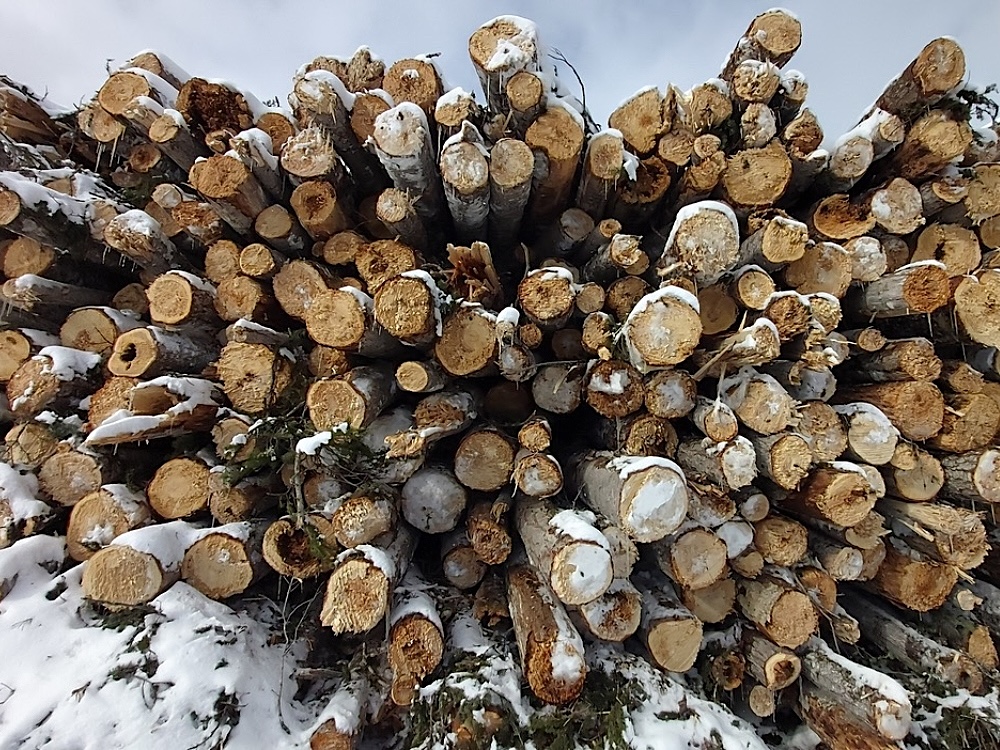
Vanderstar and two of his Bulkley Valley neighbours took numerous photographs in the clearcut that day. The photos show long lines of neatly stacked logs awaiting transport to mills, with the logs varying in size depending on what part of the clearcut the men were in.
The biggest of the logs, stacked at the lower end of the slope, were wide enough to be milled into valuable lumber pieces. But the farther up the slope the men moved, the smaller the logs became.
The logs were too small to be of use in sawmills and were destined to be chipped whole to make wood pulp or wood pellets.
‘Logging our libraries’
Drax, the United Kingdom-based company that owns or co-owns several wood pellet mills in B.C., including in Vanderstar’s hometown, operates a massive thermal electricity plant in northern England that burns millions of tons of wood pellets each year. The company states that many of those pellets are produced directly from “low-grade” logs.
But Vanderstar says that describing logs from centuries-old trees as “low-grade” suggests the trees and forests themselves lack value as well, when the opposite is true.
Much like a library made poorer with each book not returned, a forest’s catalogue is whittled away with each new clearcut.
“We’re logging our libraries basically,” Vanderstar said. “Maybe we need to sit back and think about not destroying that. It doesn’t feel right from a scientific, biological or emotional perspective. If I was a practising professional forester, I would not be clear cutting that.”
High-elevation fuelling sites
Because of their remoteness, higher-elevation forests have not received the scientific study that their valley-bottom counterparts have.
The diversity of life at higher elevations is generally poorly understood, biologists Alice Boyle and Kathy Martin wrote in a 2015 study for the journal Biological Conservation. Yet such landscapes are critical to maintaining healthy flora and fauna.
In surveys of 10 different locations on the flanks of B.C.’s Coast Mountains, Boyle and Martin identified the presence of 95 different bird species. Of that “remarkable diversity” of avian life, one-quarter of species were in decline and of conservation concern.
Notable birds on the list included “blue-listed” hairy woodpeckers and pine grosbeaks, species considered particularly sensitive in the face of clear cutting and other anthropogenic changes, as well as “red-listed” northern goshawks, horned larks and peregrine falcons, species at imminent risk of extinction and therefore of the highest conservation priority.
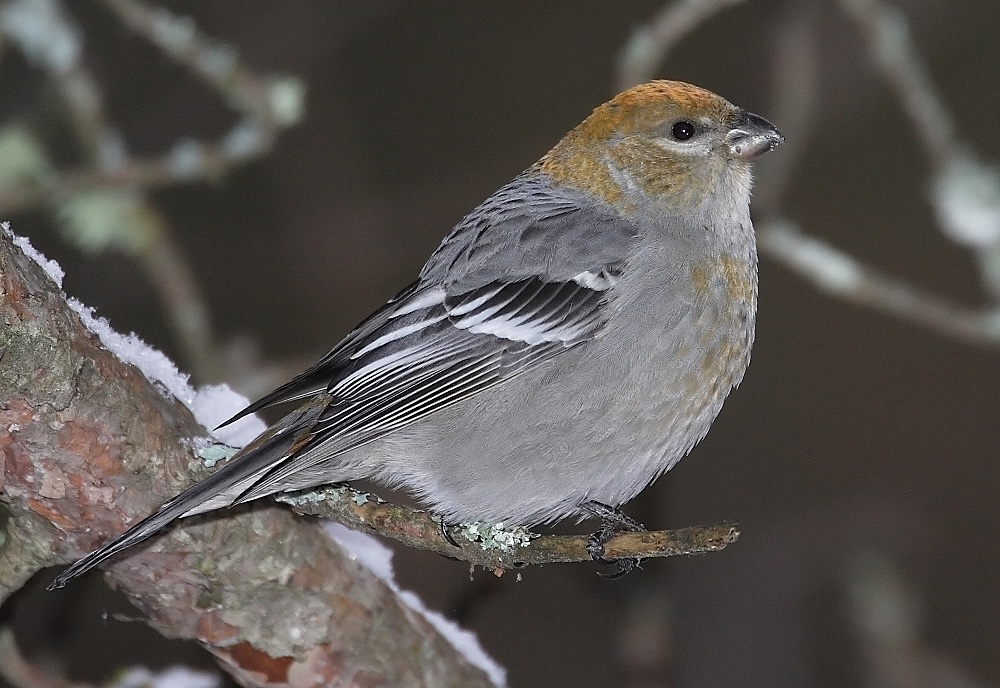
The diversity of birds found suggested that high-elevation environments are of outsize importance to migrating birds that must stock up on food before or during their flights south.
For that reason, Boyle and Martin call high-elevation forests “high-quality fuelling sites.”
The colder temperatures and delayed snowmelts at higher elevations mean trees and shrubs flower and fruit later in the season. That translates to more food available to birds later in the season, when such food may be less abundant or absent at lower elevations.
Two years earlier, Martin was one of three scientists to note that migrating birds used high-elevation forests as stopover sites where they replenished their fat reserves.
With many lower-elevation forests shrinking and struggling, the scientists warned that a better understanding of the importance of high-elevation ecosystems will be needed to ensure “effective and targeted conservation strategies” in future years.
The challenges to replanting
In addition to posing threats to wildlife, high-elevation logging poses unique challenges to the forest industry itself. Provincial regulations require companies that cut down publicly owned forests in B.C. to re-establish new crops of trees after they have logged.
The replanting requirement is much more onerous at higher elevations because of lower temperatures, fewer frost-free days and more snow. All of this increases the chances that tree seedlings planted in high-elevation clearcuts may succumb to the cold or be crushed under the weight of snow. Making matters worse, snowpacks are deeper in clearcuts than in adjacent unlogged forests because there are no trees left to intercept snow and prevent it from reaching the ground below.
Foresters inside and outside of government have known of these challenges for decades.
In 2005, ecologist Ella Elman and biologist David Peterson published a paper in the B.C. Journal of Ecosystems and Management that noted there were benefits to not clear cutting at high elevations and that partial logging of forests was prudent.
They wrote that certain tree species had evolved to grow in the shade, not the harsh sun of open clearcuts. Leaving standing trees adjacent to logged trees would allow for more shade and more opportunities for the full diversity of trees found at high elevations to grow.
“Alternative harvest systems that leave partial tree cover can improve regeneration and growth of shade-tolerant species,” Elman and Peterson wrote.
Is the timber there?
B.C. chief forester Shane Berg told The Tyee the provincial government doesn’t have a hard-and-fast definition of “high elevation,” in part because the province’s forests span many different biogeoclimatic zones and there is wide variation in tree growth within those zones.
“Harvestable” forests exist at both low and high elevations, Berg said, with lumber markets playing a pivotal role in dictating what gets logged when.
Berg said the Ministry of Forests doesn’t track how much logging occurs by elevation zones but rather calculates logging on an area-by-area basis.
But he acknowledged that companies were doing more logging at higher elevations than before.
“Across the province, as is no surprise, licensees are having to move higher up the valley given the harvesting history.”
Berg acknowledged that logging at high elevations makes for unique challenges, particularly when it comes to growing new crops of trees.
“High elevations get snows earlier and the snow is very late to leave so the growing season starts later,” Berg said. “As such... [trees] are going to take longer to grow.”
Although partial cutting or logging may provide benefits at higher elevations, Berg said “partial cutting is certainly more costly.”
“The harvesting system is slower and the volume that is removed and extracted per day is going to be less,” he said.
For that reason, Berg said, a more likely alternative to clear cutting is “smaller patch cuts with patch reserves.” That means small clearcuts with patches of forest left between them.
As the Ministry of Forests’ top forester, Berg’s primary job is to set the “allowable annual cut” or permissible logging rate in the province’s publicly owned forests.
Berg said computer modelling by ministry staff helps him with his allowable annual cut decisions. The models consider many factors, including how long it takes trees to regrow in all forest types, including those at higher elevations.
Presently, logging rates in B.C.’s publicly owned forests hover around 40 million cubic metres per year. Premier David Eby has instructed Forests Minister Ravi Parmar to increase that number to 45 million cubic metres.
Meanwhile, the allowable cut is more than 60 million cubic metres per year — far higher than what is actually being logged and well beyond the premier’s target.
Berg told The Tyee that the 60-million figure represents “the sustainable harvest that could be achieved based on the biology and maturity of the timber across the province.”
If that is the case, it appears certain that hitting such a number will require a lot more logging in the high country. ![[Tyee]](/design-article.thetyee.ca/ui/img/yellowblob.png)
Read more: Labour + Industry, Environment









Tyee Commenting Guidelines
Please note that email notifications for replies are not currently working due to a software issue which may be resolved in a future update.
Comments that violate guidelines risk being deleted, and violations may result in a temporary or permanent user ban. Maintain the spirit of good conversation to stay in the discussion and be patient with moderators. Comments are reviewed regularly but not in real time.
Do:
Do not: