


 SHARE:
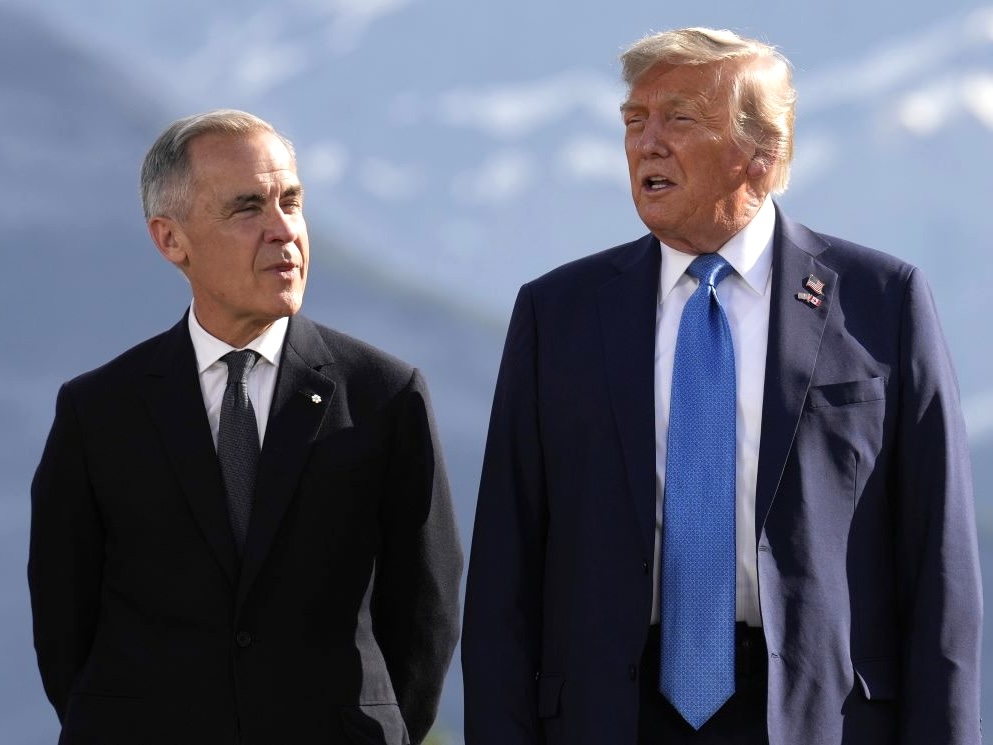
The divergence in opinion between the country’s political and business elite and grassroots citizens on how to protect Canadian identity and sovereignty appears wider now than at any point since the debates on constitutional reform in the early 1990s.
Whereas the elites are seemingly content to once again “roll the dice” — in former prime minister Brian Mulroney’s infamous words — on the country’s future, it is everyday Canadians who are standing on guard for thee. This is why it is imperative that any new agreement with the United States — especially one about a “comprehensive economic and security partnership” — be put to a national referendum for approval.
There is precedent.
In fact, it was 35 years ago this summer that the Meech Lake accord set of constitutional amendments failed to be ratified. Meech Lake was originally intended to entice the Quebec government to sign Canada’s Constitution with the offer of asymmetrical federalism; its defeat led to more comprehensive political negotiations that culminated in the Charlottetown accord. The resulting agreement would have fundamentally changed the country, further decentralizing the federation, creating a U.S.-style elected Senate, and undermining the Charter of Rights and Freedoms.
While there was near-universal support for the accord from Canada’s government and business leaders, a clear majority of Canadians voted “no” in a 1992 national referendum. The Constitution was not changed.
There are clear parallels to the current debate around Canada’s future relationship with the United States. Just as our political class was once preoccupied with negotiating the Meech and Charlottetown accords, our leaders today are in near-fanatical pursuit of a trade agreement with President Donald Trump’s administration.
As was the case then, the business community is agitating for a resolution now.
In a situation reminiscent of how Canadians were encouraged to abandon national ideals to resolve those previous crises, we are again asked to sacrifice civic convictions to address the present threat.
With Prime Minister Mark Carney pressing forward in search of a deal, time is of the essence to pressure the government to commit to holding a referendum.
Jettisoning levers
Since being elected mere months ago with a mandate to put their “elbows up” and defend Canada from Trump’s attacks on our sovereignty, economy and way of life, Carney’s Liberals have swerved between embarrassingly futile concessions and reckless acts of appeasement, all directed toward an ever-diminishing objective: to maintain a trade deal with an authoritarian power that is marginally better than those of other countries.
Consider the growing list of indignities and harmful compromises, none of which were discussed during the recent federal election campaign, including:
- The introduction of unprecedented border security legislation that critics warn violates the Charter and harms refugees.
- A pledge to massively increase spending on the military, which almost certainly involves more purchases of U.S. equipment.
- An apparent commitment to join Trump’s staggeringly costly “Golden Dome” missile defence scheme.
- The last-minute abandonment of the digital services tax opposed by U.S. Big Tech.
- The decision to no longer allow transgender Canadian applicants to the Nexus program to choose X as a gender marker.
- A refusal to match U.S. tariffs on a dollar-per-dollar basis.
- And, most recently, the dropping of all strategic retaliatory tariffs on goods covered by the Canada-United States-Mexico Agreement.
The government’s weakness in standing up to the United States is evident not only via its actions but through its silence. The Carney Liberals said nothing when the U.S. State Department’s annual human rights report ludicrously claimed “significant curtailments of press freedom” in Canada.
The government refused to respond when the United States slapped sanctions on a Canadian justice with the International Criminal Court, nor did it explain why a social media post from United Nations Ambassador Bob Rae criticizing the move was taken down.
The government said nothing as a U.S. state senator openly solicited annexation.
Perhaps most alarmingly, the Carney Liberals continue to be silent about the nearly 150 Canadians who have been detained by U.S. Immigration and Customs Enforcement under what are reported to be deplorable conditions, even as that number includes two toddlers.
Additionally, concerns remain that the federal government may capitulate further, rejecting calls for digital sovereignty by repealing the Online News Act and Online Streaming Act, minimizing efforts to reintroduce the Online Harms Act and embracing AI with minimal regulation.
Carney’s Liberals also appear set to follow Trump’s lead in eviscerating their predecessor’s climate policies.
Other contentious issues involve potentially signing away mineral rights and compromising on supply management.
Heavy influence by business advocates
To be sure, there is broad alignment between the provinces and the federal government on the approach to the United States, although Manitoba Premier Wab Kinew recently said he believes “Canadians want to see a stronger response to Donald Trump.”
Notably, on all aspects of the Carney government’s repositioning of its elbows are the fingerprints of business advocacy groups including the Business Council of Canada, the Canadian Chamber of Commerce and the Canadian Federation of Independent Business.
In the same way corporate leaders urged Canadians to prioritize stability over concerns about constitutional equality in the Meech Lake and Charlottetown debates, they are now preaching stability at the expense of sovereignty.
These powerful elites have deep ties to Trump’s America. Many of the members of Canadian national business groups are directly affiliated with corporations based in the United States. This is the constituency the federal government appears to be listening to most closely.
Additionally, U.S. dark-money-supported policy institutes, including the Fraser Institute, the Macdonald-Laurier Institute and SecondStreet.org, are all echoing the call for Canadians to drop their elbows.
The Macdonald-Laurier Institute in particular has created a separate initiative called the Center for North American Prosperity and Security, which, among other claims, accuses Canada of “villainizing U.S. tech companies” and — without a hint of irony — allowing “its legal, democratic and other institutions to be suborned by malign foreign actors.”
This week, the pro-America perspective was welcomed into the heart of our government as the Carney Liberals invited Heritage Foundation president Kevin Roberts to speak to its cabinet retreat. The foundation is the dark-money organization behind Project 2025, the far-right policy blueprint guiding the Trump administration. Roberts has promoted Trump’s agenda in the pages of Canada’s U.S.-owned Postmedia, and has even spoken about Canada becoming the 51st state. The foundation also recently collaborated on a statement with the Macdonald-Laurier Institute. The inclusion of Roberts in the cabinet retreat is mystifying.
It is grassroots Canadians — the constituency whose interests our leaders insist they are protecting while negotiating concessions with an authoritarian demagogue — who are demonstrating the conviction, creativity and common sense necessary to successfully defend our country.
Nearly two-thirds of Canadians want the federal government to take a hard line in negotiations with Trump, according to a recent poll, and these citizens are showing the way. From boycotts on groceries including orange juice, wine and other alcohol, to reductions in air travel and tourism, to the dumping of real estate, their actions are having an impact.
To date, thankfully, the predicted “severe economic fallout” for Canada from Trump’s tariffs has not materialized. The most recent Statistics Canada reporting shows a slight drop, 0.4 per cent, in gross domestic product in the second quarter, an unwelcome event but a far cry from the 18.2 per cent decrease in GDP in the first two months of the COVID-19 pandemic.
Economists projecting the future impact on Canada vacillate between doom and notes of optimism. In reality, it is impossible to predict the trajectory of a Trump administration tariff strategy that defies both logic and law.
Nor can there be certainty in knowing how Canadians would react if the worst-case economic scenarios were realized. It might be clarifying, however, if the current federal government would commit to providing similar pandemic-level citizen supports should such a scenario occur. Instead, the Carney Liberals are planning massive cuts to public funding.
Most Canadians are ready to sacrifice
What we do know from current polling information is that nearly two-thirds of Canadians favour responding to Trump with counter-tariffs, and 76 per cent of those support doing so even if it causes financial pain. Further, those most likely to be negatively affected materially — namely via job losses — are the ones willing to fight the hardest, as illustrated by Unifor national president Lana Payne’s comments to a large labour rally last week: “This is the fight of our lives... and I want to be very clear: Trump will not win.”
These Canadians appear to understand more clearly than our political and business elites that the threat the United States poses is much broader than economic.
The U.S. government continues to assail truth, rewrite history, arrest opponents, enrich allies, punish the vulnerable, ignore the rule of law, demonize media, threaten institutions and destabilize the global community.
In sum, Canada is living next to a government that is dissolving into what prominent historians say resembles a form of fascism. There is no reason to believe this development is temporary, or that it will end when and if Trump is no longer president.
Most acutely for Canadians, Trump continues to try to subjugate our country while his media mouthpieces keep threatening invasion. Canadian political science professor Blayne Haggart argues, “It makes no sense to sign any agreement with the U.S. under these conditions.” Academic Eric Wilkinson proposes “walking away” altogether.
Should the Carney Liberals proceed, however, the message to the prime minister must be clear. There can be no major agreement made with the Americans without the direct consent of Canadian citizens.
Referendums should be used sparingly in a parliamentary democracy, but on rare and important occasions they are necessary. A potential trade and security deal with Trump’s America undoubtedly qualifies.
The process itself carries risks, but no risk greater than our country’s elites potentially diminishing the meaning of being Canadian.
A referendum would allow for a vigorous national debate on the future of the country and, in the prophetic words of former prime minister John Turner, “let the people decide.” ![[Tyee]](/design-article.thetyee.ca/ui/img/yellowblob.png)
Read more: Politics









Tyee Commenting Guidelines
Please note that email notifications for replies are not currently working due to a software issue which may be resolved in a future update.
Comments that violate guidelines risk being deleted, and violations may result in a temporary or permanent user ban. Maintain the spirit of good conversation to stay in the discussion and be patient with moderators. Comments are reviewed regularly but not in real time.
Do:
Do not: