


 SHARE:
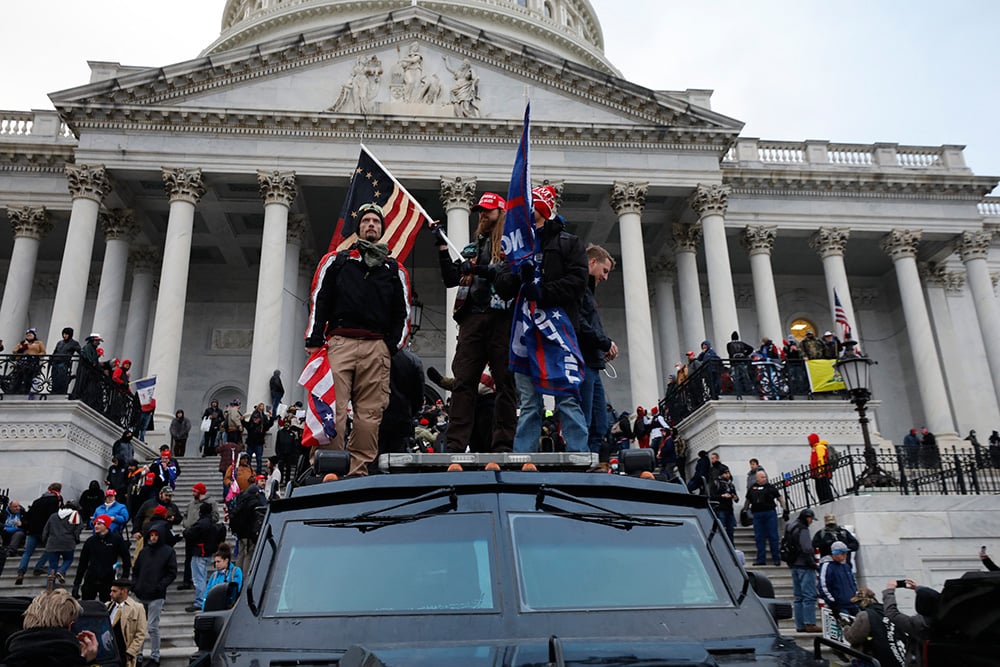
One year ago, some witnesses to the assault on the Capitol building in Washington, D.C., referenced zombies when describing the mayhem as a mob of Donald Trump supporters broke into the building and people sought safety.
“It was like something out of a zombie movie,” recalled a photographer who was at the scene, referencing hordes of rioters. Similarly, Rep. Alexandria Ocasio-Cortez said it “almost felt like a zombie movie” as she described hiding and seeking shelter.
In the 20 years that zombie apocalypse narratives have grown and reached critical mass in popular media, such comparisons about an insurrection where five people died and scores more were injured and traumatized are disturbing, but unsurprising.
More significant, however, is that zombie apocalyptic and post-apocalyptic narratives have become popular during the same economic and cultural currents that gave rise to Trump’s MAGA movement and his presidency.
Post-apocalyptic glut
Depictions of the end of civilization on Earth, especially after the advent of nuclear weapons, have often focused on the spectacle of disaster, as discussed by writer Susan Sontag in her classic 1965 essay “The Imagination of Disaster.”
In many post-apocalyptic narratives that have become prevalent in the past two decades, like Cormac McCarthy’s novel The Road and the television series The Walking Dead, the actual disaster itself is less significant than life in the aftermath.
Literature scholar Connor Pitetti notes this diversification of the apocalyptic imagination in his essay “Uses of the End of the World: Apocalypse and Postapocalypse as Narrative Modes.” He writes that in the 21st century narratives about the bomb have been joined by those pertaining to more diverse “eschatological powers” — forces bound in some transcendent and otherworldly way with end times and the final history of humankind.
Cultural critic Laurie Penny writes that “more post-apocalyptic entertainment has come out in the beginning of this century than in the entirety of the last one.”
Easier to imagine the end of the world
But why should this be the case? Some scholars of history, literature and culture suggest that if people come to believe civilization as we know it is irreparably broken, the prospect of its end may become an appealing fantasy.
One factor may be the desire for alternatives in a world where contemporary consumer capitalism is often presumed to be inevitable, rather than a human choice, as noted by the late historian Tony Judt in his book Ill Fares the Land.
It becomes easier, says literary critic Fredric Jameson, “to imagine the thoroughgoing deterioration of the Earth and of nature than the breakdown of capitalism” — or even “to imagine the end of the world than the end of capitalism,” in the words of cultural critic Mark Fisher.
Economic insecurity, inequality at play
Writing about the dangers posed by Trumpism, interdisciplinary political scientist Thomas Homer-Dixon notes the key factors giving rise to it “include stagnating middle-class incomes, chronic economic insecurity and rising inequality.” Additionally, he writes, while “returns to labour have stagnated and returns to capital have soared,” right-wing ideologues inflamed white fears that whites are being “replaced.”
Trump’s principally white constituency views the increasing diversification of the American populace as a threat.
During his campaign, Trump — elected amid this populist, nativist backlash — vowed to be a wrecking ball laying waste to the edifices of the Washington establishment. The sentiment was similarly voiced by his former senior strategist Steve Bannon, who in 2017 characterized Trump as a “blunt instrument” with which to “deconstruct the administrative state.”
This appetite for destruction wasn’t Trump’s creation; rather, Trump has given voice and license to the forces of reaction and backlash.
Reaction, backlash
A sense of perverse pleasure in imagining the end of democratic law and order was evident in the Capitol assault a year ago, especially in the often absurd and mythically styled costuming of some of the insurgents. It ranged from sinister white supremacist, extremist paramilitary garb to the familiar 1776 getup of Tea Partiers, but also vaguely frontiersman-like furs and pelts, and of course the pseudo-tribal cosplay of Jacob Chansley, the notorious QAnon shaman.
As news footage from the day shows, bizarre outfits did not mitigate the rage and violence that marked the attempted coup. Nor do they detract from the dangers posed by the MAGA movement.
Commentators have noted how the extremist ideologies of Trump supporters are entwined with a revival of religious impulses. These are often focused on stark contrasts between goodness and evil and the possession of secret knowledge that fuels conspiracy theories and “end times” apocalyptic speculation.
Seeking authenticity in ashes
Penny argues that the proliferation of apocalyptic narratives exist “somewhere between wish fulfilment and trauma rehearsal.”
An example of this can be seen in discussion groups and message boards enthusing over the prospect of a zombie apocalypse.
A common refrain, widely merchandized on decals, T-shirts, mugs and beyond, has become: “The hardest part of the zombie apocalypse will be pretending I’m not excited.”
Such statements reveal a sort of hopeful nihilism: a sensibility that seeks, gleefully, to demolish and destroy in the vague assumption that life in the ashes will be better, truer and more authentic.
In a zombie apocalypse, this may be seen in characters who come into their own as hyper-competent badasses when resisting zombies (a trope notably parodied in the British zombie comedy Shaun of the Dead), but also characters who face zombie enemies against whom violence is not merely sanctioned but morally imperative.
So have the zombies been trying to warn us about Trumpism this whole time?
The question is not nearly as glib as it seems. Cultural preoccupations, such as the disaster films Sontag wrote about in 1965, almost invariably provide a window into societal anxieties and fears on one hand, and wishes and desires on the other. Unfortunately, such insights often only reveal themselves with the benefit of hindsight.
Sontag’s writing articulated the pervasive fear imbued by the Cold War’s threat of nuclear war. At the same time, however, they expressed faith that societal institutions — government, the military, science — would prevail.
Sadly, our obsession with post-apocalyptic scenarios is largely borne of the loss of such faith.
![[Tyee]](/design-article.thetyee.ca/ui/img/yellowblob.png)
Read more: Politics







Tyee Commenting Guidelines
Comments that violate guidelines risk being deleted, and violations may result in a temporary or permanent user ban. Maintain the spirit of good conversation to stay in the discussion.
*Please note The Tyee is not a forum for spreading misinformation about COVID-19, denying its existence or minimizing its risk to public health.
Do:
Do not: