


 SHARE:
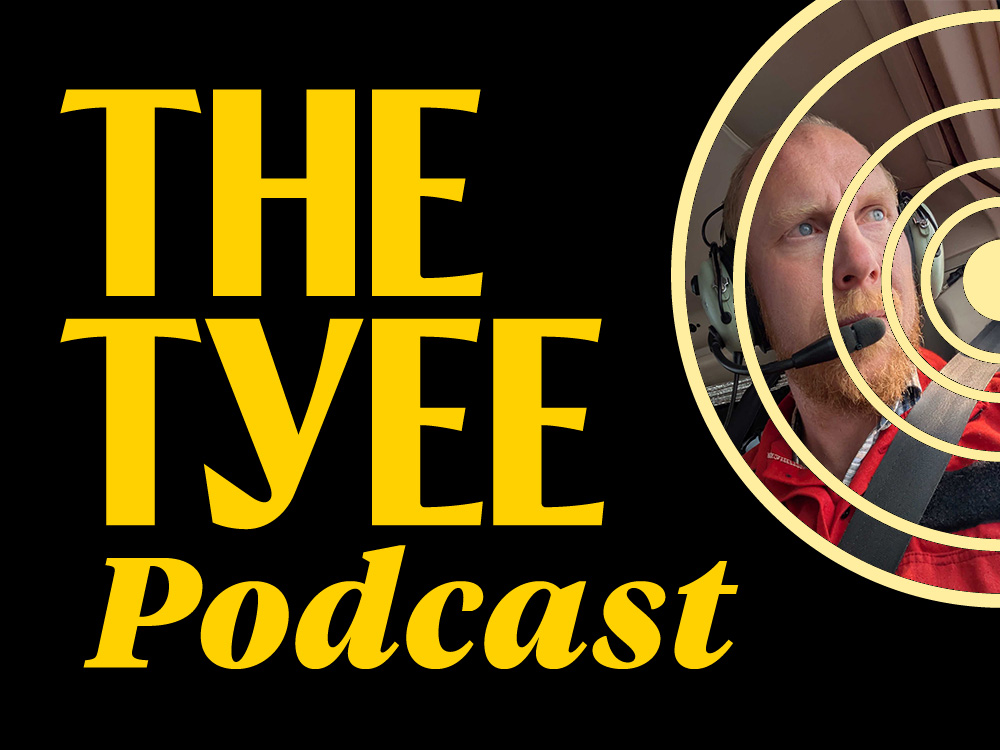
Tyler Olsen is no stranger to wildfire. He and his family no longer notice the smell of smoke in the air, and they are familiar with the sight of fire on the hillside near their home in Lillooet, B.C. He’s gotten used to the sound of firefighting helicopters whirring overhead.
The Tyee senior editor jumped at the opportunity to climb into a Bell 407 helicopter with wildfire fighters battling the Ainslie Creek wildfire in August.
“I’ve been reporting on wildfires for years now, and I’ve never had this opportunity,” he said. “As journalists, we don’t actually have the ability to see firefighting on the ground, basically at all, because they are generally in places where there are evacuation orders or the media otherwise can’t get into.”
This week, Olsen takes us inside the fight against B.C. wildfires. He shares what’s changed, why this year is different and what it’s like to live with fire.
Listen to this episode by clicking the embedded podcast player below or by following The Tyee Podcast on Apple Podcasts, Spotify, iHeartRadio, Amazon Music, Pocket Casts or YouTube.
Transcript
Note: Episode transcripts may contain errors. Always check the corresponding audio before quoting any part of the transcript.
Tyler Olsen: When you’re in a helicopter around 11 a.m. over a fire, it’s not hugely spectacular in the way you might immediately imagine. There’s no huge wall of flames that you’re battling. There’s probably no huge plume of smoke.
Harrison Mooney: You’re listening to Tyler Olsen. He’s a journalist here at The Tyee.
And this summer, he got the rare chance to join wildfire fighters in a Bell 407 helicopter as they fought the Ainslie Creek wildfire.
Tyler Olsen: Sometimes for as far as I as the eye can see these little, like, spots of fire are just sending up white smoke into the air, and it's not so much the individual scale that gets you, but the broader scope of these fires and just how big they are over such a wide landscape. And you start to realize how many helicopters or anything you would need to just pour water on a fire the size of the Ainslee Creek fire.
Harrison Mooney: This is The Tyee podcast. Every week, we dive deep into the stories shaping the west coast. Because Canada needs more B.C. Tyler is no stranger to wildfire. He and his family live in Lillooet. That’s fire country. He told me he no longer considers the smell of the smoke that wafts through town. He watches fire blaze along the hillside near his home and he’s gotten used to the sound of fire-fighting helicopters overhead. This week, Tyler takes us inside the fight against wildfires. He shares what’s changed, why is this year different, and what it’s like to live with fires. Stay with us.
Harrison Mooney: Tyler, you got a rare opportunity to climb onto a helicopter with wildfire fighters as they fought the Ainsley Creek fire. Why did you want to do that? And did you get to dangle your legs over the side, or did you have to be in a chair where your legs were on solid ground? I always I see people dangling their legs from helicopters sometimes, and I think if I ever go up in a helicopter, first thing I'm going to do, let it dangle.
Tyler Olsen: You don’t want to let your — you don’t want to be in a helicopter over fire and not have a door on the side of that helicopter probably, on account of the the smoke that would get into the-
Harrison Mooney: The smoke, right? I was like, the fire doesn't get up that high. What are you talking about, Tyler? But I always forget about the smoke.
Tyler Olsen: The smoke is the big thing, like, and you, you and I, and everybody in B.C. kind of is familiar with complaining about wildfire smoke. But then it's a totally different dynamic when you're obviously a firefighter or you're piloting a helicopter above one of these fires, where all the smoke is coming from, and suddenly you can't see anything, or you have to stay away from the places you can't see.
Harrison Mooney: Did you have to wear a mask?
Tyler Olsen: No. No.
Harrison Mooney: No mask, just free breathing that deadly Wildfire Smoke. Tyler, Tyler.
Tyler Olsen: That’s why I don’t smoke for the rest of the year because I get plenty of smoke in the two or three months living here in Lillooet.
Harrison Mooney: Yeah, no kidding. Yea, why did you want to go up in the helicopter?
Tyler Olsen: Right. So I have been wanting to do this for a couple years now. The roots are actually — I play hockey with a guy who does this for a living. He’s one of these one of the flight officers, so he goes up in helicopters, and it’s his job to kind of direct and help coordinate firefighting activities from the air. And recently, they've started flying at night, which is a very interesting and cool operation. Provides a whole bunch of long-term benefits in terms of being able to get on spot fires quickly when you can see them at night and extinguish them, I wanted to go up in one of those awesome night flying helicopters that I saw in action actually this year, but apparently there are a whole bunch of rules that make it so you can't do that because it's more dangerous than they want to put a random journalistSo I had asked, and the B.C. Wildfire Service has taken a lot of flak, I think, for how the public perceives its use of aviation resources, and so I had thought, and I've seen some of their messaging, and I'd thought, you know what, maybe if I, I think the people don't understand how helicopters and planes are used to fight fires very well in British Columbia, and so I think there is a real gap there. The B.C. Wildfire Service itself has been trying to educate people. Obviously, I come from a different angle. I'm a journalist. I'm I'm not just interested in understanding all the great ways they use helicopters, but I think that there is a general public education element there that's useful to explore, and so I wanted to learn about how they use aviation resources, and it became apparent that it was possible to actually get up in a helicopter to see firsthand how Helicopter bucketing and and how aviation is used to fight one of these fires that we see in B.C. . I live in Lillooet, which is about two hours from Kamloops, but otherwise is pretty much in the middle of nowhere, but it's in the middle of this year, three or four massive blazes-
Harrison Mooney: In the middle of three — like it’s just in the middle of a bunch of fires. You're just surrounded by fire.
Tyler Olsen: The Pear Lake fire, which is the fire that encroached on Clinton, is about 40 kilometers north of here. You've got two other fires just west of there that are massive but aren't around many populated areas. And then you've got the Ainslie Creek Fire, which is near Boston Bar and kind of in between Boston Bar and Merritt, that's about an hour south of here. It's closed the highway, so I can't get to like the the Vancouver very easily through that route now. And then near Lillooet here, we have a fire about 10 kilometers south of town. That's kind of create it's it's caused a little bit of localized anxiety because it was encroaching on some rural homes, including that of some of my friends, so those fires are all around Lillooet. We have a little fire base, heli base here in Lillooet, so it's kind of a everyday part of life here. And so you kind of see these helicopters going in and out. We have questions. Where are they going? What are they doing? That one has a bucket on. That one doesn't have a bucket on. So it's interesting, and just on a personal level, you want to kind of learn more about what exactly is going on with all these helicopters I see every day flying in and out of town.
Harrison Mooney: If I lived in a town that was surrounded by wildfires, I'd want to go up in a helicopter too. That is maybe to escape. I mean, obviously in your case, very noble to to learn. The public public education angle is is valuable, but yeah, just to get the heck out of there.
Tyler Olsen: I've been reporting on wildfires for for years now, and I've never had this opportunity. We hear a lot about how wildfire tactics are used and how fire behavior works, but as journalists, we don't actually have the ability to see firefighting on the ground basically at all because those are generally in places where there are evacuation orders or otherwise the media can't get into, and so this provided a route around that and a good opportunity to see both how helicopters are used and just how fire behaves and fire tactics are used to fight fires.
Harrison Mooney: Tell us about this fire, then. You kind of describe where it where it is, but I mean, how big is it? What's what are the stakes in fighting this? What's at risk? What is the the the firefighting team's priorities here?
Tyler Olsen: So it gets complicated because there's multiple fires here, but this big fire is now like 600 square kilometers in size. It reaches towards Merritt, reaches towards the Coquihalla. It's closed down Highway One. So this is a real big fire, and it's just kind of- its tentacles have continued to spread and spread and spread, and fighting such a fire is incredibly hard because obviously, as a fire spreads, you can't. B.C. does not have nobody has enough people, manpower, helicopters to surround a fire of that size that's got a perimeter that is hundreds and hundreds of kilometers long, and to just pour water on the whole fire, you'd need a you need multiple lakes worth of fire, or multiple lakes worth of water to even start to make a dent in it. So you have to pick those parts of the fire, and just like a military battle or something else, you pick the parts of the front that you want to focus on, and put your resources and put your crews there to think. Okay, this is the objective we're going to do. We're going to stop the fire from progressing in this way because this is a weakness in our battle line. Essentially, this is a place where the fire will want to go and where we have a chance to stop it, and so that's kind of behind the fireside tactics. And then just for for everyday people in B.C. , this fire it's already closed Highway One. It's now 10 kilometers from the Coquihalla Highway, which is one of Canada's busiest arteries, just for people passing through there every single day, but also a huge amount of goods goes through that corridor. If the fire gets to that place, it shuts down a huge amount of Canadian trade, business, everything. It's like a millions of dollars goes down the drain if every single day or minute, if the fire gets that that place, and then there are communities. There are some rural communities and a First Nation again, about 10 kilometers away from this area where we spent much of the time on. The problem also with fires in B.C. is once a fire starts to move, a fire can move 20 kilometers in a single day, so you've got Merritt even up the line. So the crews at this place in the fire were really focused on drawing a line there. They've got like a natural barrier in the form of a creek to kind of base their tactics around, and then. They decided to try to hold this line just like you would hold a line in a in in any other contest where you've got two sides pushing against one another, and start to basically true a wall through the forest with logging machines to create a place where the fire hopefully will not break through to kind of like stiffen that line and stiffen that border.
Harrison Mooney: Right. So the fire's in the red zone. It's a prevent defense. You're not trying to put the fire out. You're trying to keep the fire from scoring a touchdown in this in this unfortunate sports metaphor.
Tyler Olsen: In this in this metaphor, what you're doing is instead of pushing against the other team, you're digging up the field and putting barbed wire in the field so that ideally they can't cross that area. You're not actually trying to even push up against the other team. You are physically trying to remove their ability to cross any territory. It is like instead of having a chess match where you're you're doing you're you're playing chess with the person. You're just trying to upturn the table. You're just you're just throwing all the pieces up in the air, and saying how you can't you can't pass this because we're playing different games.
Harrison Mooney: Yeah, you know that’s how you got to do it. You know, it's funny too, like, I I hadn't really I hadn't really thought about that aspect of it, where like you are trying to just, you know, prevent the fire from going to specific places, right? You know, you talk about I think it's Maka Creek, and yeah, and then these communities. It's like, well, the fire is going to burn, but we don't want it to burn over here. We don't want to lose the Coquihalla. We don't want to lose these homes. So yeah, you you. I mean, describing the way that you just kind of tear up the earth and you know make this line in the sand, it actually sounded a little bit like parenting. Honestly, you know, it was like okay, well, first we're gonna establish a line in the sand. We're gonna draw a line in the sand, and then we're gonna work as hard as we can to enforce that boundary. Is firefighting parenting, Tyler?
Tyler Olsen: No. Yes.
Harrison Mooney: (Laughs)
Tyler Olsen: Probably. I I think it's- what I love about it is it it like it scratches a a kind of a military dad nonfiction history itch that probably a lot of us have, where like you look at old battle lines on like World War Two or something, and you don't actually. Obviously, this is hugely different in scale and human scope, but there are certain tactical elements that are similar and kind of I think help inform how we can think about this, and just make it kind of interesting, and and bring it down to people, and in thinking about like you are finding avenues in which the enemy is constrained by geography, and you're gonna use those natural defenses to your ability to to to operate in this fight.
Harrison Mooney: Tyler. The time has come to tell me everything you know about helicopters. I know you've been waiting for this day. You know, and like honestly, like until I read your reporting, I kind of assumed helicopters were just up there gawking. Like I knew about the water bombers, but there was a part of me that kind of thought the choppers didn't do as much. You know, but I I suppose if you can airlift a horse out of a flood zone, you can carry a whole bunch of water up over a wildfire. So you know, there's that. But then it turns out the helicopters do all this other stuff. Can you tell us, how are helicopters used in wildfires?
Tyler Olsen: So like, all right. So like, this goes back like five years when there was a massive fire near in the Shuswap and you could actually watch on like these flight radar maps, imaging things where you can track helicopters and flights. Just these helicopters going from the lake to the fire front, lake to the fire front, and they had probably seven or eight or nine helicopters, or even more, just like moving water from the lake to the front of. Fire, just trying to cool that fire down. That is like the simplest thing that a lot of helicopters are used for is just moving water from a water source onto the front of a fire, to it's not going to put out the fire, but it cools it down in the way you might throw water on a fire that has gone too big, a campfire that's gone too big. Within that group of dumping water on fires, there's a bunch of different other things helicopters do. They dump the water on the fire itself. They dump the water on the places that aren't burning that they don't want to start burning. f we're in a drought in the interior of B.C. , lots of this these forests haven't had water in months. You get a big bucket of water, and you dump water on a bunch of trees on the trees that you don't want to burn. That's going to increase their ability to resist the fire as it approaches. You also have these bucketing operations, just trying to stop the fire's progress, but also often used around other ground operations on the ground, which is includes building fire guards, starting and controlling prescribed ignitions in which crews are burning off fuel on the ground, but they don't want that a little fire to become a big fire.
Tyler Olsen: So a helicopter might be there to provide backup, put a little bit of water on this this part of the fire or not. Beyond all this, you have firefighters basically used for reconnaissance, so sending up an operations guy in the air to watch a fire, make sure that the fire isn't burning where they don't want to burn. Figure out where they need crews to be.the first thing that happens often when there's a fire is a helicopter will pick up a crew in town or at a fire base, and then move that crew towards the place where the little fire is that they want to put up. The first thing that crew will do sometimes is hack a helipad out of the bush, out of nowhere, so that then that helicopter can bring people in, bring people out. One thing apparently that's it's like the craziest job in firefighting maybe is some of those first crews sometimes just have to like actually physically build a helipad out of like — they'll log trees, they'll stack the trees, and they'll build like an actual like plank helipad in the middle of the forest that hadn't been there before. And then there are like there's helicopters that are now used for ignitions to create like controlled burns and start a controlled burn over extended.
Harrison Mooney: Right, like so they're dropping fire, right? Like rather than-
Tyler Olsen: Yeah, a little little incendiary ping pong ball, essentially, that over a course of a fire line will start can do what like it would take dozens and dozens of actual firefighters to do this. Now they can use a a helicopter too.
Harrison Mooney: I have to admit that your reporting was the first time it occurred to me where we get the phrase "fight fire with fire.” Like I've, I've used it lots, you know. I just kind of assumed it was a metaphor, but then I was you know reading reading your reporting and realize that they were fighting fire with fire, and as I chuckled to myself about how funny it was that they were doing what the expression is, I realized that that's where the expression comes from. So thanks for that. What's a fire guard?
Tyler Olsen: A fire guard's basically the firefighting equivalent of a trench in the lot in in the in the ground. One part's burning, one part's not burning. The fire is going to burn the whole forest if you don't take away the progress its ability to chew through land and chew through greenery. So you basically you can hand dig a fire guard by just pulling up like basically using using shovels and pickaxes to draw a line, have crews draw a line, or you can, and this is how it's often done, use logging equipment to basically true a line through a forest so that the the fire can't move from one part of that forest to the other. That within creating that fire guard is like a pretty complex operation. You'll have like a a logging faller machine that is cutting the trees. You'll have a skidder, which is a machine that pulls the trees through the the fire guard, which becomes like a logging road, and then you have a bulldozer that it goes through and basically creates something that looks like a logging road, but it's a fire guard specifically designed to stop the advancement.
Harrison Mooney: Right, nothing to burn here. Turn around, go somewhere else.
Tyler Olsen: Exactly, fire needs fuel, oxygen, and heat to burn. If you take away the fuel, it doesn't have anything to burn. Now it can vault that guard if it by burning the stuff that it's already burning, but the idea is to hopefully make that more difficult, and then make it so that instead of just having to fight along a continuous front, you can target and like react to those spots while holding that line.
Harrison Mooney: How well will the firefighters hold the line? And why has firefighting suddenly become so difficult? That’s when we come back.
Harrison Mooney: All right, it's time for a bird's eye view of wildfire season. Back in August, you wrote about how prolonged drought conditions have changed the playing field for the B.C. Wildfire Service. So, what makes this year different? You know, at one point in your reporting, you talked about the smoke, and there's there's more smoke. Why is there more smoke? What's going on here?
Tyler Olsen: Climate change is going on here. Have you heard?
Harrison Mooney: I hadn't. I hadn't. How bad is it?
Tyler Olsen: It's not great. It's bad this year. It's bad. The and there is such a prolonged drought in the interior that it makes has made the fire conditions worse than many previous years, as as fire officials have said, which is incredible because previous years have been really really bad as well, the wildfire kind of experts in this province are continually finding that fire is just behaving more and more intensely. It's traveling greater distances more quickly than it ever has, and it's because of the prolonged drought that we've had in the interior and in much of the province, and then the heat, and then we've had a few of these fire weather days in which the the weather has turned and really kicked the the the wind has really kicked up in unpredictable and really severe ways. A lot of it really is a like a ratcheting up of what we've seen in the last 20 years. at the start of the century, Fires that traveled huge distances and like infringed on communities happened, but they were very rare, and they didn't behave with the theory that they really started behaving in with in 2003, and since then we've seen kind of an explosi on of these large mega fires, and they've tended to happen all around the same time for pretty obvious reasons. The weather in Kelowna and Kamloops is usually quite similar to one another. So you have fires breaking out around the region around the same time, and all those fires, and as they grow into really huge, huge fires that we didn't have previously, is creating all this smoke that people everywhere is familiar with.
Harrison Mooney: Right. So the smoke is worse because everything is worse. It's just much worse.
Tyler Olsen: The smoke is worth worse because a larger quantity of like trees and vegetation and grass is burning. The smoke is just that stuff that's burning transported into the air.
Harrison Mooney: All right. Well, so I mean, there's climate, but like I read Tyler Olsen stories, so I know there's also other stuff that we're doing wrong. What else have we done to make our wildfire situation worse? Can you can you tell me a little bit about our our past wildfire suppression strategies?
Tyler Olsen: Previously, throughout most of the 20th century, we would try to put out every fire that we have in B.C. , and that was possible in part because the fires grew a lot slower. We have about the same number of fires now as we did for most of our history. They just grow a lot faster now. fire plays a natural role in a forest life cycle, without the the fire that would naturally come through there every 25 or 50 years, and usually those fires would be relatively low intensity. It would burn mostly at ground level. By not having those fires, it created a situation where we have more and more fuel in the forests, so that when fire does break out now, we have decades of fire fuel that allows or fires to grow at a very quick rate,More fuel allows that fire to get into the tree tops to the point where you have these entire for like sections of forest burning at once. That's when you get this rapid spread and rapid growth of a fire. And we still have forestry policy that encourages the creation of large uniformly planted, basically timber plantations where all the trees are about the same age, and that means they're about the same size and become particularly prone to fire about the same time. So those two things, the forestry policy combined with the suppression policies, have kind of set the stage for a lot of what we see now. But then it's the the long hot summers that have really kind of set it off to the point where we have these seasons with multiple huge fires burning.
Harrison Mooney: It's a cruel irony, I think, that by putting out all of these fires, we just somehow made more fires later. Like here we are fighting our fires with water, and it turns out you're supposed to fight fire with fire. That's something I just learned, so I'm gonna say it a lot today.
Tyler Olsen: There's a few cruel ironies about wildfire fighting, like the fact that smoke can help reduce kind of the the amount of sunlight hitting the fire and reduce the amount of oxygen getting into a fire. So all that smoke can actually help reduce fire activity.
Harrison Mooney: Right. Yeah, this is complicated stuff, man. Have I mean, I'm having a hard time wrapping my head around it, but I have to imagine the B.C. Wildfire Service is adjusting and learning and figuring out what needs to change in order to fight these these modern climate change fueled super duper fires? What are we doing differently now?
Tyler Olsen: A big challenge is it kind of sometimes seems that the fire's behaviour is changing faster than our ability to adapt to it, or at least the fire changes, and then we have to adapt to it. And it's hard to predict what hasn't happened yet. There's a few interesting developments. The simplest one is that we have more large helicopters that are being deployed to these fires. They're bigger choppers that can haul more water and can kind of dump more on like real big hot spots. And these things are huge. They cost a ton of money. They suck gas like crazy. Some of these go through gas at like 10 liters a minute. They require a ton of maintenance, but they can dump a whole bunch of water, and that's kind of how aerial resources are judged in B.C. . In the last seven or eight years, night vision goggles have started being used, and we had in B.C. a a growing but still pretty small night flying program where helicopters can fly at night and do some of this work.There's all these visibility limits that kind of impair the ability to do this, but it creates huge opportunities, especially in terms of after big lightning storms or other events that can create fires. Being able to track down those small tiny fires and put them out before they become larger than ground crews can handle, and and just able to grow quickly. So if we can deploy some of these helicopters, you can spot these fires when they're infants and kind of snuff them out of the cradle, get them in the cradle, if you will. drones are increasingly being used. You can use a drone to not not like drop water on a fire, but to do like all the cumbersome, the cumbersome work that like reconnaissance helicopters used to do. So mapping a fire is a big thing that they need to do. They need to know where where the fire is, and that's something that would historically be done by either just somebody walking around a fire's perimeter or a bunch of guys, or like a helicopter slowly moving around the perimeter, and like if you imagine that these are like fires that are 600 square kilometers, and what the what the perimeter of that is, that's hugely time consuming. So that's all the cool tech that's happening, and how tactics are changingThe things that we're doing differently on other fronts are basically trying to- the the the weather challenge is such that the strategies constantly have to evolve.And not necessarily in ways that like make things better, but just stop things from getting even worse.and then kind of related to that, there's the idea that right some fires are good fires, right? We accept that you know you actually do need to allow some fire on the landscape, as as they say, but that is a riskier riskier proposition when that landscape is 20 kilometers from somebody's house. If you let a fire on the landscape spread in a way that would have been healthy and productive 30 years ago, well, today you might do the same thing, and that fire takes off and has a much more likelihood of taking off and going through, going towards that community. So they're really having to figure out how you balance that line of allowing some fire while recognizing that the conditions today are so extreme that it can be dangerous.
Harrison Mooney: Do the firefighters ever win? I feel like you know we there's a lot of firefighting efforts. We never hear about when they're successful. Why don't we hear about successful firefighting efforts?
Tyler Olsen: You don't hear about successful firefighting efforts because they result in a lack of news. There is no fire. There is nothing that happens after a firefighting effort is successful. So we saw above Maka Creek was an example of a successful firefighting effort. It was work that was being done to stop this fire. That, if it had been let to go unimpeded, probably would have headed towards homes headed towards Coquihalla Highway, closed down that highway, closed down trade across much of B.C. , forced residents from their homes, put people on edge in Merritt It would have done all that, but by kind of concentrating on this one area, holding that line of fire upstream of that one little creek that we saw, putting out the spot fires that were trying to cross that creek, and if they had been left to burn, would have probably gone up the hillside. Fire loves to fo up hills and potentially race towards the Coquihalla. By concentrating on this one little area. That's where all the firefighting essentially took place, and they were able to hold that line. They put out the spot fires overnight after after I'd left the area. They removed the fuel from the area, cooled the rest of the fire down, and now residents have been able to return to homes near there. The Coquihalla now seems relatively safe. It has been open for the last week, and all those things that we could have imagined stories about the Coquihalla being closed, more people being forced from their homes, they didn't happen because crews were successful in this one area, and that's kind of happens across B.C. , but we don't see it in part because just the news doesn't exist. And then the other reason we don't see it is because the media is kind of it is barred from these areas because there are evacuation zones, but also just because of government policy that is more risk averse than other places where journalists would be able to see this work in action.
Harrison Mooney: You live in this area. What is that like? What I feel like I would be scared all the time, and… and move, but you haven't moved. Doesn't seem like you're going to move. You've just kind of adjusted to this. Explain yourself to me, please.
Tyler Olsen: So in Lillooet, we have actually been pretty fortunate the last five 10 years to not have many large fires quite near here. We've had a few in the further distance, but this year we've we had one breakout really in or started by lightning in in June.there was a period in which you wonder how is it going to could it affect my house? Could it affect my community? Could it force me from our homes? And there's a world in which it could do that under the right weather circumstances. The terrain isn't ideal for it, but if it had enough room to run, it could have got to my house in in not too many hours, let's say. Fortunately, through kind of some of the firefighting tactics we've discussed, crews were really able to like hold a line there The fire is still there, the smoke is still down there. You can still see it, but kind of knowing once you start to understand and know a little bit more about fire behavior, and I think this is a big thing that people are learning, is that you can put some of these issues into context and and realize that wildfires are going to happen. They're going to pose a threat sometimes. Usually, they're not going to pose a threat. They'll be an annoyance, or something that's in the distance and it can unsettle you, but is probably not going to do you any actual harm. It's a little bit like in B.C., learning to live with the fact that there are maybe bears in your area, cougars in your area. You have to kind of take that for what it is. It's part of the landscape. Lori Daniels, a UBC professor, she runs what's what they're calling the Center for Wildfire Coexistence, which kind of gets at this aspect that fires are a part of the landscape, and we do need to learn how to like manage and and create landscapes in which that accept the fact that fires are going to exist while reducing the threat to humans, but allowing fire also to play a role in the places where it just is going to happen, whether we like it or not. There are some areas in the interior of B.C. where there are forests where there would not naturally be forests, where There would be so such frequent fires that these places would be essentially grass landscapes, especially near Kamloops and probably in parts of the Okanagan too. But because of our suppression strategies, we now have forests in these areas that look natural, seem like seem like they are part of the landscape, but are post fire hazards and just are not actually natural in those areas. And so, the work that Lori Daniels at the UBC Center for Wildfire Coexistence and others are doing are trying to find out how to how you strike that balance and how you humans can find ways to ensure that the parts that forests can be fostered that are more natural and tend to, which tend to be more fire resistant and diverse and better for wildlife and humans and all this sort of thing, while understanding that fires are going to happen and and they'll need to be addressed.
Harrison Mooney: Just remarkable. The pivot from fire bad to the Centre for Wildfire Co-existence that has happened over my lifetime. Like I'm struggling to wrap my head around it. Like that-that's remarkable.
Tyler Olsen: Yes, but there's also limits to how much you can actually coexist with with a predator in your backyard, and that's the challenge that a lot of communities and even experts and scientists are going to have to figure out. There's idealistic strategies that aren't going to work because of politics, but not just politics, just human existence. You want to be able to coexist with things and nature in ways that sometimes are isn't just isn't possible.
Harrison Mooney: That's a lot of thinking and a lot of nuance and a lot of adjusting to the new reality when you could instead just move to a place that has no trees. Have you thought about that?
Tyler Olsen: You could or you could move to a place like Vancouver with trees that are pretty wet and where people are can be quite worried about wildfires, but history suggests it's not one of the major dangers to be considered, and you can live there for years and years and years and decades and decades, and then the Fraser River floods, or there's a major earthquake, or Mount Baker erupts, and all those other things, all these things that are rarer events, but potentially more serious events can hit you like long. I don't know why you're not living in a place like Edmonton.
Harrison Mooney: Yeah, no, that is a good point. I mean, just about anywhere you go, there's the potential for something bad to happen, and you do just have to live with that uncertainty a little bit.
Tyler Olsen: The thing we have to also be aware of is a lot of these places that are most at risk of of wildfire are places with large Indigenous populations and First Nation populations for very obvious reasons because they've lived in these places for millennia. The suggestion by some that we should retreat from these areas often and usually doesn't kind of take into account the fact that we people have lived in these areas for 1000s of years. These areas have immense cultural and social value to a lot of people, and the communities themselves provide services and supports that need to be there to facilitate that continued life on the landscape. There needs to be grocery stores in these places, hospitals in those communities, all that sort of thing.
Harrison Mooney: Tyler, this has been so fun. I could talk to you forever, but if I do that, then it's going to take Isaac a really long time to edit this episode. So I'm going to have to let you go. Thank you so much for joining us. I honestly had so much fun.
Tyler Olsen: Thanks, Harrison. It's been great. Always fun to talk to you.
Harrison Mooney: Tyler Olsen. He’s a senior editor here at The Tyee. And you can find all of his coverage — wildfire and other — here at thetyee.ca Did you enjoy today’s episode? Let us know by sending an email or voice note to [email protected]. The Tyee is a nonprofit reader- and listener-funded journalism organization, made possible thanks to the support of our Tyee Builders. That could be you, listener. Head over to support.thetyee.ca to sign up, so we can keep publishing journalism in the public interest. That's support.thetyee.ca. If you want to advertise on this podcast, we have a team that wants to hear from you. You can email them at [email protected]. Today's episode was hosted by me, Harrison Mooney. It was produced by Isaac Phan Nay and engineered by Jacob Boon. Our music is by Brian Binnema. Join us again in two weeks.
Read more: Media, Environment





Tyee Commenting Guidelines
Please note that email notifications for replies are not currently working due to a software issue which may be resolved in a future update.
Comments that violate guidelines risk being deleted, and violations may result in a temporary or permanent user ban. Maintain the spirit of good conversation to stay in the discussion and be patient with moderators. Comments are reviewed regularly but not in real time.
Do:
Do not: