


 SHARE:
Why does British Columbia keep arriving at the same place? Every generation, a new set of political leaders faces the same Indigenous land question, reaches the same conclusions about cost and timing and legal uncertainty and finds a way to leave the question closed.
The answer is not cynicism or coincidence. It is the architecture of the province, and one man did more than anyone else to build it.
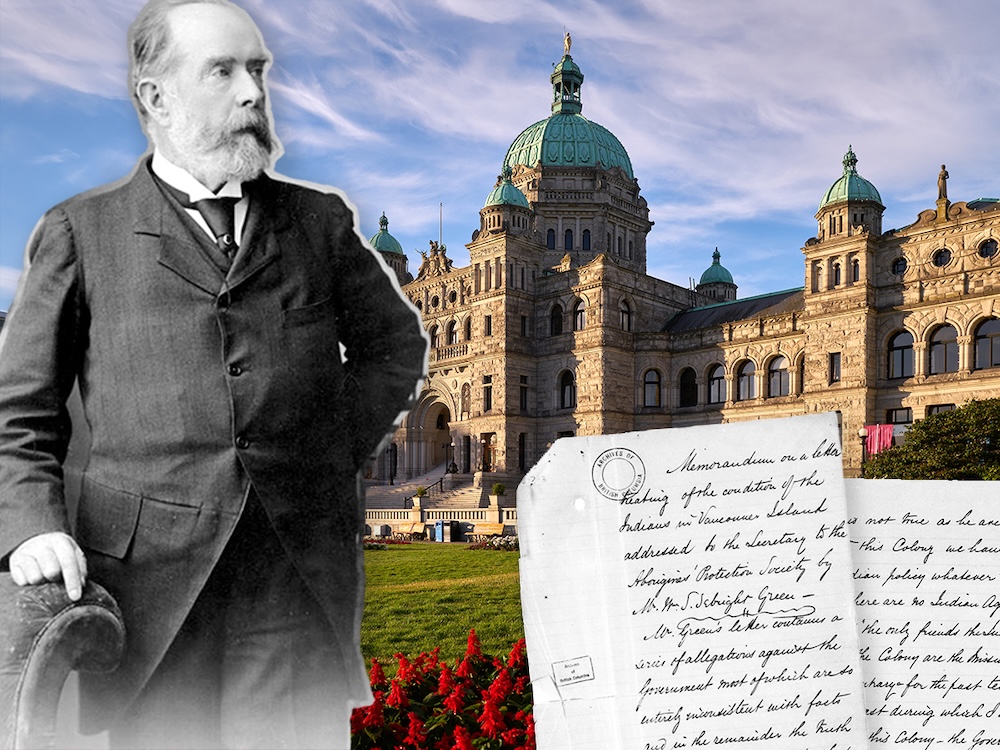
Most British Columbians know little about Joseph Trutch. What they do know usually comes from a letter he wrote to his family shortly after arriving in the Pacific Northwest. He called Indigenous people “the ugliest & Laziest creatures I ever saw” and scoffed that one might “as soon think of being afraid of our dogs as of them.” It is tempting to leave it there, to file Trutch under ugly history and move on.
That would be a mistake.
Trutch was not a social outlier. He was an architect. Before Confederation, he was an elected official, a government contractor and a self-interested land speculator. He led the three-person delegation that negotiated British Columbia's terms of union with Canada. And once that job was done, he was appointed the province’s first lieutenant-governor. His opinions about Indigenous people did not stay in his letters. He embedded them into B.C.’s foundations.
Trutch dismissed Indigenous title as a legal and moral fiction. This was a substantive departure from the Dominion of Canada and the British legal system that arrived here on the boats with the fur traders, such as James Douglas, who had a much closer relationship with the Indigenous people they traded with. Trutch represented the next generation, who saw Indigenous people as impediments to colonization and irritants to settlers.
What made Trutch dangerous was his capacity to turn the colonial theory of Indigenous title into the policy of the land. From his prominent role as the chief commissioner of lands and works for the Colony of British Columbia from 1864 to 1871 and as the province’s first lieutenant-governor from 1871 to 1876, Trutch built the machinery of law and administration that entrenched Indigenous land dispossession. Then he made himself indispensable in the execution of the policy.
Douglas had seen a future in the province for Indigenous people. He created treaties, established Indian reserves based on the direction of Indigenous people themselves and that were sizable enough for them to be productive, and allowed Indigenous people to pre-empt land.
When Trutch became lands and works commissioner, he aggressively reformed those policies. He slashed Indian reserves to a fraction of their size, disallowed pre-emption and clearly stated that Indigenous people had no title to the land.
On several occasions, Trutch lied directly to Indigenous leaders, telling them that previous Crown officials they engaged with had no authority to give them what they did. When he went east to negotiate the terms of Confederation, he delivered his greatest deception. Clause 13 committed Canada to an Indian policy only as “liberal” as British Columbia’s. British Columbia’s Indian policy was far less liberal than Canada was led to believe.
Trutch went further. Following Confederation, he became the first lieutenant-governor of the province of British Columbia. At that time, he was the most powerful person in the fledgling government. When Prime Minister John A. Macdonald was set to appoint Dr. Israel Powell to lead the Indian policy, Trutch intervened in October 1872 with a letter to Macdonald voicing a perspective that ripples through Crown-Indigenous relations in British Columbia to this day.
Calling into question Powell’s experience and advocating to keep himself at the head of Crown-Indigenous relations, Trutch wrote: “As to Indian policy I am fully satisfied that for the present the wisest course would be to continue the system which has prevailed hitherto.... We have never bought out any Indian claims to lands nor do they expect we should.... If you now commence to buy out Indian title to the lands of B.C., you would go back of all that has been done here for 30 years past, and would be equitably bound to compensate the tribes who inhabited the districts now settled and farmed by white people equally with those in the more remote and uncultivated portions.”
The table Trutch set
Four years later, Gov. Gen. Lord Dufferin was at Government House in Victoria speaking to a crowd. He directly articulated the dismay of the Dominion that British Columbia’s Indian policy was not at all liberal and entirely problematic.
He laid that at the feet of Trutch. “Now, we must all admit that the condition of the Indian question in British Columbia is not satisfactory. Most unfortunately, as I think, there has been an initial error ever since Sir James Douglas quitted office in the Government of British Columbia neglecting to recognize what is known as the Indian title. In Canada this has always been done; no Government, whether provincial or central, has failed to acknowledge that the original title to the land existed in the Indian tribes.”
Dufferin went on to admonish British Columbia for not following other provinces in paying for land and making treaties. Instead, he said, B.C. had “always assumed that the fee simple as well as the sovereignty resided in the Queen.”
However, despite these seemingly progressive views of the governor general, especially for the time, he said: “Of course in what I have said I do not mean that, in our desire to be humane and to act justly, we should do anything unreasonable or Quixotic, or that rights already acquired by white men should be inconsiderately invaded or recalled.”
We know what’s right, friends, but we do not want to upset the table that Trutch spent nearly two decades setting. This has a familiar echo, doesn’t it?
That is why this history is important for British Columbians to understand. No matter how ugly we find Trutch’s opinion on Indigenous people to be, no matter how backward we feel the settler’s colonial mindset was, it is the DNA of the contemporary arguments made by the public office holders, and some of the public themselves. Even though we know, and have known since the start, that Trutch’s land policy, which deliberately excluded Indigenous people, was wrong, there was no political will to do anything about it.
What is different now is that since the middle of the 20th century the judiciary has been hearing cases and making decisions about Indigenous rights and title. From Calder through Section 35 of the Constitution Act, 1982, Delgamuukw, Tsilhqot'in, Cowichan and Nuchatlaht, it isn't just Lord Dufferin's 19th-century words framing the land question Trutch claimed did not exist.
The courts have been saying it too, for decades.
Same letter, different letterhead
We see the same pattern in the contemporary political narrative. When the B.C. Court of Appeal confirmed in Gitxaala that the Declaration on the Rights of Indigenous Peoples Act, or DRIPA, creates real legal obligations on government, Premier David Eby rejected the court's authority and moved to suspend the legislation rather than honour it. The court told him what Dufferin had told British Columbia in 1876: There are obligations, now keep them. Eby’s response, like the province’s response to Dufferin, was to protect what Trutch built.
I was one of the MLAs who voted for DRIPA in 2019. It passed unanimously. Eby was there. So was Spencer Chandra Herbert, who now holds the title of minister of Indigenous relations and reconciliation. That title means something. Or at least it should.
As the premier moved to suspend the most significant Indigenous rights legislation in the province’s history, his minister of reconciliation was silent. Trutch also understood the value of letting the machinery do the work.
On April 8, Eby sent First Nations leaders a letter. It is worth reading carefully.
He acknowledges their opposition to his plan. “I understand this step in response to the court decision is not a path many First Nations support.” He acknowledges the timeline. “I regret that the timeline and the legislative calendar do not allow for further opportunity to engage.” Then he closes the question. “This legislation is not the end of our conversation — it is a pause designed to protect the space for a better one.”
In October 1872, Trutch wrote in a letter to Prime Minister Macdonald that acknowledging Indigenous title would mean going back on 30 years of settled policy. The costs were too high, the timing was wrong, the system in place was working well enough. The question needed to stay closed.
One hundred and fifty-four years later, Eby tells First Nations leaders that the court’s affirmation of their rights creates “an untenable degree of legal uncertainty.” The costs are too high, the timing is wrong, the collaborative process in place is working well enough. The conversation needs a pause.
Though Eby has temporarily held off on a vote to pass a bill to amend DRIPA, he has signalled that he will try again, courting the support of Independent MLAs.
The method is the same. Only the letterhead has changed.
We do not need to argue about Joseph Trutch. His own words built the case. His own letters. His own decisions made in moments exactly like this one. That record has followed him for a century and a half.
Every NDP MLA who votes for Premier Eby’s proposed suspension is writing their own entry into that same record. The Hansard will be permanent. History will read both letters. ![[Tyee]](/design-article.thetyee.ca/ui/img/yellowblob.png)
Read more: Indigenous, BC Politics










Tyee Commenting Guidelines
Please note that email notifications for replies are not currently working due to a software issue which may be resolved in a future update.
Comments that violate guidelines risk being deleted, and violations may result in a temporary or permanent user ban. Maintain the spirit of good conversation to stay in the discussion and be patient with moderators. Comments are reviewed regularly but not in real time.
Do:
Do not: