


 SHARE:
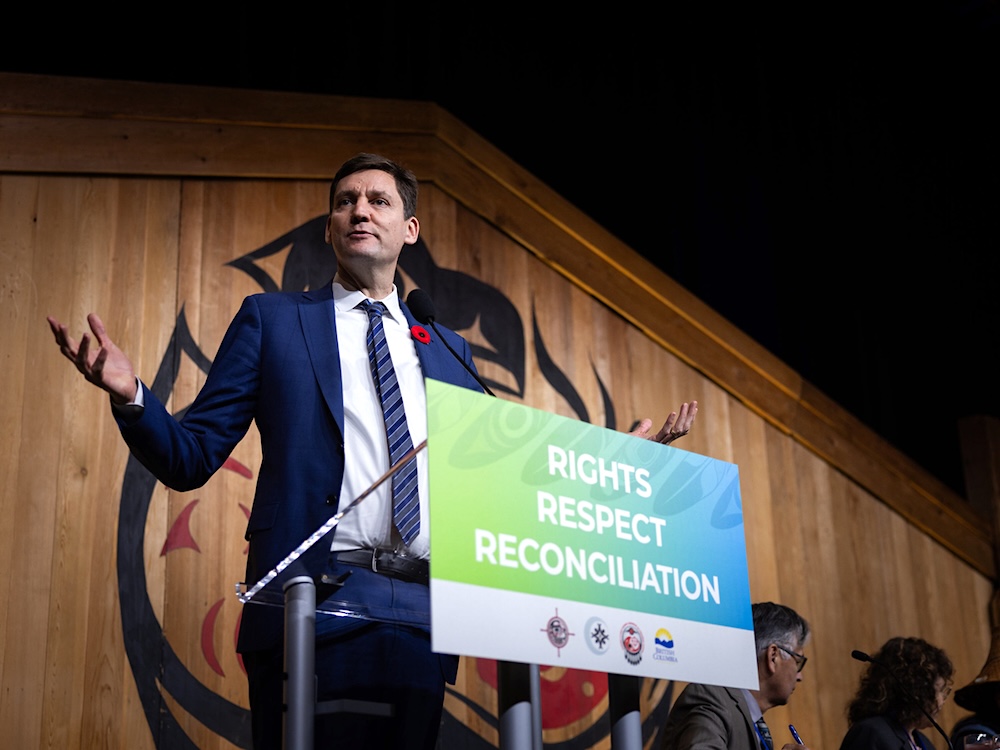
On Dec. 5, as the B.C. Court of Appeal’s landmark ruling on the Declaration on the Rights of Indigenous Peoples Act, or DRIPA, landed, Gitxaała Chief Councillor Linda Innes was ready.
“I hope that they’re ready to roll up their sleeves and work with us.... We’re looking forward to working with B.C. and all parties to implement today’s precedent-setting decision,” Innes said. The Gitxaała Nation was the appellant in the case.
The B.C. Court of Appeal’s ruling found that the province’s Mineral Tenure Act, which prioritizes the stakes of mining companies over other land rights, was “inconsistent” with DRIPA.
The same day, Eby was at an unrelated press event in Surrey. Asked about the ruling, he told reporters the government would review the decision and, if necessary, amend the act.
The opportunity Innes was offering was dismissed before it was ever seriously considered.
The premier’s signal matters
The downstream impacts of Eby’s statements are not inconsequential. By discussing amendments before legal review and before consultation with the rights-holders, Eby didn’t just make a policy choice; he set the Overton window. He defined the spectrum of public debate unilaterally.
With the B.C. Conservatives demanding the act be fully repealed, and First Nations leaders expressing an openness to work with the province to avoid amendments, when the premier states he is open to amending as necessary to satisfy his concerns with the courts, the question is no longer if DRIPA should be amended, but how far will the amendments go?
Eby set up a binary. With the B.C. Conservatives already proposing the nuclear option, anything short of full repeal becomes the reasonable middle ground. So, First Nations leaders who were offering to roll up their sleeves and get to work suddenly find themselves arguing against amendments rather than for implementation.
What if?
What if instead of signalling an eagerness to amend DRIPA, Eby instead said something like the following:
“The decision has just been published. The attorney general and her team are reviewing it. When we better understand the legal exposure for the province, we will meet First Nations leaders to better understand their perspectives and to see if we can co-develop a way forward together. These are complex issues and need to be handled carefully and respectfully.”
That measured approach would have left all options on the table. Last December, it was fully available to Eby.
We are now nearly four months downstream of that press event.
The political anticipation and pressure are building as the drafting and consultation process is underway. First Nations have established a wall of opposition to amendments to DRIPA. At the Union of BC Indian Chiefs’ council meeting in February, leadership overwhelmingly passed a comprehensive resolution strongly opposing legislative amendments and instructing staff to “engage in planning direct action as needed.”
Westbank First Nation Chief Robert Louie recently published an editorial in the Vancouver Sun expressing his opposition to amendments to DRIPA. He made a pragmatic and direct appeal to the province to step back and consider the potential impact of its actions.
Speaking directly to the economic success of his community, he wrote: “None of this happened by accident. It happened because we had clear rules, clear rights and clear relationships. When partners know who holds authority, and know it will be respected, they commit capital. Certainty secures deals. Ambiguity kills them.”
The premier needs free, prior and informed consent
Eby chose a direction in December, and he promises to deliver legislation amending DRIPA.
His margin of error is vanishingly thin. Article 19 of the United Nations Declaration on the Rights of Indigenous Peoples is clear. “States shall consult and co-operate in good faith with Indigenous peoples in order to obtain their free, prior and informed consent before adopting and implementing legislative or administrative measures that may affect them.”
This is currently the law in British Columbia. It is clear Eby does not have the free, prior and informed consent of First Nations leaders. He and every member of the BC NDP caucus need to be confident in their consultation record before proceeding, or else they may just be inviting the courts into the mess they are creating. Will the courts be sympathetic to Premier Eby’s political manoeuvres?
An opportunity missed
None of the political and economic uncertainty that has followed the premier stating his intention to amend DRIPA was inevitable.
On Dec. 5, standing at the lectern in Surrey for an unrelated announcement, Eby had a choice. He could deliver a measured response, one that signalled competence, respect and control. It would have served interests of the public, industry and First Nations, better than his decision to go straight to amendments. He just didn’t take it.
That is not the final scene. Eby still has a choice. He does not have to introduce a bill to amend DRIPA. He can pause, sit down with rights-holders and engage in genuine talks. The first opportunity came and went at a Friday press conference in Surrey. This one is still here. The question is whether he will take it. ![[Tyee]](/design-article.thetyee.ca/ui/img/yellowblob.png)
Read more: Indigenous, BC Politics









Tyee Commenting Guidelines
Please note that email notifications for replies are not currently working due to a software issue which may be resolved in a future update.
Comments that violate guidelines risk being deleted, and violations may result in a temporary or permanent user ban. Maintain the spirit of good conversation to stay in the discussion and be patient with moderators. Comments are reviewed regularly but not in real time.
Do:
Do not: