


 SHARE:
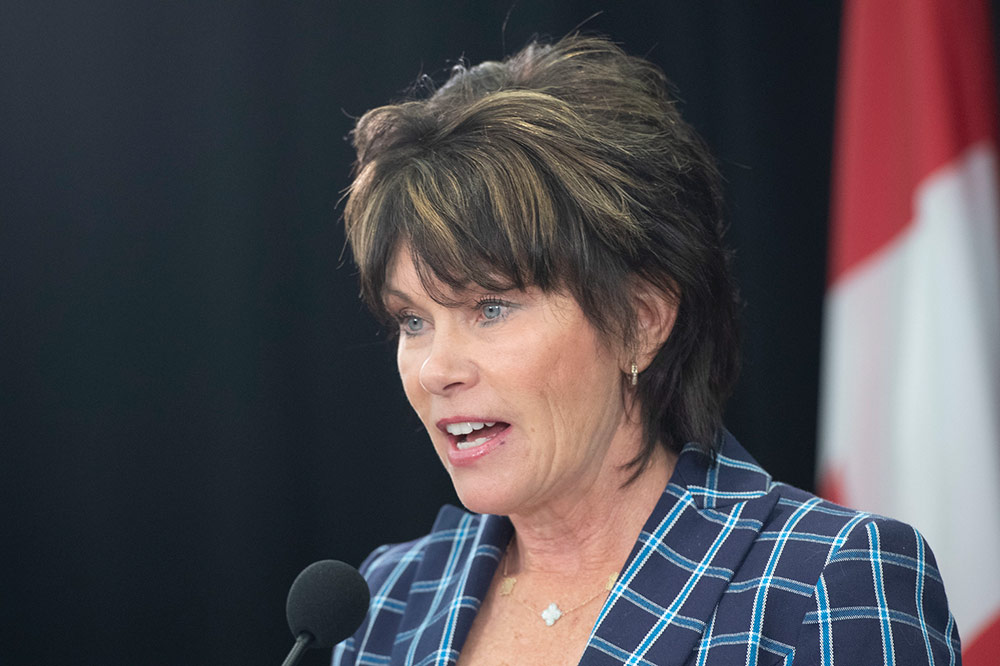
Former United Conservative Party energy minister Sonya Savage spoke the truth Friday when she said that without public funding, Premier Danielle Smith’s perpetual pipeline project is little more than a pipe dream.
This has been obvious from the get-go, of course. Still, it’s nice to hear someone long influential in the Alberta oilpatch and once associated with the UCP, albeit back when Jason Kenney still bestrode this province like a political colossus, saying aloud what no member of Smith’s cowed cabinet dares to admit.
Savage told CBC’s West of Centre podcast, in a widely quoted clip, that the chances of any private sector actor ever stepping up to build another pipeline to Canada’s West Coast are basically zilch.
When podcast host Kathleen Petty asked her three panellists — Savage, former Liberal MP Martha Hall Findlay and former Canadian Energy Regulator CEO Gitane De Silva — if they agreed the chance of a private proponent stepping forward to build the pipeline was diminishing, Savage was direct.
“I would say it’s not just diminishing... I would say it’s almost zero at this point.”
Savage spoke this so mildly that the exclamation mark her thought deserves can’t be used. Just the same, it was an important point made by someone who has an insider’s knowledge of both the fossil fuel business and the politics of pipeline building.
As befits the holder of the energy portfolio when Kenney’s bad bet on Donald Trump winning the 2020 U.S. presidential election and quickly restarting work on the Keystone XL pipeline cost Alberta taxpayers $1.5 billion, Savage went on to indicate she doesn’t have a problem with governments paying for pipelines.
“There’s going to be politics in there, and politicians are going to want to reinforce their narrative on how urgent it is to get a new West Coast pipeline going,” she explained calmly.
But since the hope that a private proponent will come forward is a faint one, and with Venezuelan heavy crude re-entering the U.S. market sooner or later, as we have been saying here for months, public investment is probably the only way Alberta’s pipeline demands can be met.
Anyway, governments playing a big financial role in building pipelines is nothing new in Canada, Savage kept trying to say, despite serial interruptions from the podcast host and the fact that little effort was made to identify which of three guests with similar voices were speaking at any given time.
Of course, as the podcast participants acknowledged, Smith’s pipeline deal with Prime Minister Mark Carney requires a proponent to emerge from the private sector.
But it seems likely that requirement will be tossed under the bus given the prevailing mood that with Trump back in the White House, it’s in the national interest to get cracking on another bitumen pipeline to the coast so we can sell the stuff to China.
Never mind that China is electrifying at Manhattan Project speed to avoid having to strategically depend on anything that must be shipped through the South China Sea, and that for similar geopolitical reasons the Trump administration is unlikely to permit Canada to sell anything of strategic value to China.
Savage also had some relevant and interesting observations on the likely impact on Alberta government budgets of shipments of Venezuelan heavy crude resuming to the United States.
For some reason, despite being quite significant, these seem to have generated less interest from the media that jumped all over her pipeline commentary.
“It doesn’t seem to be disputed that 10 per cent of Canadian oil could be at risk in the short term,” she observed. Right now, she added, we ship about four million barrels a day to U.S. refineries — most to the U.S. Midwest, and about 350,000 to 450,000 a day to refineries on the Gulf Coast.
“That’s what’s at risk, that 350 to 450 thousand barrels a day to the Gulf Coast.”
So, never mind the impact on the energy industry and energy users, she continued. “You have to look at what the impact is, not only on the oil producers and the energy industry, but what is the impact on governments, on government revenue? And in Alberta, 10 per cent is not chump change.”
“Ten per cent of the production is a significant impact on the provincial budget and on royalties,” she explained. “Even a $1-a-barrel decrease in the price of oil, or a spread in the differentials, is $750 million to the provincial budget in royalties.
“The provincial budget was predicated and budgeted on $64 a barrel,” Savage said. Right now, prices are about $7 a barrel below that.
Cue sinister music. “So we’re looking at about a $9-billion deficit,” she concluded, “and that’s a reason to pull the fire alarm bell for the provincial budget.”
Just imagine how Alberta politicians will respond to the prospect of a deficit of $9 billion or more!
Service cuts and privatization, of course. More covetous eyes cast at your Canada Pension Plan funds, naturally. And with another pipeline proffered as a panacea absent any proponent, what do you think is going to happen? ![[Tyee]](/design-article.thetyee.ca/ui/img/yellowblob.png)








Notice about commenting changes
The Tyee’s commenting system will be moving to a new platform on Nov. 12. If you’re already a Tyee commenter you must register with the new system on or after Nov. 12 with your preferred username.More information can be found here.