

 SHARE:
Today marks the 70th anniversary of Pearl Harbour, a not-inauspicious date if you happen to be a Japanese Canadian, as I am.
But if it hadn't been for the two older, white Canadian gentlemen who mentioned it at a recent local gathering of the Writers' Union, the anniversary might have slipped my mind. Our union chapter was planning a gathering for Dec. 7, and we were discussing a possible theme around which to have open mic readings. The men named Pearl Harbour as a flippant possibility, and I grasped onto the idea. In recent years, I have come to look at this anniversary in a much different light than previously.
Growing up in predominantly white suburban Alberta, I found myself either defensive about Dec. 7, or ashamed of it. A friend's father would jokingly refer to my "kind" as having been responsible for Pearl Harbour. My retort in those days was "And your 'kind' put us into camps for it." What happened to Japanese Canadians was not widely known then, so I would have to explain how my father's family was forcibly displaced from their Surrey farm to interior British Columbia because of the Canadian government's wartime policy, which removed all Canadians of Japanese descent off the coast.
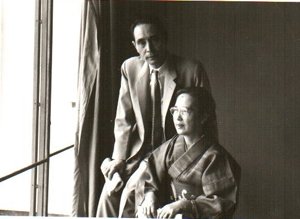
But of my mother's family, I said nothing. She was truly Japanese, of the "kind" that bombed Pearl Harbor, and there was no mistaking it when you met her. Her English was of a halting, clipped variety that marked her as an immigrant. She came from Osaka in 1962 after marrying my father, a "Kika-Nisei," a Canadian-born Japanese whose family had chosen the repatriation option after the war instead of moving east of the Rockies. My mother's family was middle class, from the robustly mercantile city of Osaka. Her father was a university educated gentleman, a graduate of Osaka Gaidai (now known as Osaka University of Foreign Studies) whose major was southeast Asian languages.
A well-read man and a consummate diarist, my grandfather was fond of writing and kept a daily journal for years. In the late '80s, he began writing a memoir, and before he died in 1992, he gave each of his children a copy. I remember my mother receiving hers. I was excited by the idea of its contents, but my Japanese reading skills were not up to the task. Only recently have I had the wherewithal to read and translate the work into English.
What was it like to be Japanese on Dec. 7 (or rather, Dec. 8) in Japan? My grandfather's memoir reveals the date and its effect on his particular life, and although it is not as dramatic an event as the bombing, the day would also prove to be a personal turning point for him. Married with two children and working as a businessman in the steel trade in Osaka, he would now be subsumed by Japan's mobilizing war machine, sent off to worlds hitherto unknown.
THE WAR YEARS
By Toshiro Saito
1941
And so the fateful year of 1941 arrived. I forget where, and who it was who had told him about me, but that year my old classmate Ichikawa Hiroshi, whom I hadn't seen since graduation, suddenly showed up at my office one day. This fellow, whom I had once agreed to go to work with in Java, took me by complete surprise. Long ago, he'd been told by his uncle in Sumatra that two employees could not possibly be hired, and so Ichikawa had left without saying anything to me.
On this visit, he apologized to me for this long ago incident. He explained to me now how the Dutch-administered government of Indonesia had ordered all Japanese out of the country, and some of the employees had returned to Japan and were working at the branch office in Kobe. To be more specific, Ichikawa's uncle's business had gone bankrupt because the overseas Chinese merchants were boycotting Japanese products. Ichikawa worked for the Nanyo Warehouse Company, which had a warehouse in the part of Java where they acted as agents for shipping companies and did customs inspections paperwork on behalf of the owners of the goods; they had received permission from the Dutch government to do this. They were expelled because they were suspected of being spies. Ichikawa, in fact, had been discovered counting the number of war planes at the airport and counting warships in Batavia Bay port by a Dutch official. He was told to wait at the Kobe branch office until his next set of orders came in from the army. He told me he'd come in and drop by when he could. So that night, we went out drinking.
Around this time, I heard some information from one of my classmates, Momii Kiyoshi, who owned a business with his brother called Tokiwa Shokai in Yawata-shi. A company whom they dealt with -- Yawata Iron and Steel -- had recently begun buying American-made flying micrometers, which is an accessory to a "strip mill" made of thin sheet metal (strip mills are devices in which steel slabs are rolled into strips). They were concerned that if these micrometers were faulty they would not, in the current climate of tension between the U.S. and Japan, be able to exchange them, so they were looking for a local producer of this device in Japan. Because of the delicate political situation between Japan and the U.S., they could not publicly declare this demand, and could only make it known to a select few tradesmen who had access to iron or steelwork companies.
The person that came to mind then was Kawakita, who was an engineer with Showa Seiki (Showa Precision Machines) whom I contacted. Regardless of whether or not Showa Seiki could produce the micrometer, they needed to see an actual model. Of course, this particular American-style model was not yet available in Japan, but if it were just the normal kind of micrometer that you held in your hand, Kawakita told me he could make a similar one with various modifications. After talking about this potential business opportunity with each other, we parted company.
The next day, Momii-san showed Kawakita and me around the Yawate company compound where his business activities took place. The strip mill was not only bigger in size than I expected, but the speed of it was also beyond my imagining. I was amazed and struck by this American-style mass production system. The engineer there was familiar with the micrometers of Showa Seiki. He explained to Kawakita how the micrometer on the working mill operated and spoke of other technical matters with him. When we returned to the offices of Tokiwa Shokai, there was a telegram for me. I opened it, wondering what it could be about; it was from my wife, telling me to come back right away and report to the Osaka prefectural office.
The cryptic notice made me suddenly question myself. The cast steel I was selling was a regulated product; however, most of what I was selling was going to unticketed buyers which essentially meant that the transactions were black market ones. I could not report this activity at all to any of the authorities without meeting first with the buyers at Kotobuki where we would need to think about how to proceed next. Instead of going home right away, I pretended that I had received this telegram late and delayed my return to Osaka for two days. When I showed up at the office, there was a phone call from one of my classmates asking why I hadn't shown up earlier at the Osaka prefectural office as indicated. He told me I'd be caught by the military police because there had been a flap about my absence since I had failed to report for the draft notice which had been issued to me from the Ministry of Health and Welfare. Draft notice! So that was what the message to report to the prefectural office was about! Apparently I was to report the next day at the assigned train station. I went home immediately.
I got my draft notice and headed straight for the Osaka prefectural office. The official in charge told me they would accept my reason for the delay in reporting. I would therefore not have to make the following day's departure and was excused for the time being, although I was to keep this a secret. There would be two or three more calls yet for conscription, and so I was told to stay healthy and go home. I'd heard by phone that Sasa had to report at Kobe station, so the next evening I went there and saw a group of men in national uniform with long boots, bearing long swords and wearing army caps. Looking at their faces, I could see they were men of my age and generation as well as those who were either a couple years older or younger than me -- the average age being about 34, the age of one's working prime. Military standing aside, what all these men had in common was that they were all former graduates of the Malaysian language department and so it was, one could see the military's design in conscripting these particular men just at this time when Japan was advancing into French Indochina.
When everyone found out I had been spared, they were envious of me. I discovered later that those who lived in Osaka had to report to Osaka station. In the same way as conscripts were called up to serve, companies were made to pay their conscripted employees salaries to their families according to their particular wage scale. However, in my circumstance, I would not draw a salary from either company or military, so what should I do? If suddenly I were to abandon my job, the impact would be huge. Of course, my household income would be affected, but so would my customer's as well as the Navy's supply-and-demand situation. And I could not predict when I would have to leave my job.
On Dec. 8, the day that would determine Japan's fate arrived. While mulling over the current circumstances of Japan's difficult negotiations with America, I heard the announcement on the radio of the outbreak of war. I felt suddenly relieved, as if a burden had been removed from my shoulders and I listened with refreshed feelings to the military music playing on the radio. So, now my own fate was determined. When it would happen, I did not know, but I was certain to be conscripted soon; this was inevitable. I would now have to find someone trustworthy to replace me at my work.
Just when I was worrying about all this, Ichikawa, whom I hadn't seen for awhile, showed up and told me he had been ordered by the military to land at Java with the army at the time of their occupation of the island. I told him about my current problems. He suggested I become an employee of the Nanyo Warehouse Company as employees who were sent abroad to investigate foreign markets eventually fell under the auspices of the military anyway, making them the same as conscripts. When I heard this, I became hopeful. Ichikawa, who was currently recruiting new employees for the Kobe office, offered to recommend me. As soon as I had consulted with my wife, I would let him know.
I went home and talked it over with Kiyoko in detail. We agreed that the prospects with Ichikawa's offer for employment were good ones for our living conditions, and even though it would be lonely for us to be separated, we would endure it together. The next day we agreed to consult with my Yoshida in-laws about this plan. When we talked to them, they said, "When your draft notice actually comes in, then think about what you will do. Don't think ahead like this." Their answer was just what I expected. My wife, who had accompanied me and knew the nature of my business, persisted in a roundabout way to defend my plans and managed to get them to agree to look after her while I was away. My father-in-law was not satisfied with this decision that Kiyoko and I had made together. However, when I asked my older brother if he would look after my business affairs, he said he would do so gladly for me.
The war had at last come to my doorstep, and my life was about to be changed. ![[Tyee]](/design-article.thetyee.ca/ui/img/yellowblob.png)
Read more: Politics

Tyee Commenting Guidelines
Comments that violate guidelines risk being deleted, and violations may result in a temporary or permanent user ban. Maintain the spirit of good conversation to stay in the discussion.
*Please note The Tyee is not a forum for spreading misinformation about COVID-19, denying its existence or minimizing its risk to public health.
Do:
Do not: