

 SHARE:

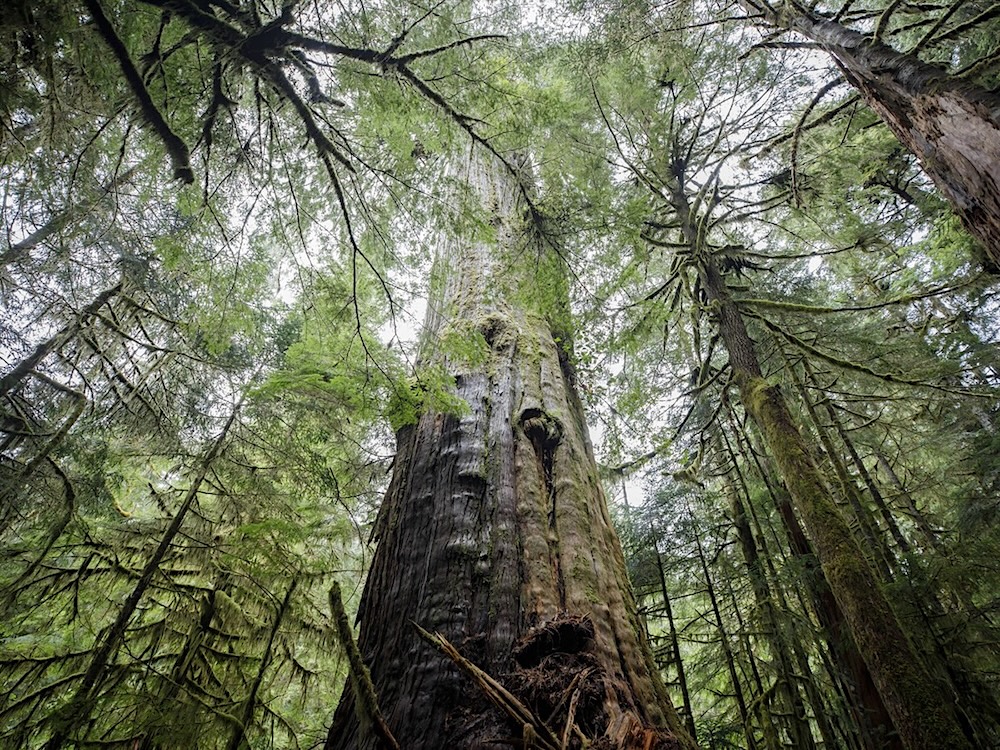
On Sept. 21, the day before David Eby called a snap election, his government quietly extended logging deferrals in the old-growth Fairy Creek watershed on southwest Vancouver Island.
The government granted the deferrals five years ago, at the request of Pacheedaht First Nation, after more than 1,000 people were arrested during logging blockades at Fairy Creek that lasted for more than a year.
But following the election of the Conservative Party of BC, the future of Fairy Creek — and two million hectares of old-growth forests elsewhere in the province, also deferred from logging — is up in the air, prompting scientists and conservation advocates to caution that B.C.’s “war in the woods” could reignite.
On Saturday, during a rousing acceptance speech, premier-designate Lorne Doerkson promised “more fibre on trucks” as part of his party’s plan to supercharge B.C.’s economy.
The Conservatives’ election platform pledged to protect “original old growth and the most endangered and rarest ecosystems” and “return remaining land to the working forest.” The Conservatives also said they would “resolve” old-growth logging deferrals that “dragged on under the NDP.”
Forester Garry Merkel, a member of the old-growth strategic review panel established by the BC NDP government, told The Tyee he was encouraged to see the Conservatives promise to protect old growth and rare and endangered ecosystems.
But so much old growth in the province has already been logged that all old-growth deferral areas are part of endangered and rare ecosystems, Merkel, a member of the Tahltan Nation, pointed out.
“We’re down to the bottom of that little triangle of what’s left of those primeval and old forests now, and we’re starting to see some very big consequences,” he said, adding that “people from all walks of life are angry about that.”
Merkel said he appreciates that B.C. needs to build a strong, stable economy.
“But you can’t do it by continuing to erode the resource over time,” he said.
“If you find yourself in a hole, stop digging.”
Merkel said the logging deferral areas were never meant to be permanent and were established to keep options open while the province, First Nations and communities worked on a new plan for old-growth forests that maintains ecosystem health and other important values, and isn’t just focused on timber supply.
Pacheedaht First Nation told The Tyee that one of the objectives of the Fairy Creek watershed logging deferrals is to provide time and space for Pacheedaht to draft a stewardship plan for their territory. The nation said it offers “qualified support” for the deferral extension but did not elaborate.
The stewardship plan “seeks to find balance between the cultural, environmental and economic values and goals of the Pacheedaht Nation,” the nation said, adding that the confidential draft plan is currently being reviewed by nation leadership and members.
“It is Pacheedaht's expectation that operators in the territory will follow Pacheedaht's stewardship plan once it is released and shared publicly,” the nation said.
Pacheedaht First Nation also pointed to the Hišuk ma c̕awak declaration it made jointly with Huu-ay-aht First Nations and Ditidaht First Nation in June 2021, as the RCMP continued to arrest Fairy Creek protesters.
The declaration said third parties — including companies, other governments, organizations and individuals — “have no right to speak on our behalf, or on behalf of the lands, waters and resources in our territory.”
For third parties to be welcome in the nations’ territories, “they must respect our governance and stewardship, our sacred principles, and our right to economically benefit from our resources,” the declaration said.
Speaking about old growth in general and not about Fairy Creek, Merkel said B.C.’s options for building a “healthy, balanced landscape” that provides stable flows of ecosystem services, including timber resources, will be much more limited if old-growth deferral areas are logged.
“Once they’re gone, they’re gone. They don’t come back. You can grow old trees again, but you can’t get old ecosystems back in any reasonable time frame.”
Logging the province’s old-growth deferral areas would have consequences not just for wildlife but also for humans who rely on old forest ecosystems for services such as clean water, clean air and wildfire resilience, he said.
Merkel described Doerkson as a “reasonable person” who understands collective wisdom, also noting that he leads a party with wide-ranging points of view. Merkel said he doesn’t believe the Conservative government’s position on old-growth logging will go “too far out of bounds, because I think there would be too much backlash from all walks of life.”
Yet, if the new government doesn’t approach the issue of old-growth forests carefully, Merkel cautioned that “rhetoric you hear around war is going to turn into a lot more than rhetoric.”
“Old growth is going to be one of the many topics that’s caught up in that war, and I don’t think it’s going to be healthy for this province.”
Ken Wu, executive director of the Endangered Ecosystems Alliance, told The Tyee that the Conservatives’ promise to protect old growth and rare and endangered ecosystems is “one nugget of potential hope” amid serious concerns.
The rest of the Conservatives’ plan for old-growth forests “means a lot more big stumps where the big trees once towered,” Wu said, adding that he anticipates the new government will “open up the logging deferrals for industrial logging.”
Scientists and conservationists criticized the NDP government for logging old-growth deferral areas around the province, including in the Tsitika Valley watershed on east Vancouver Island.
But Wu said there’s a “world of difference” between the NDP’s old-growth policy and the Conservatives’ election platform promises.
“The NDP have done nefarious, terrible things when it comes to old-growth forests,” he said. “But taken in totality, there were huge leaps forward.”
He pointed to new protected old-growth areas, including in Clayoquot Sound on Vancouver Island’s west coast and the Incomappleux Valley in southeast B.C., as well as the NDP government’s decision to set aside about two million hectares of old growth in logging deferral areas.
The NDP government also shepherded plans for five new Indigenous-led protected areas and a sixth expanded protected area whose futures are now uncertain, Wu pointed out.
“We do have to give them a chance,” Wu said of Doerkson’s government, adding that a love of nature cuts across all political party lines.
“Nature is part of our DNA,” he said. “It doesn’t matter whether you’re on the left or the right, or an NDP or Conservative supporter.”
Biologist Rachel Holt told The Tyee that the future of Fairy Creek and “any other important old growth” is far from secure.
Logging deferrals, including in the Fairy Creek watershed, “can be undone,” said Holt, a member of a government-appointed technical advisory panel that determined which old-growth forests were at the highest risk of biodiversity loss and should be deferred from logging.
If the Conservatives approve clearcutting in globally significant old-growth forests, “it will push us back to an era of public civil disobedience,” she warned.
Holt said the current old-growth deferral areas are a “very small fraction of what is needed to actually maintain biodiversity” in B.C.’s forests.
The Endangered Ecosystems Alliance is prepared to “put up the biggest fight ever, if need be, if things are going to go sideways,” Wu said.
A red line for the alliance and its supporters will be if the new government opens parks and protected areas to logging, under the guise of wildfire risk reduction, he said. 
Read more: BC Politics, Environment

Tyee Commenting Guidelines
Please note that email notifications for replies are not currently working due to a software issue which may be resolved in a future update.
Comments that violate guidelines risk being deleted, and violations may result in a temporary or permanent user ban. Maintain the spirit of good conversation to stay in the discussion and be patient with moderators. Comments are reviewed regularly but not in real time.
Do:
Do not: