
 SHARE:

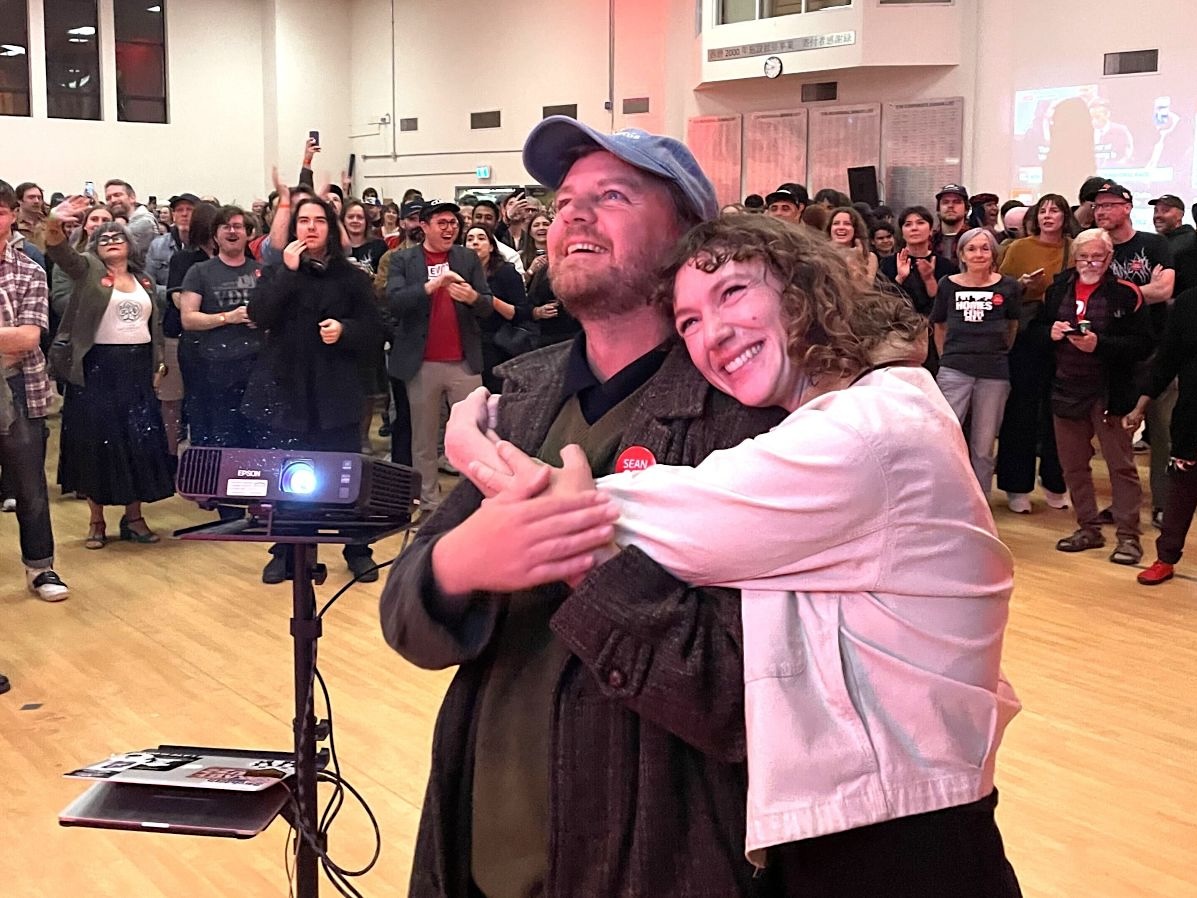
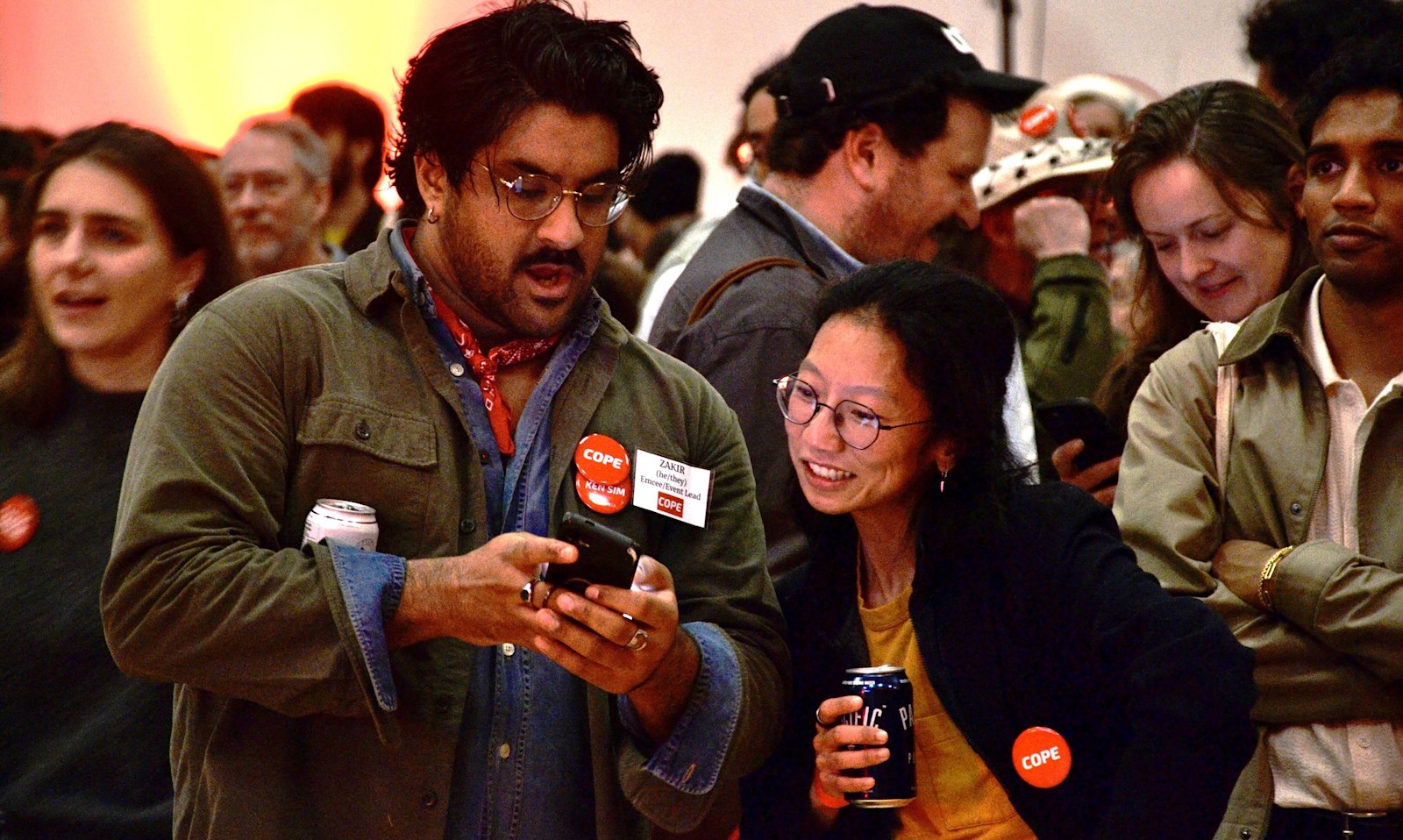
Early in the evening, after Vancouver’s political battle had been fought but before its outcome was known, a young man stood in line to enter the Strathcona hall where the Coalition of Progressive Electors was set to host its election party.
The line was short. Beyond the door, a handful of COPE supporters were busy sticking red campaign signs to the walls, laying down red tablecloths and arranging red and white balloons onstage.
At the entrance, the young man gave his ID and said he’d come to help. “You’re born in 2000! You’re old enough to vote!” the clerk joked, welcoming him inside and among the ranks.
It was a fitting moment for Vancouver’s oldest and farthest-left political party, which boldly returned to political relevance thanks to a record haul of progressive voters, many born in the new millennium.
Now COPE, whose candidates won every office they attempted, placing four members on the 10-member council and eight on the park and school boards, holds powerful sway at city hall. But it must contend with the new Conservative Party of BC government that sent David Eby’s BC NDP packing on Saturday night.
“We are willing to work with whoever is in power,” said COPE’s Devyani Singh, a climate scientist newly elected to council on Oct. 17.
The Conservatives have vowed to cancel the Declaration on the Rights of Indigenous Peoples Act, wipe away the province’s supportive approach to teaching about sexuality and gender identity, take a hardline, anti-harm reduction approach to drug users and cut taxes.
COPE disagrees on all those counts, but the party isn’t picking fights yet. “Premier-elect [Lorne] Doerkson is, by all accounts, a decent guy on a personal level,” Singh wrote in a followup email to The Tyee.
She added that a change in government could help advance mutual interests such as a SkyTrain expansion or more funding for school meals and voluntary mental health treatment.
Singh also suggested it could allow the city to advance retrofits and make the case for investing in new jobs and training that support the “green transition.”
“It’s about showing them the numbers, talking to them about how this is actually a better business case for the people, for the economy, for sustainability,” Singh said.
COPE incumbents Coun. Sean Orr and school board trustee Suzie Mah each topped their races. On council, Orr will be joined by COPE colleagues Singh, Chloe Leslie and Solomon Yi-Kieran, who just turned 21.
“We worked so hard for this,” Orr told The Tyee two days after the municipal election, adding that the job is just beginning.
“Yes, we have a very strong mandate, but at the same time, we represent all of Vancouver now.”
Time on the sidelines
COPE’s last heyday was in 2002, when former coroner Larry Campbell ran under its banner to become mayor. But the party split and Campbell did not run again. The more centrist offshoot, Vision Vancouver, recruited NDP MLA Gregor Robertson to successfully run for mayor in 2008. His mayoralty lasted until 2018, and during that stretch COPE was largely sidelined as a progressive force.
But in a 2017 byelection, longtime anti-poverty activist Jean Swanson gained a council seat for COPE following an energetic campaign fuelled by young activists and artists. Eight years later, Orr won another byelection and reprised Swanson’s role as sole COPE representative on council.
The right-of-centre ABC Vancouver party led by former mayor Ken Sim held the majority, even as it shed members due to controversies. A big one involved Orr, who Sim falsely claimed was “handing out illegal drugs on Christmas Day to people on the streets.” After strong disavowal from Orr and public outcry, Sim was forced to apologize. Orr is suing him for defamation.
Orr was ABC Vancouver’s natural target, having won his seat by pledging to “grill Sim” for his bitcoin boosterism, retreating on policies addressing the climate crisis and inequality and implementing budget cuts that harmed vulnerable communities.
Shawn Vulliez is a 36-year-old animator, political organizer and COPE campaign director. Before Orr arrived on council, said Vulliez, there was a feeling that ABC Vancouver was invincible and Vancouver was “not a progressive city anymore.” The party didn’t see it that way. “We know that other people were feeling the way we were feeling about the direction of our city.”
As Vulliez expressed those views, he was standing amidst what had become a jam-packed COPE election-night party and results were pouring in. They told a stunning story of triumph for the city’s most radical party. How did they pull it off?
Getting people to the polls
In a contest that featured a 43 per cent voter turnout — up from 36 per cent in 2022 — COPE phoned more than 10,000 people and had a text bank of 40,000 people. “The bread-and-butter direct-voter contact and the volunteer base really won us the election in a big way,” said Ezra Bloom, who helped COPE with field organizing.
All that came before COPE knocked on over 10,000 doors on election day.
It’s a stark contrast to last weekend’s provincial election, which had a lower turnout than the 2020 election held during the early months of the COVID-19 pandemic. The Conservatives won a majority despite receiving 50,000 fewer votes than in 2024.
To Singh, the voter numbers show the election wasn’t about “everyone going right wing.” Instead, it signalled frustration at thwarted change felt by progressive-leaning British Columbians who decided not to show up to vote.
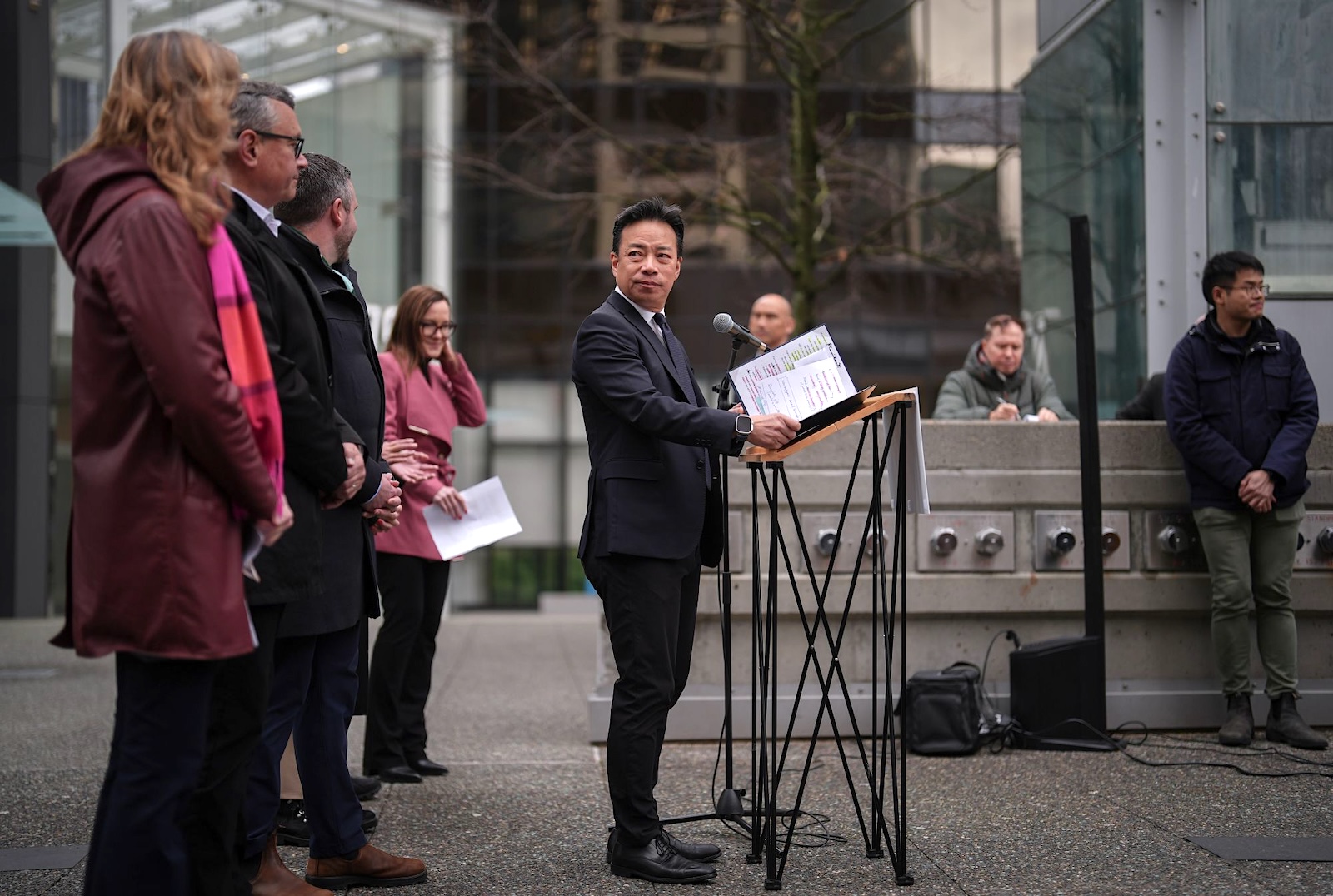
While David Eby’s snap election campaign seemed an uphill slog, COPE matched sharp messaging with good vibes, reflected Orr. “We’re having fun.” It showed as COPE held biweekly pub nights, pumped out cheeky social media content and handed out piles of “Evict Sim” buttons.
Now the challenge is sustaining that level of happy-warrior engagement. “We want people not just to be one and done but to stay around and hold me accountable,” Orr said.
What comes next
The Greens not only saw their mayoral candidate, Pete Fry, win in a landslide; the party matched COPE in electing its own full slates of candidates, including four on council. That portends a potentially formidable progressive coalition controlling city hall. What does COPE aim to achieve?
For COPE’s Yi-Kieran, the first step is starting off small, tangible and, literally, at street level. His party wants more covered bus stops and to extend bus lanes on major bus routes including Kingsway, 49th Avenue and Hastings Street. The plan was first announced in 2024 but has since stalled.
Fulfilling those projects could help build trust with citizens turned off by local government. “Projects like this are really important to show that we can actually make your life better,” Yi-Kieran said. “People can rightfully demand more from their city governments, and we can make it happen.”
Fellow COPE councillor-elect Leslie is keen on making food more affordable and equitable. A former food security worker, she wants to test public grocery stores in Vancouver by leveraging city-owned buildings and the city’s buying power to procure and offer food at affordable rates in “priority areas” like the Downtown Eastside and other neighbourhoods. Leslie also wants to see a universal meal program for all Vancouver students, a goal she says is shared by the Greens.
To get there, the city will have to rebuild a food system department at city hall. Three out of the four food system planner roles were cut in last year’s “zero means zero” budget, Leslie said, leaving gaps on who determines where food security resources go.
“Food security was obviously not a priority for the previous mayor and council,” Leslie said, adding that she’ll be advocating to make it a priority in next month’s budget.
Orr has stated that restoring the city’s living wage is a goal. He and OneCity’s Lucy Maloney have joined Green councillor-elect Annette Reilly in vowing to reverse the ban on net new supportive housing.
In fact, the Greens align with many of COPE’s promises, including extending rapid transit to the University of British Columbia, growing the city’s tree canopy and pausing the use of AI in schools.
But as columnist Mo Amir recently wrote in The Tyee, policing and housing could serve as sticking points between the two, though they are not “irreconcilable differences.”
On policing, the Greens are calling for “regular independent performance reviews to ensure resourcing is evidence-based, accountable, transparent, and achieving the best outcomes for residents and frontline emergency responders,” while COPE is calling to “challenge the legal structures which handcuff the city to unelected police boards, and push for democratic community oversight and an audit of the VPD.”
COPE also wants to stop the practice of “street sweeps,” where police and city workers require homeless people to move and often confiscate their belongings. Both parties are calling for the development of non-police emergency responses for mental health crisis situations.
Orr told The Tyee that COPE isn’t going to shut anybody out of talks, adding that the most experienced person on council will be the only ABC Vancouver candidate to be re-elected: Mike Klassen.
“It’s democracy, I expect there to be differences. It would be strange if there wasn’t, right? That’s healthy, but how we deal with those differences is what’s going to set us apart from ABC,” Orr said.
COPE councillor-elect Singh knows what it’s like to be on the other side of the aisle. She ran with the Vancouver Greens in the 2022 election. Though the Greens never told her to moderate her views, Singh said, she felt more comfortable switching to COPE because it allowed her to “be more open about my socialism.”
When having difficult conversations, Singh said, it’s important to start with the issues before advancing solutions. Once everyone agrees on the city’s major issues — she cited affordable housing, public safety and climate — then it’s time for ideas.
“You don’t start with ‘I want a mansion tax’ because mansion tax is a tool to get funding for climate and housing,” she said, citing a measure mentioned in COPE’s platform. “Let’s begin with ‘You know we need public housing, great, so where do you think that money can come from?’”
Electoral reform in the offing?
If you’re looking for one way a COPE-Green axis could deliver lasting change to Vancouver, consider that both parties have called for significant electoral reform. Each has voiced support for a ranked-ballot system for mayor. COPE wants it to happen fast, setting a goal date of 2030. The Greens did not specify a date in their platform.
A ranked-ballot system has voters list their preferred candidates in order. If there’s no majority after one vote, then voters’ second choices are counted. The system is already in place in New York City and San Francisco.
On election night, COPE’s Vulliez revealed that a ranked-ballot system for mayor was discussed with other parties during vote-splitting negotiations that resulted in COPE withdrawing its mayoral candidate, Stephanie Allen. The talks, he said, were to ensure that “in future elections we don’t have to have crazy negotiations,” adding that the parties all agreed to that direction.
“The COPE negotiation team brought that we wanted a fair process that centred the public,” Vulliez said.
Given Sean Orr won more votes than any other council candidate, he possesses a lot of political capital. What is he eager to take on?
In keeping with COPE’s general theme of starting small and specific, Orr said his goal is to take a hard look at the city’s finances. The latest budget put out by Sim and his ABC Vancouver party was “pretty slim” — only about 16 pages. It raised rather than answered key questions about how, in inflationary times, the city could operate well despite a zero per cent lid on the budget.
Orr wants to find out where costs to the city are rising, what charges other than property taxes have been hiked to make ends meet and what exactly Sim’s regime axed.
Ask Orr to name COPE’s biggest priority and he sounds very COPE, new and old versions. Protecting tenants, is his answer.
His party has long identified with people on the margins as Vancouver’s powerful developer community held sway in city hall. Today homelessness is on the rise. Upzoning has allowed older apartments with rent-controlled residents to be razed. And public input has been curtailed. Grassroots frustrations with such trends have fuelled COPE’s success, and now the party is in position to act on its principles.
To do so successfully, Orr said, all of COPE’s councillors “have to be on the same page,” the better to “hold Pete Fry accountable and clearly delineate what our goals are.” 
Read more: Municipal Elections 2026, BC Politics, Municipal Politics





Tyee Commenting Guidelines
Please note that email notifications for replies are not currently working due to a software issue which may be resolved in a future update.
Comments that violate guidelines risk being deleted, and violations may result in a temporary or permanent user ban. Maintain the spirit of good conversation to stay in the discussion and be patient with moderators. Comments are reviewed regularly but not in real time.
Do:
Do not: