

 SHARE:
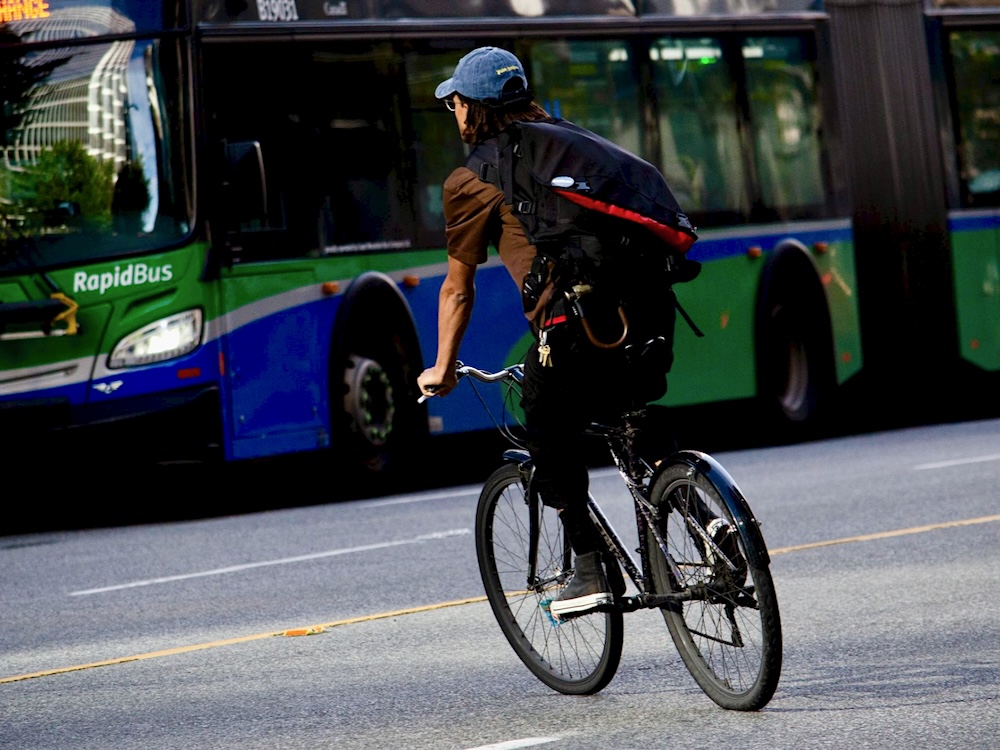
I meet the bicycle courier outside a trust company in Vancouver’s West End. It’s the last day of the month, he notes, while fiddling with the U-lock securing his bike to a parking sign.
That means he’s got deadlines — law firms will be rushing to get last-minute cheques to the bank. He’s got to be at four offices and a bank in the next 30 minutes.
The courier takes a running start, hops onto his bike, drops off the curb and then darts out of sight into an alleyway. It’s 9:28 a.m., I’m less than 10 minutes into shadowing one of Vancouver’s last bike couriers, and he’s already dropped me.
I get on my own bike and take off pedalling.
Forty years ago, hundreds of bicycle couriers traversed the city’s streets, carrying cheques, court filings and needed-it-yesterday documents. Then came the fax machine. And the internet. And e-transfer, Docusign and Uber.
Bike couriering took a dive. In 1998, there were 412 licensed bike couriers in Vancouver. By 2016, according to the city, there were just 82 couriers with licences. Today there are 10 (although any courier will tell you there are at least double that actually working on the streets).
The story starts to feel familiar: technological progress threatening jobs. The adoption of personal computers saw secretaries suffer. A steep decline in letter mail has seen Canada Post employment plummet. Artificial intelligence is threatening a wide range of white-collar workers, including software developers, accountants and customer service representatives.
But a nimble few bike messenger companies have found a way to buck the trend — including Vancouver’s Phantom Couriers, which leverages artificial intelligence, a flexible business model and a lot of hard-earned trust to outcompete the delivery apps. Its founder, Mark Huggan, has adapted a paper-based profession for the digital world.
“I do think it’s a dying, cool business, but I think it’s necessary,” Huggan says.
And at least for now, Phantom is one of the half-dozen companies keeping couriers on Vancouver streets.
That’s why, at 9:28 on a Monday morning, I find myself chasing down Eric, Phantom’s last remaining staff bicycle courier. Gripping my drop bars, I roll into the street and follow him up the alleyway. I’m barely able to catch a glimpse of his rear tire before he turns right onto Thurlow Street.
By the time I catch up, Eric is off his bike and in an elevator. I take a breath next to his bike — a vintage seven-speed GT Terra Karakoram, most likely made in the early to mid-’90s — determined not to lose him again.
Eric is not his real name. The courier asked The Tyee not to share his identity for safety reasons. He’s been threatened by other road users before and says he’s worried about a driver being able to Google him after a road rage incident.
“You make some enemies on the road,” he says. “Bus drivers, taxi drivers. It’s not all a friendly job.”
He’s not the only courier who asks to have their name off the record.
“Don’t put me in the piece,” a veteran courier told me while waiting in a bank line later that day. “I’m a ghost.”
While growing up in Vancouver, Eric worked a series of jobs in kitchens and on film sets. He first started courier work three years ago.
“It’s a good job,” he says. “Of all the jobs in this pay realm, it’s the best I’ve worked.”
The first thing I notice is how Eric remembers nearly everyone’s name. Even when he’s on deadline, Eric checks in with the law office receptionists, bank tellers and mailroom attendants. He sees many of them every day and introduces himself to anyone new.
He remembers details — where their old office was, what they were last chatting about, where they used to work.
It’s partly these relationships that keep the courier business alive. I’m reminded of the previous Wednesday, when I first met Phantom Couriers founder Huggan.
As we walked the two blocks from his office on Granville to Phantom’s shipping centre on Howe Street, three people noticed Huggan and waved: a former courier turned mail carrier, a jewelry shop owner and an active bike messenger.
“I’ve been on Howe Street for 30 years,” Huggan said. “I’ve met people.”
Huggan has been a courier since 1995. He says he still remembers his first trip — a flower delivery. He was hooked. Huggan printed out flyers advertising his services as a bike courier and slid it under as many office doors as he could. He’s been in the industry ever since.
His bike courier service has earned the trust of dozens of law offices downtown. Couriers are frequently entrusted to carry cheques for million-dollar payments, court documents and other important packages. It’s this trust, plus Huggan’s relationships, that keeps Phantom’s cyclists cycling.
Still, demand for courier work has plummeted in the past decade.
At one point, Huggan employed a roster of more than 30 couriers. But offices started adopting new technology, such as online document-signing software and electronic money transfers.
By the time the COVID-19 pandemic reached Vancouver, Huggan had only five couriers on bikes. Now, Eric is his last bike courier.
Huggan believes there will always be demand for some level of bike courier. Law offices still run on paper — and largely trust bicycle couriers to get important cheques and documents to the banks and courts on time.
But to round out the business, Huggan says he has had to become an “entrepreneurial cowboy.”
“We're not sitting around waiting for the next thing to come along,” he says. “We're going to create the next thing.”
Phantom has drastically expanded its services over the past four years. Most recently, the company’s service centre, about a block away from Waterfront Station, started offering luggage storage for tourists who arrive in the city before their hotel check-in time. On the second-last Saturday of August, the company stored more than 275 bags.
About four years ago, Huggan also launched a service that helps people digitize, organize and read their physical mail online. It’s attracted thousands of customers, according to Huggan.
The digital mail service and luggage storage are both substantial earners. But the courier service still brings in the lion’s share of Phantom’s revenue.
Phantom now employs couriers who use cars and trucks across the Lower Mainland, expanding to Nanaimo and Whistler. Phantom has been competitive on prices and offers service on weekends, Huggan says, and the courier service has grown by 250 clients so far this year.
“We’re trying to keep this trajectory,” he says. “You have to grow. Before you die.”
Still, Huggan gets quiet when asked if he would keep running the company if demand for bicycle services disappeared.
“That's something I don’t want to talk about,” he says. “That would be a terrible day.”
The company started using artificial intelligence to keep a competitive edge. Huggan uses it to prioritize his inbox — which might otherwise be a mess of client emails, dispatch requests and internal communications. His company uses AI to generate marketing materials for social media.
And code-generating large language models have helped the company keep its software up to date to outcompete courier apps such as Uber or Dragonfly.
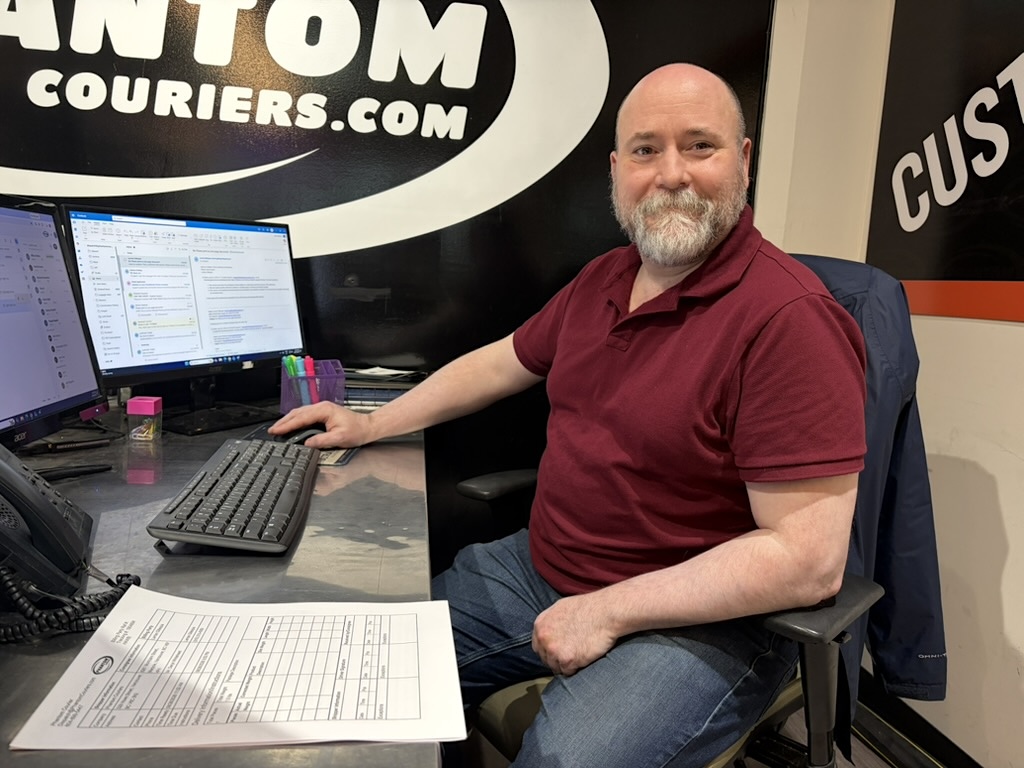
Surrounded by shelves of hard-shell suitcases at the Howe Street shipping centre, Phantom dispatch manager Jeff Teare shows me his monitor setup. On one screen, a queue of client requests sits next to a list of couriers. On the other screen is a map of Vancouver.
Teare still manually dispatches most trips. But an algorithm helps organize deliveries by priority to make sure the couriers can honour their 60- and 30-minute deadlines.
“If you can't be in two places at the same time, tell us,” Huggan says. “That’s basically what a courier does.”
Eric keeps track of trips on an app on his phone that displays each job’s client name, address and how fast they need the trip done. By 10:40, he’s already made 16 stops. All are in the downtown core, where cycling is still the fastest way to get around.
It takes some time to adjust to Eric’s style of riding. He makes quick lane changes and accelerates through yellow lights with his head on a swivel. He knows the patterns of traffic at each intersection, and which alleyways can shave valuable minutes off each trip.
Later that morning, sipping a coffee on the corner of Georgia and Hornby, Eric says his priorities are getting documents to clients on time and keeping himself safe.
He’s got his own system of rules for the road. At red lights, he makes his way up to the front of the intersection where he’s at lower risk of being rear-ended by a distracted driver. If a car is faster, he lets it pass. And if he can make it through a yellow light, he can shave valuable minutes off a delivery.
“It’s about going with the flow of traffic,” Eric explains.
In 2014, The Tyee published anthropologist Gregory Gan’s short documentary about Phantom Couriers.
On 16-millimetre film, Gan portrays a subculture of young, skater-adjacent couriers racing fixed-gear bicycles through busy streets, over bridges and into elevators. The reality of the scene today is a little different.
Fixed-gear bicycles have been largely swapped out for vintage mountain bikes, which are simple to maintain and easy on the knees. The majority of the couriers active in Vancouver have been on the job for decades.
Eric is the exception. The skateboarder turned fixie rider turned courier sports a designer cap, a button-front shirt and cargo pants rolled above the ankle. A black, red-accented bike messenger bag (a style that has largely been co-opted by white-collar bike commuters) rarely leaves his back.
After a couple of hours riding around the city’s downtown core, we run into one of the old guard. Joel worked as a courier for 30 years before leaving the job earlier this year. He declines to share his last name.
“It’s a really cool lifestyle, but it’s not glamorous,” he says.
Cycling from 9 to 5 through the rain, fog and snow takes a toll on the body, Joel says. He watched some career couriers work through injury. Joel himself tore his anterior cruciate ligament and rode despite the pain for three years. He theorizes that his body adapted to the pain. Joel still rides his bike every day.
“Whatever bicycle injuries you had, they always start to flare up if you don’t keep at it,” he says. “You have got to keep cycling every day; otherwise a lot of stuff that your body's been masking will come up.”
Couriers are susceptible to other dangers, too. Joel and Eric both say they have seen messengers lean on substances on the job — although none of the remaining couriers have a habit. The lack of supervision, physical demands and intense deadlines can lead some workers to turn to drug use.
“A lot of bike couriers just self-destruct,” Joel says. “It’s really sad.”
Joel still misses his routine — waking up before his alarm, heading out on the bike and doing his regular morning routes. His favourite part of the job was chatting with receptionists, bank tellers and mailroom attendants as he made his rounds.
“I've had lawyers say they were jealous of what I was doing because I’m getting exercise every day out in the sun,” he says. “Those people are locked in their offices or under mounds of paperwork. But it's like, ‘Let's swap salaries and then we'll talk.’”
WorkBC data shows that on average, couriers in B.C. make $43,990 per year. Hourly pay ranges from minimum wage to $32 per hour. Huggan tells me he pays $30 per hour.
Some earn commission or bonuses based on how many deliveries they complete. Those drivers are often paid by the minute for the time they spend waiting in bank lines, stuck in elevators and waiting for delays.
It’s time for which some gig workers aren’t compensated. Ride-hailing app workers aren’t paid for the time they spend waiting for restaurants. And it adds up.
That Monday, Eric and I spend a total of two hours in banks waiting, either in line to see a teller or while bankers make deposits or certifications.
By mid-afternoon, my legs are cooked. That’s when Eric’s phone pings — we’ve got another 30-minute deadline. We take off pedalling east on West Georgia Street.
The street is on a slight incline — up to a five per cent grade, according to Strava — and filled with cars and buses speeding off the highway out of Stanley Park. The light turns yellow as we approach a cross street.
A bus is turning right, out of the intersection. Meanwhile, a car approaches the intersection from the lane to our left. I hesitate. That’s when I fall behind — Eric checks his shoulder, swerves around the bus and accelerates through the intersection. I put my foot down as the light turns red.
He pedals off up Georgia Street.
The light turns green and I take off up the road. I stand up and push hard, white-knuckling my handlebars. Catching Eric is no easy feat. I’ve got a lighter bike — a 2021 aluminium Cannondale Topstone, built for long distances and fast rides. But Eric cycles 40 hours every week, and for him, traffic is second nature.
I catch up to him waiting at a red light, holding a track stand (when a cyclist balances on their pedals while remaining in place). As soon as the light changes, he speeds off again, reclaiming the gap.
I catch up once more as he’s locking his bike to a railing. He runs into an office building and is back out in less than a minute. We’ve got a new trip — it’s time to grab some documents from a law firm in the financial district and file them at the Supreme Court before it closes in 20 minutes.
Rushes — like the one this afternoon — come often and with irregular frequency. The last of the month is reliably busy. So are Fridays. But deadlines can happen any time.
Just last week, Eric says, he got a 30-minute delivery while waiting in line at the bank. He had to run out of line, hop on his bike and ride around town before coming back to finish his first trip. It’s chaotic, Eric says, but liberating.
“It’s pretty free,” he says. “You’ve got nobody breathing down your neck. That’s the main thing.”
By the end of the day we've completed 45 stops. The farthest was on the western edge of Chinatown. That’s a medium day, Eric says. On busy days, he expects 75 stops (Huggan estimates that would be up to 50 kilometres of pedalling). Slow days are fewer than 40.
In total, according to my watch, we’ve pedalled 28 kilometres and gained 1,127 metres of elevation — all within the downtown core. We part ways outside the Bentall Centre. Eric hops on his bike, drops off the curb, cuts over to an alleyway and rides out of sight.
This story was edited on Monday, Sept. 14 at 9:37 a.m. to correct the identity of Jeff Teare in a photo caption. ![[Tyee]](/design-article.thetyee.ca/ui/img/yellowblob.png)
Read more: Labour + Industry






Tyee Commenting Guidelines
Please note that email notifications for replies are not currently working due to a software issue which may be resolved in a future update.
Comments that violate guidelines risk being deleted, and violations may result in a temporary or permanent user ban. Maintain the spirit of good conversation to stay in the discussion and be patient with moderators. Comments are reviewed regularly but not in real time.
Do:
Do not: