


 SHARE:
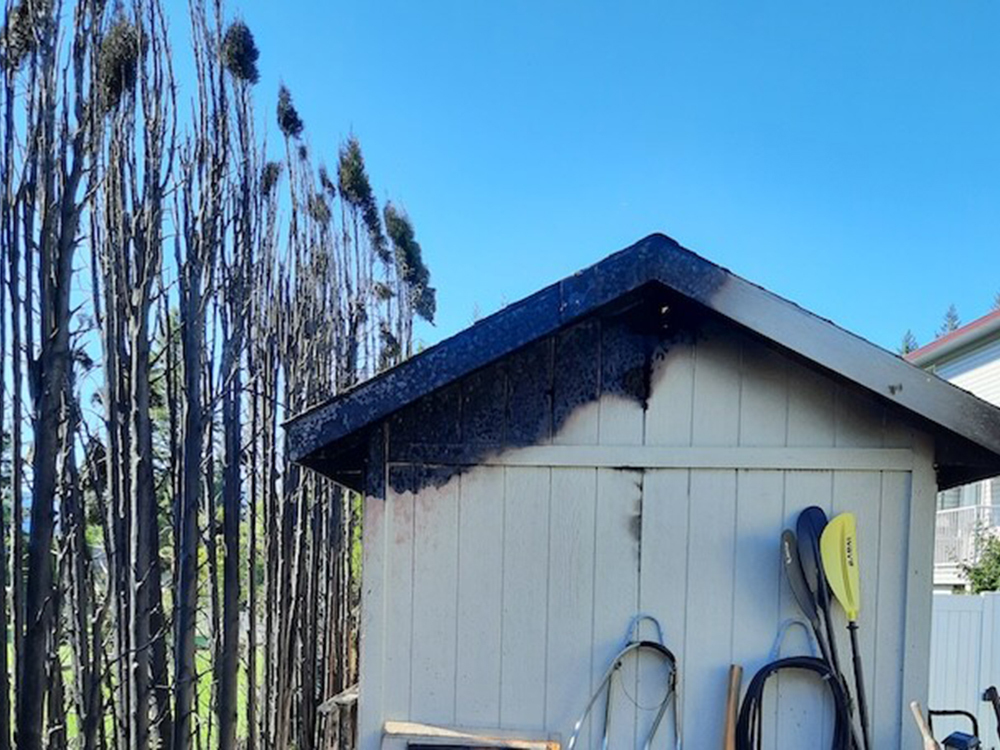
The FireSmart BC program website shows a moderately large single-family home through the eyes of a wildfire. As you move your cursor around, fire follows: flaming debris on the unkempt asphalt roof; blazing patio furniture leaning against the garage; potted cedars scorching the siding.
Cedars have been a popular landscape plant in B.C. yards for decades, says Lori Daniels, a professor in the department of forest and conservation sciences at the University of British Columbia, and the Koerner chair in wildfire coexistence.
Unfortunately, she says, they “go up like a Roman candle.”
As B.C.’s wildfires become more frequent and intense, resulting in evacuations, the loss of homes and businesses, and deaths, experts are encouraging homeowners and developers to remove cedars and junipers, or not plant them at all.
“Cedars are highly flammable when they are dry,” Daniels says. “They retain dead foliage.”
Most cedars contain quite a lot of dry material at their core, Daniels adds, even when they look green on the outside.
“When we're using cedar hedges for privacy, which is why most people have them, they're really dense,” says FireSmart program lead Rachel Woodhurst. “They’re very resinous.”
During wildfires, Daniels says, embers can travel a long distance, up to three kilometres, in high winds. It’s those embers that can set a cedar alight.
And once one cedar catches fire, Woodhurst says, the fire quickly spreads to the whole row.
The cedars then carry the fire from the ground upwards and start throwing off their own embers. The fire can then spread to a home’s siding or roof, and, if hedges are being used like fencing, connecting homes, it can quickly move to a neighbour’s.
A fire in the 800 block of DeHart and Rowcliffe avenues in Kelowna earlier this year offers a dramatic example. In video captured by Cass Hritzuk, published by Castanet and shared below, a massive ball of flames sends sparks high into the night sky as neighbours look on, and one man tries in vain to slow the spread with a garden hose.
Luckily, firefighters who arrived on scene shortly thereafter were able to extinguish the blaze, which damaged a nearby garage.
People were not as lucky during the 2023 McDougall Creek wildfire, which burned 303 structures in and around West Kelowna.
There were “definitely properties with cedar hedges where it contributed to the loss of the homes,” Daniels says.
“It isn’t that fire will come up and consume your home,” Daniels says. Instead, it’s embers. It was embers that were carried over three kilometres, across Lake Okanagan, in 2023.
“We saw it in Jasper, as well,” Daniels says. “It was the embers that came off the fire front and then got carried into the community, and it was the homes that were not fire smart that sadly were most vulnerable.”
FireSmart assessments, rebate programs
Susanna Klassen and Sean Kearney, who own and run the nine-acre Pickle River Farm in Paradise Valley, on the northern Sunshine Coast, had a free FireSmart assessment done after they purchased their property in 2021.
Woodhurst says FireSmart has conducted over 11,000 such assessments since 2021.
“The very highest-order priority, according to his assessment, was to get rid of the very flammable cedars next to the house and the garage,” Klassen says.
The couple had about 60 metres of western red cedar — which had been planted decades earlier to act as a privacy screen from the neighbours next door — to tackle.
Western red cedar is native to B.C. and can often be managed by trimming branches and lifting the crown of the tree over your house, Daniels says.
Klassen and Kearney were aware that a devastatingly massive fire tore through Paradise Valley a century ago.
That history, plus the fact that their cedars were too close together and growing into the power line, and their property includes and borders the forest, made them decide that it was best to remove their hedge and replant it with broadleaf native trees and shrubs.
“We’ve done it in phases,” Klassen said. They started off by removing the portion of the hedge that was growing into the power line.
“The first chunk we took out, we did it ourselves,” Klassen says. “Sean cut them down, and we bought a wood chipper and chipped all the branches.”
In the interim, the couple became parents, ran an egg business and hired outside help for the next two phases.

Today, what used to be an unbroken line of tightly packed western red cedar is a burgeoning native garden: mahonia, ocean spray, flowering red currant, June plum, thimbleberry, Nootka rose, dogwood, mock orange and more.
FireSmart BC offers a comprehensive plant guide highlighting highly flammable trees, shrubs and grasses, and offering replacement suggestions that factor in irrigation requirements and pollinator benefits.
Klassen and Kearney estimate the work, factoring in their own labour, cost about $5,000. They received rebates totalling about $1,000 from FireSmart to offset their costs.
Woodhurst says many communities across the province offer similar rebate programs to help residents tackle FireSmart recommendations. Costs can be a barrier for residents, as can the physical labour necessary to wield a chainsaw, or move branches and brush.
Rossland offers a good example, Woodhurst says. Eligible homeowners can be reimbursed 50 per cent of labour and material costs, up to $1,000, when they implement FireSmart recommendations.
Kamloops’ program is even more targeted: homeowners can receive an incentive between $150 and $800 per household per year to remove cedars and junipers from their properties.
Kathleen Cahoon, FireSmart liaison for the City of Kamloops, says the program received an “overwhelming amount of interest” when it was launched last year. The city gave out $143,400 in rebates, and 264 households participated.
Woodhurst, who lives in Salmon Arm, says her personal favourite cedar replacement is Swedish aspen.
“That's what I have in my yard for privacy screening,” she says. “They were only planted four years ago, and they're already over 30 feet tall, and they are beautiful, and they glisten in the sunlight.”
Working with developers and insurers
Replacing cedars on Pickle River Farm was a “big undertaking,” Klassen says.
Even with incentives, it’s a lot to leave on the shoulders of residents and homeowners.
That’s where working with developers and municipalities comes in, Woodhurst says.
“FireSmart Canada and FireSmart BC are improving our training and our resources for developers and home builders,” she says.
And they’re also working with municipalities to intervene before any more highly flammable trees and shrubs can be planted.
The Squamish-Lillooet Regional District, for example, passed a 2021 bylaw that bans the use of all varieties of cedar, yew and juniper in new landscaping.
Woodhurst says FireSmart BC has also been working with insurance companies to offer financial incentives to implement FireSmart recommendations. BCAA offers a 15 per cent discount on home insurance to homeowners who get a wildfire mitigation assessment.
That’s the carrot, Woodhurst says. But there’s also the stick.
“Down the road,” Daniels says, “we're going to find that if you live in a fire-prone environment, which is most of British Columbia, you're going to need to take some of these actions in order to get insurance.”
Residents in many areas of BC are eligible for free FireSmart assessments. Visit FireSmart BC’s website for more information. ![[Tyee]](/design-article.thetyee.ca/ui/img/yellowblob.png)
Read more: Housing, Environment







Tyee Commenting Guidelines
Please note that email notifications for replies are not currently working due to a software issue which may be resolved in a future update.
Comments that violate guidelines risk being deleted, and violations may result in a temporary or permanent user ban. Maintain the spirit of good conversation to stay in the discussion and be patient with moderators. Comments are reviewed regularly but not in real time.
Do:
Do not: