

 SHARE:
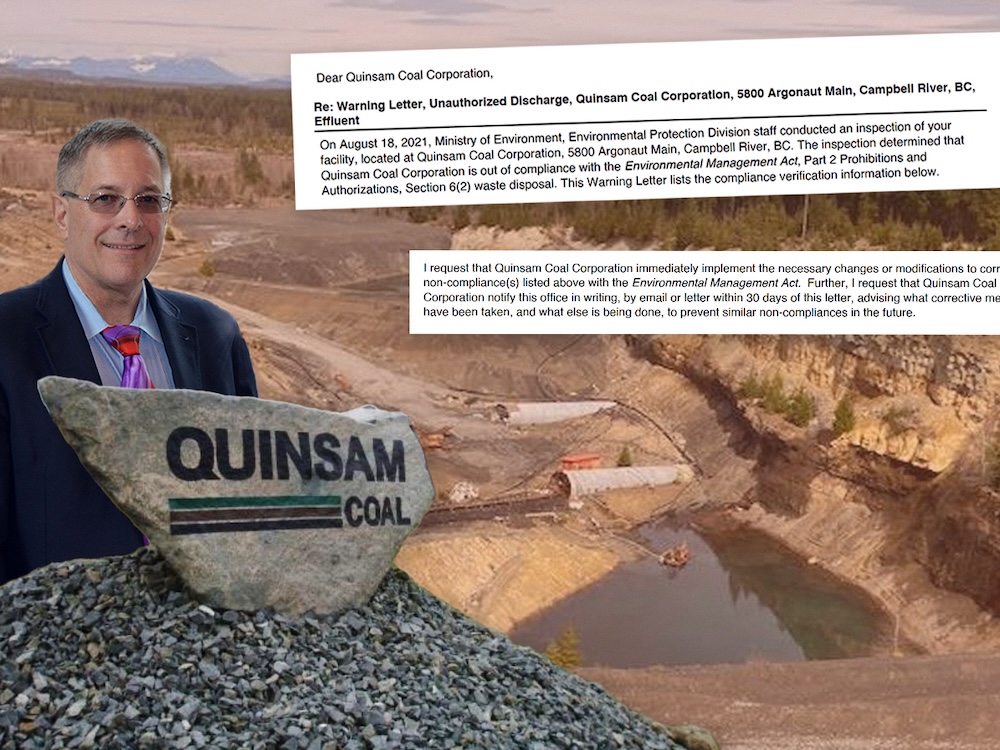
When left unattended, large piles of coal can spontaneously combust, which is what happened on Campbell River’s oceanside loading dock on Sept. 24, 2019.
The coal pile and the mine from which it came had just been abandoned by its owner, Thomas Clarke. A nursing-home owner turned coal magnate, Clarke had developed a reputation for just this kind of disappearing act, having left a trail of bankrupt mines across the United States. Now, as firefighters worked to extinguish the blaze, the Quinsam Coal mine was about to join them.
A half-hour’s drive west of the dock and its burning pile of coal, the mine site was leaking sulphuric acid and arsenic into a salmon-bearing watershed. Investigators warned that accumulating gases underground might explode.
Clarke, meanwhile, was shopping for new coal mines under a new corporate banner. Just days before the fire broke out, he made an offer to buy a coal mine in Wyoming, increasing his bid to “sweeten the pot” to ward off a competitor. He promised to move to the nearby town of Gillette if his bid was successful.
“We want to be good citizens and neighbours,” he told the Wyoming News Exchange.
Clarke is an odd character in the coal industry. He once courted the media, pitching himself as a business-savvy environmentalist with a bold plan to offset his coal mines’ emissions with his own brand of carbon credits. He planned to use the revenues from “green” coal to clean up his growing list of mines.
But by the time his Quinsam mine went bankrupt in 2019, his vision had already begun to crack.
After an unsuccessful attempt to sue Clarke and his affiliates, Quinsam’s cleanup is publicly funded and managed by a court-appointed receiver. The province has spent $25 million so far, but many of the site’s risks remain.
Quinsam’s hidden costs
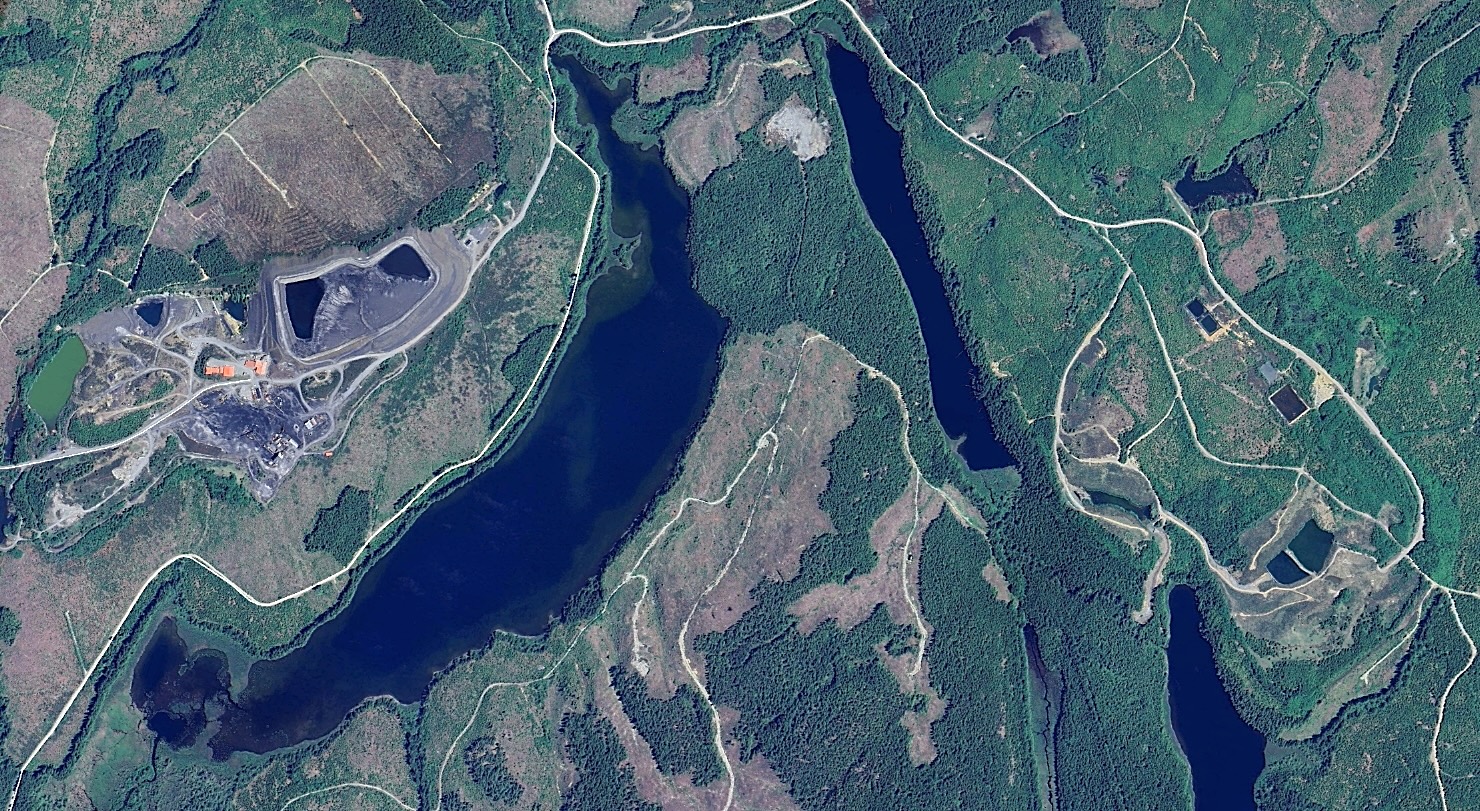
The Quinsam Coal mine sits in the watershed of the Campbell River, dubbed the “salmon capital of the world” for hosting all five species of Pacific salmon. The river and its salmon drew the Wei Wai Kum and We Wai Kai First Nations to the area thousands of years ago, Wei Wai Kum Chief Chris Roberts says. Today, he worries about the mine’s precarious placement alongside the watershed’s main artery.
“It’s right there,” he says. “It’s so close.”
Five years after it was abandoned, inspectors recommended that the receiver be fined for spilling arsenic-contaminated effluent into the fish-bearing Quinsam River. Officers recommended a fine, but it was never levied — perhaps unsurprisingly, because the government would have been paying the fine to itself.
Over the previous 15 years, a different spill leaked at least three billion litres of mine waste into nearby Long Lake. That is the equivalent of an Olympic-sized swimming pool every five days. But in the rain-drenched region of Campbell River, containing that wastewater is no easy feat. One tailings dam regularly exceeds its capacity and is “exhibiting signs of instability.”
Meanwhile, there are signs that heavy metals are now leaching throughout the site: groundwater tests have shown arsenic up to 17 times over the water quality guidelines.
The BC NDP has emphasized the province’s mining potential as global trade tensions increase and other resource sectors, like forestry, contract. Under its new “Look West” strategy, the province plans to expedite four new mines or expansions in the next eight years.
But Quinsam’s story points to the hidden costs of uncareful expansion. Quinsam is one of seven major mines in the province that have gone bankrupt, and 2,000 other, smaller mines have been abandoned.
Having tracked Clarke and other mine owners’ behaviour for years, U.S. coal researcher Erin Savage sees Quinsam’s story as a pattern, not an outlier.
“Executives are trying to squeeze the last dollars they can out of a dying industry and then not be the ones left holding the mine when it has not been reclaimed,” she told The Tyee.

Sulphur and swamps
Around 80 million years ago, Campbell River and its surroundings were a swampy marshland full of peat and plant matter, laced with a sulphur-rich helping of sea water. After thousands of years buried beneath rock and sand, the peat bogs hardened into sulphur-rich coal, which can wreak various kinds of havoc above land.
When burned, sulphuric coal billows black plumes of smoke carrying the distinct smell of rotten eggs — generally unattractive qualities that price it at a discount to purer and less-polluting coal varieties. Quinsam’s coal was among the most sulphuric in the province.
When exposed to oxygen and water, sulphur turns into acid, leaching otherwise-fixed metals from the surrounding rocks. In Quinsam’s case, those rocks include high concentrations of arsenic.
Quinsam’s location on B.C.’s rain-drenched coast completed a trifecta of risky conditions. Clouds overhead and underground aquifers provided plenty of opportunities to leach the sulphur and arsenic stored in the nearby rocks.
“The more water carrying oxygen down into the rock, the more drainage problems you get,” said John Steen, an associate professor in the University of British Columbia’s Norman B. Keevil Institute of Mining Engineering.
Problems extend to the mine’s airways: Quinsam’s sulphuric coal is considered “high volatile,” meaning its pulverized dust has a tendency to explode.
Added together, Quinsam’s characteristics raised red flags for the community when the mine was first proposed in the 1980s.
“The public is overwhelmingly opposed to the construction of that coal mine,” former MLA Colin Gabelmann said in the B.C. legislature in 1983. “It is not possible to develop a coal mine in that particularly vulnerable, high-rainfall, salmon-producing area — period.”
Yet the project went ahead anyway, starting as an open-pit mine in 1987, before moving its operations underground in 1994. Gabelmann’s warnings bore out, and the formerly pristine watershed soon exceeded its permitted contaminant levels. The province responded by upping the mine’s permitted thresholds four years after it opened. The mine took advantage of the leeway by increasing its production as coal prices boomed in the 2000s, which saw more growth in demand for coal than the previous four decades combined.
To catch the upswing, Dutch commodities trading giant Vitol acquired Quinsam Coal in 2008. By 2010, the mine had produced 10 million tonnes of coal in its lifetime, with 40 million tonnes still in nearby reserves. To access the coal, the company applied for an expansion permit to exploit a new deposit, 3.5 kilometres south of its original mines, with even more sulphur and metals like arsenic.
The expansion project faced widespread opposition, including from experts like William Cullen, a UBC professor who had been tracking arsenic and other pollution from the Quinsam mine. He warned the expansion could exacerbate already-brewing problems, including a known leak of arsenic and acid-laden effluent into nearby Long Lake. He noted that the company had said little about how it would address the risks of leaking contaminants post-closure.
“At the moment, they can't control what's happening around this particular area, so there's no indication really that they will be able to do so in the future,” he told CBC in 2010.
Two years later, B.C.’s then-minister of energy and mines, Rich Coleman, travelled to Campbell River to announce the expansion would go ahead. The company assured concerned residents it had “taken corrective action” to address the site’s contamination.
By 2016, coal prices had nosedived again, and Vitol halted Quinsam’s production.
The mine’s then-chief executive officer, David Turnbull, said at the time that “there may be certain parties” willing to acquire the mine.
Before long, Thomas Clarke would prove him right.
Big promises
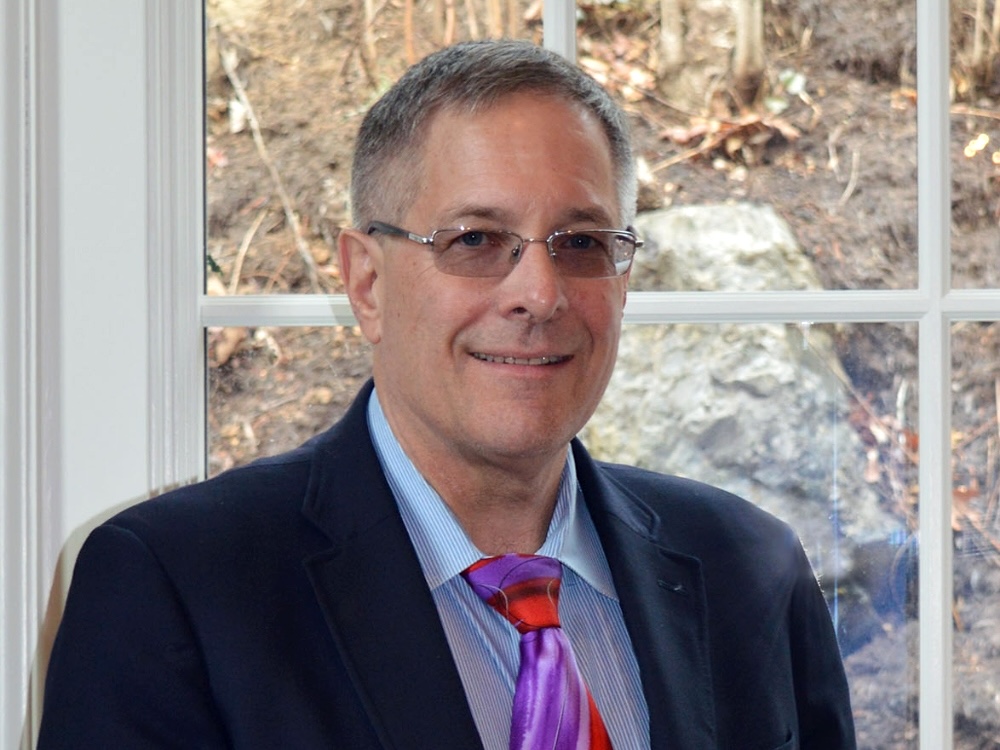
Wearing an electric red and purple tie and an ill-fitting suit, Clarke paced a dark lecture hall, delivering a PowerPoint presentation to a class of business students in Virginia in the spring of 2015.
Clarke, students learned, was a big-picture guy.
“I think business can act in moral and ethical ways that change our world,” he said, as he clicked through a chain of seemingly disjointed business exploits.
Clarke had purchased dozens of beleaguered nursing homes, started an in-home health-care program and, more recently, acquired an indebted Virginia monument called Natural Bridge, along with its hotels and gift shops. He said he had bought an ecological conservancy in Belize that was about to be sold and converted to farmland.
Clarke’s thesis was that by tweaking his properties’ business models and creating various side enterprises, he could turn around his flailing entities. All it would take was some ingenuity and unbridled optimism.
During the hour-long presentation and in the question-and-answer period that followed, the students got a live demo of Clarke’s approach. After one student made a business pitch, Clarke responded, “I know a guy who spent one hour with President Bill Clinton,” as if he had the former president on speed dial. “I’ll give you my card. We’ll get that idea to Bill Clinton.”
Less sunny parts of Clarke’s history went unmentioned. His nursing-home company, Lenox Healthcare, had gone bankrupt. Natural Bridge was deep in debt and would eventually be repossessed. He had been fired from his old job at a health-care company after suspicious money transactions, though Clarke had denied his involvement.
Undeterred, Clarke was about to set his sights on a newly distressed target: coal.
By 2015, coal prices were in chronic decline. Between 2012 and 2016, an average of one U.S. coal company went broke every month.
But major coal companies like Arch Coal and Peabody adopted another approach. They had used the restructuring tools of bankruptcy law to hive off their least valuable and most costly mines to reclaim, and then sold them to a new startup called Patriot Coal. Peabody’s CEO at the time described the move as a “key element in transforming our business portfolio.” Unions described the company as “created to fail.”
Before long, Patriot was bankrupt and looking for another company to shoulder its most troubled mines.
Clarke was happy to oblige, taking on what the West Virginia Department of Environmental Protection called a “carcass” of Patriot’s remaining assets.
But Clarke had a plan: he would take over Patriot’s mines and charge a premium for the last dregs of their coal using a self-styled carbon credit scheme propped up by tree planting in the United States and carbon credits from his conservancy in Belize. In theory, he would use the proceeds from his green-branded coal to reclaim his mines.
“I am the guy that is trying to work from within,” Clarke told the New York Times in 2016. “The goal is to have a big enough footprint to drive our environmental philosophy home.”
Accordingly, Clarke adopted a high-volume approach, eventually buying more than 100 mines across the United States. His method had detractors, including West Virginia’s environmental department, which warned that Clarke’s company had “no experience in operating a coal company or performing boots-on-the-ground reclamation and water treatment.”
“He had made pledges to reclaim all of those sites [and] had virtually no capital to do it, ” said Jim Kotcon, the conservation chair of the Sierra Club’s West Virginia chapter.
Clarke soon set his sights on B.C., scooping up the environmental liabilities for three Tumbler Ridge-area mines — Brule, Wolverine and Quintette — from the bankrupt Walter Energy under a new company name, Conuma Resources.
In March 2017, coal companies and their lawyers descended on Florida’s Mar-a-Lago Club for a cocktail reception at the year’s Distressed Investing Summit.
After a day of panel discussions (including one on “Making America Great Again, Through Turnarounds”), Patriot’s progenitor, Arch Coal, won the “Restructuring Deal of the Year” award for emerging from bankruptcy having shed $6 billion in debt. Clarke’s Canada exploits were celebrated, too, winning the “Cross-Border Turnaround of the Year” award for his coal buyouts in northeastern B.C.
Two months later, Clarke and one of Patriot’s former vice-presidents, Charles Ebetino, bought the Quinsam mine on Vancouver Island. According to the province, Clarke and Ebetino co-owned Quinsam through two distinct companies, though the precise ownership structure is murky — Ebetino’s company was called ENCECo, though U.S. documents suggest it was also operated as a spinoff of a company controlled by Clarke.
Clarke’s fall
After running the mine for two years, Clarke and Ebetino sold off Quinsam’s entire coal stockpile in 2019.
The sale was insufficient to pay down a $3-million loan that ENCECo had given the mine just a month before. Yet ENCECo demanded full repayment of the loan, plunging Quinsam Coal into bankruptcy.
Investigators soon discovered that Clarke and Ebetino had not reclaimed the mine, nor had they made a plan to do so. Instead, the site was in disarray, with large piles of acid-leaching waste rock sitting open to the elements. The coal pile on the dock was left untended amid negotiations over the future of Quinsam and its debts. It would soon catch on fire.
Clarke’s record of bankrupting coal companies had begun to catch up with him.
Down south, his West Virginia coal mines bought out from Patriot Coal had racked up 160 violation notices and 118 orders to stop polluting, none of which Clarke successfully addressed. One mine in particular sat next to a town’s drinking water, requiring $900,000 annually for water treatment. A few months after Clarke abandoned Quinsam, the company he launched to hold Patriot’s mines was also bankrupt.
And as in B.C., taxpayers were left on the hook. Clarke’s Virginia mines were so numerous that declaring them all bankrupt could collapse the state’s orphaned-mine fund.
“There were literally dozens of them,” Kotcon said. Having “lost faith” in Clarke’s company to manage its affairs, the state seized the mines and publicly funded a special receivership to start cleaning them up.
Savage and her environmental colleagues had long harboured doubts that Clarke’s business model — using carbon credits to boost profits on otherwise low-value coal — would work out.
“We’re like, ‘We’re missing something here, or this doesn't actually work,’” she said.
Regulators required no such carbon credits, and it was unlikely that Clarke was ever equipped to generate them at scale. It turns out that he seems to have never owned the conservancy in Belize, and that his other tree-planting efforts resulted in a fraction of what he had promised.
Others alleged that Clarke was more than just a misguided dreamer.
In a lawsuit, coal company Cleveland-Cliffs accused Clarke of engaging in a “fraudulent scheme” that “comes from a playbook he had developed over the course of his career.”
They alleged that Clarke would acquire companies, saddle them with debt, treat the indebted company as an “ATM” for his interests and leave “the former entity in ruins or bankruptcy.” In its lawsuit, the state of Virginia accused Clarke of similar behaviour.
Among Cleveland’s evidence was an email sent from Clarke to his affiliates that described one such loan as “an amazing BLESSING... so that we can all pay down our debt... both corporately and personally.”
Cleveland’s case was dismissed in 2018 when the judge deemed the court did not have the proper jurisdiction to rule.
Since then, the number of lawsuits against Clarke and his various entities has metastasized. He has been sued by lawyers, regulators, environmental organizations, a banker and a cleanup company for various failures to pay his debts. Some cases were settled out of court, but as with the province of B.C.’s conundrum, some plaintiffs were unable to collect on their debts after Clarke’s various corporate entities went bankrupt.
Some of Clarke’s creditors had a secret weapon: their contracts required Clarke to sign personal guarantees. In one such case, Clarke was required to pay a debt from the profits of his still-running northern B.C. coal company, Conuma Resources.
Most recently, Clarke and his wife, Ana Clarke, were ordered to pay back $47 million for debts related to an ill-fated enterprise promising to clean up and decommission offshore oil wells in the Gulf of Mexico, which have now been abandoned and are contributing to the mounting crises in the ocean area that now holds more than 14,000 unplugged wells. The case is still awaiting trial. Meanwhile, new lawsuits continue to accumulate related to Clarke’s offshore oil wells, including one that has now toppled over.
Thomas Clarke did not respond to The Tyee’s attempts to contact him by email and through his most recent legal representation. Charles Ebetino also did not respond to The Tyee’s request for comment through LinkedIn.
‘Sometimes you’ve got to face the music’
Clarke’s outsider status in the coal industry and his tendency towards the grandiose make him an interesting case study, Savage said. But, she continued, “in a lot of ways, he’s not unique.”
“He did what everyone's doing,” she said, “and they're doing it because the regulators allowed it.”
Bankruptcy law and its loopholes play an established role in coal’s corporate ecosystem.
A 2019 study found that almost half the coal produced in the United States was being mined by companies that have recently gone bankrupt. Often, these companies rely on a familiar playbook provided by bankruptcy laws that allow companies to liquidate and sever their still-valuable assets from the ones with little to sell and lots of mine to reclaim. Their secured funders, often private equity firms, emerge with a new, debt-free company, and the public pays for the cleanup work, if it happens.
“Unfortunately, this is a pattern that is repeated and recognized across the mining industry,” said Jamie Kneen, Canada program lead with Mining Watch Canada. “A big mining company operates a mine, and then it's not so profitable anymore, so they offload it to whoever.”
“Often those folks will operate it as well, and they’re happy to get the crumbs.”
In Canada, a landmark 2019 Supreme Court decision — Orphan Well Association v. Grant Thornton Ltd., or Redwater for short — began to patch that loophole. The court prioritized the public regulator’s cleanup costs over the interests of a bankrupt company’s creditors.
Taking a cue from that case, B.C. sued Clarke and his affiliates on similar grounds. The province lost, in part, because of gaps in its mining laws.
When asked by The Tyee how it plans to avoid being saddled with bankrupt mines’ cleanup needs in the future, a spokesperson for B.C.’s Ministry of Mining and Critical Minerals said the province undertakes a “comprehensive review” to determine if new companies are fit to take on a mining permit.
And yet its recent attempts to secure a new buyer at Quinsam suggest that assessment may fall short.
The province told Clarke and his affiliates that it wouldn’t appeal the judge’s ruling in Clarke’s favour if he helped find a buyer for the mine. Clarke obliged by introducing another now-defunct company, Sovereign Mining Inc., to the mine. Sovereign then made a bid. But that bid came with several concessions, said Chief Roberts, who, along with We Wai Kai Chief Ronnie Chickite, was involved in discussions about the mine’s future at the time.
“It was a hard no,” said Roberts about his response to the province’s interest in accepting the bid, citing concerns about the watershed and the climate. “Sometimes you’ve got to face the music.”
In the end, the province followed the First Nations’ guidance, and the bid didn’t go through. But in the current economic climate, Roberts worries that the nations might have faced greater pressure from the province to accept the deal.
In the event that companies do go bankrupt, B.C. requires companies to acquire bonding insurance that would compensate for reclamation costs.
In an emailed statement to The Tyee, Minister of Mining and Critical Minerals Jagrup Brar pointed to recent improvements to the bonding policy, noting that the province now considers 95 per cent of mines’ cleanup work to be insured, an improvement from 2017, when less than half of mines’ cleanup obligations were insured.
“We are continuing work to get to 100 per cent,” he said.
But Quinsam offers another cautionary tale. When the mine went bankrupt in 2019, its $7-million insurance package was considered sufficient to reclaim the site. After Clarke’s company abandoned the site, the appointed trustee, PricewaterhouseCoopers, quickly determined that the bond would likely fall at least $5 million short. Now, six years later, the province expects it will need to spend $35 million just to address the highest-risk issues.
“These bonds need to be bigger,” Chickite said. “There’s no way this should happen again for anybody.”
The spills continue
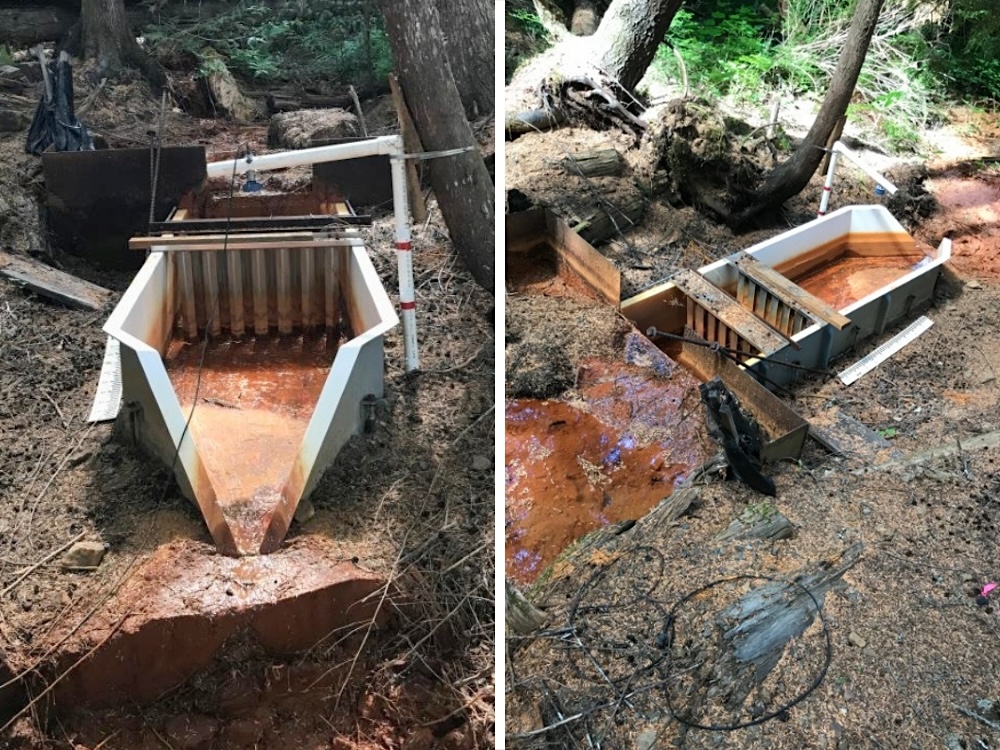
At the Quinsam Coal mine, stream beds tinted like Orange Crush hint at the acid and metals leaching into Long Lake for more than a decade. Another spill identified in 2021 flows directly into the Quinsam River, depositing effluent containing arsenic levels between eight and 18 times the province’s water quality guidelines.
Acid mine drainage is a one-way street. After acid-generating rocks have eaten through their neutralizing elements, there’s no going back, said Barb Riordan, a biologist and president of the Mid Vancouver Island Habitat Enhancement Society.
“There’s kind of a deadline on that material,” she said. “It’s necessary to catch it beforehand.”
Treating and containing toxic water in a rainy place like Campbell River brings its own challenges, Riordan said. At Quinsam, tailings dams often exceed their capacity, and one is deemed unstable.
Sites with acid-generating rock will likely require perpetual treatment and monitoring, but provincial officials have yet to fully factor that into their bonding requirements, said Simon Wiebe, a geologist and mining impacts policy lead at Wildsight. Wiebe estimates that B.C.’s system gives mining companies a 60 per cent discount on their water treatment costs over a 100-year time frame. And after that, it is up to the public to address any additional pollution.
If Quinsam’s story is any indication, the province could again be saddled with its various quagmires the next time a mine goes bankrupt. Quinsam’s inspectors discovered a plethora of long-term blind spots surrounding its operations, including that the province doesn’t have copies of the mine’s original designs for some treatment facilities and tailings ponds, leaving officials unable to determine whether they’re working as intended.
And there are signs that Quinsam soon could be joined by other disappearing acts.
Many mines in B.C. are in a limbo state known as “care and maintenance,” which allows mines to sit, unreclaimed, sometimes for decades. As the years wind on, so does the risk of default.
Three of those stalled mines are owned by Clarke’s own company, Conuma Resources, which recently dodged bankruptcy by defaulting on some of its loans. S&P views its financial prospects as “unsustainable.” The company was recently charged $40,000 for more than 400 violations of the Environmental Management Act.
The company did not respond to The Tyee’s request for comment on whether Clarke remains an owner of the company, nor did the Ministry of Mining and Critical Minerals.
Meanwhile, the rain-drenched Campbell River continues to face the consequences of Clarke’s abandonment. The receiver recently indicated that continual oversight and maintenance of the site will be required.
With the company’s insurance long since exhausted, the province currently pays a receiver $3.6 million per year for maintenance costs, an expense it hopes to reduce under its own management. Yet progress appears to be slow. “Known groundwater seeps” of toxic effluent continue to leak into the watershed. The receiver has recently installed a “passive” system that will discharge some mine water directly into the Quinsam River, and testing is ongoing. It remains unclear whether the system will succeed in ensuring the water falls within quality guidelines.
As the site sits open in his nation’s territory, Chief Chickite is watching for signs of change.
Closure work so far “was really more of a band-aid,” he said, and the province’s once-monthly meetings about the closure work have disappeared.
“All of a sudden it's a low priority,” he says. “To me, this is not a low priority.”
“We don't want somebody just to come in, make their money and then bounce.” ![[Tyee]](/design-article.thetyee.ca/ui/img/yellowblob.png)
Read more: Energy, Labour + Industry, Environment






Tyee Commenting Guidelines
Please note that email notifications for replies are not currently working due to a software issue which may be resolved in a future update.
Comments that violate guidelines risk being deleted, and violations may result in a temporary or permanent user ban. Maintain the spirit of good conversation to stay in the discussion and be patient with moderators. Comments are reviewed regularly but not in real time.
Do:
Do not: