


 SHARE:
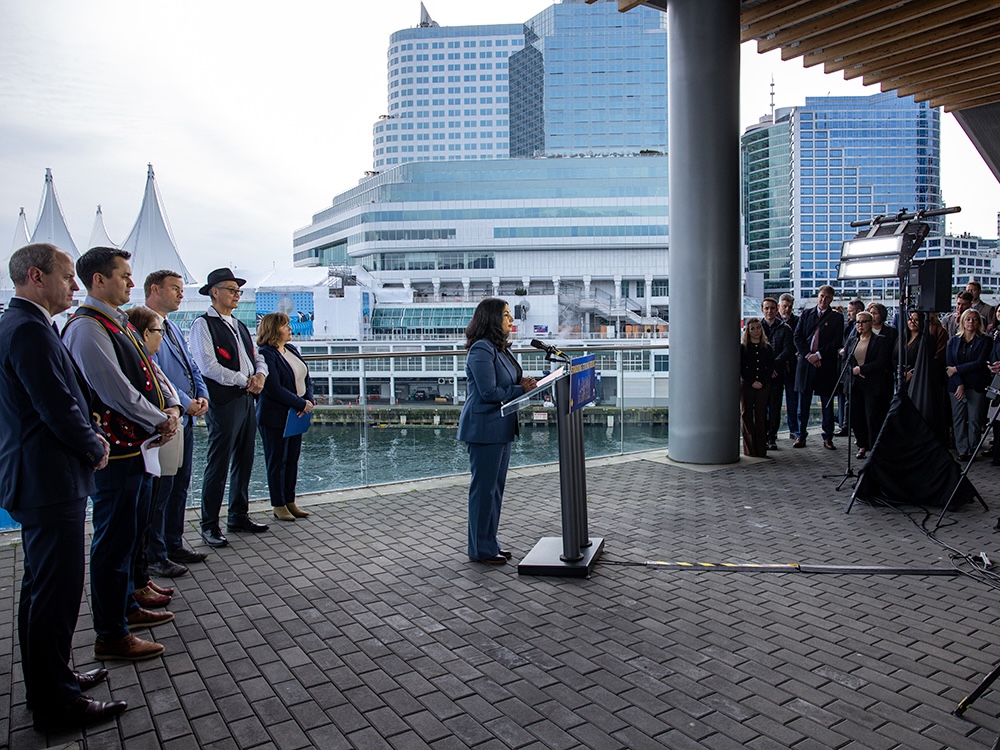
B.C. Attorney General Niki Sharma declared Tuesday a “promising day” for reconciliation, as the province and the Tahltan Central Government announced they have jointly approved plans to reopen the Eskay Creek gold and silver mine in northern B.C.
It was also a told-you-so moment for the governing New Democrats, who have faced political backlash over efforts to sign agreements that give First Nations equal say over resource development on their traditional territories.
The Eskay Creek revitalization project is the first to receive approval after following a collaborative decision-making process under Section 7 of B.C.’s Declaration on the Rights of Indigenous Peoples Act, or DRIPA. The section allows the provincial government to sign agreements that give First Nations equal decision-making power over industrial projects on their traditional lands.
The Eskay Creek mine is located 80 kilometres north of Stewart in an area known as B.C.’s mineral-rich Golden Triangle. Skeena Gold + Silver plans to reopen the site, which previously operated as an underground mine from 1994 to 2008. The mine is expected to create 1,000 construction jobs and more than 770 ongoing jobs, according to the province.
Sharma, who was acting as deputy premier at the announcement in Vancouver, described the approval as a “historic milestone.”
“A respectful collaboration has brought us to this first-ever consent-based agreement,” she said.
Sharma also took aim at political opponents who have criticized consent agreements with First Nations, which she described as curbing conflicts and keeping disputes out of the courts.
“The voices of divisiveness seek to muddy the waters with prejudice and misinformation,” Sharma said. “They seek to divide us for partisan reasons. They are not to be trusted. Respecting First Nations’ self-government leads to clarity, shared prosperity and a better future for all. This is a perfect example of what we can accomplish together.”
The announcement comes amid mounting calls from the Opposition Conservative Party of BC to repeal DRIPA — and plans by the provincial government to amend the groundbreaking legislation. Plans to change DRIPA follow two recent court decisions that confirmed First Nations’ land rights and, in one case, affirmed that DRIPA is legally enforceable.
In 2019, B.C. became the first province in Canada to adopt a version of the United Nations Declaration on the Rights of Indigenous Peoples when legislators unanimously passed DRIPA.

In 2022, the province signed its first agreement under DRIPA Section 7 when it agreed to jointly review the Eskay Creek project with the Tahltan Nation. The following year, the governments signed a similar agreement, which also gives the Tahltan equal decision-making powers over the expansion of the Red Chris copper-gold mine.
So far, they are the only Section 7 agreements signed under the Environmental Assessment Act. The province and ʼNa̱mǥis First Nation also recently signed a joint decision-making agreement to address logging plans on the nation’s territory.
Both Eskay Creek and Red Chris are located on Tahltan traditional territory, which encompasses more than 95,000 square kilometres in northwest B.C. The joint decision-making came after years of conflict over resource extraction in the region, including plans by Royal Dutch Shell to drill for coal-bed methane in an area known as the Sacred Headwaters. Those plans were later abandoned.
The provincial government has touted Section 7 agreements as a way to provide certainty for businesses looking to invest.
When the province rolled out its first Section 7 agreement with the Tahltan in 2022, the Association for Mineral Exploration British Columbia, or AME, described it as a “meaningful step toward reconciliation.”
Jill Budelli, who was at the time AME board chair, wrote in the organization’s 2022 annual report that the agreement provided “clarity and predictability for Skeena Resources’ Eskay Creek Revitalization Project and highlights the critical role mineral exploration and development play in advancing reconciliation in B.C.”
But just months after B.C. signed its second agreement with the Tahltan in late 2023, public support for consent-based decision-making began to shift. Opposition politicians have begun arguing that DRIPA is reducing, rather than improving, business certainty.
In early 2024, opposition MLAs loudly criticized the province’s plans to amend B.C.’s Land Act and add wording allowing it to “negotiate and enter into an agreement with an Indigenous governing body” — something it was already doing with its agreements with the Tahltan.
That February, BC United Leader Kevin Falcon wrote that the proposed changes would give “veto power” over most of B.C.’s land to “five per cent of the population.” Conservative Party of BC Leader John Rustad, who had voted in favour of the legislation when it was passed, said DRIPA should be repealed altogether.
Meanwhile, BC Green MLA Adam Olsen, a member of the Tsartlip First Nation, called on the politicians to “stop using First Nations people as a political football.”
Weeks later, the government abandoned its plans to amend the Land Act. Though Rustad and Falcon are no longer opposition leaders, the rhetoric has stuck. Olsen has since left politics.
B.C. Conservatives have continued to call for DRIPA to be repealed, and Indigenous relations critic Scott McInnis recently described ongoing work on Section 7 agreements as “Land Act reform by stealth.”
Provincial government support for DRIPA also appears to be softening following two recent court decisions upholding Indigenous rights.
In December, the B.C. Court of Appeal determined that the province’s mineral-staking laws conflict with its DRIPA-mandated duty to consult the Gitxaała and Ehattesaht First Nations on mining proposed for their territories. The court determined that B.C.’s Mineral Tenure Act is “inconsistent” with DRIPA and that DRIPA is enforceable by law.
Premier David Eby has now promised to amend the DRIPA legislation this spring.
In a Jan. 13 letter to Eby, the Association for Mineral Exploration called for “substantive amendments” to the legislation.
“Under DRIPA, decisions and legislative changes have been developed in secret and, once unveiled, provide little to no benefit to mineral exploration,” the mining advocacy group said. “The result has been increased delay and confusion.”
The organization added that decision-making had slowed as a result of “consent seeking decision making on even small permits.”
AME declined to comment on its recent criticism of DRIPA or offer reflections on the shared decision-making process for Eskay Creek.

In announcing Eskay Creek’s approval, Skeena Gold + Silver chief financial officer Andrew MacRitchie said the company was pleased to have been part of B.C.’s first consent-based decision-making agreement.
He called it a “significant milestone.”
“The level of involvement of a First Nation in an environmental assessment certificate is unparalleled anywhere, and this process establishes a new benchmark for other projects to follow,” he said.
Asked about her government’s plans to amend DRIPA, Sharma said the province is considering changes related to the courts’ oversight of the legislation.
“They won’t be about stepping back from DRIPA. They will be about unlocking the potential of DRIPA without leading us back to the court,” she said.
The province continues to work with other First Nations on Section 7 agreements for “various projects,” Sharma said.
Asked how many agreements are currently under development, Sharma said she couldn’t immediately provide a number. A provincial spokesperson later provided a link to a website that shows B.C. is negotiating an agreement with the Tahltan over the Galore Creek gold and copper mine. The province also signed an order-in-council last year authorizing it to enter into Section 7 agreements with the Tŝilhqot'in National Government over mining on its territory.

In December, Tahltan Nation members voted in favour of signing an impact benefits agreement with Eskay Creek parent company Skeena Gold + Silver. Three-quarters of 1,753 voters endorsed the agreement, which included a $40-million “upfront payment” to be distributed among nation members this year in payments equalling about $10,000.
Tahltan Central Government president Kerry Carlick said the completion of the first Section 7 agreement “represents a major shift” in Indigenous relations and that the outcome “shows what is possible when we work together, when relationships are built on trust, accountability and mutual respect.”
Asked about ongoing discussions with Red Chris mine owner Newmont Corp., Carlick said the review is still in its “early stages” as the nation has been focused on Eskay Creek.
“This process right here was very consuming and took up a lot of our capacity. Newmont is very much next on deck,” he said. “I know they’ve been very patient as we’ve been going through this process.”
Both Eskay Creek and Red Chris are on a list of 18 projects that the B.C. government intends to fast-track in response to the threat of U.S. tariffs.
On Monday the provincial government also announced it will cap the length of time it takes to get new mines approved in B.C. That promise comes with a $3-million investment into expediting mining authorizations and “fixed permitting timelines” aimed at keeping processing for new exploration permits to between 40 and 140 days.
But at Tuesday’s announcement, Indigenous Relations and Reconciliation Minister Spencer Chandra Herbert stressed the importance of B.C.’s relationship with the Tahltan Nation — and the time those relationships take to build.
“Doing the work — just as Skeena Gold has done, just as the Tahltan have done, just as British Columbia has done — takes time at the front end, but then everything goes way better because you have a good relationship,” he said. “That, to me, is one of the most exciting things: the trusting relationships that we've built together.” ![[Tyee]](/design-article.thetyee.ca/ui/img/yellowblob.png)
Read more: Indigenous, BC Politics












Notice about commenting changes
The Tyee’s commenting system will be moving to a new platform on Nov. 12. If you’re already a Tyee commenter you must register with the new system on or after Nov. 12 with your preferred username.More information can be found here.