

 SHARE:
The wharf was packed.
The Canadian flag fluttered in the breeze coming off the ocean. Beneath the Maple Leaf waved the Stars and Stripes, next to the flag of Lunenburg, Nova Scotia. The July sun blazed down on the crowd as everyone pressed as close as they could get to dockside.
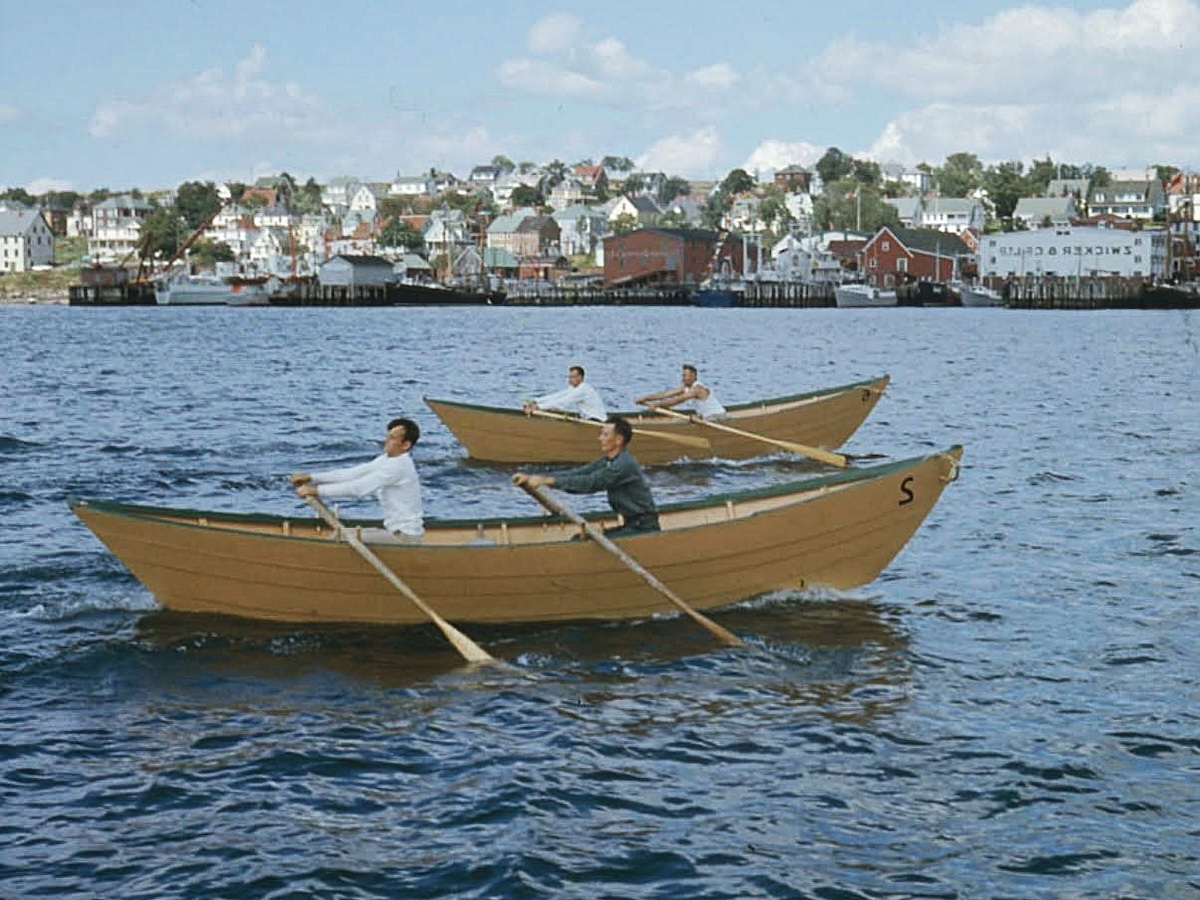
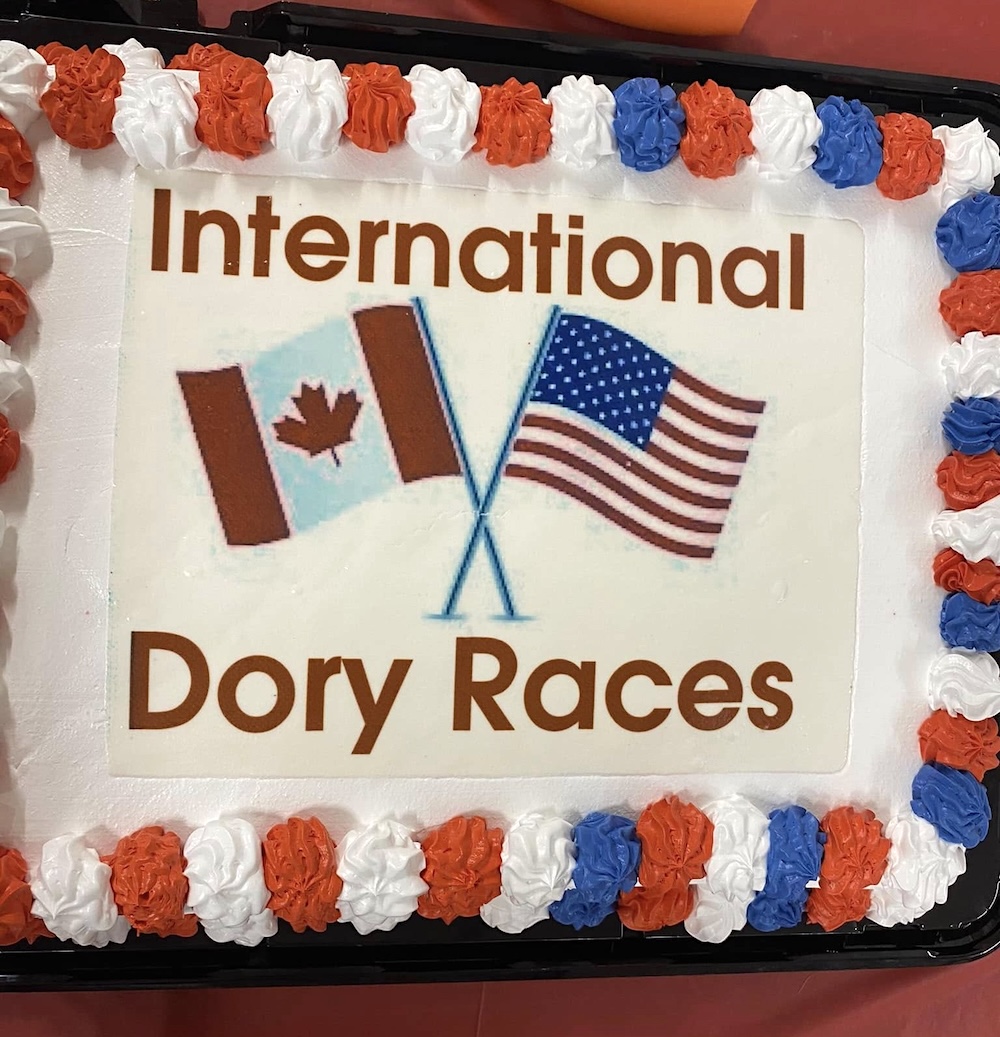
It was a special day on Lunenburg Harbour — the annual International Dory Races between Canada and the United States.
You may see a car race, a horse race or even a dogsled race in many places across Canada. But here, where a legendary 21-foot open boat is so tied to the fishery, the competition is all about the muscle and mind of humans pulling against the power of the sea.
Spectators thronged to watch teams of men and women race one another over a course a little over a mile long. On this day, the ocean is reasonably calm, unlike the boisterous fans who have come to cheer on their countries.
The event features six heats. There are separate teams for juniors, men, women, mixed, women over 50 and men over 50.
Regardless of the category, it goes without saying that the contestants have to be in good shape. Two rowers share the task, one in the stern, the other in the middle of each dory.
The event has its origins in a barroom debate over shots of rum in Gloucester, Massachusetts, in 1951. The issue under discussion was which country had the best rowers.
Tom Frontiero of Gloucester said the Americans did. Lloyd Heisler from Mahone Bay, Nova Scotia, said Canadians did.
The two fishing towns came up with a way to settle the issue. They would stage a dory race.
Canada won the inaugural contest. Seventy-five years later, the tradition continues with two summer races — one in Gloucester and one in Lunenburg.
Although the dory race is well worth seeing on its own, I had another reason for attending the event. How would the Canadian fans interact with their American counterparts?
Under normal circumstances, that would not be a concern. But these are not normal times.
Waves of issues
There are contentious issues between the countries. Potentially one of the biggest? The United States disputes Canada’s sovereign claim to the Northwest Passage. Canada insists that the United States seek its permission to navigate its northern territorial waters and abide by Canadian laws.
The United States rejects that claim, arguing that its navy can freely roam Arctic waters because they are an international strait.
In a move that some observers see as ominous, the United States has just concluded a $6.8-billion deal with Finland to build 11 icebreakers. They are clearly not headed for Mississippi.
While Americans may not appreciate Canada’s territorial claims in the Far North, Canadians are irked by the bullying ways of President Donald Trump.
Trump not only doesn’t respect Canada’s sovereignty, but repeatedly declares his desire to annex this country. And he did it to our prime minister’s face. His illegal and punitive tariffs against Canada speak not of friendship, but of the desire to inflict pain while making profit.
And then there was Trump’s deplorable stance on the Gordie Howe International Bridge linking Detroit and Windsor. Trump not only refused to defray some of the multibillion-dollar costs of building it, as laid out in the original contract, but had the gall to demand a share of the tolls.
Add Trump’s hypocritical cold shoulder to the Canada-United States-Mexico Agreement, or CUSMA. That free-trade deal is up for renewal, and Trump now says he would rather not have any deal.
Strange. Trump is the president who signed the CUSMA binding treaty in 2020, calling it “the fairest, most balanced and beneficial trade agreement in the history of our country.”
Not surprisingly, polling reflects the striking antipathy Canadians feel towards Trump. His favourability rating here is about 15 per cent. Four out of five Canadians say they have no faith in the United States under Trump.
What a far cry from the days when the wildly popular John F. Kennedy said of the two countries, “Geography has made us neighbours. History has made us friends. Economics has made us partners. And necessity has made us allies. Those whom nature hath so joined together, let no man put asunder.”
So there was reason to wonder how, if at all, the tensions between Canadians and Trump would play out on the Lunenburg waterfront.
Pulling together?
As the dories drew up to the starting line, the crowd pushed forward to get a glimpse of the action. The most experienced fans showed up hours before the race, setting up their folding chairs at the edge of the dock.
One of the spectators waiting for the action to begin was nearby resident Wayne Spindler. He has been coming to the event for decades. His daughter, Kris-Ann, has herself rowed in the race. “I have made a lot of friends here,” Wayne told me, “on both sides of the border.”
No doubt a lot of Canadians feel the same. There was a time when the relationship between Canadians and Americans could be described as “kissing cousins.”
Three-quarters of a century ago when the dory races were born, back in the era of Mickey Mantle and Marilyn Monroe, Canadians admired American flash and flair. In turn Americans valued Canada’s friendship and refreshing reserve — a national trait so different from their own.
We were not simply “decaffeinated Americans.” We were people with deep affection for our continental cousins and a profound sense of our own, very different identity.
The race was almost ready to start. The national anthems played. Both the Canadians and the Americans passionately responded, waving small national flags on sticks.
The five-minute warning gun sounded to allow the dories to reach the starting line. Moments later, the first of the six heats was off — the men’s open. Each time the starter’s gun boomed, the babies in strollers on the wharf wailed.
It didn’t take long to realize that mutual respect and sportsmanship, not politics, would carry the day.
Canadian supporters cheered loudly when the U.S. rowers crossed the finish line, and American fans applauded exuberantly when Canadian rowers finished each race.
For the record, Canada won the mixed, over-50 women’s and over-50 men’s races. The United States won the men’s and women’s races. And a Canadian junior team won an unopposed exhibition row.
As I was leaving the wharf, I took a last look back at the celebrants. It was all hugging and handshakes.
Then something special happened — an exchange of flags. Canadians received the Stars and Stripes, Americans the red Maple Leaf.
Not even Donald Trump can undo the bond between Canadians and Americans. The waters are choppy now, but side by side we two neighbours row into an uncertain future. ![[Tyee]](/design-article.thetyee.ca/ui/img/yellowblob.png)












Tyee Commenting Guidelines
Please note that email notifications for replies are not currently working due to a software issue which may be resolved in a future update.
Comments that violate guidelines risk being deleted, and violations may result in a temporary or permanent user ban. Maintain the spirit of good conversation to stay in the discussion and be patient with moderators. Comments are reviewed regularly but not in real time.
Do:
Do not: