


 SHARE:
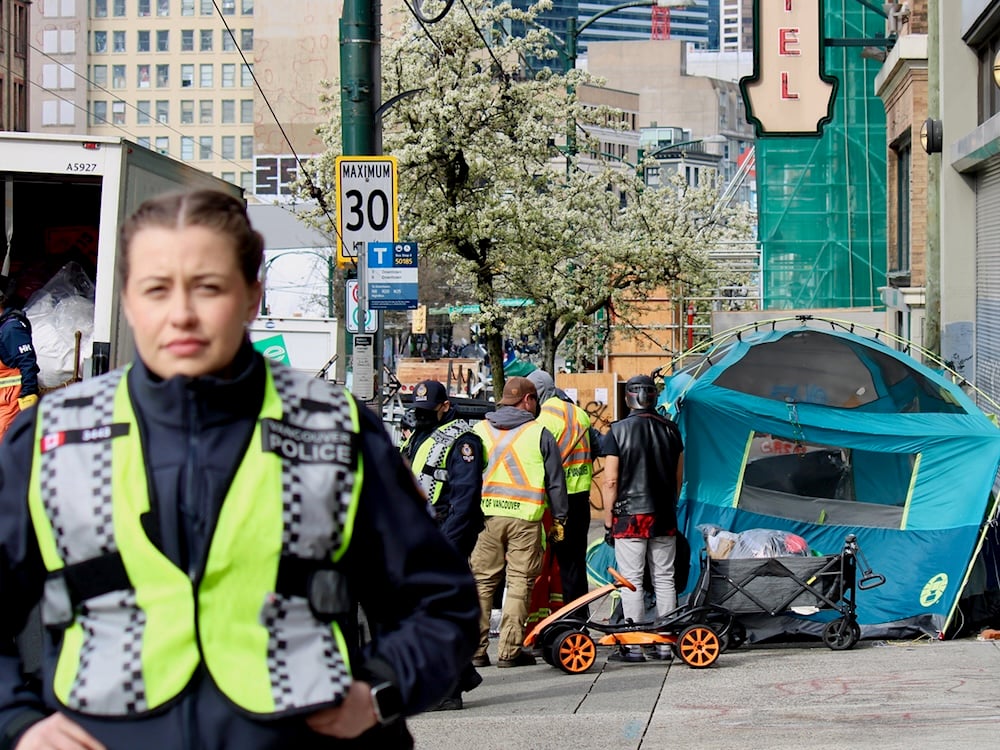
British Columbia’s human rights commissioner plans to tell the provincial government it should rewrite its laws and rules to more clearly protect the right of journalists to report on police enforcement activities, The Tyee has learned.
The commissioner wants police to stop using “exclusion zones” to bar the media from areas where officers are undertaking enforcement activities, unless they have judicial permission or are facing an immediate public safety threat.
And with police forces continuing to restrict media access despite legal rulings calling the practice unconstitutional, the commissioner is asking the province to formally restrict the practice, while also asking for more education for frontline officers.
The recommendations are to be included in a report expected to be delivered next month. The report has not been published, but the recommendations were included in a letter sent by commissioner Kasari Govender to municipalities around the province in mid-January. The commissioner had asked municipalities not to release the recommendations, but they were included in a recent council agenda for Northern Rockies Regional Municipality.
Municipalities had until Monday to respond to the coming recommendations, and Govender expects to table her report next month. In an email, her office declined to comment on the recommendations until they were officially made public. The office’s statement said it “is important for the recommendations to be understood within the context of the full report.”
Work on the report began following the Vancouver Police Department’s activities to remove homeless camps from the Downtown Eastside over two days in April 2023.
In November 2023, the Vancouver Police Board dismissed a subsequent complaint about a lack of media access, after Supt. Don Chapman told the board that the closure of a block of road did not constitute an exclusion zone.
The following month, the human rights commissioner launched an inquiry into the restrictions placed on media during the decampment. Tyee journalist Jen St. Denis, who reported on the 2023 Hastings Street decampment, testified during hearings held by the inquiry.
The coming report will be the culmination of that two-years-long probe, which broadened to include a review of other media exclusion zones in the province.
In addition to the actions in the Downtown Eastside in 2023, exclusion zones and police checkpoints have been regularly used by the RCMP at encampments in places such as Fairy Creek on Vancouver Island and Wet’suwet’en territory in northern B.C. Exclusion zones and checkpoints, which limit media access, have been criticized by legal observers and press freedom advocates.
Exclusion zones and checkpoints are also at the centre of a lawsuit filed by photojournalist Amber Bracken and the Narwhal against the RCMP.
The suit alleges Bracken’s rights were breached when officers arrested her while she reported from within an exclusion zone in Wet’su’weten territory in northern B.C. A five-week trial began Monday, with Bracken and the Narwhal seeking damages and a declaration that Bracken’s rights were violated.
The Canadian Association of Journalists has said that exclusion zones restrict the ability of journalists to observe enforcement activities and hold police and governments accountable. (The writer of this piece, Tyler Olsen, is a board member of the Canadian Association of Journalists. He was not a board member when the CAJ issued its statements related to exclusion zones, nor was he involved in issuing those statements.)
Judges have also repeatedly ruled against the use of exclusion zones. In a 2019 ruling, a Newfoundland and Labrador judge confirmed that Canada’s Charter of Rights and Freedoms protects the ability of journalists to be present and report from areas where a court injunction has barred the general public from being present. In 2021, B.C. Supreme Court Justice Douglas Thompson said the use of exclusion zones to limit journalists’ movement around the Fairy Creek protest was “unlawful.”
When asked about the Narwhal’s lawsuit, constitutional scholar Emmett Macfarlane told The Tyee that the law is clear at this point.
“A journalist has every right to be present, to do the job of reporting on a public interest story involving a protest, and that includes even when an injunction has been issued,” Macfarlane said.
Govender’s recommendations allow for the possibility that police forces might need to limit media access to a site in the event of “immediate and unforeseeable circumstances limited to a credible threat to public safety, or for the integrity of a criminal investigation.”
Absent those conditions, the recommendations say police should not be creating exclusion zones without judicial authorization. If exclusion zones are created, Govender says, police must make “every reasonable effort” to restrict their impact on the freedom of the press.
Govender writes that the province should enshrine limitations on exclusion zones in legislation and ensure that any exclusion zones that are created have time limits and size constraints.
The province should also provide direction on how police can determine whether a person is a journalist, Govender said. She endorsed a broad definition of journalism, noting that “journalism is a function shared by a wide range of actors” and that the ministry should not itself credential journalists.
Several of Govender’s recommendations focus on getting the police to better understand Canada’s press freedom protections.
That includes calls for provincial funding for “rights-based training for all frontline police officers and commanders,” as well as funding for an independent organization to provide “systemic advocacy and individual legal support to media and media organizations who encounter legal and policy issues concerning freedom of the press.”
Govender will also recommend that the Vancouver Police Board change its policy to ensure “all complaints are handled in a procedurally fair manner and with rigour, including by ensuring that members involved in a matter under investigation are not tasked with investigating their own actions or those of their superiors and that all handling of complaints is addressed in a manner that is free from conflicts of interest, either real or perceived, and transparent.”
Govender’s final recommendation is for an amendment to the Police Act that would require that investigations of police policies be done by an independent third party and to require forces to follow through on all recommendations by the Office of the Police Complaint Commissioner.
A City of Vancouver spokesperson declined to comment on the recommendations, saying officials are awaiting the final report’s publication.
A spokesperson with the Ministry of Public Safety and Solicitor General said the ministry does not comment on draft reports or recommendations but “recognizes the ability of the Human Rights Commissioner to make recommendations to the government for consideration.” ![[Tyee]](/design-article.thetyee.ca/ui/img/yellowblob.png)
Read more: Rights + Justice, BC Politics, Media






Notice about commenting changes
The Tyee’s commenting system will be moving to a new platform on Nov. 12. If you’re already a Tyee commenter you must register with the new system on or after Nov. 12 with your preferred username.More information can be found here.