


 SHARE:
Recent collisions between vessels and humpback whales in coastal B.C. waters have caused alarm among conservationists and fisheries officials. On Oct. 23, a humpback whale known to researchers as Wisp was hit by a whale-watching boat in Howe Sound. Its body washed ashore the next day Keats Island. A week earlier, one of Hullo Ferries’ high-speed catamarans crashed into a young humpback named Skipper in Vancouver’s English Bay. The impact tore a chunk of flesh out of the whale’s dorsal fin, but it appears to have survived.
On Sept. 18, a humpback named Midnight was found dead after being struck by a BC Ferries vessel in Wright Sound, south of Prince Rupert. And on Friday a 21-year-old humpback named Polyphemus was discovered dead of unknown causes, floating near Lasqueti Island.
The number of collisions and resulting deaths is likely greater than what has been reported as the whales often will sink to the bottom leaving no trace, contend whale researchers. Their findings also tell us that every deadly encounter with human machinery erases a unique individual whose species was once hunted to the edge of extinction before making a remarkable comeback.
Research has also established that humpbacks are mysteriously alluring for their song-making, acrobatics and ability to invent new behaviours. Not only do these behemoths impress with their intelligence, but they appear to display compassion for other kinds of animals.
Adapting to thrive
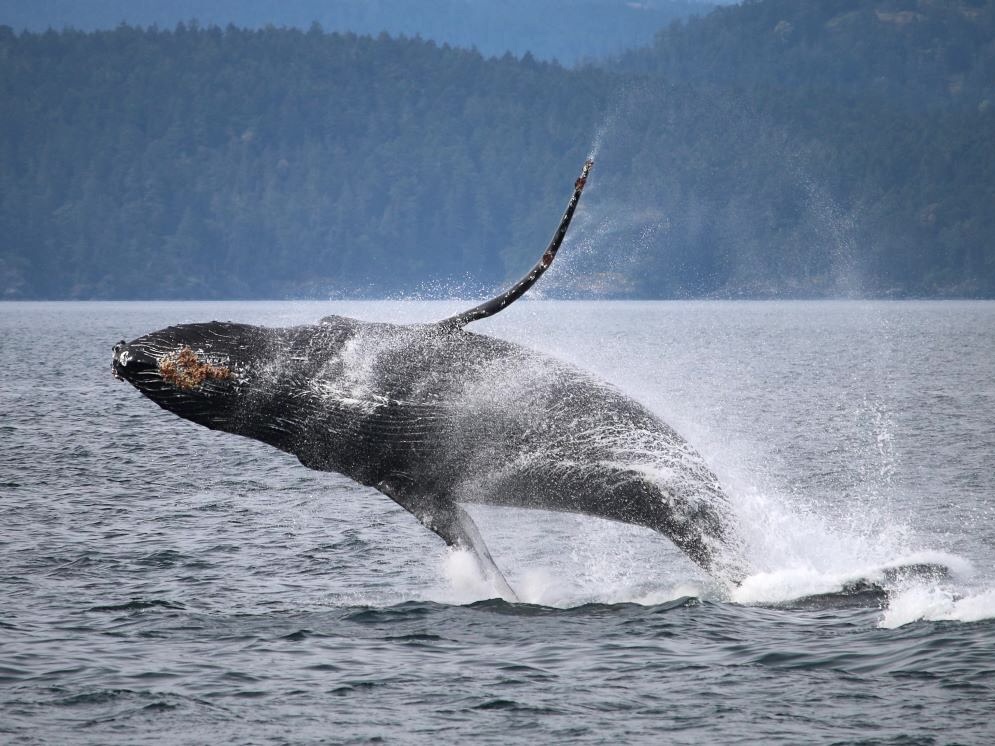
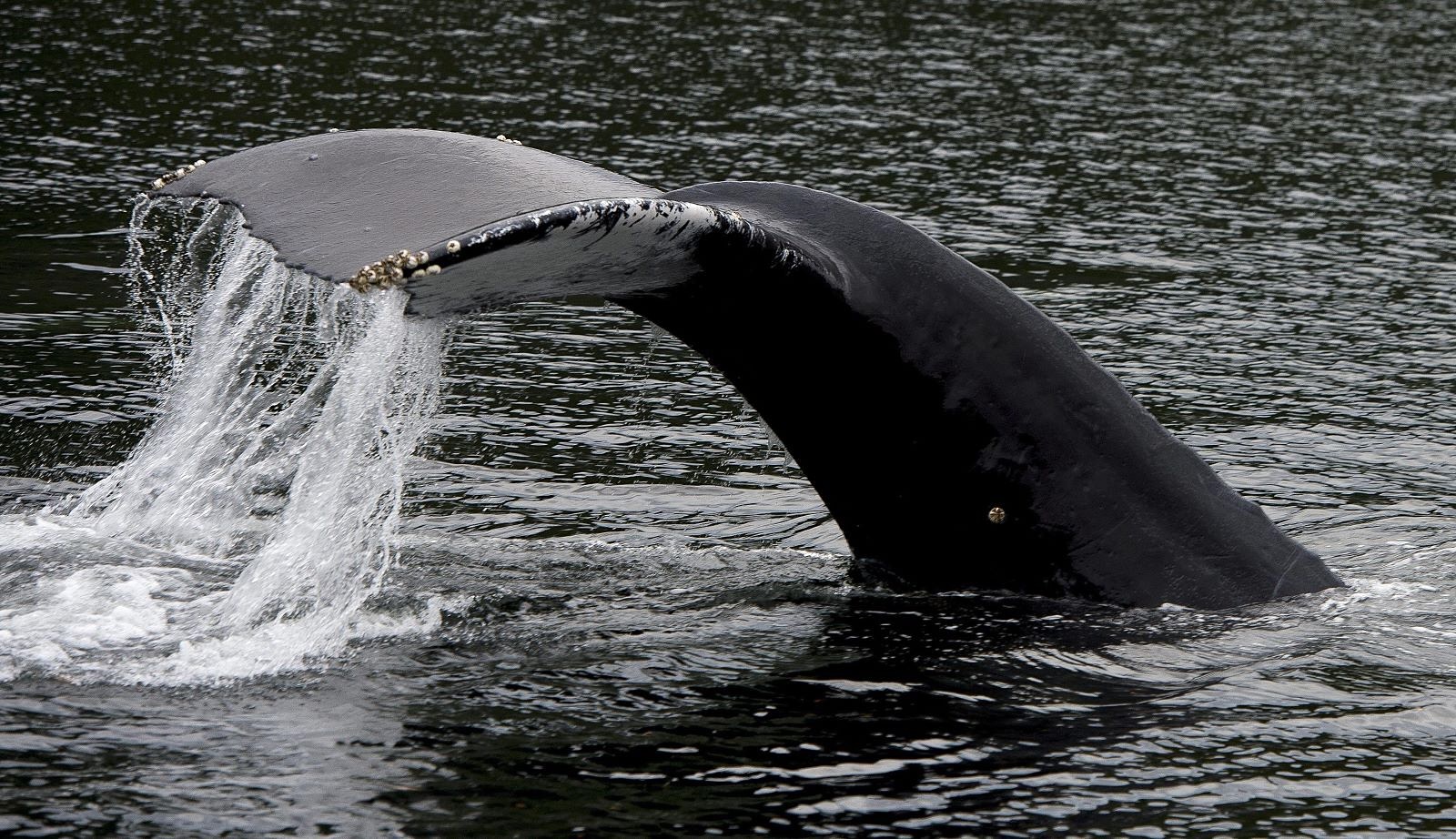
As whales go, humpbacks aren’t the most sleek. Their bulky, 17-metre-long, 40-tonne bodies, which bulge in the middle, are covered with barnacles and golf-ball-sized bumps on their heads and pectoral fins known as tubercles. The tubercles hold a couple of hairs called vibrissae, which are connected to a bundle of nerves. The purpose of the hairs is unknown. The tubercles on their fins are thought to help reduce the drag on the whale, allowing it to glide through the water in a more controlled and streamlined manner.
Humpbacks also tend to bear an array of scars, some produced by males while fighting one another, others from barnacles scraping on rocks or from clashes with killer whales, as well as distinctive circular scars produced by cookie-cutter sharks, bizarre-looking creatures with triangular teeth that tear round plugs of flesh out of humpbacks.
If humpbacks don't fit many people's idea of cute or elegant, they appeal in other ways. Pacific coast humpbacks are “giving hope to planet Earth,” declared BBC nature program host Richard Attenborough after his crew travelled in 2022 and 2023 to the northern tip of Vancouver Island to film the whales. Not only had their species rebounded from near obliteration, but some frequenting B.C. waters were thriving by inventing a clever new approach to feeding.
Humpback whales are renowned for their varied feeding strategies. Many “lunge-feed,” rushing through concentrated patches of krill or small-schooling fish with their mouths wide open. But some humpbacks have come up with an additional method of dining all their own, dubbed “trap-feeding.”
That’s what brought the BBC to B.C. Their guides were researchers with the Port McNeill-based Marine Education and Research Society, or MERS, a conservation non-profit that has been studying humpbacks for 15 years. The BBC film crew benefited from what MERS has learned from individual humpbacks around northeast Vancouver Island. They accompanied co-founder Jackie Hildering for six weeks over the course of two summers to get compelling footage about the importance of humpbacks and of trap-feeding.
The MERS team first documented trap-feeding being used by two humpbacks in 2011. It has since spread to at least 39 whales. It is what some humpbacks have learned to do when juvenile herring are not as concentrated; therefore, it is not worth the energy it would take to lunge-feed.
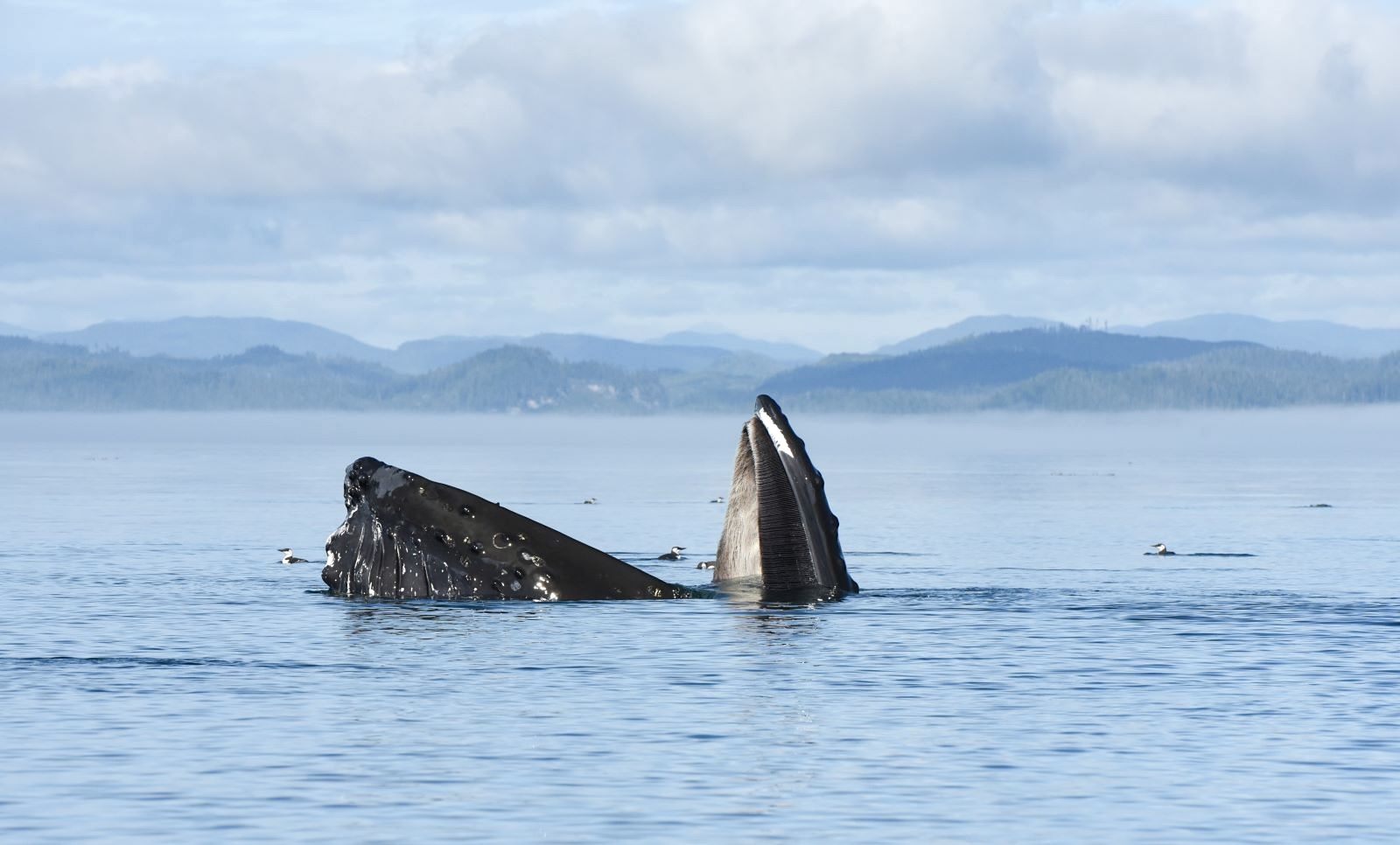
Instead, from a stationary position, the humpback sets a “trap” by expanding and holding its mouth at the surface for a minimum of four seconds. It occurs when gulls and diving birds are preying on juvenile herring that are not in a densely concentrated school. The fish will often seek refuge from the birds by hiding in the mouth of the humpback, as they would hide in a kelp bed or under the hull of a boat, says Hildering.
The trap then clamps shut. The humpback may not collect as many fish as when using a lunge-feeding approach, but this method of feeding is more efficient.
Back from the brink
The BBC crew was intent on recording something else: humpbacks pooing. Recent research suggests that nutrient-rich excrement from humpbacks and other great whales not only fertilizes the marine environment but can also help mitigate climate change by locking up carbon from the atmosphere. A process known as the “whale carbon pump” is triggered when whales defecate at the surface; the iron-rich fecal plumes fertilize an explosion of phytoplankton, which absorb carbon dioxide.
Even in death, these marine giants serve the ecosystem, sinking to the deep ocean where the carbon in their bodies remains trapped or is taken up by animals that feed on their carcasses. One study suggested the poop of a pre-whaling population of about 120,000 sperm whales could trap 2.2 million tonnes of carbon a year.
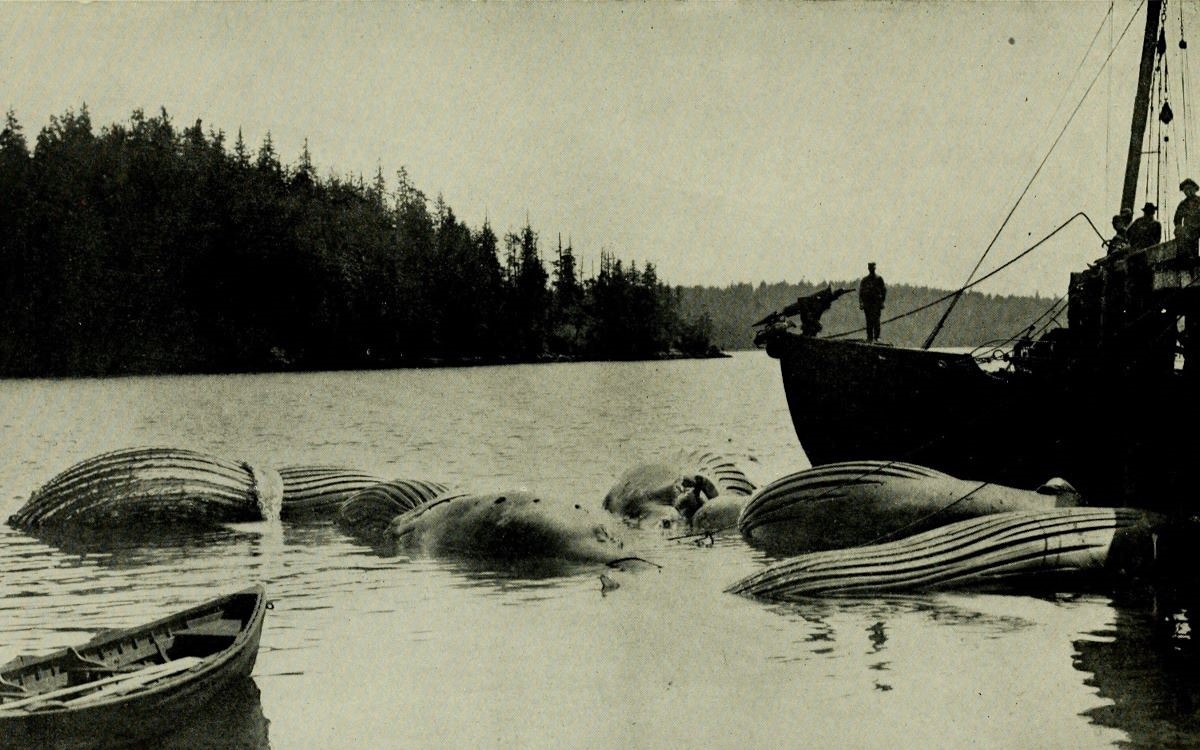
The poo effect highlights an often overlooked benefit of Earth having a healthy population of whales, a realization that escaped humans until quite recently. An insatiable demand for oil, blubber and meat caused many whales to be hunted to the brink of extinction. Humpbacks were on that list. B.C.’s last whaling station closed in 1967 and at least 5,600 were killed. Three million were killed worldwide, and 32,000 from 1900 to 1976 on the Pacific coast. While it can never be known just how many were killed, it is estimated that by the 1970s there were only 1,400 in the whole North Pacific Ocean.
A recent study estimates that the population rebounded to around 26,600 humpbacks in the North Pacific in 2021. This is indeed a second chance for humpbacks to thrive; however, in addition to the impacts of collision and entanglement, the study found there was a significant impact on population numbers due to warming waters.
Recording stars
Another factor in the forging of a connection between humans and whales was the work of biologist Roger Payne, who began recording the sounds produced by humpbacks off Bermuda in the late 1960s using hydrophones. In 1970, Payne would release a record album entitled Songs of the Humpback Whale. An unexpected hit, the album quickly sold over 125,000 copies and eventually went multi-platinum, becoming the most popular nature recording in history.
Janie Wray, the CEO and lead researcher with the North Coast Cetacean Society, a group dedicated to research and protection of cetaceans along the northern coast of B.C., says she was moved to study whales because of the haunting quality of Payne’s recordings.
“I had a strong emotional response to the songs,” says Wray. “There's just something about them that touch the human heart, perhaps more so than other animal vocalizations. Maybe it's because a whale call travels through the water and has a different type of energy when we listen to it.”
Humpback songs are the most elaborate vocalizations produced by any animal. Scientists classify these vocalizations as songs because they are structured compositions that follow specific patterns or “themes” and because they evolve over time. However, anyone who listens to a recording of humpback singing won’t recognize them as songs in the traditional sense of the word. Instead, they resemble the soundtrack of some surreal fever dream — an eerie assemblage of skirling horns, whispering moans, dripping taps, squeaky doors, thunderclaps and hiccups.
The songs, which can reach 170 decibels, louder than the roar of a jet engine, are created by humpbacks moving air between various sinus cavities in their skull and across something called “phonic lips.” Singing whales usually hang motionless 15 to 30 metres below the surface, head down. A complete song may last 30 minutes and be repeated continuously for up to 24 hours at a time.
It's only the males who sing, and they croon a new tune each year. They begin practising the songs in the fall, piecing the phrases together in growing complexity before they migrate south to the calving grounds off Mexico and Hawaii with full-fledged operettas. Incredibly, the songs can change as whales from different parts of the world socialize, creating an acoustic network as they are passed from one population to the next.
Even though scientists have been studying the songs for 50 years, they have yet to decipher their meaning. Because it is only the males who sing, it is speculated it has something to do with impressing the females. And while it is true the males produce the most complex songs when they are in their breeding areas, they also sing during their migrations and when feeding.
‘Inadvertent altruism’
Song is not the only thing that sets humpbacks apart from other baleen whales. They have also been observed displaying what appears to be compassion for other species. Robert Pitman, a marine ecologist with the Marine Mammal Institute at Oregon State University, is an expert on the subject. In a phone conversation, Pitman described an amazing encounter he witnessed in Antarctica when a pack of killer whales deliberately created a wave to knock a seal off a seal floe.
“The seal swam toward a pair of nearby humpbacks that had been harassing the killer whales,” recalls Pitman. “As the seal approached, one of the humpbacks rolled over on its back and swept it up onto its massive chest and lifted it out of the water.” Pitman and his crew mates thought that perhaps this was merely a strange coincidence, but when they reviewed their footage, they were astonished to see that at one point the seal started to slide off, and the whale responded by raising its flipper and gently nudging the seal back on its chest.
The incident appeared to run contrary to the common scientific view that animal behaviour is largely, or entirely, driven by self-interest. Helping other species is generally not on the to-do list. Intrigued, Pitman began canvassing colleagues for stories of encounters between humpbacks and orcas. A search engine query led to additional online narratives and videos posted on social media pages. He eventually compiled 115 accounts of interactions between humpbacks and killer whales.
Pitman discovered that humpbacks often intervene when killer whales are attacking another mammal. He has personally even seen them try to drive orcas away from the carcasses of creatures they had already killed. He believes this is an instinctual response as humpbacks regard killer whales as threats to their own species.
“Healthy adult humpbacks have little to fear from killer whales. In fact, their giant, flailing flippers and flukes can be a mortal threat to killer whales that venture too close,” says Pitman. “If they go charging at a killer whale, the killer whales move out of the way.”
But orcas are known to prey upon humpback calves, which travel with their mothers for the first year of life. “Off of Western Australia, killer whales probably take 200 or 300 humpback calves a year,” he notes.
Pitman contends that when humpbacks disrupt orca attacks, they are engaging in “an inadvertent type of altruism. Ultimately, they are helping themselves out. And, during the course of that, if they happen to help another species, it's not because they're trying to save seals; it's because they are trying to do what's best for themselves.”
Humpback sex and other riddles
Other types of humpback behaviour resist decoding. For example, how they find their food. They lack echolocation ability, so how do they track prey like herring? A team of U.S. researchers at Gotham Whale claim the humpbacks do it by sound — specifically by hearing the farting sounds that herring make when releasing gas from their swim bladders, which is thought to serve as a form of communication among these fish. But this explanation doesn’t explain how they find krill.
The specifics of humpback mating are another mystery. The act has been recorded only once — in 2022 off the coast of Maui. It prompted more questions than it solved. Cameras captured the sight of an older male penetrating the genital slit of an emaciated and injured younger male who was covered in lice.
Another riddle concerns the rising number of cases of humpbacks generating perfect bubble smoke rings in the vicinity of boats with humans aboard. A 2025 study published in Marine Mammal Science by scientists from the SETI Institute and the University of California at Davis examined the phenomenon. The researchers analyzed 12 episodes across the North Pacific, South Pacific and North Atlantic oceans involving 39 rings made by 11 individual whales. Could the humpbacks be trying to communicate with us? Fred Sharpe, a veteran marine biologist who works with SETI, believes this is quite possible.
Sharpe says that the presence of humans seems to trigger bubble blowing and that humpbacks improve with practice. “This may be a species-atypical signal that’s crafted for people. Whales reaching out to humans using their own parlance, their own form of communication.”
Sharpe is among a growing group of researchers who believe that the ability of advanced artificial intelligence to scan vast data sets of audio and visual signals to detect patterns could lead to a breakthrough in unlocking the vocalizations of humpbacks. A step in this direction took place recently off the coast of Alaska, where a team of scientists used AI to decode and replicate the vocalizations of a female humpback whale named Twain. The results indicated that Twain’s vocalizations followed patterns similar to those of human language.
Sadly, at the same time that humans seek to unlock such bond-forming secrets, we also pose the primary threat to humpbacks. They are especially vulnerable to vessel collisions because they are often found near shore and in shipping lanes. Floating just beneath the surface and grey coloured, they are not easily visible.
More such tragedies appear “almost inevitable,” says Lance Barrett-Lennard, a B.C. marine mammal research scientist with the Raincoast Conservation Foundation, as humpback numbers increase in waters frequented by high-speed vessels.
Barrett-Lennard says no boat operator wants to hit a whale, and the “culture” of mariners is evolving to be more aware of the risks. “But not fast enough.” ![[Tyee]](/design-article.thetyee.ca/ui/img/yellowblob.png)
Read more: Environment










Notice about commenting changes
The Tyee’s commenting system will be moving to a new platform on Nov. 12. If you’re already a Tyee commenter you must register with the new system on or after Nov. 12 with your preferred username.More information can be found here.