


 SHARE:
Significantly fewer people are requesting government records in B.C., causing advocates to worry the decline signals eroding government transparency and a loss of trust in public institutions.
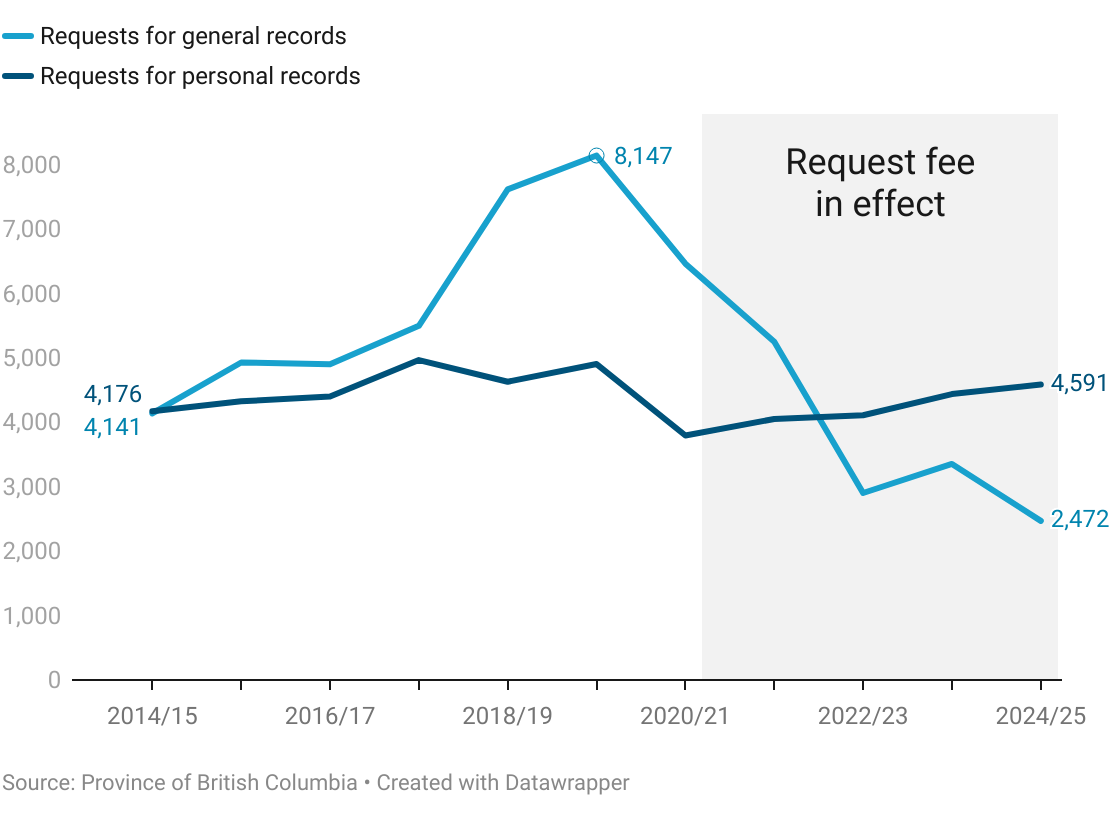
Over the past five years, the overall number of requests for government records fell by more than 30 per cent, according to a newly released government report on the administration of B.C.’s Freedom of Information and Protection of Privacy Act.
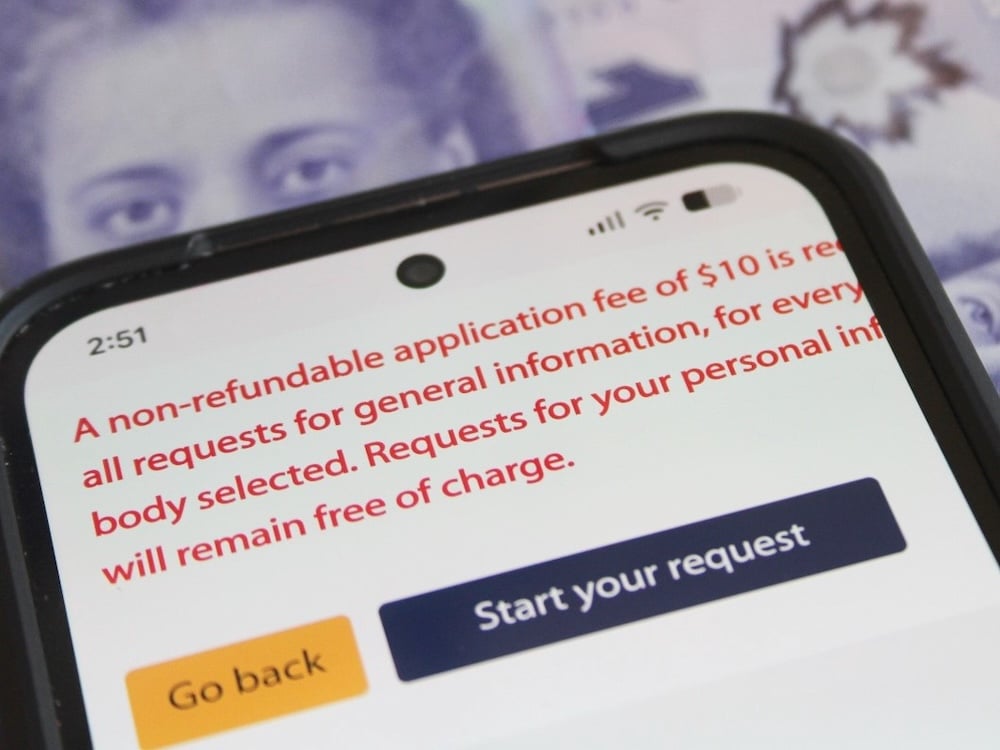
Even more dramatic is the decline in the number of requests, specifically for general government records — things like internal communications, reports or briefing notes that are considered public but not proactively disclosed. Those requests plunged, dropping to less than a third of what they were in 2020, the year before the provincial government implemented a new filing fee to request documents. Under the new policy, the government charges $10 for each request to each individual provincial ministry.
In introducing the fee, the province said it wanted to speed up response times by reducing the number of requests. But that hasn’t happened. The recent report shows that the province meets legislated deadlines to respond to an FOI request 81 per cent of the time, down from 85 per cent in 2020-21.
B.C.’s information and privacy commissioner, Michael Harvey, told The Tyee he was disappointed with the decreasing number of requests. He said he fears the decline in requested documents signals public disillusionment with B.C.’s freedom of information system.
“I think we need to ask ourselves why,” Harvey said. “I don’t think people are less interested today than they were five years ago in getting information from their government.”
B.C.’s Freedom of Information and Protection of Privacy Act provides a framework for the public to request internal documents from the province’s public bodies. The act also sets out exceptions that allow government to withhold information to protect things like privacy, legal or policy advice, and business interests.
Freedom of information — commonly known as FOI — requests fall into two categories: requests for general government records and requests for personal records. While there is no charge to access your own personal information, public bodies can charge fees on top of the $10 filing fee to help cover the cost to process more time-consuming requests for general records.
The recent annual report shows there were fewer than 2,500 requests for general records last year, a steep decline from the 2019-20 fiscal year, when the province received more than 8,000 requests. By comparison, requests for personal information, which do not incur any fees, have remained relatively constant.
Experts say frustration with the FOI system — and its longer wait times, escalating fees and broad use of redactions to withhold information — is likely to blame for the declining number of requests.
“This is the epitome of paying more and getting less,” Jason Woywada, the executive director of the BC Freedom of Information and Privacy Association, told The Tyee. “There is an enshittification of this process that is troubling and problematic.”
The annual report, which was released Oct. 20, covers only B.C. government ministries. It does not include other public bodies, which are also subject to freedom of information laws, such as Crown corporations, health authorities and post-secondary institutions.
Asked about the declining number of requests, B.C.’s Ministry of Citizens’ Services said the reduction “may be attributed to any number of factors.” The fee’s original intent was to “allow applicants to be able to better target their requests,” resulting in fewer cross-government requests, a spokesperson wrote.
“We have not seen evidence that fees are acting as a significant barrier to people making FOI requests,” the spokesperson wrote. “Government will continue to monitor the fee to ensure that it does not become a barrier for people to access information.”
The ministry also pointed to proactive disclosures, which require ministries to automatically release commonly requested records, as a possible reason for the decline. The province’s recent report shows that, while the number of proactive disclosures rose by nearly 30 per cent over the past five years, it declined again last year to two per cent above 2020-21 levels.
As requests decline, processing fees rise
The declining number of requests is underscored by decreasing administration fees collected by the province.
In the years following B.C.’s implementation of the $10 filing fee, the province collected nearly $30,000 annually from people paying the $10 charge to file requests for general records. However, that number dropped to $22,590 last year — another sign of the system’s decreased use, Harvey said.
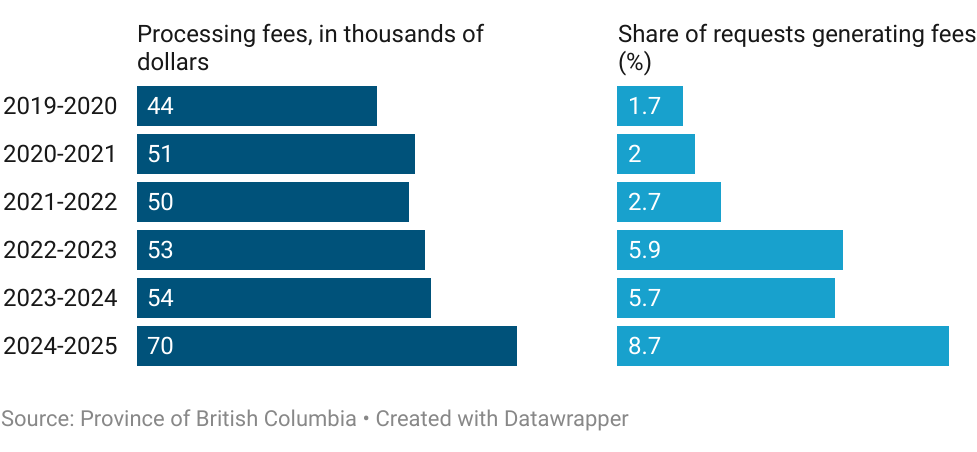
Despite the dropping number of requests, the province has been collecting substantially more in processing fees — the total processing fees rose from $54,000 in the 2023-24 fiscal year to $70,000 last year.
Most requests don’t generate a processing fee. But as the total number of requests falls, the share of requests leading to a processing charge is also on the rise. A decade ago, less than two per cent of requests ended up in a fee. In 2023-24, nearly six per cent of requests prompted a processing fee. Last year, the figure jumped significantly, to nearly nine per cent.
Asked about the increase in processing fees, a ministry spokesperson pointed to an 86 per cent increase in page counts for FOI responses over the past five years, saying the “growth in average processing fees paid for general requests is directly related to this growth in request size.”
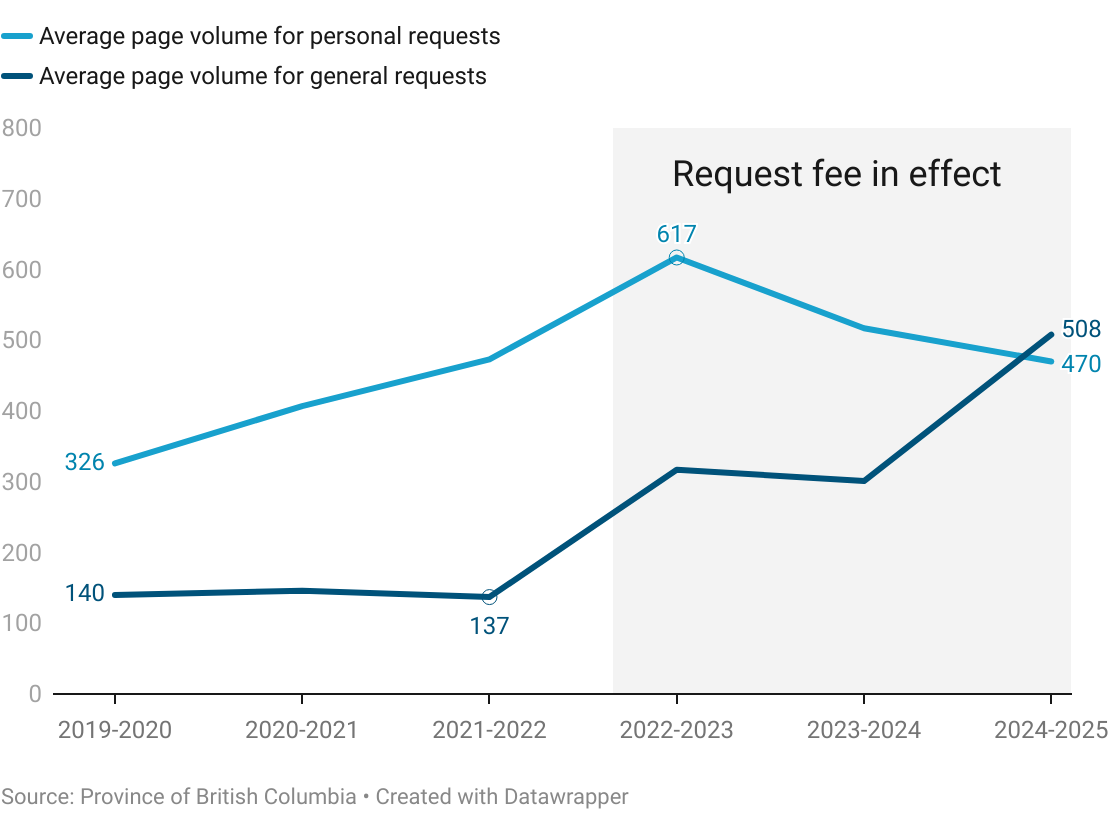
Opaque government processes may be pushing applicants to make broader requests, according to Mike Larsen, president of the BC Freedom of Information and Privacy Association and a criminology instructor at Kwantlen Polytechnic University.
FOI analysts working for the province also have a role to play in helping the public refine requests. Under the act, public bodies have a duty to assist applicants, which includes working with them to narrow a request and direct it to the appropriate department.
“I don’t think any requester that I’ve worked with wants to cast as wide a net as possible,” Larsen said. “They’re looking to get useful information, but in the absence of any information about what that looks like, then they cast the wide net, which inevitably will result in a larger request.”
Declining trust could dissuade the public from accepting help to narrow their requests and lead to suspicion about the efforts of FOI staff, Harvey said.
“I’m concerned that if people are becoming less trusting because of what they perceive as a lack of a culture of transparency, then they will respond to that duty-to-assist question as ‘Wait a second, they’re just trying to find ways to deny me records,’” he said.
Harvey added that the recently implemented filing fee could be encouraging people to “bundle their requests” rather than split them into smaller, more focused requests — resulting in larger and more complicated responses.
Releasing more pages, less information
Experts also noted that while page volumes have increased, so have the number of pages released with blanket redactions or broad swaths of information omitted under exemptions in the act.
“In some cases, we’re seeing [redactions] being overapplied, done on a vibes-based approach,” Woywada said. That is forcing people to complain to the Office of the Information and Privacy Commissioner, or OIPC, he added.
“It forces you into having to go back and correct the work of policy workers and FOI analysts who are supposed to be using a repeatable system in the application of exemptions and exceptions,” he said.
He blamed frustration with the system for people turning to whistleblowers for internal government information.
Harvey, B.C.’s information and privacy commissioner, also identified an overreliance on blanket redactions. He expressed concern that public bodies are treating discretional exemptions as mandatory. For instance, B.C.’s FOI law says the government “may” refuse to disclose policy advice, legal advice or information that could harm intergovernmental relations. But it does not say it “must” keep such information from the public.
“The trend that we’re seeing here on our end is that generally, if exceptions can be applied, then they are applied,” he said. “Everything essentially acts as if it’s a mandatory exemption.”
Harvey said his office has seen a “real spike” in the number of public complaints, which have risen about 20 to 30 per cent year over year, despite the number of requests declining.
The OIPC’s most recent annual report shows that, out of more than 900 complaints the office received last year, 84 per cent were from people requesting a review of the public body’s decision to withhold information. Another 38 per cent were “deemed refusals,” or complaints over the government’s failure to provide records within legislated timelines.
The OIPC released a special report last month focusing on how public trust is affected by governmental transparency and the citizen’s access to information. Harvey said he chose to focus on trust because it is “the most important issue that relates to my mandate in British Columbia at this time.”
“Trust and transparency are existential for our democracy, and we really need to be prioritizing that,” he said. “If the perception is that [public bodies] are not transparent, that they are opaque, then this is going to play into feelings of mistrust, and that's really dangerous.” ![[Tyee]](/design-article.thetyee.ca/ui/img/yellowblob.png)
Read more: BC Politics












Notice about commenting changes
The Tyee’s commenting system will be moving to a new platform on Nov. 12. If you’re already a Tyee commenter you must register with the new system on or after Nov. 12 with your preferred username.More information can be found here.