


 SHARE:

B.C.’s information and privacy commissioner is concerned about the number of freedom of information requests going unanswered in the province.
The Office of the Information and Privacy Commissioner for British Columbia recently took the “unprecedented step” of obtaining a court order to force a provincial health authority to respond to a freedom of information or FOI request, commissioner Michael Harvey told The Tyee.
Harvey, who took over as the province’s information and privacy watchdog just over a year ago, said delays in responding to formal information requests — and, in some cases, no response at all, known as a “deemed refusal” — are becoming increasingly common.
He worries that could erode the public’s trust in government.
“If people don’t feel like they have predictability when they make an FOI request, and that they aren’t able to get information to which they’re legally entitled in a timely way, then they’re going to stop using [the system],” Harvey told The Tyee.
“People are not going to trust public bodies if they feel that they’re not transparent.”
B.C.’s Freedom of Information and Protection of Privacy Act allows the public to access government records. Public bodies in B.C. have 30 business days to respond to formal requests for information, although some exceptions exist under the act.
FOI requests are frequently used by journalists to access unpublished information in the public’s interest — for example, briefing notes to a ministry that inform a decision on a resource project, or email correspondence between ministry and staff that shines a light on the behind-the-scenes discussions informing government policy. A lot of award-winning journalism — such as The Tyee’s own recent silver at the Canadian Association of Journalists Awards — emerges from FOI requests.
Documents posted to B.C.’s Office of the Information and Privacy Commissioner, or OIPC, show that Northern Health, one of the province’s five regional health authorities, has failed on several recent occasions to respond to requests.
Complaints over a public body’s response, or failure to respond, to FOI requests are fielded by the OIPC. After first attempting to mediate a resolution, the OIPC will send some cases for inquiry, where an adjudicator makes a binding decision.
Last month, the OIPC issued three binding decisions ordering Northern Health to respond to five freedom of information requests it received in January. The requests were due for response by late February.
In each case, Northern Health acknowledged it had not met its obligation to respond to the requests within the required timeline. The health authority told the inquiry that it is working with an external consulting company to process the requests. The recent orders give it until tomorrow, June 11, to respond.
Harvey said it is “not super unusual” for a deemed refusal complaint to make it to inquiry. It happens about 15 times a year, he said.
More concerning, he said, are two consent orders — legally binding agreements signed by Northern Health during mediation over another OIPC complaint — that the health authority failed to abide by in April.
When the health authority failed to meet not just its initial 30-day deadline but also a second April 22 deadline imposed by the OIPC, “we took the unprecedented step of filing it as a court order,” Harvey said.
This marks the first time the office has filed an order with the courts for non-compliance with an OIPC order. The B.C. Supreme Court judgment could lead to a contempt of court finding if Northern Health continues to ignore the requests, an April 28 news release from the OIPC said.
In an email to The Tyee, a spokesperson for Northern Health said the health authority is “taking steps to work with the OIPC and the applicant” to comply with the orders.
“We accept that we have not met the requirements of the consent orders and are making every effort to expedite completion,” the spokesperson wrote, adding that the health authority has been “experiencing capacity challenges” in its information and privacy office, which have affected response times.
It cited staffing challenges and a recent network drive failure as reasons for the delays and said it is recruiting additional resources, including a Vancouver-based consulting company, to process FOI requests.
“Northern Health has engaged PrivacyWorks since April 4, 2025, to support the Northern Health Privacy Office’s work to meet the legislated timeline for information requests,” it said. “Northern Health periodically retains external service providers when required to meet demand.”
Requests are taking longer and longer to respond to
Harvey said deemed refusals are just one aspect of a “broad timeliness problem” across the province as public bodies increasingly fail to respond within legislated timelines or drag out response times using exemptions under the act for things such as a large volume of records or third-party reviews.
“That extension process should be the exception rather than the rule,” he said. “Of course, the deemed refusal is outside of the law altogether, and so that’s a greater concern.”
The length of time it takes for public bodies to respond to FOI requests and the number of deemed refusals have both increased in B.C. despite overall requests being on the decline, Harvey added.
The OIPC’s most recent annual report, published a year ago, shows that the information watchdog received 264 deemed refusal complaints in the fiscal year ending March 31, 2024, a 43 per cent increase over five years earlier.
While deemed refusals made up 13 per cent of all complaints to the OIPC in the 2019-20 reporting period, they now make up nearly 27 per cent of all complaints, according to the most recently reported data.
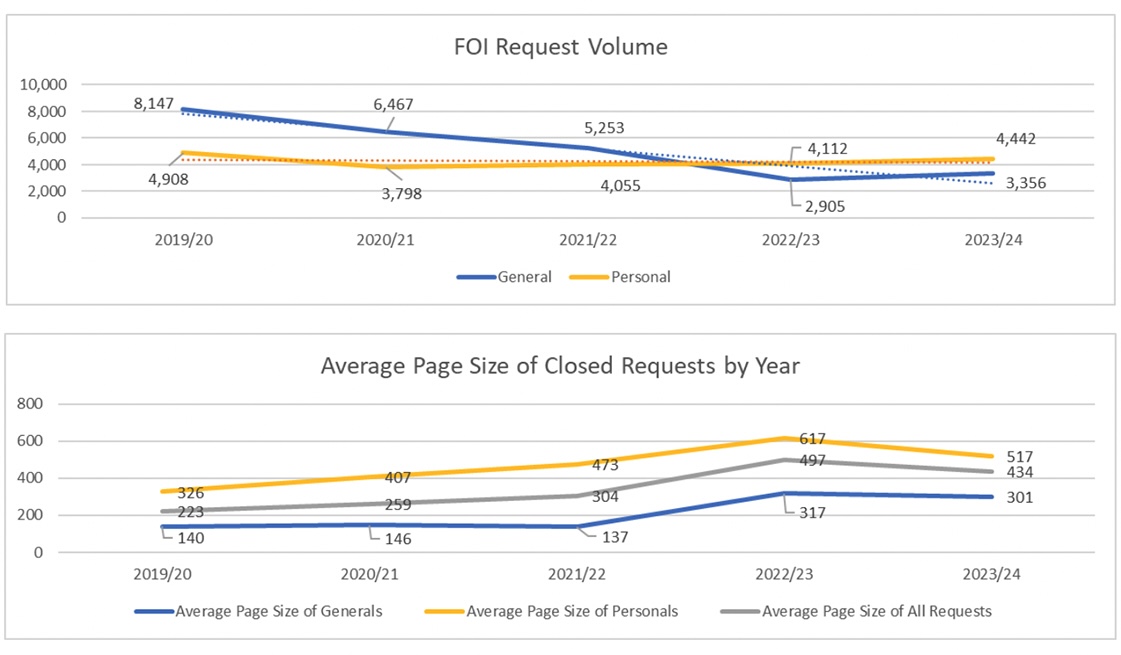
At the same time, the province’s most recent report on its administration of the act, which was released in April 2024, shows that the number of annual requests fell by more than half over the same period, to 3,356 from 8,147.
That decline in requests has been blamed in part on the introduction of a $10 processing fee on FOI requests, which was introduced in 2021. The province says, however, that the size and complexity of responses has increased over the same time frame.
“It’s concerning that it appears that there’s a growing deemed refusal problem, particularly in the context of these requests going down,” Harvey said.
The province collects data only on the ministries housed directly under government, Harvey noted, but not independent public bodies such as health authorities, Crown corporations or municipal governments. As a result, details about the volume of records that Northern Health processes each year are not proactively made publicly available.
In its statement to The Tyee, the health authority said it received 97 freedom of information requests last year and completed 91. It is in “varying stages of response in the remaining six,” the spokesperson added.
Harvey said it can be a challenge for public bodies to keep up when they receive a wave of requests, creating a bottleneck and leading to slow response times. He said he’s looking at creative ways to support smaller organizations such as health authorities to have “surge capacity” when they suddenly face unanticipated high demand.
In September, for example, the OIPC released the results of an audit that found the Vancouver Coastal Health Authority had failed to comply with time limits nearly three-quarters of the time between 2020 and 2023. The health authority’s FOI system suffered during the COVID-19 pandemic, the audit found, leading to “access requests languishing for months and applicants often left in the dark about their progress.”
Harvey acknowledged that the pandemic was “an extraordinary time for all people and organizations in British Columbia” but said that, particularly during a crisis situation, the government has an obligation to maintain public trust through accountability and transparency.
“The applicant has the right to submit” requests, he told The Tyee. “Every organization in the province needs to be able to handle their statutory responsibilities.”
*Story updated at 3:15 p.m. on Nov. 3 to correct misinterpretation of comments from information and privacy commissioner Michael Harvey. ![[Tyee]](/design-article.thetyee.ca/ui/img/yellowblob.png)
Read more: Rights + Justice, Media











Tyee Commenting Guidelines
Please note that email notifications for replies are not currently working due to a software issue which may be resolved in a future update.
Comments that violate guidelines risk being deleted, and violations may result in a temporary or permanent user ban. Maintain the spirit of good conversation to stay in the discussion and be patient with moderators. Comments are reviewed regularly but not in real time.
Do:
Do not: