


 SHARE:
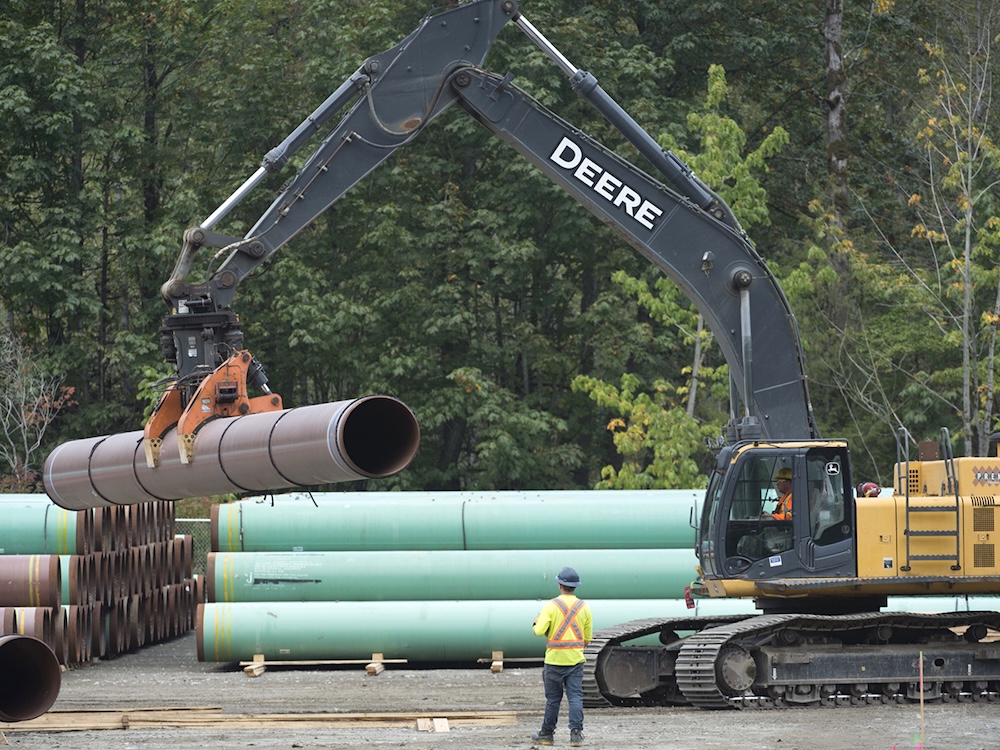
Homeowners may be on the hook to cover what amounts to a multimillion-dollar tax cut for pipeline companies operating in B.C.
After years of lobbying, Enbridge, FortisBC, Trans Mountain and other major companies have convinced BC Assessment to change how it assesses the value of pipelines in the province. A subsequent review has resulted in slashed assessment values, which will, in turn, dramatically reduce the amount of property tax the companies will pay next year.
Local taxpayers will have to make up the difference. Outlying communities where pipelines comprise much of the commercial tax base will be most affected.
“For small towns like ours this will be a big deal,” Clearwater Mayor Merlin Blackwell told The Tyee. Some residents, he said, could see double-digit property tax increases next year to make up for reduced pipeline taxes.
Last week, BC Assessment’s Chris Whyte told Blackwell and other directors of the Thompson-Nicola Regional District that the pipeline companies had approached BC Assessment in 2016 about a review of their assessments. The companies had complained that the assessed values of their properties “were not representative of the current costs,” Whyte said.
The complaints triggered a review of the costs that has continued ever since. Whyte said the agency “has maintained a proactive collaborative relationship with the pipeline industry.”
The review involved an industry working group that included Enbridge, TC Energy, Trans Mountain, Canadian Natural Resources, Encana, Pacific Northern Gas, FortisBC, AltaGas and Pembina, Whyte said. The companies account for 90 per cent of B.C.’s pipelines by value.
Most B.C. properties are assessed based on their market value. The assessed value of houses, for instance, is calculated based on recent sale prices for similar properties nearby. But that method is not possible for utilities and other properties that rarely change hands. Instead, the assessed value of pipelines is governed by B.C.’s Assessment Act and has historically been determined based on the costs to build and maintain them, Whyte told regional district directors. Costs take into account the average cost of labour, overhead and other indirect costs, according to the agency.
Whyte said the pipeline’s previous assessed values were based on construction costs from the 1980s and that depreciation costs related to the pipelines hadn’t been reviewed since the early 2000s.
Whyte said BC Assessment considered appraising pipelines according to the revenues and expenses of the companies but decided against that after early tests suggested that method would have produced a much lower value than cost-based assessments.
Whyte said BC Assessment’s revised model uses the Marshall & Swift costing platform, a widely used service. That model suggested costs to build transmission pipelines had declined. Whyte said the lower costs were linked to the twinning of pipelines and the use of composite materials in pipeline construction. He did not mention the cost overruns that plagued the construction of the Trans Mountain pipeline and led to its eventual purchase by the federal government.
Pipeline assessments lowered across the province
The review led BC Assessment to slash the assessed value of pipelines across the province. In the Thompson-Nicola Regional District alone, the value has dropped 27 per cent, or $300 million, Whyte said.
Thompson-Nicola Regional District officials say the reduced valuations will result in pipeline companies paying $250,000 less in property tax in their region. Directors say local residents and businesses will end up paying higher taxes in order to maintain existing services.
With pipelines criss-crossing British Columbia, the Thompson-Nicola Regional District is only one of many local governments that will be affected and whose residents might end up facing sharply higher tax bills in the coming years to make up for lost revenue from the pipeline companies.
The Ministry of Finance has informed the District of Hope that pipeline assessments are expected to drop 28 per cent, for example. That will result in pipeline companies paying the district $640,000 less in taxes, staff say. To make up the difference, residents and businesses in the town of 6,000 in population may be looking at an average tax increase of about 6 per cent.
A report by Hope staff says other hard-hit communities will include Kent, Houston, Chetwynd, Rossland, Burns Lake and the Regional District of Fraser-Fort George.
The assessments aren’t fully approved yet. The minister of finance will review the regulated rates and rules in November and BC Assessment’s board of directors will be asked to approve the changes in December.
Other reviews coming
Whyte said BC Assessment is also set to review rates for other utilities, including rail, telephone, cable and “potentially” electrical infrastructure.
Whyte’s presentation received a frosty reception from the directors of the Thompson-Nicola Regional District, which includes representatives from the City of Kamloops and 10 surrounding municipalities, ranging from Merritt to Clinton. The regional district also includes representatives for the vast rural tracts in the region.
Thompson-Nicola Regional District chair Barbara Roden asked why local governments couldn’t have been consulted before “rather than being hit with a fait accompli in mid-September.”
“We have not been consulted or included in any of these discussions,” she said. “[It’s a] very short timeline now to try and change anyone’s mind.”
Whyte suggested that it was not until August that BC Assessment knew what the precise impacts would be for each local government.
“It has a huge impact on residential properties,” said David Laird, who represents a rural area east of Merritt. “Some of our areas only have 300 residents and the cost is going to be so high for the residents.... It doesn’t compute for us.”
The directors also expressed confusion as to how BC Assessment had determined the pipelines were less valuable than previously judged.
“Why is the pipeline not being assessed the same way as the value of the replacement?” Laird asked, noting that the values of homes appreciate even as they age. “I can’t relate to the fact that a company as big as the pipeline companies are being able to depreciate and not pay the proper amount of taxes that they have been paying.... The value is obviously more now than it was when they completed the pipeline. You couldn’t build that pipeline again for the amount of money they invested.”
Thompson-Nicola Regional District Area J director Michael Grenier suggested that regularly depreciating the cost of pipelines failed to account for the modern value of the infrastructure.
“These pipelines are in high demand, they’re oligopolies,” he said. “Depreciation is an accounting concept of a piece of steel pipe that has a certain lifetime. Pipelines are regularly maintained.”
The directors voted to send a letter to B.C.’s finance minister asking that BC Assessment postpone the updated assessments until next year, when the agency says it will review assessments for other utilities, including railways.
Some hope that increased rail assessments might compensate for the pipeline tax drop, while others like Blackwell are skeptical that major businesses would accept reviews that might leave them paying far more.
District of Hope staff, meanwhile, told that community’s council that they’ve asked BC Assessment for more information and that “the Ministry of Finance is noting all concerns.”
In an email to The Tyee, BC Assessment communications manager Ben Mittelsteadt wrote that the agency updates its rates on an annual basis, and that they must still be approved by the Ministry of Finance.
“BC Assessment is committed to providing advanced notice to our Municipal/Regional District partners and our First Nations Partners of changes that may impact assessed values prior to the upcoming 2026 Assessment Roll, and we formally did so on Sept. 18, 2025,” he wrote.
On Bluesky, Mayor Blackwell described the information from BC Assessment as an “absolute bomb” and told Victoria Coun. Susan Kim in a message, “You’re going to want to rally the troops.”
In an interview with The Tyee on Friday, Blackwell said he wasn’t happy about the lack of information local governments had been given by BC Assessment — especially given the involvement of the pipeline companies in triggering the assessment review.
“Having talked to BC Assessment and continually told over the years they’re not to be influenced by anything, it is concerning,” he said. “The word that was running through my head yesterday was ‘Trumpian.’”
“If you’re going to listen to industry, there should be at least equal opportunity for municipal governments to be part of the discussion. And if this is purely an accounting thing, there’s a whole bunch of people that should be included a hell of a lot sooner than the last month of a nine-year process.”
If you have any information for this story, or information for another story, contact Tyler Olsen in confidence via email. ![[Tyee]](/design-article.thetyee.ca/ui/img/yellowblob.png)
Read more: Energy, Municipal Politics









Tyee Commenting Guidelines
Please note that email notifications for replies are not currently working due to a software issue which may be resolved in a future update.
Comments that violate guidelines risk being deleted, and violations may result in a temporary or permanent user ban. Maintain the spirit of good conversation to stay in the discussion and be patient with moderators. Comments are reviewed regularly but not in real time.
Do:
Do not: