


 SHARE:
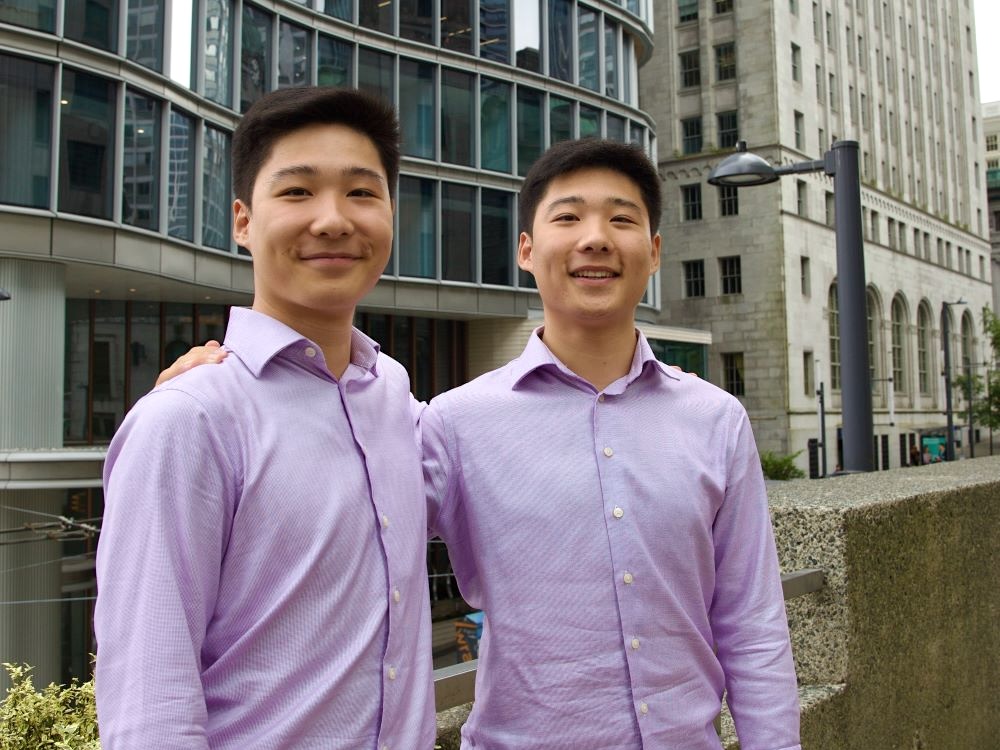
When Jason and Jerry Song tuned in to the televised leaders' debates during the 2019 federal election, it wasn’t because they loved politics.
Like many 12-year-olds, the twins found the debates boring. But their parents, especially their mom, needed their help.
Their family had immigrated from China about five years earlier, and Jerry and Jason had a better grasp of the rapid-fire English spoken by the party leaders than their parents did.
“My mom kept asking [us] — I don't think her questions were necessarily the greatest. Like, ‘Who likes education?’” Jason said during a June interview with The Tyee. “‘They all do, Mom.’”
For their parts, Jason and Jerry weren’t convinced voting was even worth it.
But waiting for hours alongside so many of their neighbours so their mom could vote at the polling station on election day flipped a switch in the brothers.
“Seeing so many people wanting to go vote because they actually believe in that one vote making a difference really put into perspective how important democracy and voting are,” Jerry told The Tyee.
Now 18, the Songs were finally able to vote during the federal election earlier this spring. But they don’t think teens should have to wait that long.
Sixteen-year-olds in Canada can drive, have sex, work and pay income taxes, participate in army training, vote for federal party leaders and get married.
The Songs say they should get to cast a ballot, too.
The twins join a legacy of advocacy in B.C., in Canada and internationally, calling for the enfranchisement of 16- and 17-year-olds.
Co-directors for the B.C. chapter of the #Vote16 national campaign to extend voting to 16- and 17-year-olds, the Songs are putting their effort into local and provincial politics.
They’ve already been successful in Squamish, where councillors voted unanimously to support extending the franchise to 16-year-olds and write a letter to the minister of housing and municipal affairs endorsing their vote in municipal, school board and provincial elections after hearing from the brothers on July 15.
On July 16 they presented to the provincial Special Committee on Democratic and Electoral Reform, and they are actively pushing the District of West Vancouver and the District of North Vancouver to endorse 16- and 17-year-olds voting in municipal, school board and provincial elections.
Youth, who will be impacted most by long-term, life-altering decisions like whether to build or close schools, build housing or approve pipelines, should get to cast their vote, the brothers told The Tyee.
Twins talking politics
In high school the Songs volunteered at Liberal MP Patrick Weiler’s West Vancouver constituency office, mainly reading correspondence from constituents.
They noticed a particular demographic was missing from Weiler’s inbox — young people.
This confounded the twins, as there are many politicians under 30 in all levels of government from coast to coast to coast.
So they decided to ask politicians directly about engaging youth, in a forum young people would be more likely to access: a podcast.
“It's called TwinTalk Politics,” Jerry told The Tyee. “It's exactly what it sounds like: it's twins talking about politics.”
TwinTalk Politics currently has 26 episodes available on all podcast streaming platforms, as well as a YouTube channel.
Each episode features an interview with a political figure, including 21 MPs, two senators and three academics.
“The main goal of our podcast is getting the youth perspective in there, asking the politicians questions that the youth wanted answers for,” Jerry said. “Asking, ‘How can we get more [youth] engaged in democracy and society?’”
A “strikingly consistent answer” — “continuously, across party lines” — among their interviewees, Jason said, was extending the voting age to 16.
Though the Songs reach out to politicians of all political stripes, they’ve tended to have more buy-in from the NDP and the Liberals. B.C. MP Marc Dalton is, so far, the sole Conservative Party of Canada member featured in the available episodes, and no Green Party MPs have featured.
But they have interviewed former NDP MP Taylor Bachrach, who sponsored a 2021 private member’s bill to extend the federal vote to 16- and 17-year-olds.
Like many private member’s bills, it died on second reading. It had near-unanimous support from Bachrach’s fellow NDP MPs, the Bloc Québécois MPs and both Green Party MPs.
But the Liberals, who formed government at the time, saw only 20 out of 158 MPs vote in favour. No Conservative MP voted yes.
Until 1970, when the franchise was extended to 18-year-olds, you had to be 21 to vote federally. B.C. made the same change in 1992.
Independent Sen. Marilou McPhedran introduced her own bill in 2021 to lower the voting age to 16. Like Bachrach’s, it never went beyond the first reading.
Provincially, former BC Green Party leader Andrew Weaver introduced a motion to extend voting to 16-year-olds in 2018, which failed but was publicly considered by then-premier John Horgan. The BC NDP caucus endorsed the idea in 2019.
Municipal councils in Vancouver, Saanich, Penticton, Victoria, North Vancouver, Vernon and Invermere and the Union of BC Municipalities have all endorsed the idea of lowering the voting age to 16 for municipal elections.
Support has also come from labour unions like the Vancouver and District Labour Council, New Westminster and District Labour Council and Kamloops and District Labour Council.
Internationally the franchise has been extended to 16- and 17-year-olds in general U.K. elections; Scotland and Wales allow 16- and 17-year-olds to vote locally.
Sixteen-year-olds can also vote in Brazil, parts of Germany, Austria, the European Union, Cuba, Ecuador and Nicaragua.
Responses to the critics
No matter the argument you have against 16-year-olds voting, the Songs have a response.
Brains haven’t developed enough by 16? One study shows cognitive development maturity happens around age 16, which assists with decision-making.
Teenagers favour progressive parties? Not according to an Elections Canada 2019 student vote in which the Conservatives picked up the highest percentage of votes.
“That also debunks the argument that a lot of certain political parties use, which is ‘Oh, if you let 16-year-olds [vote], they will just get an influx in one party and sway it,’” Jason said.
Teenagers won’t vote? While the voter turnout for 18-to-24-year-olds is lower than for older age groups in Canada, in Scotland the voter turnout for the youngest age bracket has increased beyond their slightly older peers. Plus, research has shown voting in your first election increases the likelihood you vote for the rest of your life.
Finally, will teenagers just vote the same way their parents or friends do? Maybe. But so do many adults.
“They obviously get influenced by social media, by their own friends, by a sports league they may play in,” Jason said. “We don't ask them, ‘Oh, did you get influenced by your friends before you voted?’”
‘Critical for democracy’
NDP MP Jenny Kwan, who began her political career in 1993 at age 26, said she “absolutely supports” extending the vote to 16- and 17-year-olds.
“It’s critical for democracy. As we can see, more and more people are disengaged with the political process and the democratic process,” Kwan, who appeared on TwinTalk Politics, told The Tyee.
“Lowering the age to 16 would send a critical message to young people that their voice matters, that their vote will count.”
MP Patrick Weiler, who also appeared on TwinTalk Politics, was one of 20 Liberals to vote in favour of Bachrach’s bill to lower the voting age in 2021.
While the Liberals haven’t taken an official stance on extending the franchise, Weiler told The Tyee he still supports investigating the impact of 16-year-olds voting.
“It's a really important priority that we should have, to find ways of getting young people involved in politics and government,” he said.
The Tyee sent interview requests on extending the voting age to communications staff for Conservative Party of Canada MP Andrew Scheer, who is interim Opposition leader, as well as to the Conservative Party of BC. Neither responded.
BC Green Party MLA Rob Botterell hadn’t met Jerry and Jason Song until they addressed the provincial Special Committee on Democratic and Electoral Reform on July 16.
But his party, which sparked the creation of the special committee Botterell sits on, was already committed to extending the vote to 16- and 17-year-olds.
“It means the parties are going to look at what are the priorities for that age group and what are the things that are top of mind for students,” he said.
Botterell is trying to keep an open mind as a member of the special committee, which will use the public feedback received at hearings and online to make electoral reform recommendations to the government.
“I want to hear all of that information before I make up my mind,” he said. “Maybe there will be some convincing reason [against] that recommendation. But right now I’m not seeing it.” ![[Tyee]](/design-article.thetyee.ca/ui/img/yellowblob.png)
Read more: Rights + Justice, Politics, Media








Tyee Commenting Guidelines
Please note that email notifications for replies are not currently working due to a software issue which may be resolved in a future update.
Comments that violate guidelines risk being deleted, and violations may result in a temporary or permanent user ban. Maintain the spirit of good conversation to stay in the discussion and be patient with moderators. Comments are reviewed regularly but not in real time.
Do:
Do not: