


 SHARE:
Carbon capture and storage — a method for capturing emissions created during industrial processes and transporting them to store deep underground — is having another moment in the sunshine in Canada.
Both federally and provincially, in Alberta, governments have pointed to it as a solution for how to balance oil and gas development with climate targets.
However, experts underscore that the country should, with just as much enthusiasm, invest in a much older, more reliable form of carbon capture.
That’s because carbon is an essential ingredient in carbon dioxide, a greenhouse gas that traps heat close to the earth. Decreasing carbon is key to mitigating the impacts of climate change.
And from forests to peatlands to the kelp forests that line the coast, Canada’s western ecosystems are in a much better position to absorb greenhouse gases than any current technology.
While these ecosystems may be better positioned to take on Canada’s current emissions, however, they require some restorative work to get them back to their full potential.
The Tyee took a look at three critical and vastly different means to store carbon in the West, examining how these ecosystems capture carbon, the restoration work they require and why Canada should take them seriously as solutions.
Peatlands, ancient and reliable
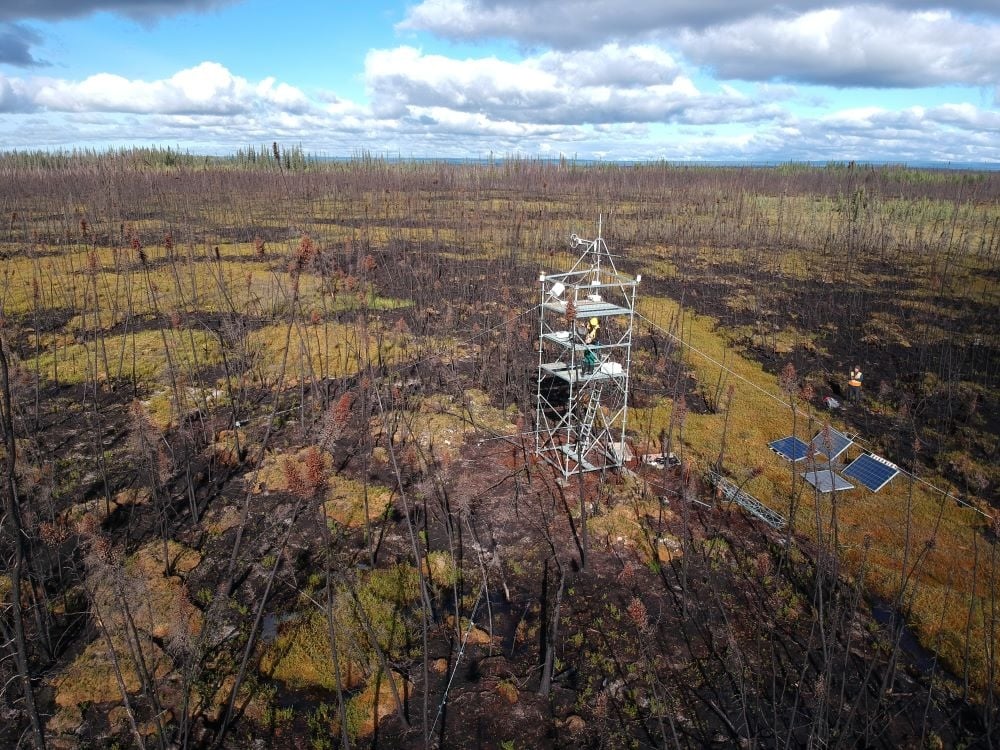
Peatlands, characterized by their squishy texture and brightly coloured moss, are a type of wetland found all over Canada. In the West, they are found in northern B.C. and Alberta.
Peatlands capture carbon by staying wet, David Olefeldt, an associate professor in the department of renewable resources at the University of Alberta, tells The Tyee.
Their soil and plants stay soaked for most of the year, lowering their oxygen content. When the oxygen content is down, decomposition slows, meaning growing plants build up in the wet soil instead of breaking down. Ultimately, this results in the storage of soil carbon.
As the plants grow, they pull carbon out of the air through the process of photosynthesis. Because their decomposition has slowed down, the carbon-rich plant material sticks in the peatland instead of rotting away. Over time, the peatland stores massive amounts of carbon.
In undisturbed peatlands, Olefeldt says, this could amount to up to 12 metres of non-decomposing plant material that’s accumulated over 12,000 years. That can, in turn, add up to “200 kilos of carbon per square metre that’s stored,” says Olefeldt.
However, peatlands do come with a catch; as much as they absorb carbon, they also emit methane, another greenhouse gas. Methane is so powerful that over the course of 20 years it is 80 times more potent at warming than CO2.
But Olefeldt says that shouldn’t necessarily deter people from investing in peatlands as natural climate solutions.
“It makes for a hare-and-the-tortoise scenario,” says Olefeldt. “For the first few decades, this might have a climate-warming impact because the effect of methane emissions outweighs the uptake of carbon dioxide.”
But as time passes, the level of methane being emitted levels out, and the amount of carbon sequestered continues to increase.
So, what does investing in peatlands mean? In short, it means restoring them to their former glory. Researchers are trying to figure out the best way to do that.
Disturbances to peatlands include activities such as the oil and gas industry, agriculture and climate change.
“In Alberta, two major disturbances are wildfires and permafrost thaw,” Olefeldt says.
Olefeldt and his lab, the Catchment and Wetland Sciences Research Group, are currently looking into the impact of disturbances on peatlands.
According to Olefeldt, permafrost thaw leads to more decomposition of the plants that have been in the soil for hundreds of years, which can lead to greater methane emissions.
Wildfires can also severely damage not only the peatlands but the amount of carbon they are holding. “You can lose hundreds of years of carbon accumulation in the combustion,” Olefeldt says.
After these disturbances, it takes thousands of years for peatlands to replenish their previous carbon storage.
To mitigate these outcomes and use peatlands as natural climate solutions, restoration processes need to be permanent, and other peatlands should remain untouched, Olefeldt says.
The problem? The economic gains from peat harvesting and oil and gas development are much larger than restoring and retaining peatlands, Olefeldt says, meaning peatland restoration and retention isn’t the most economically efficient way to reduce carbon emissions.
Still, Olefeldt says that the other benefits that come with restoring peatlands, like flood protection and biodiversity management, along with carbon sequestration, make it a more valuable solution than carbon capture and storage.
Kelp, the new kid on the block
Kelp is one of the newest potentials for natural climate solutions and carbon sequestration in Canada.
The two species that are most often found off the coast of British Columbia are giant kelp and bull kelp.
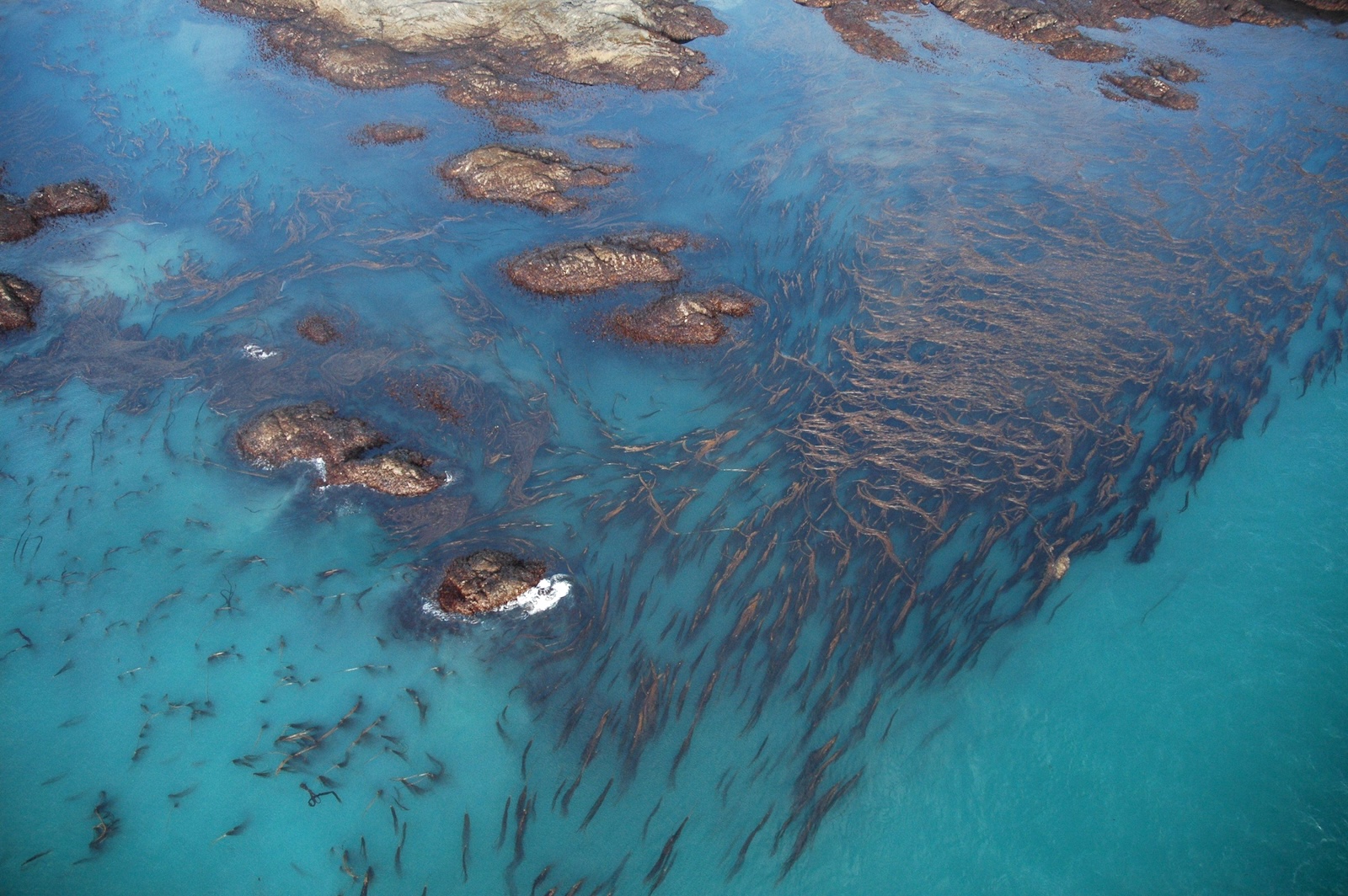
“We have two primary regions that [the Kelp Rescue Initiative] are currently restoring kelp in, and those are the north Salish Sea and Barkley Sound,” says Jasmin Schuster, program manager for the Kelp Rescue Initiative, a research group that works to restore kelp off the coast of British Columbia.
Recent research has pointed to kelp as an emerging blue carbon ecosystem, working to store carbon through three main pathways.
One is that kelp releases tiny bits of carbon that small organisms have a hard time breaking down. The carbon is then carried deep down into the ocean, where it may stay for up to hundreds of years.
The second is that broken pieces of kelp carry carbon down to the bottom of the ocean, where they’re buried in the seabed or other coastal systems, such as seagrass meadows.
The final way is that kelp particles can sink into the deep ocean, almost 200 metres down, where they may stay for up to thousands of years.
But kelp isn’t currently storing as much carbon as it could. Instead, it faces challenges in its habitat because of two main stressors — temperature stress and overgrazing, mostly by sea urchins.
The Kelp Rescue Initiative has been working on a few solutions to these issues.
One involves raising kelp in a lab and later reintroducing it into the sea.
The initiative is also experimenting with making kelp more heat resistant. The process includes exposing young kelp to heat stress so that it becomes more heat resilient, Schuster explains.
The Kelp Rescue Initiative has also been trying to mitigate the appetites of sea urchins by placing barriers or cages in and around the areas where young kelp is introduced.
The research around kelp as a carbon sink is still relatively new. It is hard for researchers to fully evaluate how much kelp carbon is sequestered in the deep oceans in the long term.
But as Schuster points out, investing in kelp restoration is vital, because “there’s nothing else in coastal cold waters that grows like that, or functions like them.”
Forests, the sink and source
Trees are one of the world’s largest carbon sinks. Like peat, trees sequester carbon through photosynthesis. As trees grow, they take in carbon from the air around them and store it in their wood, soil and plant matter, says Jacob Bukoski, an assistant professor and the director of the forests and climate change graduate certificate at Oregon State University's department of forest ecosystems and society.
Younger trees sequester carbon quickly, taking in carbon as they grow rapidly. In comparison, older trees store larger amounts of carbon for longer.
Forests are “both a massive sink for atmospheric carbon dioxide, but then they’re also through their disturbances, whether that’s human or natural disturbances, they’re also emitting a lot of carbon into the atmosphere,” Bukoski says.
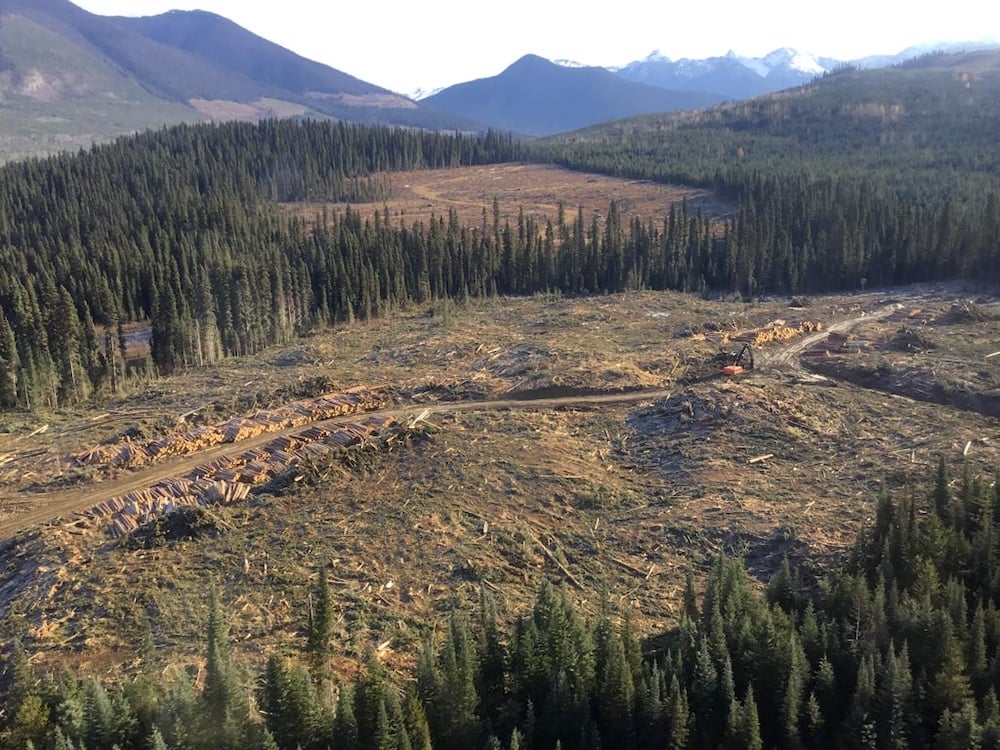
These disturbances include harvesting and forest fires, and they result in two billion tonnes of carbon emitted per year, making forests not only large carbon sinks but also carbon sources.
How do we mitigate this? Bukoski has a few ideas.
One is to lengthen the amount of time between the harvesting of forests.
Right now, companies harvest younger trees, meaning that “productive forests across the landscape are, on average, sequestering less carbon on a yearly basis than if they were managed where they were harvested at their peak rate of growth,” Bukoski says.
Throughout a tree’s life, the rate at which it grows and takes in carbon can plateau. The point where a tree experiences its fastest rate of growth is referred to as its peak rate of growth. This occurs at different points depending on the species. Douglas firs, which are found in the Pacific Northwest, experience a peak growth rate of about 70 to 100 years, for example. They are currently being harvested after about 35 years, Bukoski says.
Bukoski suggests that it may be a better option to harvest them later in their life cycles.
Another solution Bukoski suggests is to diversify productive forests so that they have more than one type of tree. That way, they are storing carbon at different rates and promoting biodiversity.
In B.C., after harvest, forests are replanted by adding baby trees — usually evergreen trees, which are the quickest to grow — leaving the forest floor bare of biodiversity.
“Generally speaking, more diverse forests tend to stock more carbon in them,” Bukoski says.
While disturbances and harvesting mean forests aren’t sure bets when it comes to carbon sequestration, with these changes, forests have a higher chance of sequestering more carbon for longer.
‘We need all of the solutions’
While no single natural carbon storage solution is going to be the solution, together, they form key pieces of the puzzle of carbon sequestration.
“We’re currently at the point where we need all of the solutions,” says Bukoski.
Researchers who spoke with The Tyee also emphasized the importance of considering the other benefits that these ecosystems provide beyond carbon sequestration potential.
Some of the extra benefits that peatlands provide, for example, are helping to normalize river flow during drought periods, acting as natural fire breaks, filtering water, and providing sites for Indigenous communities’ hunting and trapping, Olefeldt says.
Kelp forests, Schuster says, also provide a lot of benefits to their surrounding ecosystem, including shelter and food for all kinds of marine life.
“What’s unique about them is that they extend from the sea floor to the water surface,” she says.
“That allows animals to hide and have nursery grounds and feed. Without kelp, there’s just nothing there.”
Thinking about the animals and the overall ecosystem is very important, Kai Chan, a professor and Canada Research Chair at the Institute for Resources, Environment and Sustainability at the University of British Columbia, told The Tyee.
“Restoration is absolutely key,” Chan says, but it’s “not just the plants, because the animals are fundamental parts of those ecosystems.” ![[Tyee]](/design-article.thetyee.ca/ui/img/yellowblob.png)
Read more: Alberta, Environment









Tyee Commenting Guidelines
Please note that email notifications for replies are not currently working due to a software issue which may be resolved in a future update.
Comments that violate guidelines risk being deleted, and violations may result in a temporary or permanent user ban. Maintain the spirit of good conversation to stay in the discussion and be patient with moderators. Comments are reviewed regularly but not in real time.
Do:
Do not: