


 SHARE:
In 2003, the BC Liberal government passed a law that let it fast-track “significant projects” and bypass the normal approval process.
The legislation had much in common with Bill 15, the controversial law being tabled by the NDP government that could remove major parts of the environmental assessment process for projects such as mines.
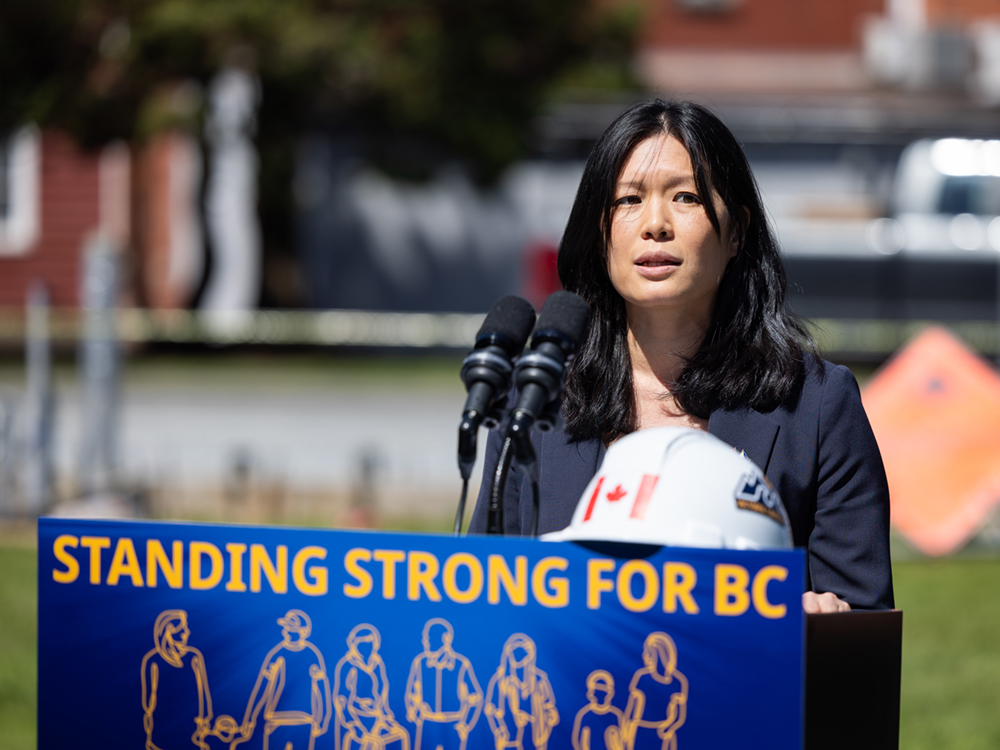
Infrastructure Minister Bowinn Ma noted the similarities during debate on the current government’s bill.
“The framework in this legislation is modelled after the process laid out in the Significant Projects Streamlining Act, and it is not an entirely new power,” she said.
But the NDP of 2003 had strong feelings about the BC Liberal legislation.
“It is the equivalent of a banana republic,” said Joy MacPhail, then-leader of the two-person NDP caucus in the legislature.
“The premier will have unrivalled, near-absolute power,” she added. “That is something that every British Columbian and every government caucus member should be concerned about.”
The Liberals passed the Significant Projects Streamlining Act in 2003, citing the need to strengthen B.C.’s economy in the face of shifting trade relationships.
The NDP is citing similar trade tensions to pass the new law, folding many sections of the BC Liberal legislation, some parts copied verbatim, into its new Infrastructure Projects Act, tabled in early May and slated to be passed this week.
Both bills allow the government to remove a variety of “constraints” from impeding infrastructure projects wanted by government or industry proponents.
But the NDP’s law includes new tools to let government fast track environmental assessments and provide industry consultants opportunities to sign off on permits.
The NDP say the new law will uphold the government’s commitment to the Declaration on the Rights of Indigenous Peoples Act.
But the bill has been opposed by First Nations, including organizations such as the First Nations Leadership Council.
The Union of BC Municipalities, environmental organizations and some legal experts have also rejected what they deem to be the bill’s vast overreach.
Deborah Curran, executive director of the University of Victoria’s Environmental Law Centre, said the legislation reflects a big shift for the NDP government.
“The legal approach of this bill is surprising,” she said. “It takes away due process and it concentrates authority without guidelines or standards in cabinet.”
“This is particularly surprising given the relationship building and the co-governing legal arrangements the province has entered into in the last five and seven years with Indigenous communities,” she said.
Fast track comes back
Deregulation was big in the early 2000s when Kevin Falcon, current leader of the BC United party, took the helm as the BC Liberals’ minister of state for deregulation with a mandate to slash regulations.
The Liberals’ Significant Projects Streamlining Act was pitched as a deregulation multi-tool for making projects happen faster. “Act cuts red tape, creates economic opportunities,” said the headline on a 2003 government release on the law.
“It was a hugely contentious piece of legislation at the time,” said Andrew Gage, a staff lawyer with West Coast Environmental Law, whose organization called it “unprecedented in modern democracies.”
Even pro-business groups like the Canadian Taxpayers Federation rejected the Liberals’ bill, saying it would “put political decisions exactly where the Liberal government promised never to intrude: in the selection of winners and losers in the marketplace.”
The government argued such measures were needed to tackle the economic pressures it faced, including U.S. softwood lumber tariffs; an economic slowdown in Japan, a key trading partner; the SARS virus; and, according to former MLA of West Vancouver-Capilano Ralph Sultan, “the lingering hangover from the tomfoolery of a previous government.”
The government passed the Significant Projects Streamlining Act in December 2003. But the powers government gained in the act were never used.
Now, the NDP government is putting the law’s powers back in the spotlight with its new version, the Infrastructure Projects Act.
Gage said it’s likely the law will be used now. “You don't repackage these kinds of regulations if you don't intend to use them," he said.
The legislature is only scheduled to sit until Thursday, leaving days to pass the bill.
Bill 15, like the 2003 BC Liberal legislation, allows the government to remove “constraints,” including laws, regulations or bylaws, impeding a project it decides is essential. Both laws allow the government to impose timelines for project approvals to speed up the decision-making process.
But there are also differences between them.
Both laws allow the government to decide which projects are eligible for special fast tracking. But the NDP government bill promises regulations that will set out criteria. The Liberals made no such commitment.
“That’s arguably an improvement,” said Gage. But the government can change regulations anytime without a legislative debate, he noted.
The Liberals also said the 2003 law wouldn’t let the government bypass the environmental assessment process. But the NDP’s new Bill 15 is clear that scrapping parts of the environmental assessment process is on the table, including processes to assess cumulative effects and engage in dispute resolutions with First Nations.
The NDP’s new bill also allows industry paid consultants to sign off and approve permits on behalf of their employers.
Gage noted that reliance on industry hired consultants has roots in the Liberals’ policy approach that promoted a regime of “professional reliance,” which reduced the size and reach of government by letting companies hire contractors to assess parts of their projects.
Shortly after coming to minority power in 2018, the NDP government contracted a review of the Liberals’ professional reliance regime as part of its confidence agreement with the BC Greens, promising to make changes to improve government oversight over qualified professionals.
Gage said he was surprised to see Bill 15’s commitments to beef up the powers of industry-hired consultants.
“They basically said they were moving away from that.”
In an email to The Tyee, B.C.’s Ministry of Infrastructure said that the Liberals’ law was “designed to provide the province with the ability to overrule local governments,” but that their iteration is a “more holistic piece of legislation” that focuses on provincial processes to expedite project reviews.
Bill 15 and DRIPA
B.C. describes Bill 15 as a “modernized” version of the Liberals’ law.
Minister Ma said the new law, unlike the Liberals’ 2003 legislation, was shaped to align with the province’s commitments to uphold Indigenous rights through the Declaration on the Rights of Indigenous Peoples Act.
“Nothing in the bill allows for a project proponent or the province or any authority to sidestep obligations to First Nations,” Ma said in the legislature.
In part, the province said that’s because amendments passed in 2021 requires its laws to align with the DRIPA act.
Merle Alexander, a Hereditary Chief of the Kitasoo Xai'xais First Nation and a lawyer practicing Indigenous resource law, said that’s a misreading of the amendment.
“They’re trying to use it as a shield,” he said, adding the province did not co-develop Bill 15 with First Nations as DRIPA commits it to do. The amendments, he added, don’t allow the province to create new laws that are not consistent with DRIPA.
The province also points to a section in Bill 15 that stipulates parts of the law must not override “engagement with Indigenous peoples” as indicated in DRIPA.
But that qualifier rang hollow to Alexander, who said it is limited to certain sections of the bill and that the word “engagement” isn’t a term used in DRIPA.
Those details matter, he said. “If there's any room for ambiguity, for the Attorney General and any ministry or any office, then, in a way, it doesn't happen,” he said.
Premier David Eby has said his government won’t impose privately owned projects without the consent of the “Nation whose core territory the private project is on.”
But “core territory” also doesn’t have a legal definition in DRIPA.
“Core territory doesn't exist as a legal concept,” Alexander said. “There’s no mechanism.”
Alexander said the province’s commitment to First Nations’ consent is not clearly stated in Bill 15.
“If that’s what you’re really saying, put your money where your mouth is?” he said. “Why don’t you amend the act to put a consent provision in?”
By email, the Ministry of Infrastructure said projects designated under the new bill “will be required to uphold government’s commitment to the Declaration on the Rights of Indigenous Peoples Act.”
Alexander said the law could let the province avoid consultation requirements. “They’re creating new laws to bypass not just UNDRIP but actually the entire body of consultation law, because there will be no statutory decision to review,” he said.
Since the government announced Bill 15, opposition from First Nations across the province has been extensive.
The First Nations Leadership Council, which represents members from the BC Assembly of First Nations, First Nations Summit and the Union of BC Indian Chiefs, participated in a press conference late last week with the Union of BC Municipalities, calling on Eby to withdraw the bill.
The province has not backed down on the law, but has acknowledged that it erred in its consultation with First Nations.
“We did not have the time to consult on this,” said Ma in committee speaking on the bill. “We definitely acknowledge that.”
Ma said the province believed "interest would be quite low from First Nations” because the legislation would not affect them and the focus would be in regulations to be determined by cabinet once the bill passed.
But Alexander also contests the notion that regulations can solve Bill 15’s problems, noting that DRIPA’s powers currently don’t extend to the regulatory process.
“It’s a move they’ve been making all along, is to say they’re going to fix it later,” he said. “That’s all it really is, is kicking it down the road.
Speed versus substance
The NDP and BC Liberal governments defended their fast-track laws with a similar approach, arguing they wouldn’t reduce environmental and other protections.
“It should be made clear that no project should expect that the environmental standards that they need to meet will change,” said Ma in the legislature. The tools, she said, “are to reduce redundancies and duplication, not standards.”
Falcon offered similar arguments in 2003.
“Nothing in this bill affects environmental, social or health standards,” he said, adding that the bill would instead impact only “review and process provisions. ”
The NDP didn’t buy that then.
“That might be what the minister is thinking, except that's not the language of the bill,” said then-MLA Jenny Kwan.
“The legislation does not say what the minister claims.” ![[Tyee]](/design-article.thetyee.ca/ui/img/yellowblob.png)
Read more: Indigenous, Energy, Environment












Tyee Commenting Guidelines
Please note that email notifications for replies are not currently working due to a software issue which may be resolved in a future update.
Comments that violate guidelines risk being deleted, and violations may result in a temporary or permanent user ban. Maintain the spirit of good conversation to stay in the discussion and be patient with moderators. Comments are reviewed regularly but not in real time.
Do:
Do not: