


 SHARE:
[Editor’s note: This article was originally published by Hakai Magazine. Read the original story on their website.]
Aquaculture is big business in Canada. In 2023, open-net-pen salmon farming in B.C. alone produced 50,000 tonnes of fish worth just over US$350 million. But on June 30, 2029, the federal government’s long-looming ban on open-net-pen salmon farming is set to take effect. On that day, 63 operations will be forced to shut down.
For decades, B.C.’s open-net-pen salmon farmers have faced criticism that their activities are harming the environment by promoting the spread of disease and fostering parasitic sea lice that can infect wild salmon. But closing a salmon or other kind of marine farm isn’t as simple as letting a field lie fallow.
Whether degraded by poor maintenance, battered by heavy storms or beset by financial woes, aquaculture operations have gone under before — sometimes literally. And when they do, derelict equipment can find its way to the sea floor or become suspended in the water column.
“It’s pretty devastating,” says Ben Boulton, program manager of Rugged Coast Research Society, a charity that works with the provincial government and First Nations to clean up marine debris from shellfish farms. These efforts have often involved smaller mom-and-pop oyster operations that lost gear to the ocean floor years or decades ago.
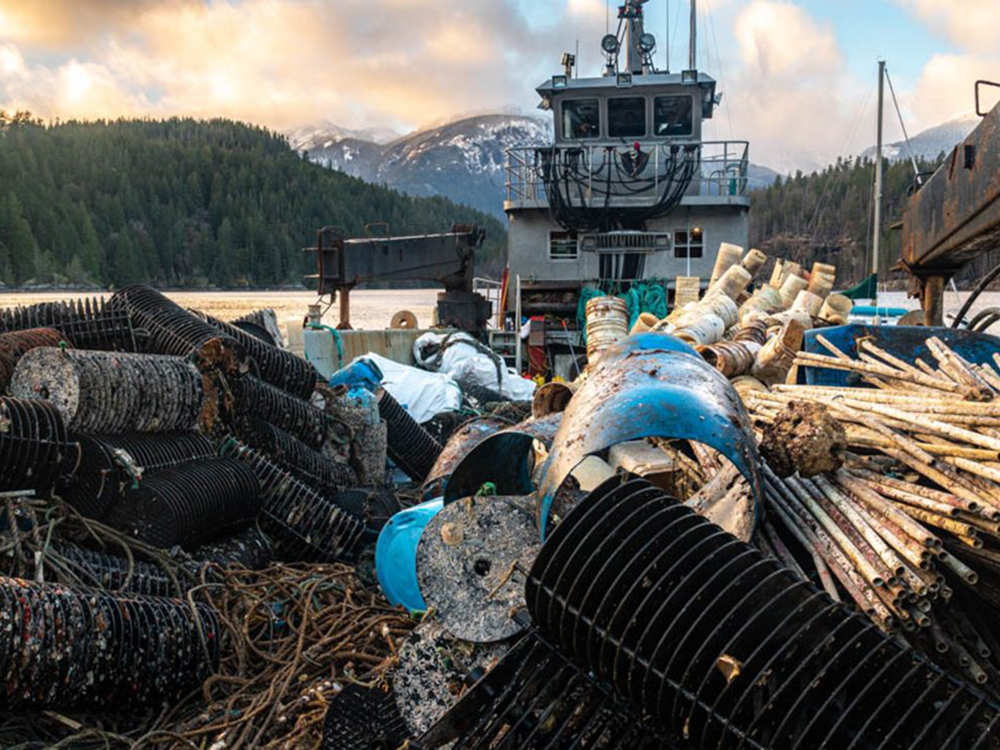
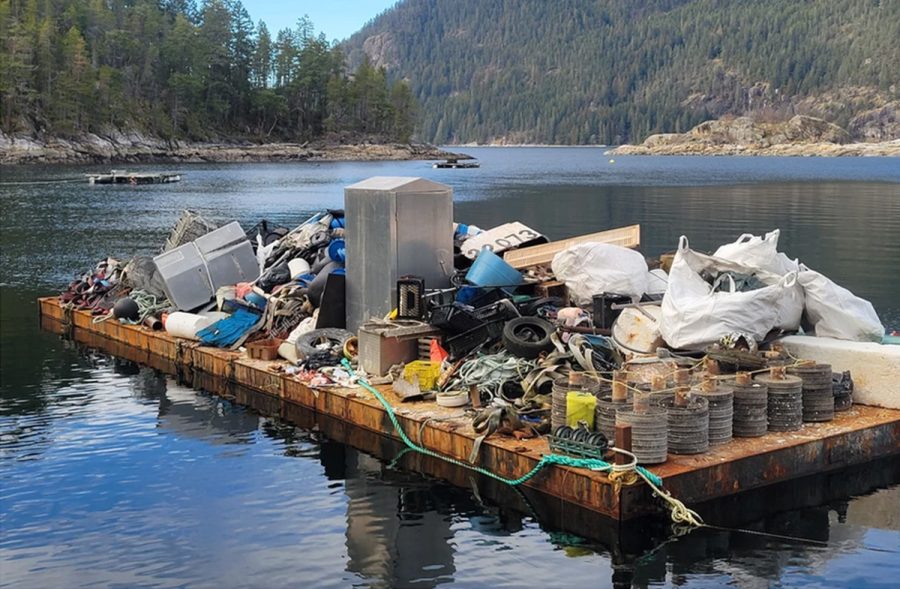
“You come upon a mound of gear that is seemingly infinite — a huge mess everywhere you look,” he says. Abandoned nets, ropes, buoys, concrete blocks, plastic buckets and trays, PVC pipes, generators, steel anchors, iron rebar, floats, gangways, docks, drums, tires and polystyrene foam can all linger, threatening the marine environment.
During one disturbing stint at a derelict operation on northern Vancouver Island, for instance, workers with the non-profit Ocean Legacy Foundation found that a group of river otters had started building dens inside the polystyrene foam from decaying floats and were eating the marine life growing on it.
The federal government is more optimistic that open-net-pen salmon farmers in 2029 won’t leave an environmental mess.
Multinational companies dominate salmon farming in British Columbia and are “quite professionalized and generally highly compliant” with regulations, says Brenda McCorquodale, senior director of the aquaculture management division at Fisheries and Oceans Canada, commonly referred to as DFO, on the West Coast. “We’re not anticipating there’d be some sort of abandonment of infrastructure.”
Boulton’s experience with shellfish aquaculture, however, emphasizes the importance of vigilance. “There’s a need for oversight — a third party, for sure — on sites to supervise the decommissioning,” he says.
Nico Prins, executive director of the BC Shellfish Growers Association, says government oversight of marine debris issues at shellfish facilities has historically been lax.
“I’ll be honest with you,” Prins says. “The level of enforcement probably hasn’t been what was required or what has been needed.”
“I know there are plenty of shellfish farms that are in a pretty bad state of repair,” he adds. “There’s a lack of... government regulators to achieve enforcement of the conditions.”
In recent years, the government has been trying to make a dent in the problem, working to clean up sites and prevent more farm owners across the province from cutting their losses and walking away from nets, floats and other equipment. But cleaning up ocean debris requires money — and lots of it.
Provincial government regulations require licensed aquaculture operations, including salmon farms, to outline their future debris management plans and post a security deposit to cover cleanup. But the amount set aside, Prins says, can fall short of what’s required. In the past, some purchasers of farm sites have also inherited the costs of removing the accumulated mess. Otherwise, taxpayers can wind up paying the price.
In 2020, the province launched Clean Coast, Clean Waters, an initiative that has so far spent roughly $35 million to remove more than 2,100 tonnes of marine debris and 215 derelict vessels from the province’s coast. The program tackled the first two derelict aquaculture sites in 2024.
The Rugged Coast Research Society, says Boulton, specializes in cleaning up remote and hard-to-reach parts of the coast. The organization’s process of trash removal starts with using a remotely operated vehicle — equipped with a camera and grabber claw — to survey the site. Often, they’ll complement this visual search with side-scan sonar to identify hot spots of trash and map out targets. From there, four commercial divers work in limited visibility and at risk of entanglement to rig up gear for removal. Then, they’ll use a hydraulic crane to haul the material to the surface to be cleaned, sorted by type and brought to shore. Typically, about half the haul is repurposed or recycled, with the rest going to landfill. Depending on the depth of the water, the weather and the tides, divers may have only a few minutes to work.
“It’s a very challenging industry,” says Dylan Smith, the owner of BC-based Deep Search Diving.
Since 2020, Smith’s company has been contracted by governments or private operators to survey 92 shellfish farms, half of which he’s already cleaned up. Typically, the company’s services cost between $7,000 and $35,000 — but they can climb as high as $70,000 if a lot of gear has drifted beyond the reach of divers.
The work is taxing but rewarding, says Boulton. “It takes months to get these projects going, then you end up in the field. It’s a lot of labour, very dirty. But seeing a barge fully loaded up with debris from a site — our crews feel a sense of relief and accomplishment.”
Tossing money at debris cleanup is one thing, but changing future behaviour is another.
Over the past five years, DFO has launched several initiatives targeting marine debris, including a mandatory tagging program to more easily identify who owns aquaculture equipment that goes rogue, and containment measures to prevent foam flotation from breaking free.
One of the big game-changers occurred in 2022 when federal regulations began forcing aquaculture operators to hire divers or use remotely operated vehicles to survey the sea floor for old gear within their operating areas and document its removal. The goal, says McCorquodale, is to make licence holders “responsible for knowing what’s going on underneath their sites and keeping the area clean and free of debris.”
As the world increasingly turns its attention to the environmental woes caused by ghost nets, microplastics and other forms of marine debris, increased scrutiny of the hidden costs of aquaculture on the ocean environment couldn’t come at a better time. ![[Tyee]](/design-article.thetyee.ca/ui/img/yellowblob.png)
Read more: Environment








Tyee Commenting Guidelines
Comments that violate guidelines risk being deleted, and violations may result in a temporary or permanent user ban. Maintain the spirit of good conversation to stay in the discussion and be patient with moderators. Comments are reviewed regularly but not in real time.
Do:
Do not: