

 SHARE:
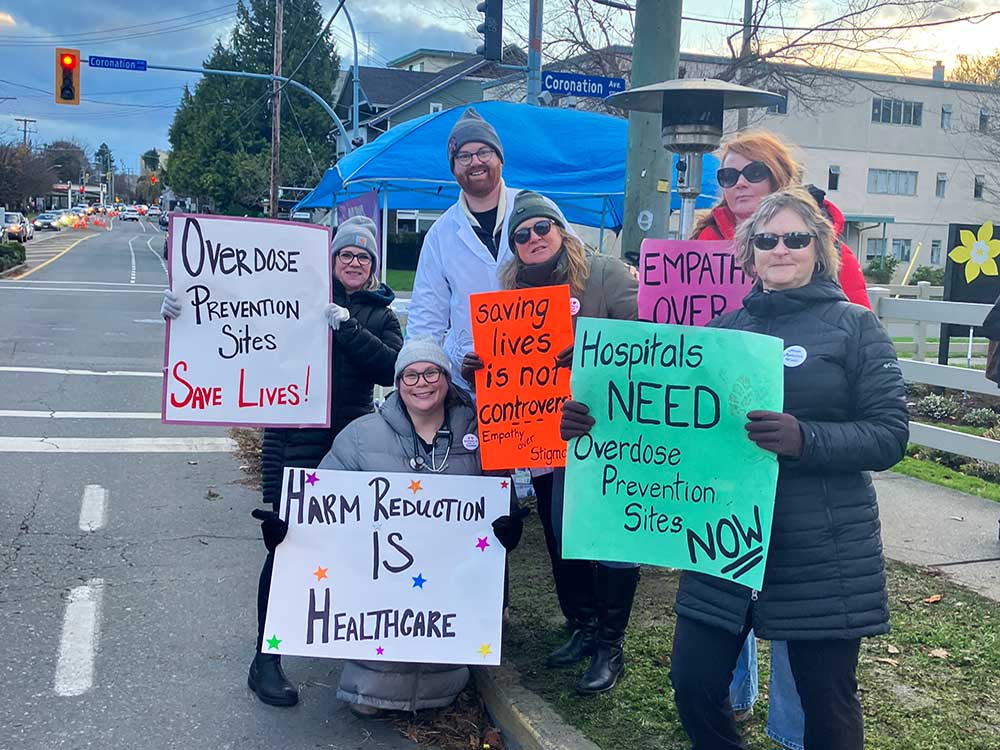
Teams of doctors say they’re exhausted and emotional after spending the week volunteering their time at two pop-up overdose prevention sites near Nanaimo Regional General Hospital and Royal Jubilee Hospital in Victoria.
Volunteers with Doctors for Safer Drug Policy, an independent group of physicians from across Vancouver Island who work with people who use substances, advocating for compassionate, inclusive and evidence-based care for all, opened the sites from 10 a.m. to 6 p.m., starting Monday. The Victoria site was only planned to run until Wednesday. The group intends to keep the Nanaimo site open until the end of day Friday.
The unsanctioned overdose prevention sites have been staffed with physicians and volunteers trained in overdose prevention, and supported by harm reduction organizations including Moms Stop the Harm, the Nanaimo Area Network of Drug Users and the Harm Reduction Nurses Association.
The sites have provided harm reduction supplies, such as sterile needles and alcohol swabs, connected patients with referrals to treatment and detox, and allowed people to consume drugs while supervised by someone who can intervene if overdose occurs.
The sites did not provide drugs.
As of Wednesday the Nanaimo site had witnessed 14 drug consumptions (13 hospital patients and one community member), distributed 11 harm reduction kits, connected one person with housing and community supports and helped one woman start her application for treatment, said Dr. Jess Wilder, a family and addictions medicine doctor in Nanaimo.
The Victoria site had a slightly lower turnout but was very warmly received by community members in the area, said Dr. Ryan Herriot, a family and addictions medicine doctor in Victoria.
Patient dies of overdose in Nanaimo hospital
Speaking with The Tyee Wednesday, Wilder was emotional as she explained how the team wasn’t able to help a patient who died in a Nanaimo hospital bathroom after using drugs unsupervised at 4 a.m. Tuesday morning. The BC Coroners Service confirmed it is investigating this overdose death.
The man who died had previously been a patient of Wilder’s and had even used the pop-up overdose prevention site Monday afternoon while waiting to be admitted to hospital.
“He was declared dead in the very building he went to for care,” she said. “It’s stories like this that fuel the drive to keep doing this work. He already showed us Monday when a safe spot was available he used it, and when he didn’t have one he did something unsafe, which caused him to die unnecessarily.”
Herriot similarly had to pause his interview with The Tyee and take a moment to gather his emotions when he spoke about support the community had given the Victoria overdose prevention site.
“Of course I have a lot of grief, just like many people,” Herriot said. “We must be approaching the saturation point where just about every adult — or every person — in B.C. knows someone who has died from overdose.”
More than 16,721 unregulated toxic drug deaths have been recorded between January 2016 to September 2024 in the province, with annual deaths steadily climbing since 2016. Numbers for October have not yet been released.
“When it comes to people with real decision-making power, I’ve run out of tolerance for kind words,” Herriot continued. “We’re heading into our ninth year of this emergency and I fear when people read about that they will think it is because the problem is unsolvable. Like it must be so difficult to solve, otherwise we would have solved it.”
That’s not true, Herriot said. “We know the solutions. Government knows the solution. We just have to do it,” he said.
Herriot says solutions could include widespread overdose prevention sites, access to a regulated supply of substances of known purity and potency, more access to treatment like opioid agonist therapy and trauma therapy, and working to tackle poverty, for example by increasing social assistance and disability rates and making sure they keep up with inflation.
Herriot says he got to speak with an eight-year-old while she was walking home from school with her parents, passing by the unsanctioned OPS, and “she gets it” and supports the site.
“I was speaking with my own eight-year-old yesterday, and she asked me what happens when I leave, will people die?” Herriot said. “I said yes, but at some point you have to let someone else do the work.”
The overdose prevention sites were temporary because they were funded and run by volunteers who were also taking time off work, Herriot said.
Wilder and Herriot both told The Tyee they hoped the pop-up sites would raise awareness for the need for accessible government-run overdose prevention sites at all major hospitals across the province.
Speaking with The Tyee for a piece published earlier this week, Wilder estimated there are between 25 to 50 patients at every major B.C. hospital right now who use unregulated drugs and who would benefit from being able to access an overdose prevention site.
When patients who use drugs need hospital care they are put in extremely uncomfortable and dangerous positions, she said. A patient may be cut off from their regular dealer and harm reduction strategies and have to use in a bathroom or off hospital grounds, which increases their risk an overdose going unnoticed.
In an emailed statement Dr. Réka Gustafson, Island Health Chief Medical Health Officer, said major hospitals have Addiction Medicine Consult Service teams who work with patients to create individualized care plans, “that meet the needs of patients, protect the safety of staff and other patients and align with provincial policies and regulations.” These teams help manage withdrawal symptoms and have the goal of reducing the need to use substances in hospital and supporting patient comfort, she added.
However, the toxicity of the current unregulated drug supply means addictions medicine teams might not be able to prescribe a patient what their body needs to avoid withdrawal, Wilder said.
Herriot said the fentanyl that people use from the unregulated supply is more powerful than what a doctor can prescribe in hospital, and Wilder added that many people are addicted to benzodiazepines, which can cause withdrawal seizures if doctors aren’t able to find the right dosage to give a patient.
These seizures can cause injury due to a lack of oxygen to the brain or other medical complications, she added. Benzodiazepines are a drug class that were involved in 43 per cent of all unregulated drug deaths in 2023, according to the BC Coroners Service.
Not welcome on hospital grounds
On Monday Wilder said Nanaimo RCMP and hospital security guards met the volunteers and told them they were not allowed to set up on hospital grounds.
When The Tyee asked why the health authority did not support these overdose prevention sites, Gustafson said the sites were not supported because it had to “ensure that all services provided on Island Health property adhere to regulatory, safety and clinical standards.”
The team instead set up across the road, within sight of the emergency room entrance. Wilder says the team is set up on private property but no one has approached them to ask them to move. If asked Wilder says she would respect the request, but would also take the time to explain what the volunteers are doing and why the service is important.
In Victoria the team of volunteers was similarly told they could not set up on hospital grounds and had to set up a couple blocks away. Herriot said they are still across the street from the hospital, but no longer within sight of the ER.
On Tuesday he said a Victoria Police officer told the team to take down a tent because it facilitated drug use.
Herriot says they complied and took down the tent, but after speaking with their lawyer put it back up Wednesday.
On Wednesday the officer once again told them to take it down.
In a recording of police and volunteer interactions shared with The Tyee, an officer is heard explaining that possessing controlled substances is illegal under federal law, and having a tent that facilitates drug use makes the volunteers party to possession.
This is similar to why you are not allowed to let someone use drugs in your car, the officer explained.
The officer is then heard saying he would not arrest the person currently using drugs and being supervised by the volunteers.
“Let him finish whatever he is doing and then when he is done just deconstruct the canopy,” the officer says.
In an emailed statement to The Tyee, Victoria Police spokesperson Griffen Hohl said the VicPD did not ask or tell people to leave the site or remove signage and respected their right to protest peacefully.
But the independent group of volunteers do not have the right to set up an “unsanctioned safe injection site to supervise persons who wish to possess or consume drugs,” Hohl said.
Wilder and Herriot told The Tyee they would be opening and operating supervised consumption sites under the 2016 Order of the Minister of Health, which calls for overdose prevention sites to be set up “for the purpose of monitoring persons who are at risk of overdose, and providing rapid intervention as and when necessary… in any place there is a need for these services.”
Hohl said the 2016 order only applies to B.C. emergency health services and regional health boards. As the group of volunteers has identified themselves as independent, the order doesn’t apply to them, he said.
The Nanaimo RCMP told The Tyee they would not be issuing a comment.
Herriot says he is not arguing with the law, he added he is frustrated that the police did not use more discretion in this case.
“B.C. has a strong history of these things being allowed to operate whether government sanctioned them or not because everyone understands the crisis we're in,” he said. “It’s surprising and disappointing.” ![[Tyee]](/design-article.thetyee.ca/ui/img/yellowblob.png)
Read more: Health, Rights + Justice




Tyee Commenting Guidelines
Comments that violate guidelines risk being deleted, and violations may result in a temporary or permanent user ban. Maintain the spirit of good conversation to stay in the discussion and be patient with moderators. Comments are reviewed regularly but not in real time.
Do:
Do not: