

 SHARE:
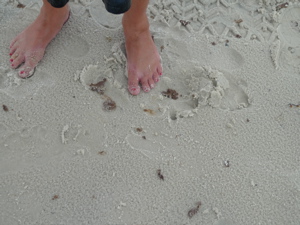
Stare straight ahead towards the horizon at the edge of the Gulf Coast of Alabama, and the oil drifting on to the shore can easily be mistaken for something natural dragged in by the tide.
From a distance above, the scattered coppery splotches floating on the surface of the ocean cannot be anything else, and up close, the mud-brown globules on the pale sand are unmistakable.
Still, there are people around me on the beach who can't -- or won't -- believe what is washing up on their beach until it sticks to them.
Jennifer Munoz, tipsy, weepy, clutches her son's arm with one hand and her drink with the other. She adds to her existing unsteadiness by lifting up an oily foot.
"Look," she demands to no one in particular. "This is a goddamn thing. Now it's on me."
For weeks after the BP oil started billowing into the Gulf of Mexico, the people of Alabama were in denial. Surely it couldn't reach their little share of the Gulf shore. So much beach, so little of it in Alabama. There was a blind hope that the tides would be different, the winds would shift.
'The whole world, including us, is guilty'
As with every year in this region, hurricanes threaten; few turn out to be more than bluster.
Ivan and Katrina, back-to-back hurricanes in 2004 and 2005, racked up billions in damages to homes and businesses, but after those two years of havoc, relative peace, storm-wise, returned. Then on April 20th, 66 kilometres off the coast of Louisiana, a drilling rig exploded, 11 workers died and the slick began advancing towards the shorelines of the Gulf states.
"We're used to storms, hurricanes," says Mark Foster with the Alabama Gulf Coast Visitors and Convention Bureau Director. "Everyone down here initially thought, well now this is a terrible thing but we'll get it fixed up, cleaned up and go on. But we now know there's no timetable for this."
By June, ads trumpeting that the Alabama coast was oil-free had to be scrapped. Booms began attempting to encircle floating fragments of the slick in hopes of keeping more from reaching the beach, and the double red flags went up banning swimming in the greasy ocean. On July 30, the flags came down but officials warned the oil could still be present.
The beach has been part of Kristie Taylor's life every summer for as long as she can remember; after the four-hour drive from Tuscaloosa, arriving at the shoreline has always been followed by a beeline for the ocean. This year, she bursts into tears as she says she had to physically restrain her toddler from doing the same this summer.
"As soon as she gets on the beach, she's running," says Taylor. "We love our little section of the world here. This is our beach and the whole world, including us, is guilty for what happened because we have become so dependent on oil. Now there's oil here where we don't want it and we're responsible."
Sticking to reality
The Gulf Coast is home to about 9,000 people spread along Alabama's 52-kilometre stretch of beachfront, one of the smallest shorelines in the gulf. During the summer, the population triples, with most visitors coming south from other regions in the state.
Except for this strip, Alabama is as vast as the prairies with the same timelessness that could be any era when you turn your gaze from the road ahead to look sideways and see nothing but land.
On a billboard, a familiar name and recognizable face, George Wallace, is campaigning to be the state treasurer and it doesn't seem that odd.
Arrive at the Gulf Coast and there is no doubt that time has moved on. Here in this notch, a corridor to the ocean, is an Asian-like city of high rises. Southern Alabama is flat but this southern most tip is stacked upwards.
Florida, next door, has more than 1,000 kilometres of beach and is so close that every year for the past quarter of a century, there has been a competition, inspired presumably by alcohol, of tossing a mullet (fish, not the hairstyle) between the state lines. Local proudly call this stretch the Redneck Riviera.
Talk to anyone on the shoreline long enough and they start to choke up. Then a forced cheerfulness.
"I'm calling it oil spill brown," says Stacie Russell of Kilmichael, Mississippi, pointing to her fresh pedicure, green toe nails smeared with rust-coloured clumps. "I picked green cause I thought it wouldn't clash."
Riding the tide
White-suited clean-up crews mingle among the beach-goers during the day, scooping up oil-soaked debris, gooey tar balls. At night, mechanical harvesters comb through the sand and out over the ocean, lights from clean-up ships glow, turning visible the specks that are lost in between the horizon and skyline during daylight.
In chairs facing the shore, Kristie Taylor and her family talk quietly in the dark; down the beach a short distance, Stacie Russell and her girlfriends who all went for pedicures before their beach vacation, stretch out on towels and debate where they will go for dinner.
A few hours later at dawn, the sand once again looks pristine. The tide rolls in and the sheen returns, a little less every day as the determined people of Alabama stride through the sand and pick up what they can on the soles of their feet and in between their toes. ![[Tyee]](/design-article.thetyee.ca/ui/img/yellowblob.png)
Read more: Environment








Tyee Commenting Guidelines
Comments that violate guidelines risk being deleted, and violations may result in a temporary or permanent user ban. Maintain the spirit of good conversation to stay in the discussion.
*Please note The Tyee is not a forum for spreading misinformation about COVID-19, denying its existence or minimizing its risk to public health.
Do:
Do not: