


 SHARE:
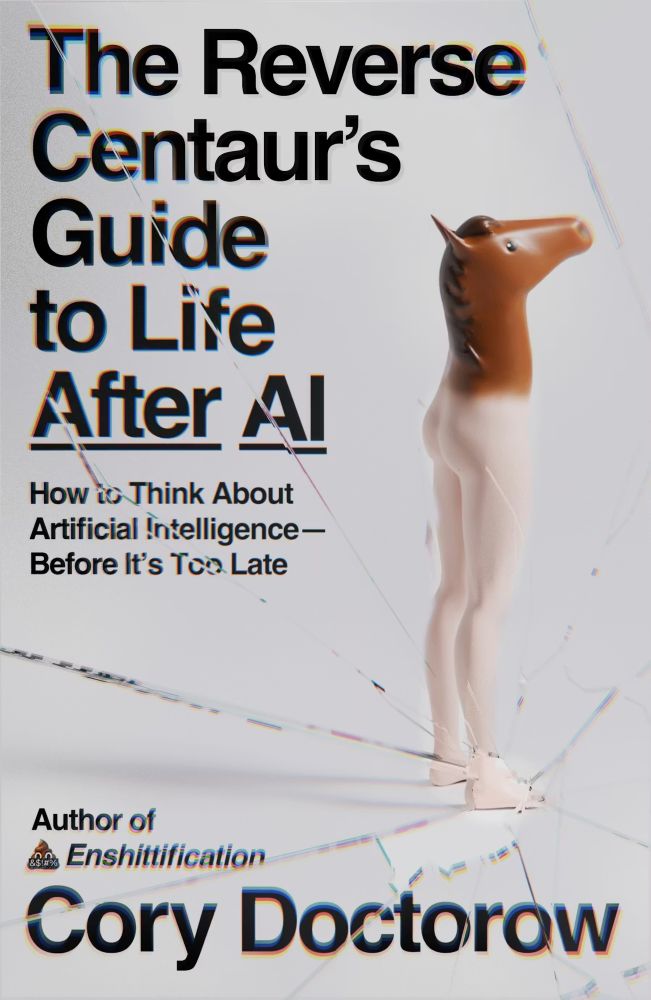
The Reverse Centaur’s Guide to Life After AI: How to Think About Artificial Intelligence — Before It’s Too Late
Cory Doctorow
Farrar, Straus & Giroux (2026)
In tech-bro dialect, a centaur is a human assisted by a machine, such as a motorist or a user of hearing aids.
“A reverse centaur,” Cory Doctorow tells us, “is a human who is conscripted into acting as an assistant to a machine,” like users of social media providing themselves as targets for advertisers.
In his latest book, the Toronto-born science fiction author and tech critic argues that artificial intelligence will make us all reverse centaurs, or assistants to machines, if it succeeds.
He consoles us with a promise that AI is a classic investment bubble and will soon pop. It’s an argument that makes me oddly cheerful about the prospect of global economic collapse.
‘If you’re not at the table, you’re on the menu’
In judging technology, Doctorow writes, “Stop thinking about what the gadget does, and pay attention to who the gadget does it to and who the gadget does it for.”
If the gadget does something to you, to benefit its inventor, or advertisers, or the police, or scammers, you’re on the wrong end of a power relationship. As Prime Minister Mark Carney famously observed, “If you’re not at the table, you’re on the menu.”
The marketing of AI in the past few years, especially since the release of ChatGPT in 2020, has been awe-inspiring. It has many of us worried that AI will take our jobs, and possibly destroy the world when it improves itself into godlike power.
This marketing, Doctorow says, isn’t aimed at us; it’s aimed at investors.
That’s because investors want to put their money into a growing corporation whose greatest profits are in the future. When a corporation stops growing, Doctorow explains, it’s considered “mature,” ticking along but unlikely to deliver a hot new product or service that will generate a surge in profits.
“Once a company stops growing,” he says, “it becomes vastly overvalued, because it is now a mature company.”
Grow or die
This is especially true of the tech sector. Even a multitrillion-dollar corporation like Apple still wants to be seen as growing, always on the verge of attracting a tsunami of money thanks to some new gadget or indispensable app.
No such gadget or app will be built in anybody’s garage. It will take hundreds of millions of dollars just to construct the global supply chains for such gadgets, and the tech corporations are competing against one another for investments.
Very early on, the AI companies knew they needed to make investors, governments and consumers all believe that a race was on — not just between companies, but between nations like the U.S. and China, to produce ever better versions of the technology.
The logic went something like this: if Apple faltered, OpenAI would rule. If the U.S. didn’t commit to AI, China’s versions would conquer the world. Those who invested in the winner would enjoy enormous wealth.
To strengthen this belief, tech companies adopted a marketing strategy for AI that Doctorow calls “inevitabilism,” which he describes as “the insistence that there is only one conceivable way to do things, and any problems you’re experiencing aren’t anyone’s fault, they’re just inescapable reality.”
He cites the late British prime minister Margaret Thatcher, who famously sold neoliberal economics by saying, without evidence, “There is no alternative.”
But Doctorow insists we must have choices. And we can’t simply accept the billionaires’ decisions for using AI.
“The boss who tells you the only way to use a cash register is to fire your coworkers and make you do their jobs, too, is practising vulgar Thatcherism,” he writes.
“They’re trying to bamboozle you with inevitabilism.”
Doctorow sees “the bosses,” the managerial classes, as a major market for AI. The bosses are united in their dislike of having to hire workers, and therefore excited by the prospect of replacing them with AI.
Even those who remain become reverse centaurs, mere proofreaders of AI-generated code. He uses the example of Amazon’s coders, who once enjoyed high salaries and endless perks.
They “are now being worked like Amazon’s warehouse workers and delivery drivers, among the most abused workforce in the wealthy world,” he writes.
Two-thirds of a trillion dollars
We are in a bubble, Doctorow insists, and it’s going to pop soon. “Being a growth company is awfully nice,” he writes. “But it’s also awfully precarious.”
He cites the case of Nvidia, which lost $600 billion in one day in 2025 after China released DeepSeek — an AI-powered chatbot vastly cheaper than American models. As the maker of expensive high-end chips used by AI companies, Nvidia saw its stock lose, as Doctorow describes it, “two! thirds! of! one! trillion! dollars!”
The company eventually recovered, but Doctorow warns that “the higher a company flies, the more likely it is that if it stalls out, it will never recover from its tailspin, because the more a company is growing, the higher its P/E [price to earnings] ratio will be and the more its stock will drop once it is perceived as ‘mature.’”
So much money, but few profits
AI builds itself by scanning millions of words to find statistically likely answers to our questions. Increasingly, Doctorow notes, those words are themselves AI-generated, and therefore more likely to be wrong.
As computer scientists pointed out in the days of room-sized computers running on vacuum tubes, “Garbage in, garbage out.”
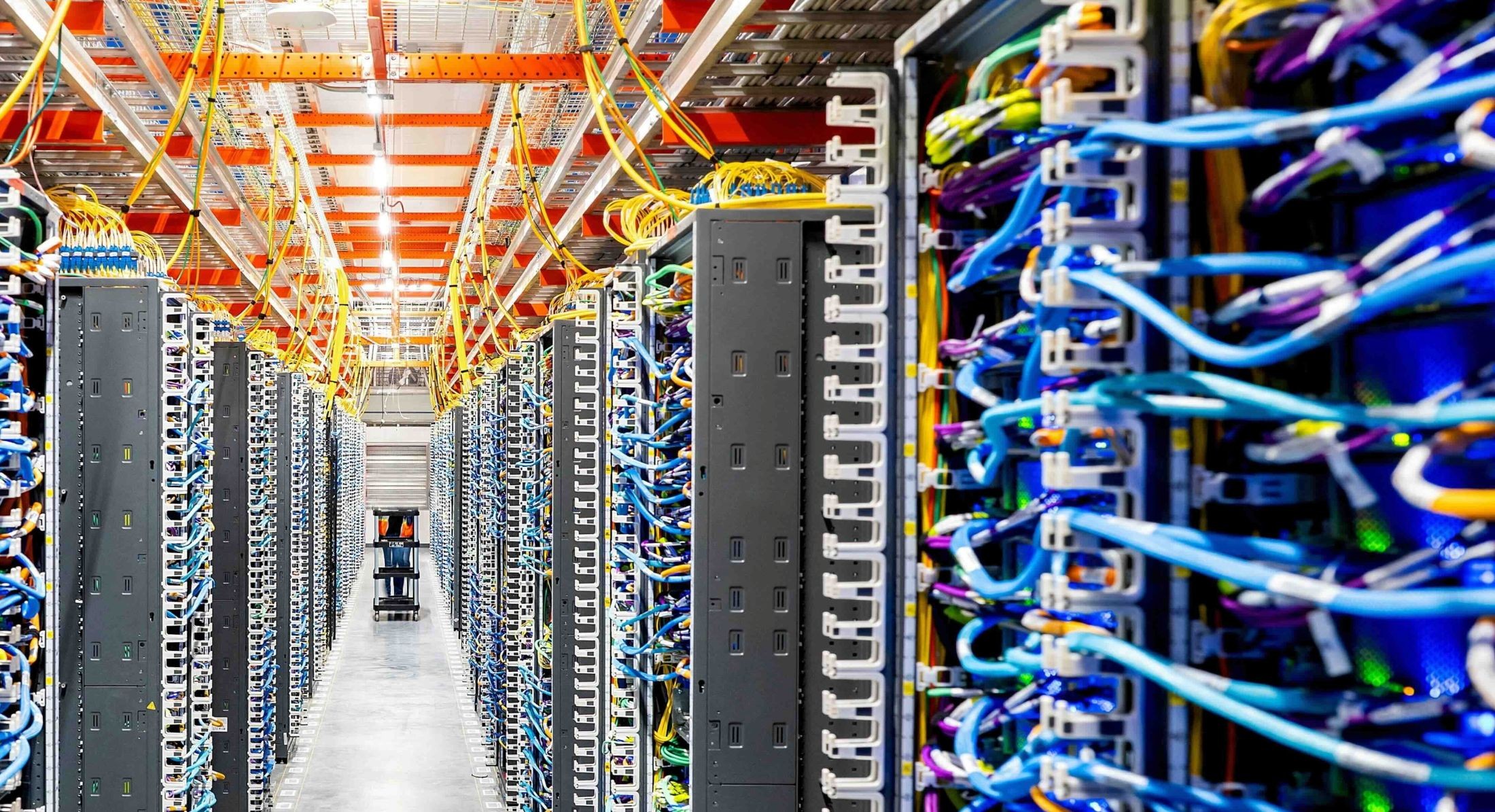
Doctorow points out that so much money is going into AI and data centres that the companies involved simply can’t make a profit, ever.
No matter how many high-salary jobs AI replaces, it won’t bring in enough to cover the investment in AI, let alone make a profit.
The newly unemployed may well use AI to design their résumés, but that won’t be a major revenue source either.
An old union joke comes to mind.
Henry Ford shows Walter Reuther, then the head of the United Auto Workers, a new robot working on the assembly line.
Ford asks: “How are you going to get the robot to take out a union card, Walter?”
Reuther replies: “How are you going to get the robot to buy a car, Henry?”
Consistent underperformance
“Where AI is deployed in commercial settings,” Doctorow writes, “it consistently underperforms expectations. During the drafting of this book, an MIT study found that 95 per cent of commercial AI deployments fail with ‘no measurable impact on profit.’ The news sparked a panicked sell-off of AI-related stocks.”
Many investors know they’re in a bubble, he suggests, and they hang on in hopes of selling out at the top of a doomed market.
“Remember,” Doctorow warns, “seven giant AI companies account for 35 per cent of the U.S. stock market. Amputating 35 per cent of the market is going to destroy a ton of innocent bystanders, including people whose retirement savings are invested in index funds considered the safest of all safe bets. We’re talking about a crash that will put 2008 in the shade and meet or exceed the pandemic sell-off.”
Doctorow’s arguments are persuasive and oddly cheering.
We will be rescued from the AI apocalypse by the collapse of AI and the global economy.
Our pension funds may be lost in the rubble, but the oligarchs and their purchased politicians will face a crisis far worse than, say, the beginning of the COVID-19 pandemic.
Their credibility and power will evaporate with their wealth.
Their data centres will go dark, or never be built at all.
The bright side of collapse
Implicit in such a collapse is a sharp reduction in the use of fossil fuels. Jobless workers will not holiday in France or Bali in the foreseeable future.
Pipeline projects will stall because demand for petroleum will fall.
Governments will welcome renewable energy simply because it’s cheaper.
Life will not always be pleasant, but it will be far better than the subjugation and surveillance the oligarchs dream of.
It’s noteworthy that AI has so far failed to solve its own problems, from copyright to CO2 emissions to unemployment.
But Doctorow is no Luddite. He foresees a post-bubble world where AI can be useful in automating various tasks that now take up too much human time.
He thinks chatbots acting as therapists or counsellors could persist — but only if the bots are on the users’ devices, not in the cloud. AI as a cloud-based surveillance tool should be out of the question.
“The future is up for grabs,” Doctorow concludes.
“It is not inevitable. AI isn’t a genie that can’t be put back into a bottle. How we use AI is up to us. Whether we use AI is up to us. The future can be ours, if we never stop remembering that the most important fact about a technology isn’t what it does, it’s who it does it for, and who it does it to.” ![[Tyee]](/design-article.thetyee.ca/ui/img/yellowblob.png)
Read more: Books, Science + Tech










Tyee Commenting Guidelines
Please note that email notifications for replies are not currently working due to a software issue which may be resolved in a future update.
Comments that violate guidelines risk being deleted, and violations may result in a temporary or permanent user ban. Maintain the spirit of good conversation to stay in the discussion and be patient with moderators. Comments are reviewed regularly but not in real time.
Do:
Do not: