


 SHARE:
In 1946, speaking at Westminster College in Fulton, Missouri, former U.K. prime minister Winston Churchill gave his famous “Iron Curtain” speech declaring an end to the wartime alliance with the Soviet Union and the start of the Cold War.
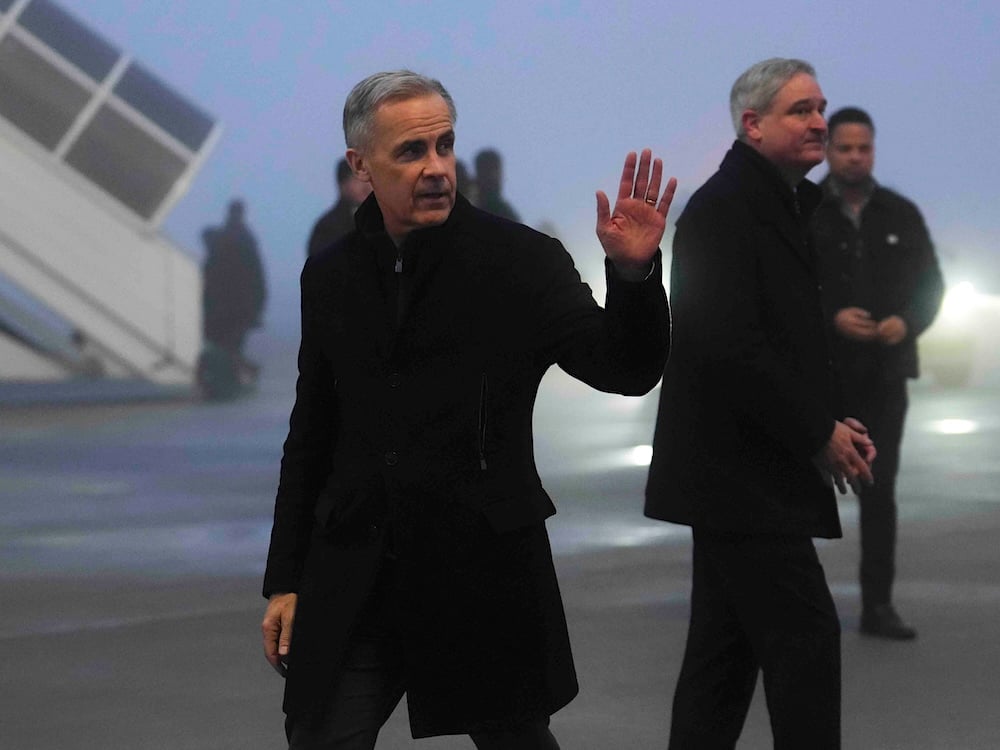
Eighty years later, speaking at the World Economic Forum in Davos, Switzerland, on Tuesday, Canada’s Prime Minister Mark Carney declared the end of the “international rules-based order” that had won the Cold War but lost the resulting peace. It is hard to recall a similar speech by any national leader in the past century.
Carney spoke “about the rupture in the world order, the end of a pleasant fiction and the beginning of a harsh reality where large, main-power geopolitics faces no limits, no constraints.” He compared the rules-based order to the performative support for communism in the Soviet satellite nations, when every greengrocer had a “Workers of the world, unite” sign in the window.
The implication was that the United States, like the Soviet Union, was just another goddamn hegemon, and not the shining city on a hill it claimed to be.
Rather than bewailing Canada’s sudden loss of its hegemon, Carney called on middle powers to create “a new order that encompasses our values, such as respect for human rights, sustainable development, solidarity, sovereignty and territorial integrity of the various states.”
That makes Carney’s 2021 book Value(s): Building a Better World for All a useful guide to the world he envisioned at Davos.
As a banker, Carney faced the credit collapse of 2008, the shock of Brexit and the outbreak of COVID-19. As a former United Nations special envoy on climate action and finance, he understands the money involved in confronting climate change — or failing to.
And before running for the Liberal leadership, from 2020 to 2022 he was vice-chair and head of transition investing at Brookfield, a firm managing a trillion dollars in assets. When Brookfield spun off Brookfield Asset Management, he became chair of the new company until early 2025.
Carney somehow managed to write Value(s), a 528-page book, while also working for Brookfield. First published in 2021, early in the pandemic, it was republished as a paperback the following year with a new preface.
On first reading, it seems like an idealistic attempt to portray capitalism with a human face, as concerned with society as with profits — and it seems dated by its optimism about public health, climate change and the wisdom of corporate leaders.
But after his Davos speech, Carney’s book also offers glimpses of how he intends to go about building Canada into a resilient and sustainable nation next door to a collapsing great power.
Value(s) is strikingly well written and well organized. Carney tells us what he’s going to do in each chapter and section, does it, and summarizes his points concisely.
While its main audience is clearly the financiers and CEOs of North America and Europe, he explains his points clearly for all readers.
Foundational values
Carney’s thesis is that “value” has both an objective meaning (money) and a subjective meaning that’s much more complex.
In his book he lists subjective values as the foundation of any successful economy:
- dynamism, to help create solutions;
- resilience to recover from shocks while protecting the most vulnerable;
- sustainability, defined as “long-term perspectives that align incentives across generations”;
- fairness, especially in markets;
- responsibility, making individuals accountable for their actions;
- solidarity, “whereby citizens recognize their obligations to each other and share a sense of community and society”; and
- humility, “so that we act as custodians seeking to improve the common good.”
Any enterprise that focuses on money, he argues, is likely to fail in the long run; it concerns itself with increasing “shareholder value,” when the shareholders are merely “the last to be paid” from a long list of stakeholders who should benefit from the enterprise: suppliers, workers, customers, governments.
Failure to take stakeholders into account, Carney says, weakens social values like solidarity and creates ever-increasing inequality.
Much of Carney’s book now seems dated. He praises Canadians for their solidarity in support of public health during the early pandemic, but that solidarity is now long gone and we have over 5,000 measles cases as a result. He praises corporations that work to transition to renewable energy, when his support for a new pipeline only delays such a transition.
‘No libertarians in a financial crisis’
But he understands the financial world and is not in awe of the bankers and hedge fund managers. “Just as there are no atheists in foxholes,” he dryly observes, “there are no libertarians in a financial crisis.”
One passage stays with me. Describing the months before the United Kingdom voted on Brexit, Carney tells us everyone expected it to be defeated. But he planned for failure, maintaining reserve funds in the Bank of England that saved the markets when the votes were counted.
With his Davos speech Tuesday, Mark Carney addressed the world as it is, not as he wished it to be in his book. But if he is serious about the value of the values he outlines in his book, we can expect some dramatic measures in the near future.
Carney’s world travels are clearly in search of dynamism, resilience and sustainable partnerships with everyone from Denmark to China to Qatar. We will see more such partnerships emerge, and we can expect Donald Trump to try to punish Canada for them.
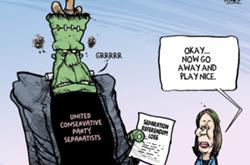
Trump’s efforts will only strengthen solidarity. Groups like the anti-vax convoy people and Alberta separatists will be overwhelmed by the vast mass of Canadians lined up behind Carney. Every insult from Trump will drive more Canadians to enlist (no doubt including many coming home as refugees from the United States).
Economically, the transition from vassal state to free state will be as rough as the transition to net-zero emissions. But if fairness is a real value for Carney, he will have to support the vulnerable with higher taxes on the wealthy. Canada ran the war with “dollar-a-year men,” corporate managers who used their skills to build a formidable military. Carney may draft some of our current masters of the universe into similar service.
We can expect some of our partnerships to take some getting used to, like investors from Qatar, China and India. But they are what they are, and if we make deals with them we can demand that if we don’t interfere with them, they won’t interfere with us either.
It’s predictable that the United States will interfere non-stop, inserting spies into companies and government agencies while flooding our social and legacy media with disinformation. We should be capable of countermeasures, like the Finns and Swedes.
Win the war before you fight it
The Chinese philosopher of war Sun Tzu advises generals to win the war first, before fighting it, by knowing their enemies. Carney knows his adversaries very well, and his allies. He has spent his first months in office preparing for a confrontation, and now he has confronted Donald Trump before the whole world.
I suspect he will call a snap election sometime this spring — an election that he knows will give him a strong majority government and a mandate to carry on. The Conservatives will be trapped by their own far right, who will make Pierre Poilievre (or his successor) look like a quisling. Alberta Premier Danielle Smith will force a smile with every barrel of bitumen Carney sells to China.
The Iron Curtain seemed eternal, but the Cold War ended. The implosion of the rules-based order will take a long time, too. But a new order, what Carney calls values-based pragmatism, is already emerging to replace it. ![[Tyee]](/design-article.thetyee.ca/ui/img/yellowblob.png)








Notice about commenting changes
The Tyee’s commenting system will be moving to a new platform on Nov. 12. If you’re already a Tyee commenter you must register with the new system on or after Nov. 12 with your preferred username.More information can be found here.