

 SHARE:
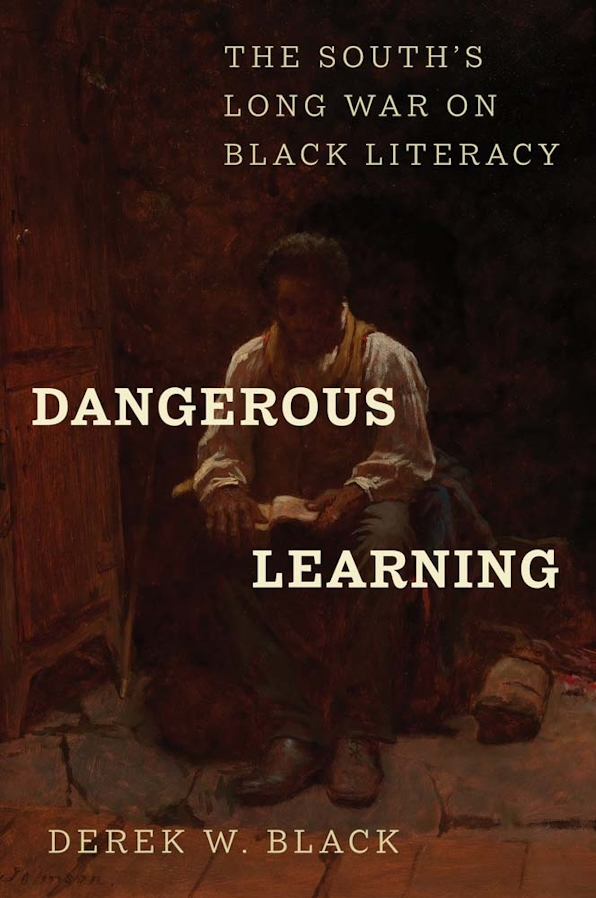
Dangerous Learning: The South’s War on Black Literacy
Derek W. Black
Yale University Press (2025)
Two hundred and eighty-five years ago this month, the Negro Act of 1740 was passed in what was then known as the Province of South Carolina. This new law, enacted eight months after the largest slave rebellion in the Southern Colonial era, was aimed at preventing the next one. Its target was literacy among slaves, a trend which has led to some “great inconveniences,” lawmakers wrote.
Even the Bible was dangerous in the wrong hands. Any slave who reads straight through to Exodus may find, and even memorize, the verse that reads: “He who stealeth a man and selleth him should be put to death.”
Enslavers were cautioned by anti-literacy lawmaker Whitemarsh Seabrook, the 63rd governor of South Carolina, to teach from the Bible to slaves with selective precision, limited to “points essential to his salvation.” Any more, Seabrook wrote in “An Essay on the Management of Slaves, and Especially Their Religious Instruction,” and the slave would be “irretrievably ruined.”
Early in his new book, Dangerous Learning: The South’s War on Black Literacy, University of South Carolina law professor Derek W. Black acknowledges the “connections emerging between the story of Black literacy and the current battles engulfing public education.”
Black goes on to note that the current U.S. Secretary of Defense, Pete Hegseth, is the co-author of the best-selling book, Battle for the American Mind, which casts the current K-12 system as “a 16,000-hour war for our kids and our country,” and the very concept of public education as “an invention of Progressives” and a “plot” to make the children hate America. The solution, Hesgeth and co-author David Goodwin write, is insurgency: a formal campaign to discredit the public school system and replace it with Christian education — instructed, one assumes, with selective precision.
This campaign has picked up speed in recent months. In March, President Donald Trump issued an executive order directing Secretary of Education Linda McMahon to “take all necessary steps to facilitate the closure of the Department of Education and return authority over education to the States and local communities.”
For many, Trump’s agenda is the culmination of the right’s decades-long mission to end federal programs that “turn elementary and secondary-school classrooms into vehicles for liberal-left social and political change.” But in Dangerous Learning, Black traces this culture war back even further. “The quest to rewrite our nation’s racial narrative through education — the task envisioned at least half a century ago — remains unfinished,” he writes.
Black’s focus is the U.S. public education system, just as it was in his previous book, 2020’s School House Burning: Public Education and the Assault on American Democracy. But in reading through Dangerous Learning, released in January by Yale University Press, it’s not hard to see echoes of Charleston in Charlottetown, P.E.I., or Chilliwack, B.C. There are attempts to enshrine parents’ rights; to ban books; to teach heritage rather than history, censor discussion of non-hegemonic identities, recolonize the curriculum.
As Black reviews the Jim Crow era, when “the opposition reclaimed political power and turned public education against Black equality,” one is reminded of BC Conservative Leader John Rustad’s recent pledge to “remove ideology from the classroom,” or federal Conservative leader Pierre Poilievre’s similar bid to “put an end to the imposition of “woke ideology” in the federal civil service and in the allocation of federal funds for university research.”
“The past is still with us,” notes Black, quoting William Faulkner, the great southern writer. “It’s not even past.”
“As the country fights over young people’s education again today,” Black writes, drawing a clear line from America’s pre-Civil War era to now, “it should take stock of what is at stake, the damage it does when it fails our children, and the danger of politicizing something so essential.”
Recently, Black spoke to the Tyee about propaganda, censorship and progress, and whether or not his remarkable new book is likely to be banned amid North America’s anti-woke backlash.
“You have to be read to get banned,” Black said, laughing.
This interview has been edited for length and clarity.
The Tyee: It seems like so much of American history, or at least the history of Black literacy presented in your book, is about the policy makers really trying to put the genie back in the bottle. To regain ground that has clearly been lost.
Derek Black: It’s impossible to put the genie back in the bottle. Ideas spread like electricity, right? “I heard it through the grapevine.” That’s a characterization of information spreading through the Black community, not just on one plantation, but across the South, right? Put literacy aside. The information flows. The human mind is a sponge and wants to absorb and share and interact.
But I think the other part of the puzzle here is the perversity of trying to deform humans. The act of reading, regardless of politics and policy, is an act of becoming. It is an act of self-actualization. It’s the mind going places beyond someone’s control, the sort of ultimate expression of human autonomy. And what you have are people trying to deform that most human aspect of people’s lives. That is a timeless issue.
So you fast forward to today. People are saying, oh, we’re trying to protect children. What kind of monsters are we? I mean, are we really protecting children? Or are we trying to deform them into some version of themselves other than what they would become through their own self-actualization? And if the answer is, we’re not just protecting them, then we’re monsters. It’s a monstrous thing.
There’s that great quote in the book, I think it’s Henri Harrisse, where he says, “as long as people study and think among you, the absurdity of your system will be discovered.” That’s the whole thing in a nutshell, right? The guilt and paranoia that drives so many of these bad educational policies is based on some understanding that this system is absurd and unfair. If people can think for themselves, they're more likely to think about that. Better to indoctrinate.
There was a kid, 14, 15, that was being homeschooled in the Shenandoah Valley in Virginia, probably about a decade ago. The Washington Post picked up the story. He walked into the school board office one day and said, please enroll me.
When you talk about indoctrination… there’s part of me that gets it, I suppose, if you think you’ve got something to protect. But what I don’t get is people’s conceptualization of what it is that they’re defending. This comes out, not directly in this book, but a little bit in School House Burning. On one level, like I say in the prologue, I’m the most unlikely character to be in charge of this book, right? Or one might think that. And I had my reservations about writing… maybe someone else should write it.
But I don’t think of this story as being just Black people’s. This is my cultural heritage. It has shaped the places that I live. Our families may have come at these stories from different perspectives, and may still live in these different perspectives, but these stories are still shaping us all, and I think some of the Black heroes in this story, they’re my heroes too. It is their path to bringing public education to the South that brings public education to my town, brings public education to me.
I think part of what’s getting into this trouble is how people define their heritage. Heritage is an entirely human construct. There is some empirical heritage, but where we stand in relationship to these stories are, in part, moral choices as well.
I certainly agree a lot of heritage is ideological. And I understand that, when people — Canadians, Americans — start talking about defending their heritage, there is a very explicit kind of code in which that rhetoric is used. And that rhetoric hasn’t really changed over time, as you note with that Faulkner quote: “The past is never dead, It’s not even past.” It really does seem like we keep going around and around and around. There’s progress, and then the clawing back of that progress. I think a lot of readers will be shocked to learn that American schools are as segregated now as they were in the 1960s. How the heck did that happen?
I’ll give you the nutshell version. We really only engage in what we might call active, aggressive desegregation for about a decade, right? So we have a pattern that persists from the end of Reconstruction all the way up until 1960. Like, 1954, Brown v. Board of Education, that is not the magic moment. That is the symbolic moment where you think something's going to change. The magic moment, really, is the Civil Rights Act of 1964, and then another case by the Supreme Court, Green v. School Board of New Kent County, 1968. So it’s really at that point in the late 60s where you have the executive, the courts and the legislature aligned around doing something, and then what we have is really a short window in which schools begin to actively desegregate, and the courts are supporting that.
But by the mid-’70s, arguably only six or seven years later, the court already fractures through the Nixon administration. And the court starts throwing roadblocks up, half a decade after the final roadblocks had come down.
We arrive at this narrative. There’s what’s real, and then there’s our perception of reality, and our perception of reality is distinct, and sometimes more powerful than what’s real. So we began to project, through politics, that desegregation was a failure, when we actually went from, like, zero Black children attending integrated schools to about 40 percent in a decade, and saw the achievement gap shrink during that period more than any other period in American history.
That is the greatest education success story that we’ve ever had. Yet desegregation was a failure. That’s the story that gets told. And so we just chop it to death and slowly let it die and let social forces and implicit biases take back over, and the schools just slowly resegregate.
And then, like you said, the dismantling of all that progress, that’s everybody’s story. Everybody is affected by what education has become as a result of that false narrative.
My colleague Kevin Brown wrote this fantastic article, like, 20 years ago. He talks about inculcating value. He said, look, there’s sort of two harms to segregation, right? And we only focused on one: the physical separation. But we never dealt with the value inculcation.
We never dealt with the fact that we ran schools for a century that injured white children too, that taught them they were superior, that they ought to be apart. What comes out of [Brown v. Board] is that, well, Black children are broken, and we need to help them and bring them into the system.
I think we’re all broken. We never really seriously tackled the stories that we taught ourselves. We never told ourselves, at least not through our public institutions, a story that undid that harm. And that's kind of what we are reckoning with.
When I talk about what has triggered this backlash over the last few years, a good part of that backlash is that we began to try to tell ourselves a different story. Some people couldn’t hear it. Some people refused to hear it.
We’re living with the aftermath of that. I also say, to be fair, I think some of us were probably a little bit too righteous in our telling of this new narrative as well. That doesn’t justify the backlash. But you know, we’re all, for good or bad, fighting through this moment with one another.
We really are all together with this. You’re talking about, say, North and South Carolina, but it really seems to echo what we’re dealing with here, in B.C. public schools. The big bad up here right now is woke ideology — this undefined blanket term that covers everything from sex and gender education to anything with a whiff of the other big bad, critical race theory. Suddenly, parents’ rights rhetoric is back, and parents’ rights groups are making a big stink. To me it just seems like the issue is the same here as anywhere, and public education is under attack here, the same way it seems to be all over North America.
That’s fascinating. So this woman was interviewing me out of Wisconsin, and she asked if, in writing the book, I was ever ashamed. I said disappointed but not ashamed, because I don’t really know what it is I would or wouldn’t be ashamed about. But I didn’t grow up in a house filled with a lot of vitriol. I don’t recall it being filled with mean spiritedness towards other people. So when I confront these topics, it’s not a reflection of the values of my family.
But I imagine maybe if my parents raised me differently, some of this stuff would unsettle me. I know Canada is not immune to racism or classism or all that, but I am kind of curious: what is the cultural divide in Canada?
I think that Canada has done a really good job of crafting this narrative of being different from America, at least in terms of our history, in the way that we’ve oppressed people of colour. But that’s all bullshit. Our identity is that we’re not America, but the history of Canada is such that, honestly, you could argue that we’ve always been the 51st state.
Whatever is working in the culture war for the American right tends to be adopted by the right-leaning groups here. Even without the localized history and context, the battle for the public education system is pretty much the same. We simply find different ways to justify the discourse, different villains.
In B.C., for instance, we don’t have the same sizable Black population. So we wind up vilifying others, usually Indigenous groups. And if that doesn’t work, then it's queer people. Right now, we're doing the same thing that you guys are doing in the States, which is aggressively, shamefully vilifying the trans community. But it's all with an eye towards controlling and censoring public education.
You’re killing me. This is making my thoughts of coming to work at the University of Toronto seem like a fanciful idea.
The University of Toronto is where Jordan Peterson comes from, right? And he’s, like, one of our worst philosophical exports.
We all talk about going to Canada down here.
Yeah, I'm sorry.
It'll be a short vacation.
I have one last question for you, and it’s a question you asked in your book: “Is educational opportunity for students of colour hopelessly restrained by a perpetual cycle of retrenchment?” Is this just going to keep happening? Because it sure looks like it's just going to keep happening.
I don’t think a perpetual cycle of retrenchment is inconsistent with progress. As I said, earlier in this conversation, we didn't deal with that invidious value in 1954, or ‘64, or ‘74, and the sad, honest truth might be that America, white America, was not in a position to have that conversation. It just wasn’t.
But the fact that a pretty substantial chunk of our education system was ready to begin that conversation, and began that conversation in 2020, give or take a year or two… it shows a culture that was more ready than it had ever been before. And that's progress. Did we solve it? No. But we proved that a lot more people were ready for it than before. That’s progress. And the fact that we're now having people lashing out doesn't mean that a lot of us haven’t moved to a different place. It's just not enough of us have moved to that place.
We’re in a moment of retrenchment. But I don’t think that tells us where we’re going to be. I say this in the book as well: there is no Reconstruction, no civil rights, none of that without a moral force that is equally as tenacious as those fighting against it.
We have managed, across time, to secure a slightly larger moral majority than generations prior; I think that 2020 moment tells you that we are — as painful and up and down as it is — doing things that weren’t previously possible. ![[Tyee]](/design-article.thetyee.ca/ui/img/yellowblob.png)
Read more: Books, Rights + Justice









Tyee Commenting Guidelines
Comments that violate guidelines risk being deleted, and violations may result in a temporary or permanent user ban. Maintain the spirit of good conversation to stay in the discussion and be patient with moderators. Comments are reviewed regularly but not in real time.
Do:
Do not: