


 SHARE:
I still have nostalgia for bubble swims.
Back in 2021, when COVID-19 was surging, Vancouver’s community centres shut down. But you could still book pool time for your family, or “bubble,” and have the whole place to yourselves for an hour.
This particular amenity was under-advertised. We had been lucky to find out it was an option. We went often. My kids learned to swim at the Templeton teaching pool, just down the road from our house in East Van. For a time, my son swam better than he could walk.
When the world began to open up again, we started visiting the Hillcrest Aquatic Centre, arguably the best pool in Vancouver for families. That’s when I was reminded of a persistent, widely felt tension that has long roots in Vancouver’s public swimming pools: they’re peculiar places where racist stuff either has been baked into pool policy or echoes in off-putting, intractable clashes with others who feel more entitled to the space.
I remembered that swimming while Black, brown or otherwise racialized remains a political act.
An example: One day, in the hot tub, a South Asian student was reading a textbook. An older, white man waded over to him and said loudly, “You can’t read in here!” The old guy even tried to grab the book. The student pulled it back. They had a stare-down; then the man sat down a little ways away, still glaring daggers at the kid, who shifted nervously, unsure what had happened or whether to stay. All chatter in the hot tub ceased.
Having been on the wrong side of moments like this many times back in Abbotsford, where I grew up, I knew what was going to happen.
Even though everyone saw it, no one would say anything. It was awkward, and maybe it wasn’t a race thing? Maybe the old codger just hated books?
For a moment, even I was at a loss for words. But knowing how lonely it was to be stuck in a moment like that, I knew I had to act, so I shouted, across the hot water: “I see you.”
The kid looked at me. I gave a stern, fatherly nod to suggest I was with him. He smiled and settled back into the hot tub.
This was enough to engage the white people. Empowered and far more entitled than I, a woman got out of the hot tub and flagged down the lifeguard.
In no time at all, the old man was escorted away. It was deeply cathartic, I have to admit. In my day, no one did that. You simply avoided the pool for the rest of your life.
Decades of erasure from public life
It’s important to remember that for decades, old men like that held all the power. In 1948, for instance, a Calgary pool manager refused to let a Black girl in the water with her friends, claiming that he needed to consider his white patrons.
“After all, the public makes the rules and they wouldn’t stand for it,” Richard Baxter told the Calgary Herald, which was following up on a letter from the girl’s aunt, Eva Leask. “I have had complaints about Chinese and Negroes in the pool. So I have to enforce this regulation in my pool.”
This incident didn’t happen in a vacuum. Years earlier, in 1923, the City of Edmonton quietly banned its Black residents from swimming when white folks were in the pool.
The fear was that Black people either sullied the water or sullied the white women by seeing their swimsuited bodies.
The following summer, a Black boy — again, with his friends — would be barred from the East End Pool in Edmonton’s Borden Park.
A committee of prominent Black locals called for an end to the ordinance. City commissioner Christopher Yorath opposed them, but he would be forced to resign on July 14, 1924, when city council voted to reverse the policy.
This is how Canada typically does it. Rather than enforce the colour line with formal signage, we sign bills and bylaws, quietly, and hope nobody makes a fuss.
In Vancouver, a long history of racism
Vancouver has similar stories. You’d think that Joe Fortes would change things. The city’s first official lifeguard, after all, was a Black man from Barbados who lived down at English Bay.
Fortes was smart. He knew that to make it in 1920s Vancouver, he had to establish utility. His big skill, developed in Liverpool, was swimming competitively. And so he taught three generations of children to swim and reportedly saved some 100-odd people from drowning.
Nowadays, he’s lionized in ways that make Vancouver seem above the sort of prejudice that typified the times.
But you can still tell, as the artist Ruby Smith Díaz pointed out in The Tyee:
One of the quotes that for me is just one of the most jarring that I came across was written in the Daily Province after his death:“It was never suggested to his disadvantage that this is a white man’s country. If he had lived beyond the period of useful activity, the city would have maintained him in comfort. He was able to say that he gave more than value in service for all that he received.”
It just took a while to just sit with that first sentence.... And it really struck me in terms of the truth coming out: here we love this hero, this Black man, but this is a white man’s country. But we never let him know that in any bad way that this was a white man’s country.
What’s strange about the tale of “Old Black Joe” is that it didn’t change a thing. They say an estimated 10,000 people lined the streets of Vancouver to watch his funeral procession pass in 1922. Yet by 1928, racialized people were banned from the pools.
This brings us to Vivian Jung, the first Chinese Canadian teacher hired by the Vancouver School Board in 1950, whose journey to breaking the barrier to entry at school meant first doing the same at the pool in the summer of 1945.
Fiona Tinwei Lam described it this way in The Tyee:
Interviewed for the 2013 documentary Operation Oblivion, Jung described how pool staff denied her admission to Crystal Pool for a life-saving course that she needed to take to qualify as a teacher.The incident occurred at either the Crystal Garden Pool in Victoria, owned at the time by the Canadian Pacific Railway, or Vancouver’s former Crystal Pool, which was run by the Vancouver Park Board at Sunset Beach.
Back then, racialized swimmers like Jung were allowed in the pool only on Tuesday mornings, from 10 a.m. to noon.
And once again, it took an act of conscious solidarity to change the rules.
Jung’s instructor and classmates refused to get into the pool without her, and later that fall, King Edward High School’s swimming club led a boycott while the Vancouver School Principals’ Association wrote a letter to the park board “condemning the policy of the board regarding the segregation of coloured races at the Crystal Pool.”
Finally, on Nov. 6, 1945, the park board passed a motion that “the Crystal Pool be opened to the public regardless of colour, race or creed.”
But let’s be clear. A motion alone wouldn’t cut it.
Generations of racialized families had learned it was fraught to get into the pool, that white swimmers might resent them, that white lifeguards and attendants might not protect them.
That they still were not welcome, in spite of the new rule that no one could tell them to leave.
An act of defiance, even now
Little wonder that, within this context, swimming while Black had become a non-violent political act by the 1960s — not only down south, but in Canada too.
In “Let’s (Not) Meet at the Pool: A Black Canadian Social History of Swimming,” researchers Ornella Nzindukiyimana and Eileen O’Connor present a quote from Burnley (Rocky) Jones, a renowned African Nova Scotian activist, in which he suggests a protest at the public pool.
[People like Martin Luther King Jr.] are your autonomous leaders. Those are the guys that are leading a five, six, and seven hundred men game. Those are the guys — the organisers. [...] When you turn those guys [their followers] on and when you develop a confidence, and you can say to them: “Come on! Let’s do something! Let’s go swimming!”And if it’s not “Let’s go swimming” it’s “Let’s boycott this joint” or, if it’s not that, “Let’s all go down and apply for this job and if we don’t get it then we’re just gonna sit here and they’re not gonna close it to us!”
At Hillcrest Aquatic Centre, Killarney Leisure Pool or even Vancouver’s beaches, I’m often reminded that swimming while Black is an act of defiance, even now.
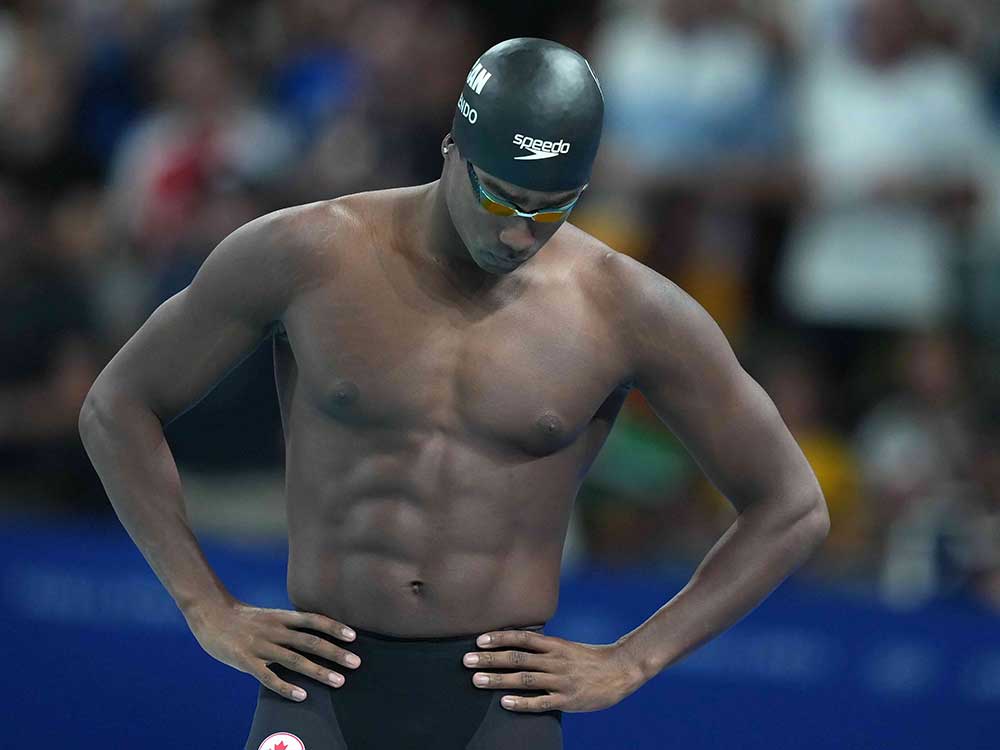
I thought about that while I watched Scarborough’s Josh Liendo win silver in the 100-metre butterfly in Paris, becoming the first Black Canadian swimmer to medal at any Olympics.
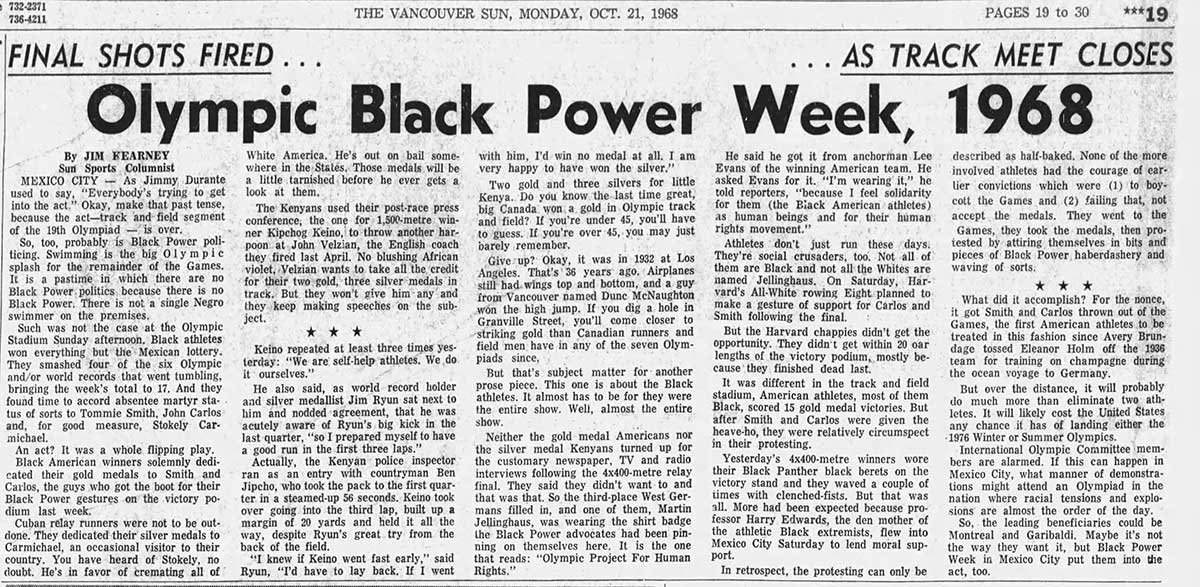
Was that a political act? Oh, you betcha. Consider Jim Kearney’s smug Vancouver Sun column on the infamous Black Power podium protest at the 1968 Summer Olympics in Mexico:
As Jimmy Durante used to say, “Everybody’s trying to get into the act.” Okay, make that past tense because the act — track and field segment of the 19th Olympiad — is over. So too probably is Black Power politicizing, swimming is the big Olympic splash of the remainder of the Games.It is a pastime in which there are no Black Power politics because there is no Black Power. There is not a single Negro swimmer on the premises.
A dozen years later, Calgary’s Debbie Armstead would become the first Black Canadian swimmer to qualify for the Olympics. Four decades later, Liendo would make his Olympic debut.
A lasting impact: lack of safety
Progress is slow. The impact of discrimination lasts for generations. Even now, as swimming has become the most affordable and popular social activity in North America, access to swimming remains a significant barrier for racialized children.
Forget about Olympic medals. Lack of access to swimming is a public safety issue. In America, Black children are seven times more likely to die by drowning.
In Canada, access to swimming lessons and spaces remains a significant issue, and while race-based data is conspicuously difficult to come by, researchers have found that drowning deaths are significantly higher among racialized youth.
It’s not a bone density issue, I promise. It’s access. This problem derives from the culture we’ve created. And we have to address it.
Efforts are underway. Some universities have created Black-only swim sessions, a practice framed as a threat by the National Post’s Tristin Hopper back in January. Needless to say, attacks on attempts to address historic disenfranchisement are another way racialized folks are discouraged from breaking these generational cycles.
Much as we like to imagine we’re past it, this country continues to prove that we aren’t.
The hardest part is that it’s all so random. In 1930s Ontario, police used to patrol Colchester Beach to keep Black people out. Just a few decades later, that same beach was one of the few places Black folks were allowed to swim. Sometimes you’re welcome. Sometimes you’re not. At public pools, the colour line is fluid.
“Exclusion was not total,” wrote researchers Nzindukiyimana and O’Connor, at the end of their essay. “It was unpredictable.”
It still is. At Hillcrest each day, you’ll see old Black folks chatting up lifeguards, ensuring their welcome before they dive in.
Even younger racialized folks can be driven away. Last year, I invited some friends — a Black dad from Georgia and his family — to meet us in the pool.
The line to get in was quite long. While they waited, a passerby told them to give up and go home.
I found them outside the community centre. ![[Tyee]](/design-article.thetyee.ca/ui/img/yellowblob.png)
Read more: Health, Rights + Justice











Tyee Commenting Guidelines
Comments that violate guidelines risk being deleted, and violations may result in a temporary or permanent user ban. Maintain the spirit of good conversation to stay in the discussion and be patient with moderators. Comments are reviewed regularly but not in real time.
Do:
Do not: