


 SHARE:

If you stand in front of the three screens that comprise the U.K. artist duo Semiconductor’s installation Heliocentric at the New Media Gallery, you can see almost all the other works in the new exhibition Measure reflected as spectral images in the dark glass. As each of the three screens lights up, these reflections slowly fade away until they disappear entirely. Viewing the individual artworks collectively like this offers a prescient reminder of that old truism: everything is connected.
In the introduction to the exhibition, a quote from author James Vincent (Beyond Measure) establishes the tone. Measure responds to what is “written into our biology, hard-coded in our DNA as circadian rhythms... co-ordinat(ing) each of our bodies to the spin of the planet that is our home.”
In attempting to understand these planetary forces, humans have devised any number of means, tools and technologies to gain some measure of control as well as comprehension of the world around them. In this way, Measure brings about a return to the idea of artist as scientist. Think of Leonardo’s drawings as attempts to gain a greater understanding and knowledge of the world. Each of the artists in this contemporary exhibition is engaged in something similar.
One of the functions of art, and there are indeed many, is to recentre the ordinary, extraordinary stuff that is part of everyday life, to reawaken a person to the preposterous magnificence of this world. Sarah Joyce, the New Media Gallery’s curator, gives this experience a human face when she describes standing in front of Matthew Biederman’s 2008 work Iterating Colour Field, Sorted and Measured Three Times.
The title kind of sums up the blunt facts of the installation. But what isn’t immediately apparent is how much colour exists only in human perception.
Through the use of an HD projector, software and three stainless-steel rulers, the piece offers up a cornucopia of changing colours marching in formation from left to right and then back again right to left, a perpetual slide through the colour spectrum. At first glance, the stripes, thin, thicker, thickest, in shades of green, pink, violet, reminded me of Missoni. The Italian fashion house built its brand on the combinations of colour woven into fabric, knitwear and other items. But the longer you watch Iterating Colour Field, the more wilder colours begin to appear. At one juncture everything is a violent fuchsia: a pink so utterly pink it would make even Barbie yell “UNCLE!”
As Joyce explains, a man stationed himself in front of the piece for several hours, watching it do its thing, until he asked her to join him for the final 45 minutes of the experience. Suffice it to say some fascinating and altogether surprising things happened.
Where the earthly meets the celestial
To fully experience everything that a piece of art is offering, you have to slow down, spend some time and just let things happen in the space that you carve out for them to happen. In larger art institutions, there is always the pressure to gallop along, taking in every work, but in a smaller gallery like this one, every piece informs how you look at every other piece. Richer, more resonant things can take place. Hold on to that word “resonant.” In the context of Measure, sound is a critical part of the exhibition.
The ambient hum from Heliocentric infuses the air with latent sound that loops around the different works. Sound is not often something we think about in a visual medium, but here it plays an outsize role. The three-channel HD installation runs almost 11 minutes of different landscapes. Kept purposefully anonymous, each of the places is presided over by the sun, centred in the frame like a domineering overlord, which in many ways is exactly what it is.
As the sun rises and sets, day falling into night, time-lapse images collapse the sun’s journey into a fixed position as the different landscapes appear to pan around the impervious star at the centre of everything. Colours shine out in brief surges of hue, then fade away into crepuscular darkness. Clouds come and go, talking of Michelangelo, but what is ultimately afforded is a different way of seeing the solar system at work. Everyone knows that the Earth revolves around the sun, except perhaps for a certain segment of Trump supporters. But it is a novel, somewhat discombobulating experience to see the sun stilled for a period, while entire landscapes slide by as if they were on a greased axis.
As the work cycles through its run, a pervasive drone underwrites the action, spreading like yellow honey throughout the gallery, coating the rest of the works in the exhibition in its ambience. The ability of sound to alter one’s perceptions and establish an emotional tone isn’t exactly a revelation, but its slippery way of shaping reaction and feelings isn’t always overt or explicit until it is. Think of the trend in memes, where soundtracks, overlaid on top of different films, utterly change the emotional quality. Peppy rom-com music changes a horror film like The Shining into a fun family outing, whereas a dark and sinister drone has the opposite effect on a chipper comedy.
In the case of Measure, the sound emanating from Heliocentric mixes with the birdsong, loon calls and natural world noises that infuse Annette S. Lee’s work Dagwaagin, Ptanyetu, and becomes something entirely different. Earthly meets celestial.
But back down to earth for a moment. In an attempt to name and measure the animals, birds and seasonal changes that constitute her daily environment, Lee recorded the sounds of birds, bugs and storms, affixing each one with a descriptive word or passage.
The cavalcade of sound, falling in random patterns across the screen like so much loosed foliage, is a startling evocation of the richly embroidered natural environment. Again, this is a work that you can sit with for a spell, letting its images and words wash over you.
To the moon and back
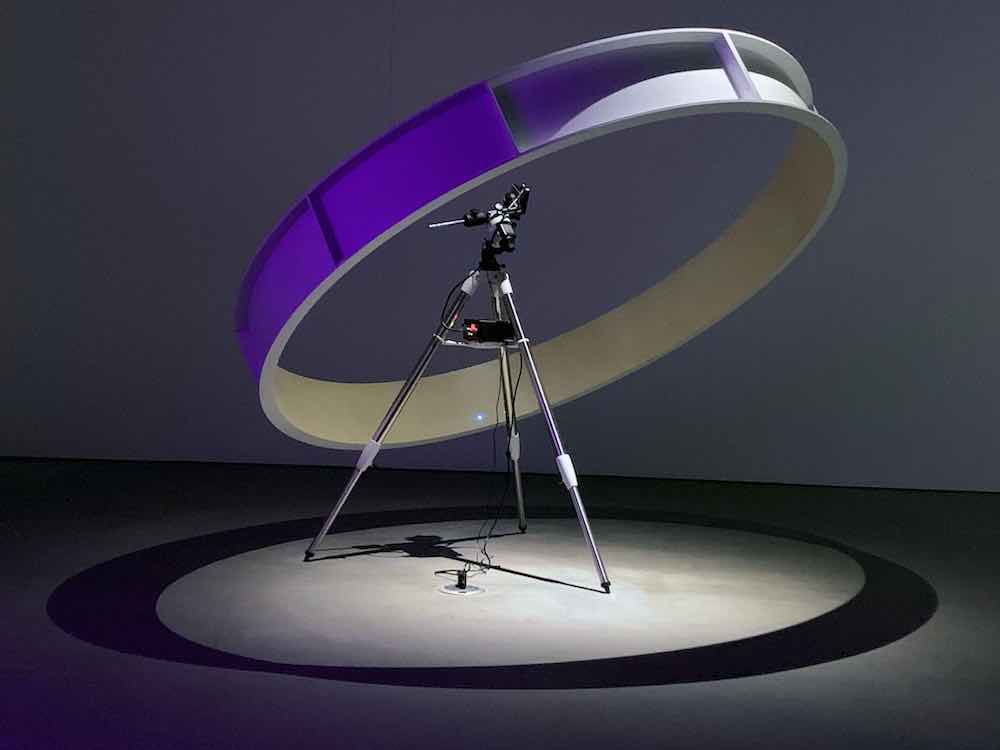
If you’ve soaked in your fill of the planet and its inhabitants, you can vault back into the heavens with James Nizam’s Earth Spin Moon Orbit. Adapted specifically for the New Media Gallery, the work is composed of a laser, a tripod and a large circular frame that tracks lunar cycles as the moon moves around the Earth. The intent is to offer a real-time indication of the lunar path, in a spectral orbit. It’s a reminder that even as you’re answering email or thinking about what to have for lunch, the moon is also going about its business, controlling the tides, inspiring moony love sonnets and such.
Even farther away, other sources of light are equally active. French media artist Félicie d’Estienne d’Orves measures the time it takes light to reach the Earth from the sun and from the planet Venus in the Light Standard series. At first glance, the work, composed of two steel bars, each fitted with custom software and electronics, appears nondescript, practical even, but it contains multitudes, not just of time, but of emotion as well.
The inherent drama of watching light draw nearer to its destination, quietly fading out like the denouement of a vast orchestral symphonic work, is like the last lingering note that marks the end of Wagner’s Ring Cycle, ascending into the sky, until it finally disappears. It is Liebeserlösung, the redemption-through-love motif. But just as the heartbreak of ending takes over, the little light returns, making its steady progress towards its destination, resolute and strangely brave. Hooray!
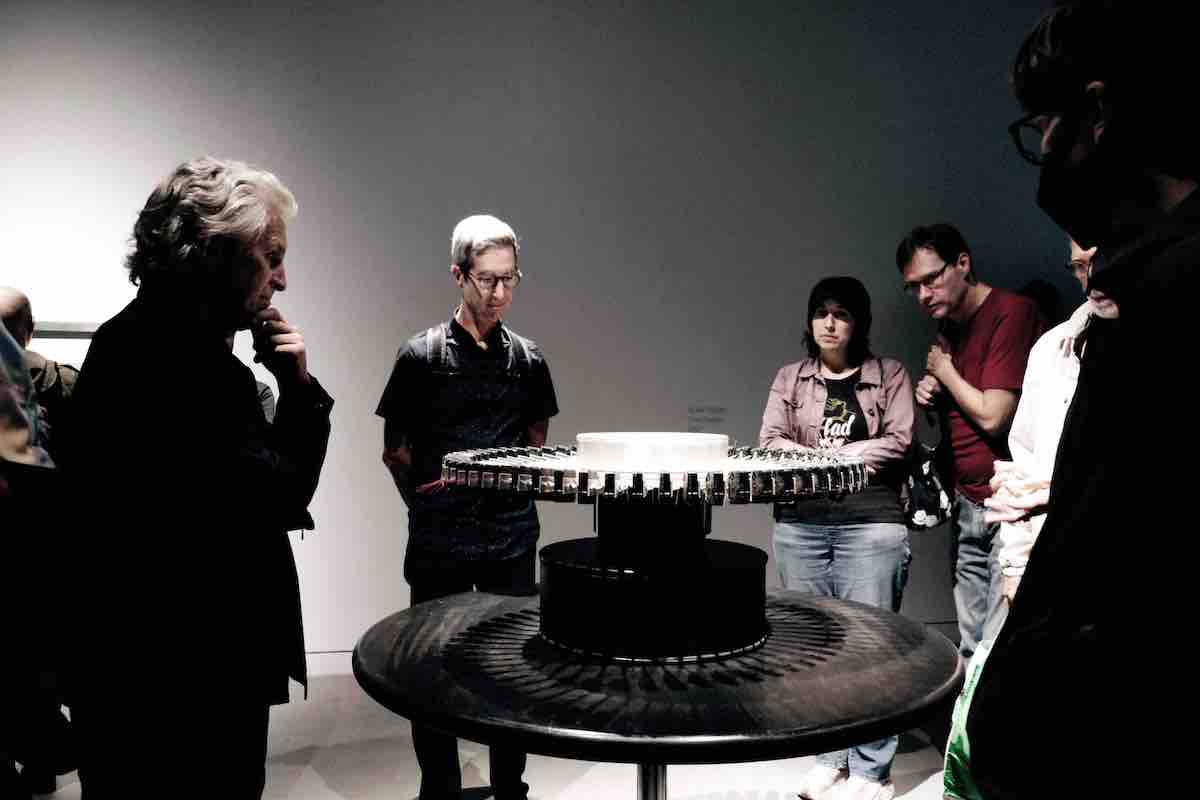
And finally, a machine to carry all of these feelings could not be better represented or constructed than Alan Storey’s Time Dilation. Part Venus flytrap, part infernal steampunk timepiece, the installation, composed of 60 clocks, casts ornate shadows on the floor below as the delicate filigree of second hands lifts and bends like whiskers from some enormous creature. There is no flutter, no uncertainty or hesitation. Every part moves in lock precision, impervious, determinate, perpetually circling like so many celestial cogs and gears. As old Sextus Empiricus, famed ancient Greek philosopher, was known to say, “The mills of the gods grind slowly, but they grind small.” Right down to the second, in fact.
Everything is connected, mixing and mingling, combining into multiple experiences that approximate the rhythms and patterns of the physical forces that govern us. Taking the measure of both time and space, the rise and set of the sun, how light travels through space from celestial bodies, the cycles of the moon, everything spinning, spinning, spinning in a great centrifugal dance. Even standing still, you begin to feel as if you too were slowly spinning in space. Because, in fact, you are.
'Measure' is at the New Media Gallery in New Westminster until Dec. 10. ![[Tyee]](/design-article.thetyee.ca/ui/img/yellowblob.png)








Tyee Commenting Guidelines
Comments that violate guidelines risk being deleted, and violations may result in a temporary or permanent user ban. Maintain the spirit of good conversation to stay in the discussion and be patient with moderators. Comments are reviewed regularly but not in real time.
Do:
Do not: