


 SHARE:
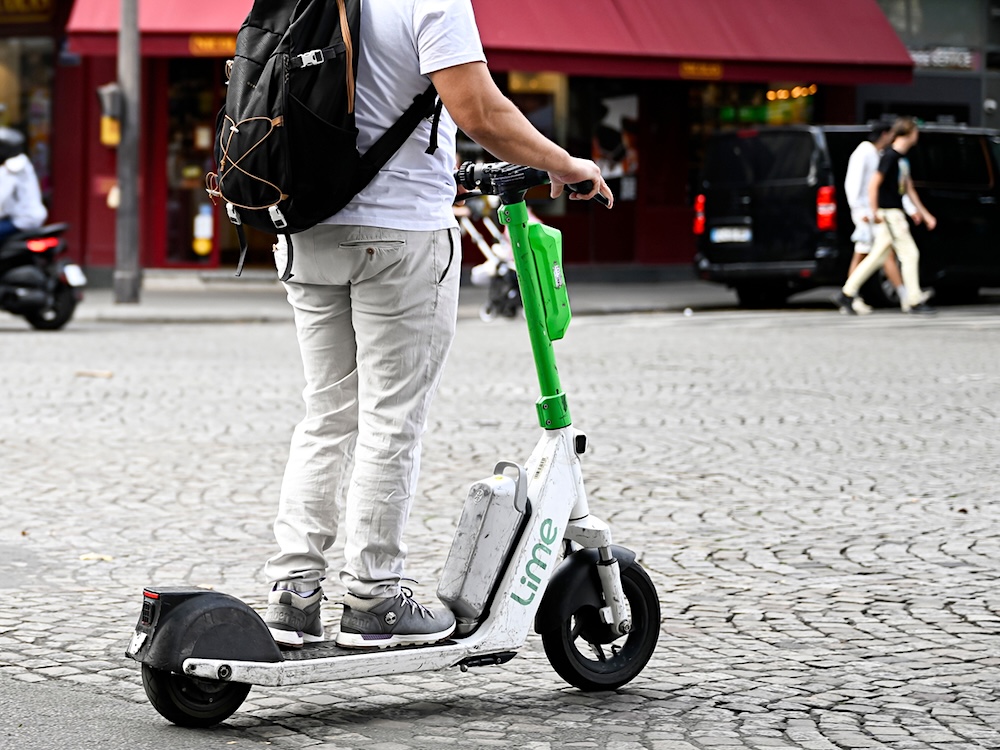
Zippy and compact, electric kick scooters, or e-scooters, convey a childlike whimsicality. They appeal to people in search of a fun, efficient mode of transportation that’s faster than walking or taking the bus, and less work than biking or driving.
And urban scooter rental services have bright, big-tent branding that casts a wide net: anyone, and maybe everyone, should ride them, they seem to say.
In Vancouver, Lime scooters are the cheeky transportation mode of choice for a group of anonymous content creators who call themselves the Lime Scoot Boyz.
The Lime Scoot Boyz illustrate the silliness of Limes with outsize stunts. They jump off the steps under the Granville Bridge, grind on seawall infrastructure near the Vancouver Convention Centre and ride near the offramp of the Ironworkers Memorial Bridge.
The Boyz can clear whole staircases on their e-scooters. But part of their appeal is how fantastical that is. They ride their Limes with a background in skateboarding, a willingness to wipe out and an indefatigable zest for life — all things most of us lack.
E-scooters are quiet, approachable and sold as eco-friendly. They might seem harmless. But data from the Canadian Institute for Health Information, or CIHI, shows the number of scooter-related injury hospitalizations has gone up alongside their rise in popularity. That raises questions about whether more should be done to enforce or reform e-scooter rules for riders, and what the long-term impacts of a four-year B.C. pilot project on e-scooter use will be.
E-scooter hospitalizations are up across Canada
CIHI data from the reporting years 2022 to 2023 shows 810 scooter injury hospitalizations across Canada. Those years show 151 total injuries in B.C. and 221 in Alberta.
In 2023-24, the most recent reporting period available, the total number of scooter injury hospitalizations in Canada went up to 992, with 182 scooter-related hospitalizations in B.C. and 234 in Alberta.
According to a 2024 technical report on micromobility safety by the International Transport Forum, e-scooter crashes “disproportionately lead to head and facial injuries, particularly in the lower face region, compared to crashes involving conventional or electric bikes.”
Head injuries are significant, the report notes; they may involve serious, lasting trauma alongside neurological complications. “They are unlike other injury types and warrant special consideration.”
Unlike standard bicycles, e-scooters can reach speeds that are “too high for young riders to handle safely,” according to two members of the Canadian Paediatric Society’s injury prevention committee who warned of the dangers of e-scooters and e-bikes back in 2024.
E-scooters are meant to appeal to a general-interest ridership, filling a gap between cycling and skateboarding. They’re less labour intensive than riding a bike but, in theory, don’t require the specialized skills needed to skateboard.
Comparing countrywide e-scooter injury numbers to skateboarding injuries, however, calls that into question. In the 2023-24 reporting period, CIHI counted almost three times as many e-scooter-related hospitalizations as those caused by skateboarding accidents, even though skateboards have been around for much longer than e-scooters.
In that reporting period, there were 992 total e-scooter injury hospitalizations across Canada and just 360 skateboarding injuries.
How we got here
In 2021, B.C. started a pilot project to test electric scooter use on public roads, which contributed to a boom in scooter sharing systems including Lime’s partnership with the City of Vancouver.
The province followed that up with another pilot in 2024, which is now in 36 communities across B.C. It runs until 2028.
The e-scooter pilot lays out safety rules for riders: among other stipulations, they must wear a helmet; they must be 16 or older to ride; they must not carry other passengers; they must ride single file, not beside another person; and they can’t ride while intoxicated or while distracted with a cellphone.
And here is where policy cleaves from humanity.
Anyone who lives in an area dense with e-scooter riders knows the rules are often tossed in the gutter like the many bright-green Lime rental helmets lying abandoned near empty scooter docks.
In my neighbourhood in Vancouver, it’s common to see people riding without helmets or doubling on an e-scooter, the person in the back tightly hugging the one in front.
At night on the weekend, we regularly see large, boisterous groups riding in formation past our apartment, carving wide, fast loops down the streets after leaving a park hang, restaurant or living room for a second location somewhere else. They laugh as they knock into each other in pileups at red lights.
Parents sometimes travel with young kids on e-scooters, their little faces at the same level as the handlebars at the helm.
It would be cute if it wasn’t so dangerous. In an interview with journalist Caitlin Walsh Miller for Maclean’s magazine this spring, an Edmonton emergency physician who co-authored an April 2025 study on electric scooter injuries in the Canadian Journal of Surgery described the front passengers riding double on e-scooters this way: “We call them airbags.”
Municipalities seek tighter rules
In response to a rising awareness of risks associated with widespread e-scooter use, local governance bodies are taking matters into their own hands.
Last month, Burnaby city council adopted municipal bylaw changes that tighten restrictions on e-scooter use.
The new bylaws ban people from wearing headphones while riding e-scooters, and they limit people to riding e-scooters only in protected bike lanes or on multi-use pathways, taking them off sidewalks, major road networks and arterials.
The changes came shortly after an 11-year-old boy and nine-year-old girl were seriously injured in a collision with a grey sedan on Hastings Street near Delta Avenue in Burnaby on May 2. News photos show a scooter and children’s footwear scattered at the scene.
Also last month, the Fraser-Cascade School District, which serves the eastern Fraser Valley, banned e-scooters on school property.
“This decision comes in response to the increasing number of injuries reported across the province involving children and other citizens because of e-scooter incidents, as well as ongoing concerns related to student and public safety,” reads a May 29 letter to families from superintendent Balan Moorthy.
“In addition to the concerns noted above, many e-scooters currently exceed the provincial speed limit, [and] in some cases, are modified in ways that do not comply with provincial regulations.”
The Fraser-Cascade School District’s new rules arrive near the end of the school year, when the weather is warming up and people are getting ready for summer break. In other words: scooter season.
Ahead of the 2025 winter break, Vancouver Coastal Health issued a media release urging parents not to purchase e-scooters as holiday gifts for their children.
Vancouver Coastal Health noted that B.C. does not yet have available data regarding the full burden of e-scooter injuries on the provincial health-care system because the new clinical codes for e-scooter injuries are so new that they don’t provide a clear picture of the extent of regional harm.
Increases in injury and injury severity
“We recognize that people need to have an efficient and effective way of getting around urban environments. But these e-scooters are not benign,” Dr. Brian Rowe told the CIHI’s podcast in a July 2025 episode on the rise of e-scooter injuries.
Rowe is an emergency room physician in Edmonton, which has had e-scooter rentals since 2019. He co-authored the April 2025 Canadian Journal of Surgery study on e-scooter injuries.
“We’ve definitely seen increases in injuries and injury severity” in the years since the rentals came to the city, Rowe said.
About 17 per cent of the cases he sees at Edmonton hospitals involve head injury. “We know that helmet use on these devices is exceedingly low,” Rowe said.
Pediatric emergency medicine specialist Dr. Daniel Rosenfield joined Rowe on the podcast. He works at the Hospital for Sick Children in Toronto, known as SickKids.
“We saw one injury at SickKids in 2020,” Rosenfield said of the e-scooter-related injuries that he and his colleagues have been tracking at the hospital. “In 2024, we saw 46. And in just the month of May 2025, we saw 16, which is more than the preceding Mays all combined.”
E-scooters are a “risky mode of transportation for children in particular,” Rosenfield said.
“They’re very powerful. They can go very quickly. And the centre of balance on them is very askew. I don’t know if any of you have ever ridden one, but they’re actually quite hard to get on and to ride competently. And kids and teens just don’t have that kind of body wherewithal just yet, which makes it additionally risky.”
I can’t confidently say that grown adults, especially those wrapping a long patio session at a local microbrewery on a summer night, have that kind of body wherewithal either. I know I don’t. And I’m drinking soda water while I write this.
The potential for lasting harm from e-scooter crashes is no joke. But an inadvertent effect of the friendly marketing and quick-access appeal of municipal sharing systems is that they engender a lack of seriousness around riding itself.
Downloading the Lime scooter app on a smartphone feels like signing up to any other service in the sharing economy, as seamless as connecting with Uber, Lyft or DoorDash.
Maybe it’s time to leave e-scooters to power users like the Lime Scoot Boyz and other jokers who know what they’re getting into. Not dabblers and children and people stumbling out of the bar.
We should heed the risks. And refuse to let our friends and their kids step behind the handlebars. ![[Tyee]](/design-article.thetyee.ca/ui/img/yellowblob.png)
Read more: Health, Transportation, Alberta, Municipal Politics, Urban Planning












Tyee Commenting Guidelines
Please note that email notifications for replies are not currently working due to a software issue which may be resolved in a future update.
Comments that violate guidelines risk being deleted, and violations may result in a temporary or permanent user ban. Maintain the spirit of good conversation to stay in the discussion and be patient with moderators. Comments are reviewed regularly but not in real time.
Do:
Do not: