


 SHARE:
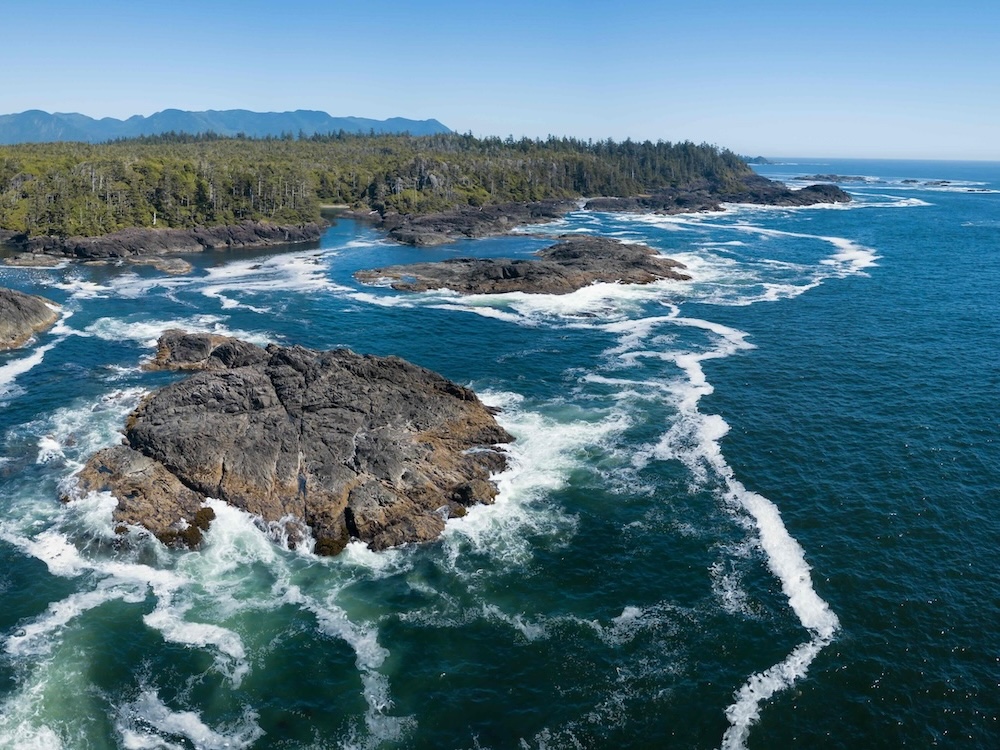
Recent seismic imaging off Vancouver Island has revealed something extraordinary: a tear in the subducting oceanic plate beneath the Cascadia subduction zone.
The finding briefly raised the public’s hopes that Cascadia might be “shutting down,” potentially lowering earthquake risk in North America’s Pacific Northwest.
A subduction zone is a boundary where tectonic plates collide, forcing a heavier plate to dive, or subduct, below a lighter one. Recent research suggests that part of the Cascadia subduction zone, just off the coast of Vancouver Island, may be slowing down due to a newly identified tear in the subducting plate.
It’s an eye-catching idea: a major plate boundary winding down, perhaps even reducing earthquake risk, would be a comforting thought for millions of people living with seismic hazards in the Pacific Northwest, particularly given the challenges of predicting earthquakes.
But while the discovery is real, the interpretation that the subduction zone is winding down gets ahead of the science.
What the new research actually shows is far more complex — and more interesting. But before we can understand what this tear means, we need to go back to plate tectonic theory.
Understanding the science
Plate tectonic theory, first formalized in the 1960s and 1970s, revolutionized our understanding of the planet.
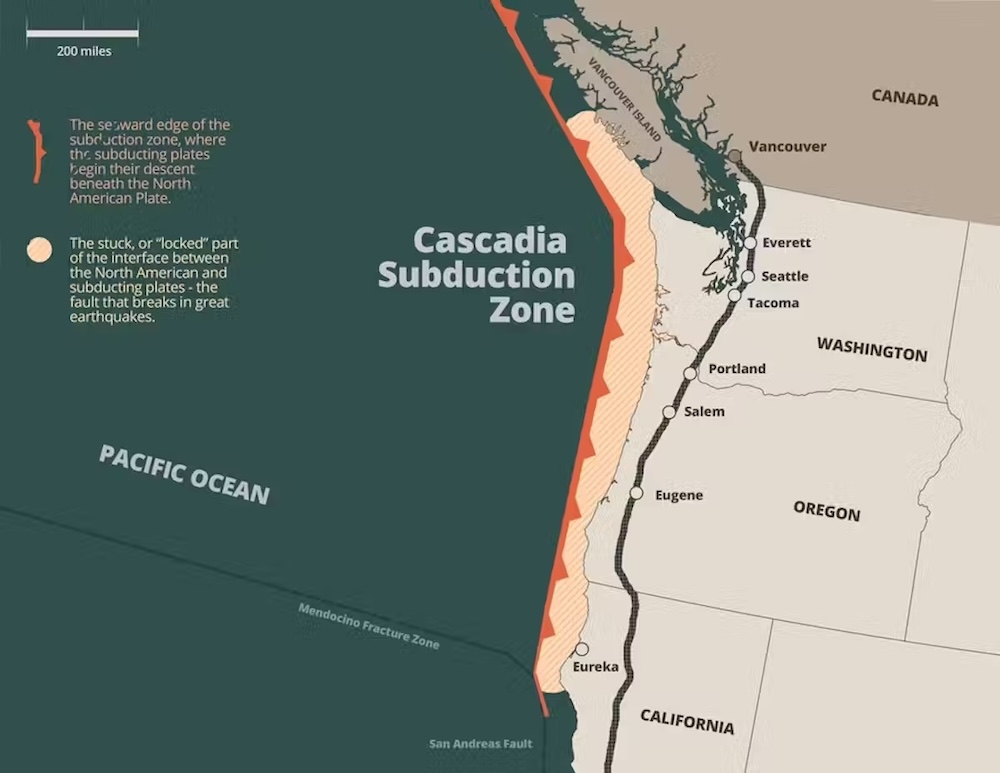
In this framework, which was built on the earlier concept of continental drift, there are two types of crust: the lighter continental crust and heavier oceanic crust. Oceanic crust forms at large underwater mountain chains that transect the oceans, known as mid-ocean ridges.
After millions of years of cooling and becoming denser, the oceanic crust sinks back into the Earth at subduction zones. Traditionally, this cycle has been framed as relatively straightforward, but recent work continues to reveal exceptions and complexities.
Continental interiors are not the stable, rigid places they were once thought to be. Microcontinents, small pieces of the Earth’s outer shell, continue to be identified, and even the simple distinction between oceanic and continental crust is being challenged through the discovery of hybrid and transitional type crusts.
A new example of this ongoing refinement of plate tectonic theory comes from the Cascadia subduction zone, a major piece of North America’s western plate boundary.
What researchers recently discovered
The oceanic plate beneath North America is not a single, intact slab. Instead, it appears to be fragmenting and tearing apart. This is not something that plays out over human timescales — it unfolds over millions of years. Still, it challenges long-held assumptions about how the Cascadia subduction zone works.
For decades, the subduction zone was treated as a relatively continuous plate boundary. Mounting evidence now shows that it is segmented and divided into smaller, structurally complex parts.
The new seismic imaging off Vancouver Island’s Pacific shore sharpens this picture, revealing that fragmentation is not only present but ongoing. The plate boundary is more complex than a classic textbook image of one plate smoothly sliding beneath another.
A tear in the subducting plate does not mean the plate boundary stops functioning. Instead, it means a tectonic reorganization is under way. And this is not only expected, but inevitable. Subduction will likely continue on either side of the tear and deformation may become more distributed across the region.
In other words, rather than of a single, coherent system, we may end up with multiple smaller pieces interacting with one another. This evolution may make the system more dynamic and its future behaviour harder to predict.
What this could mean for earthquakes
The recent finding has important implications for seismic hazards in the region, which continue to be a major concern. Large earthquakes in the Cascadia subduction zone are determined by how strain accumulates and is released along the boundary between the plates and associated faults.
Studies show that parts of this boundary remain strongly locked, meaning that strain is still building and could be released in future large earthquakes. A tear in the plate may influence where ruptures start and stop, or how far they propagate, but it does not remove the underlying seismic hazard.
If anything, increased structural complexity can make behaviour harder to predict. Segmentation may limit the size of some earthquakes, but it could also concentrate deformation in unexpected ways.
Smaller plates and microplates can rotate, interact and transfer stress across a region. These are processes geoscientists are still working to understand in the Pacific Northwest and elsewhere.
Over millions of years, this evolution will reshape the entire plate boundary, perhaps transforming it into a more diffuse system of smaller interacting plates. But for people living in the Pacific Northwest, this long-term trajectory does not change the near-term reality.
Cascadia remains an active subduction zone capable of producing large earthquakes. Rather than signalling the end of Cascadia, this discovery highlights just how dynamic and complex it really is — and how much more there is to learn.
![[Tyee]](/design-article.thetyee.ca/ui/img/yellowblob.png)
Read more: Science + Tech












Tyee Commenting Guidelines
Please note that email notifications for replies are not currently working due to a software issue which may be resolved in a future update.
Comments that violate guidelines risk being deleted, and violations may result in a temporary or permanent user ban. Maintain the spirit of good conversation to stay in the discussion and be patient with moderators. Comments are reviewed regularly but not in real time.
Do:
Do not: