


 SHARE:
Advocates for amalgamating Victoria and Saanich say the provincial government’s refusal to order a binding referendum on the question this fall is a betrayal.
“We feel it’s an about-face, and a sneaky one,” said Trevor Barry, the chair and president of the group Amalgamation Yes.
“We want a binding referendum,” Barry said. “The next time there is a question on the ballot, it should be the binding question. It should be the last time we have this question, and whichever way it goes, it goes.”
Members of a citizens’ assembly collectively devoted over 2,500 hours to poring over the question of merging the two municipalities, their efforts supported by $750,000 in public funds. They recommended letting voters decide once and for all.
This week, the matter is on the agendas for both District of Saanich and City of Victoria meetings. Both councils are considering putting a simple question on the ballot during local elections in October: “Do you support Saanich and Victoria becoming one municipality?”
Saanich’s committee of the whole was to discuss the matter when it met Monday evening, and Victoria’s will meet Thursday.
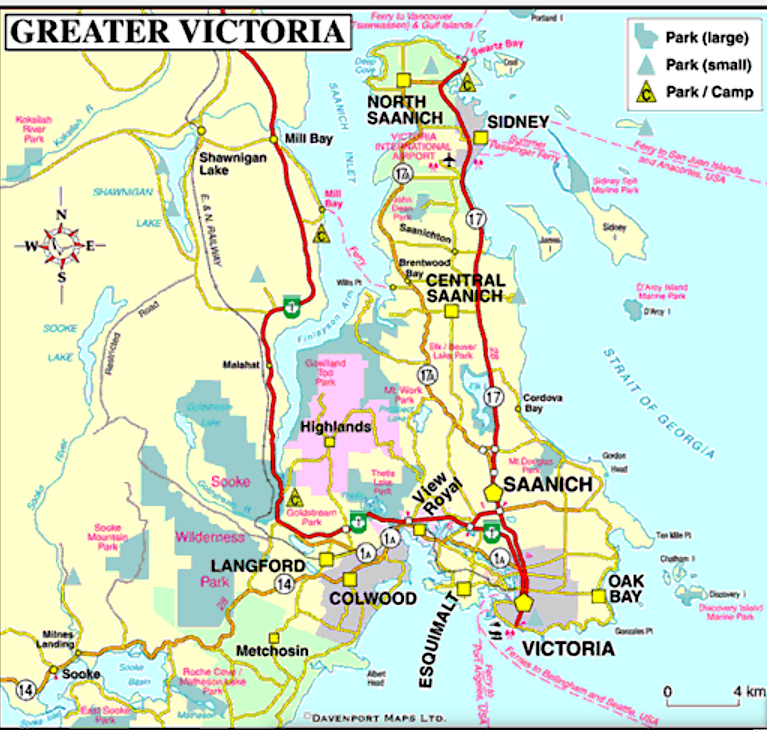
Victoria, which includes the downtown core, has a population of about 94,000. Another 126,000 people live in Saanich, which is largely suburban. They are two of the 13 municipalities in the Capital Regional District, which has a total population of over 400,000.
Not without more info, says minister
But making the amalgamation question binding requires approval from B.C. Housing and Municipal Affairs Minister Christine Boyle, and in a letter dated April 20 to Saanich Mayor Dean Murdock and Victoria Mayor Marianne Alto, the minister said she was not prepared to provide that approval without more information being available to voters.
The letter became public just last week when Saanich released its agenda package. It is also included in materials released ahead of Victoria’s meeting.
“Before I would be in a position to consider ordering a future binding vote, additional work would be required to support informed decision-making and meet provincial obligations,” Boyle wrote. “This would include more detailed analysis of financial implications, transition considerations, and service impacts.”
She said the city councils are free to ask a non-binding question, that doing so doesn’t require her permission and that she understands from an early April meeting with them that’s what they plan to do.
Boyle also cautioned that any non-binding question should clearly reflect that it is a measure of public interest in pursuing amalgamation and not a decision on amalgamation itself. “The proposed question... may not clearly signal to the electorate that additional work and information on costs and governance will be required in order for the Minister to order a vote,” she said.
The matter had been awaiting a reply from Boyle since last October, when Alto and Murdock wrote to her saying their councils wished to ask a binding question during the October 2026 local elections and seeking information on how to proceed. “We respectfully request, in as timely a manner as possible, confirmation of what, if anything, the Ministry needs to enable the municipalities to proceed with organizing a binding referendum.”
“Victoria Council made the commitment to respect the outcome of the Citizens' Assembly, and to place a question on the 2026 ballot with whatever recommendation was made by the assembly,” Victoria Mayor Alto said in an email.
“The parameters set out for proceeding were set at the outset, and Council considers them met,” she said. “That's why we are proceeding with a ballot question. It's up to the province to determine if further work is needed, and to undertake that work if they require it.”
The province was a partner in establishing the citizens’ assembly along with Victoria and Saanich, she added. The final decision on amalgamation is up to the province, and it can require whatever steps it deems necessary, she said.
Minister Boyle was not available to be interviewed by The Tyee, but a ministry spokesperson sent an email Monday noting the proposed amalgamation would be a “rare and complex” event in B.C. To “consider ordering a binding vote,” the ministry wants “detailed analysis by Saanich and Victoria of financial, governance and service impacts of amalgamation, along with provincial consultation with local First Nations.”
Both Alto and Murdock are recommending to their councils to move ahead with the simple question about becoming one municipality.
Murdock did not respond to a request for comment.
Years of inquiry
Serious discussion of amalgamating Victoria and Saanich goes back more than a decade. During the 2014 local elections, residents of both municipalities voted in favour of exploring amalgamation or integration.
In 2018 voters in approved each of the two cities spending $250,000 to establish a citizens’ assembly to consider the costs, benefits and disadvantages of amalgamation. The province contributed a further $250,000 for the process.
After being delayed by the COVID-19 pandemic, the citizens’ assembly went ahead, including 48 randomly selected residents who met for a total of eight days in 2024 and 2025. At the end of the process, they recommended Victoria and Saanich become a single municipality.
The citizens’ assembly’s final report ran to 104 pages, and there is a 167-page technical study report produced for the assembly by the consulting firm MNP.
Barry with the pro-amalgamation group said it is disappointing that it took Boyle so long to say she wants more information.
While everyone would like more information, there is enough available for residents to vote in a binding referendum on the question, he said. “To do it any other way is to disregard and disrespect the citizens’ assembly, all the effort, all the money, all the volunteer hours of those who served, the recommendations and all of that.”
The provincial government previously allowed the City of Duncan and the District of North Cowichan to vote on amalgamating — Duncan voters rejected the idea — with less financial and technical information available than there is for Victoria and Saanich, he said.
One of the alternatives in a report that staff in Saanich prepared for the mayor and council is to delay a vote until 2030 to give staff time “to identify financial information, service delivery implications and transitional issues of the two municipalities amalgamating to become one.”
Barry said his group is against waiting another four years. “That would be a huge betrayal by the province and anyone who was leading them in that direction against the will of the people, the citizens of both Victoria and Saanich as they’ve voted in the past, as well as the commitments they made on the citizens’ assembly process.”
With political will, he said, a binding vote could be held this October. “There is still plenty of time.” ![[Tyee]](/design-article.thetyee.ca/ui/img/yellowblob.png)
Read more: Municipal Politics







Tyee Commenting Guidelines
Please note that email notifications for replies are not currently working due to a software issue which may be resolved in a future update.
Comments that violate guidelines risk being deleted, and violations may result in a temporary or permanent user ban. Maintain the spirit of good conversation to stay in the discussion and be patient with moderators. Comments are reviewed regularly but not in real time.
Do:
Do not: