


 SHARE:
Once upon a time, Canada spoke like a progressive climate change actor. On the eve of the 1992 Rio Earth Summit, its national Green Plan pledged to stabilize greenhouse gas or GHG emissions at 1990 levels by 2000. Canada wouldn’t use its relatively small share of global emissions as an excuse to do nothing domestically.
Conservative and Liberal governments alike flouted that promise. By 2000 Canadian emissions were 140 million tonnes, 23 per cent higher than 1990 levels.
Failure summarizes the Canadian climate change record since 1990 — failure to meet any GHG emissions reduction ambition. “Targets and plans have come and gone,” the commissioner of the environment and sustainable development said two years ago, “and Canada has yet to deliver on any.” Canada is the only member of the G7 whose GHG emissions have increased since 1990.
Explaining this failure is easy — Alberta’s oilsands. Thanks to governments and technology, oilsands production began to grow vigorously in the late 1990s. This exploitation propelled Canada into fourth place among world oil producers. Thanks to the oilsands Canada supplies more crude to the United States than the 12 Organization of Petroleum Exporting Countries member states combined.
They account for the fact that new production records are the norm in oilpatch annual reports. These records, such as the 5.1 million barrels per day seen in 2024, are trumpeted in the business press. But increased or record GHG emissions from this sector either go largely unreported or are minimized.
Canada’s most recent inventory of GHG emissions for the United Nations reported that upstream oil and gas emissions essentially doubled between 1990 and 2023. The increase from this one sector more than equalled the country’s total emissions increase over that period (93 million tonnes versus 88 million tonnes).
And oilsands emissions figure very prominently here. In 2023 those emissions were a record 89 million tonnes. This new record was nearly six times higher than the 15 million tonnes the oilsands emitted in 1990.
Becoming the fourth-largest oil producer in the world came at the price of becoming a climate change laggard.
Canada’s COP30 goal is more oilsands output
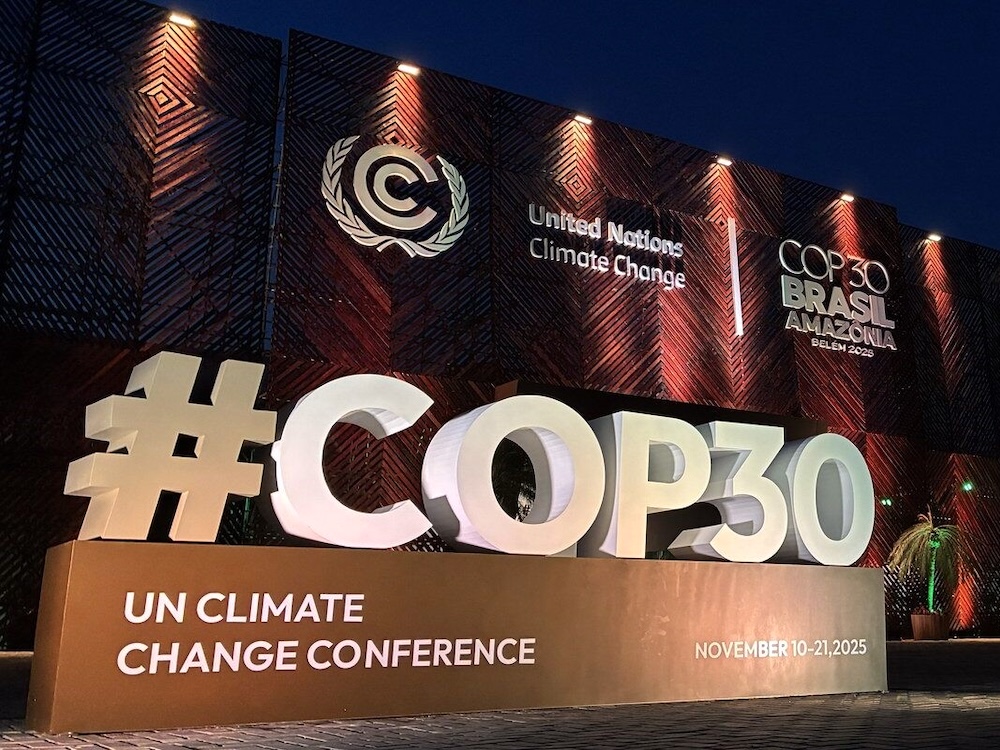
“Unprecedented highs.” That’s where atmospheric carbon dioxide emissions ended 2024. What do world leaders plan to do about that? Ostensibly they will take meaningful actions as they meet at the COP30 climate conference in Brazil this week.
But, if they follow Canada’s example, expect to be disappointed. Canada’s aspirations and commitments headed into those negotiations? Increase oil production. Don’t comment on what that will do to emissions.
Alberta Premier Danielle Smith has the most egregious ambitions. Her October mandate letter to Energy Minister Brian Jean instructs him to craft a road map to deliver massive increases in oil production. She dreams of eight million barrels per day of oil production by 2035. This is 57 per cent more than last year’s Canadian record. It would be double last year’s Alberta oil production record.
There isn’t any mention in that mandate letter of what this increase would mean for Alberta’s, and Canada’s, GHG emissions. Nor will you find any mention of cutting greenhouse emissions in the mandate letter to Alberta Environment Minister Rebecca Schulz.
Advocating reducing GHG emissions is treated as a profanity in Alberta.
Tuesday’s budget did nothing to suggest that Ottawa plans to slow the oil production train. For now, Prime Minister Mark Carney is standing by the not-yet-implemented federal oil and gas emissions cap. The Justin Trudeau government opted for a cap because, as noted above, oil and gas emissions have risen relentlessly for more than 30 years.
However, if the federal “cap” were implemented, both oilsands production and oilsands GHG emissions would rise to new records. Oilsands production under the cap is estimated to grow to a new record of four million barrels per day by 2030, approximately 700,000 barrels per day higher than in 2022.
This is estimated to propel oilsands GHG emissions in 2030 to 92.4 million tonnes. This is four per cent higher than the 89-million-tonne record reported in Annex 10 of Canada’s latest GHG national inventory.
But, as the budget made clear, the Carney government may scrap the cap. Without providing any details whatsoever, the budget dangles industrial carbon pricing, enhanced methane regulations and carbon capture as options that would mean the cap “would no longer be required as it would have marginal value in reducing emissions.” Such absence of detail and targets has been typical of Alberta, not Ottawa.
Abandoning the cap in favour of reforming carbon pricing is likely to be met with howls of outrage from industry. Petroleum producers demand the repeal, not the reform, of the federal levy on large emitters.
Alberta seems unlikely to support the type of carbon pricing reform needed to reduce emissions in the oilpatch. In September the province modified Alberta’s emissions trading market. The Canadian Climate Institute concluded those changes weakened, not strengthened, that system.
The new “Canada Strong” budget told Canadians not to expect any actions from Ottawa in the near future that will slow down oilsands production and emissions.
What Canada’s apologists don’t say
Canadian apologists for climate inaction often base their case on the fact that Canada’s emissions are very small relative to those of the United States and China. True. But as Hannah Ritchie points out, countries emitting less than two per cent of the global GHG emissions collectively generate more than one-third of global emissions. These countries, such as Canada, Australia and European Union members, generate more emissions than China and nearly three times what the United States emits.
Climate change cannot be positively addressed without seriously cutting into the 36 per cent of world emissions that rich, negligible emitters send into the atmosphere. Canada belongs to this club.
Being a good global citizen demands that Canada become the country Prime Minister Brian Mulroney imagined in 1990. We must stop chasing higher and higher oil production levels. It demands reducing, not increasing, record oilsands emissions.
A longer version of this article appeared on Bob Ascah’s blog AB Pol Econ. ![[Tyee]](/design-article.thetyee.ca/ui/img/yellowblob.png)
Read more: Energy, Alberta, Environment











Notice about commenting changes
The Tyee’s commenting system will be moving to a new platform on Nov. 12. If you’re already a Tyee commenter you must register with the new system on or after Nov. 12 with your preferred username.More information can be found here.