


 SHARE:
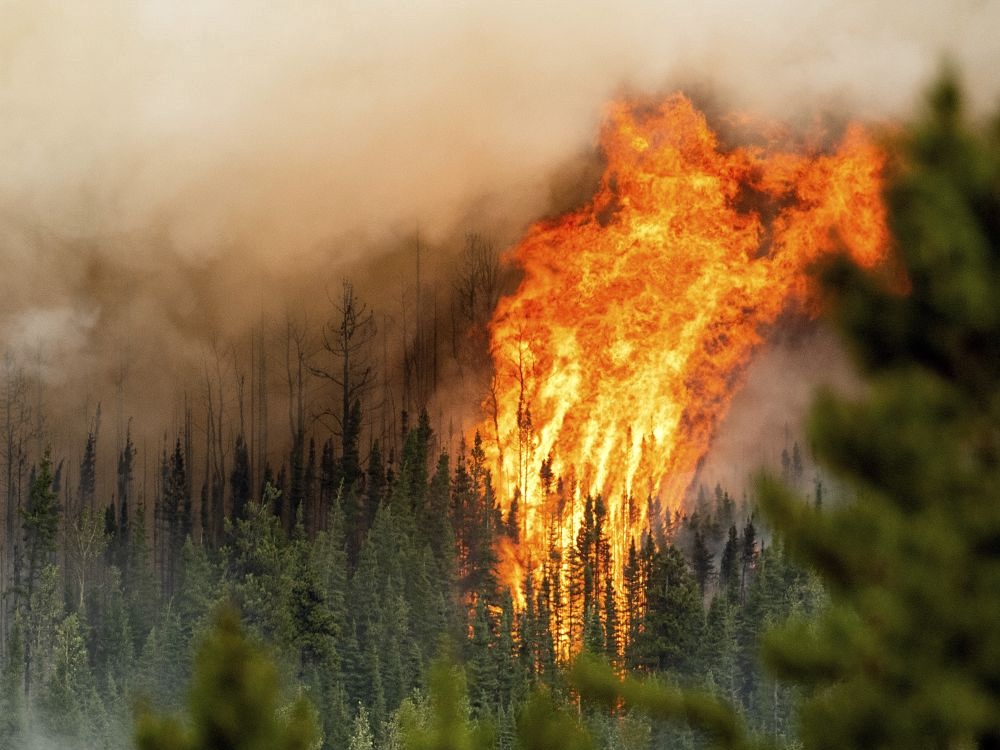
I used to believe that climate change was a hoax — that chemtrails, geoengineering and a shadowy U.S. military program to control the weather could explain destructive storms like Hurricane Sandy in 2012, the monstrous Fort McMurray fire in 2016 or the increasing frequency of droughts across Canada.
It’s hard to say exactly where I first heard about chemtrails. YouTube had just been created as I was forming my worldview in middle school, so it wasn’t the hotbed for conspiratorial or political content that it is today. Instead, conspiracy theorists like Alex Jones countered the mainstream media with independent radio shows, mail-order DVDs and livestreaming.
My understanding of the world grew from overhearing this kind of content with the same legitimacy as one might listen to the mainstream news. It helped me understand a world that often felt indecipherable to me — a world built on the dark reality that the ruling class will stop at nothing to protect themselves and oppress the “dangerous other.”
As a young Métis girl, I heard our family stories about my great-grandfather attending residential school. I knew about segregation and the forced sterilization of Indigenous women. Considering this, I wondered why it was so hard for people to believe that the government would perpetrate a hoax as grand as human-caused climate change.
When I was in Grade 8, I felt like I was the only one who “knew” that those long stringy clouds in the sky were not actually clouds at all, but streams of toxic heavy metals sprayed from top-secret military jets meant to poison us and manufacture a fake climate crisis. After chemtrail conspiracies, I eventually learned about a thing called the High-Frequency Active Auroral Research Program, or HAARP for short. Claims swirled online about how HAARP was part of a U.S. military operation in Alaska to seed clouds and control the weather. Then Hurricane Sandy hit and my fringe beliefs were proved right, or so I thought.
But my worldview, developed mostly through obscure retellings of history and diatribes from American apocalyptic Christian preachers, was starting to crack. After a few years at Vancouver Island University, where I suspiciously side-eyed my professors when they talked about climate change, I took a chance and enrolled in an environmental sociology class.
By this time, I had abandoned most of the other conspiracy theories I had dabbled in. I’d grown an interest in learning what science actually says about climate change, convinced that if I could read and understand scientific articles, I’d be reaffirmed in my belief that human-caused global warming was a hoax — or at least wasn’t as bad as the climate activists said it was. I wanted to make sure that I was doing my due diligence, that my beliefs were rooted in fact rather than emotion. I wanted to make the world a better place by helping my friends wake up to the government’s nefarious agenda.
My environmental sociology professor assigned documentaries such as Mark Angelo’s RiverBlue, detailing the impacts of pollution from the clothing industry. I was ashamed to see the devastation perpetrated by western countries’ garment manufacturing, and disgusted to learn how Canada outsources its most toxic industries to the Global South to maximize profits. I couldn't deny the impacts that pollution had on the planet.
Then, we watched Naomi Klein’s This Changes Everything, a film that looked at the impact of climate change around the world, with scenes from Treaty 8 territory where the tarsands in Fort McMurray are located — where I once lived to be closer to my dad, who worked in the oil industry for decades. We also watched In the Light of Reverence, a documentary about the Hopi, Winnemem Wintu and Lakota Sioux who have been struggling against American colonialism, fighting for the return of their stolen land and sacred sites.
I soon learned that the climate crisis isn’t just about a warming planet. I saw how the physical environment had been transforming for decades, marked by animal extinctions, deforestation, polluted waterways and the steaming tarsands pits my dad said reminded him of Mordor from The Lord of the Rings. I came to understand how wealthy countries exploit the planet, sacrifice Indigenous nations and the Global South in the name of resource extraction and wealth accumulation.
As I deconstructed my beliefs, my professors encouraged my journey, allowing me to explore new ideas through reflections and research projects. I came to accept that the conspiracy theorists I once watched were grifters, exploiting the fears and grievances of people who are seeking answers about their suffering. But the conspiracy theorists were right about one thing: there are terrible things happening around the world by the hands of the world’s wealthiest people. With this revelation, I decided I couldn’t spend another moment of my life without taking some kind of action to change course, no matter how small.
With my skepticism of climate science in the rear-view mirror, I volunteered and worked for organizations focused on fighting for climate justice and Indigenous rights. I was eager to share my insider perspective of climate conspiracies, but I soon realized that climate denialism wasn’t an issue on many people’s radar anymore.
For many people working in policy and advocacy, outright denial wasn’t worth worrying about because it seemed fringe and preposterous, a loud minority clinging to conspiracy theories that most of the public had already moved past. We had decades of sound scientific evidence — thanks to Indigenous nations sounding alarms about climate breakdown, stories about entire communities lost to floods, and the thousands of scientists on the Intergovernmental Panel on Climate Change. The idea of old-school climate denial seemed like yesterday’s fight.
But brushing off climate denial was a grave oversight. While policy experts and the climate movement focused on climate delay, the climate denial campaigns were regaining power. Climate change denial found new hosts and legitimacy in social media and in politics.
Politicians are platforming climate change denial
Now, as B.C. and many other regions across Canada move toward municipal elections and B.C.’s provincial snap election, this is an opportunity to have these crucial discussions. Even if there aren’t candidates in every jurisdiction running on bold, eco-socialist platforms, this is a moment to force the conversation to shift — away from scapegoating and conspiracy narratives, toward the solutions we actually need.
Over the last few years, leaders beyond the fringe have been openly denying facts that are objectively true. In the Cowichan Valley where I live, multiple city councillors, including incumbent Bruce Findlay, have publicly said they do not “believe” in human-caused climate change. Conservative MP Cheryl Gallant has claimed that there will be “climate lockdowns,” discrediting the legitimacy of the climate crisis while stoking our collective trauma from the COVID-19 pandemic.
Their denial is at odds with our lived realities: Canada has endured another summer of climate disasters and bizarre weather. More than 20,000 people in B.C. alone were under evacuation due to wildfires. Over four million hectares across Canada have burned in 2026. Last year, over seven million hectares burned. While right-wing politicians blame arsonists and poor forest management, the evidence shows that climate change is making fires worse and more frequent.
And yet, even when faced with these unprecedented crises and the scientific facts, many who are meant to serve us as elected officials are choosing instead to prioritize their failed vision of capitalist expansion — arguing that we need less “red tape” around short-sighted money-making developments, while needing more delays to climate-friendly projects. By stalling progress, these politicians are allowing the powerful forces who oppose action on climate change to embed their climate denialism into mainstream thought.
Who is benefiting?
According to a 2026 study on what researchers call the “Climate Change Counter Movement” and research from the Corporate Mapping Project, fossil fuel companies, astroturf organizations, think tanks and foundations representing 1,656 organizations and 44,433 people make up this movement. Together, these groups are fighting to undermine the credibility of climate science and delegitimize climate policy in society in order to protect capitalism. They do so through various means, including in partnership with the government to crack down on resistance movements with surveillance and the threat of deadly force, or by manipulating public opinion through mis- and disinformation campaigns about climate science.
These efforts have been successful. Politicians, even at the local level, are continually repeating the idea that reversing greenhouse-gas-reducing policies will solve our problems. The underlying justification is often that climate change is an elitist issue, one that will too negatively affect workers to do anything about. Or, more nefariously, that it was invented by the world’s shadowy billionaires to launder money to non-profits. Or, in the most conspiratorial argument, that climate policy is part of the globalist New World Order — a not-so-secret plan to enslave all of humanity. (And yes, I truly did believe that.)
But the truth is that “the climate hoax conspiracy” is the true money-maker, allowing the world’s corporations to freely destroy the planet through ongoing colonialism, resource extraction and fascist projects to hoard their mass profits.
There’s no doubt that climate change is a heavily politicized issue, making change extremely difficult. Elected leaders often choose to ignore climate change in order to maintain electability. That’s why, as the electors, we need more people demanding climate policy that is stronger than a carbon tax.
Shifting the conversation
Now, more than ever, we need to be courageous in our convictions. We need to talk openly about the climate crisis, talk about climate change denial and talk about the causes being capitalism and colonialism.
We should be trying to reach people who, like my younger self, are swimming in the soup of far-right conspiracy theories. Of course, real change must be more than just naming capitalism and colonialism: we must pull essentials like housing, water and energy out of private hands and fully nationalize these services and institutions. In the meantime, the least we can do is critique the capitalist systems that got us here, while naming where we need to go.
When I think about where I started politically — afraid of chemtrails in the sky, terrified of the geoengineering that I believed was causing massive storms — I feel a fire inside of me again to scream from the rooftops about the seriousness of climate denial as we face ongoing disasters. For the sake of my child’s future, and for our future ancestors, the least we can do is talk about it. ![[Tyee]](/design-article.thetyee.ca/ui/img/yellowblob.png)
Read more: Politics, Environment




Tyee Commenting Guidelines
Please note that email notifications for replies are not currently working due to a software issue which may be resolved in a future update.
Comments that violate guidelines risk being deleted, and violations may result in a temporary or permanent user ban. Maintain the spirit of good conversation to stay in the discussion and be patient with moderators. Comments are reviewed regularly but not in real time.
Do:
Do not: