


 SHARE:
Here’s a little test for you: Somewhere on the far side of the world, someone is strapped into an electric chair. The chair is connected to a button on the desk in front of you. If you press it, the person will die and you will receive $1 million. You will not be charged with causing the person’s death, and you will never meet any of the person’s family or friends.
Do you press the button?
As a matter of unhappy fact, we press that button every day, and especially every election day. That’s when we democratically choose a government that will press the button hundreds of thousands of times before it leaves office. The government will not be charged with murder, and we may well re-elect it.
The button is a metaphor for policy, mostly foreign-aid policy related to public health and nutrition. And most of the “advanced” nations, including Canada, are now leaning on the button non-stop.
Late in 2025, the Organization for Economic Co-operation and Development, or OECD, published a report on official development assistance, or ODA, totals for 2024. It found that the 32 countries of the Development Assistance Committee had reduced their ODA funding by 7.1 per cent over 2023 to $212.1 billion.
“The drop in ODA in 2024,” the report said, “was mainly due to a decline in support for the work of international organizations (-18.1 per cent) and for Ukraine (-14.5 per cent), as well as a drop in humanitarian aid (-13.7 per cent).” ODA funding also includes the cost to host countries of supporting refugees, and it too dropped 16.9 per cent over 2023, to $27.9 billion.
That sounds like a lot of money, but the OECD report notes that the total amounts to 0.34 per cent of the combined gross national income, or GNI, of the donor countries, down from 0.37 per cent in 2023. The report adds that “only four countries have reached the target of allocating 0.7 per cent of their GNI to ODA, which was adopted by the industrialized countries at the United Nations in 1970: Norway, Luxembourg, Sweden and Denmark.”
Early in 2025, U.S. President Donald Trump appointed Elon Musk to lead the Department of Government Efficiency, or DOGE. Its purpose was to get rid of “waste, fraud and abuse,” and among many other achievements it sharply reduced the funding for the U.S. Agency for International Development, or USAID.
In July 2025, the British medical journal The Lancet published an article estimating the consequences of the Trump administration’s cuts to funding for USAID after the previous 21 years of strong funding.
It found that USAID support to lower- and middle-income countries had prevented almost 92 million deaths, including 30 million deaths in children under age five. They had escaped dying from HIV, tuberculosis, malaria, malnutrition, diarrheal diseases and lack of vaccination.
The 2025 cuts to USAID, the study found, could result in 14 million deaths, 4.5 million of them in children under age five, by 2030.
The people running USAID must have been aware of how many lives their programs had saved, and how many would be lost by cutting those programs. They must surely have told Elon Musk what the consequences would be of his actions. And Musk went ahead anyway.
600,000 deaths in 2025 alone
In November 2025, Dr. Atul Gawande, former head of USAID, published an article in the New Yorker along with a short documentary, Rovina’s Choice. The film follows a woman in Kenya trying to save her daughter from starvation. It offers a first-hand account of the devastating impacts of the Trump administration’s cuts to foreign aid.
Gawande cited a mathematical model by Boston University epidemiologist Brooke Nichols. “As of Nov. 5, it is estimated that USAID’s dismantling has already caused the deaths of 600,000 people, two-thirds of them children.”
The result of ODA funding cuts is a kind of stochastic genocide: you might not be able to predict who would live and who would die, or when, but 14 million people alive today would die prematurely in the next four years. They would be conveniently distributed around the world, mostly in poor countries, and would die unnoticed by all but their families and their country’s underfunded public health service.
As the greatest donor country, the United States makes the greatest impact on global health, for good or ill. But other wealthy countries, including Canada, are pulling back on their funding. The key reasons seem to be deficits resulting from COVID-19 spending, inflation and pressure to spend more on defence after the Russian invasion of Ukraine.
The website Health Policy Watch recently reported that the European Commission plans to reduce its funding for the Global Fund to Fight AIDS, Tuberculosis and Malaria by providing €700 million over four years from 2026 to 2029. The article explained that, “as the overall sum stretches a smaller amount of money over a longer period of time compared to previous commitments, this would mean a reduction of roughly €60 million per year — a cut of 26.5 per cent.”
Combined with cuts by the United States and Germany, and no commitments by France or Japan, the article said, that will mean a shortfall of US$6.6 billion.
Four years of cuts to Canadian aid
As for Canada, Mark Carney’s Liberal government plans to cut foreign aid by $2.7 billion over the next four years, according to a November 2025 CBC report.
Cooperation Canada warns that “the budget spells out the annual cuts as follows: $470 million in 2026-2027, $590 million in 2027-2028, and $861 million in both 2028-2029 and 2029-2030, with this higher level of reductions continuing thereafter. Based on an estimated 2024 IAE [International Assistance Envelope] budgeted level of roughly $7.2 billion, this amounts to a cumulative reduction of about 12 per cent.”
According to a country profile published by the OECD, in 2024 Canada provided the vast bulk of its ODA spending to Ukraine — US$1.8 billion. But that was an 8.5 per cent decrease from 2023.
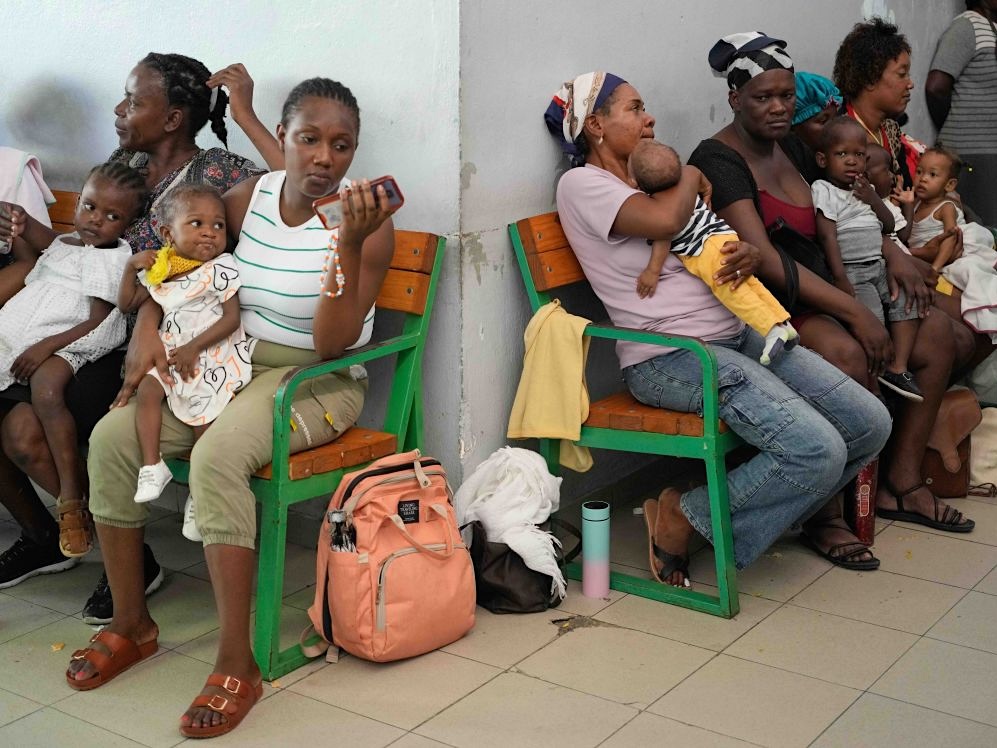
Similarly, spending on ODA has fallen from about $190 to $200 per capita in 2023 to an estimated $150 to $190 in 2026, meaning that much less in food support and funding for health care — and more deaths from malnutrition and disease in poor countries like Haiti and Malawi. We won’t kill millions like the United States, but we’ll kill our fair share.
So here’s another little test. You’re at that desk with a button in front of you. But now, if you press it, you will save a life through food aid and health care. Again, you won’t know whom you’ve saved. And $200 will be transferred to some foreign country or agency, straight from your bank account.
Do you press the button? Do you press it again? How many times? ![[Tyee]](/design-article.thetyee.ca/ui/img/yellowblob.png)
Read more: Rights + Justice, Politics










Tyee Commenting Guidelines
Please note that email notifications for replies are not currently working due to a software issue which may be resolved in a future update.
Comments that violate guidelines risk being deleted, and violations may result in a temporary or permanent user ban. Maintain the spirit of good conversation to stay in the discussion and be patient with moderators. Comments are reviewed regularly but not in real time.
Do:
Do not: