


 SHARE:
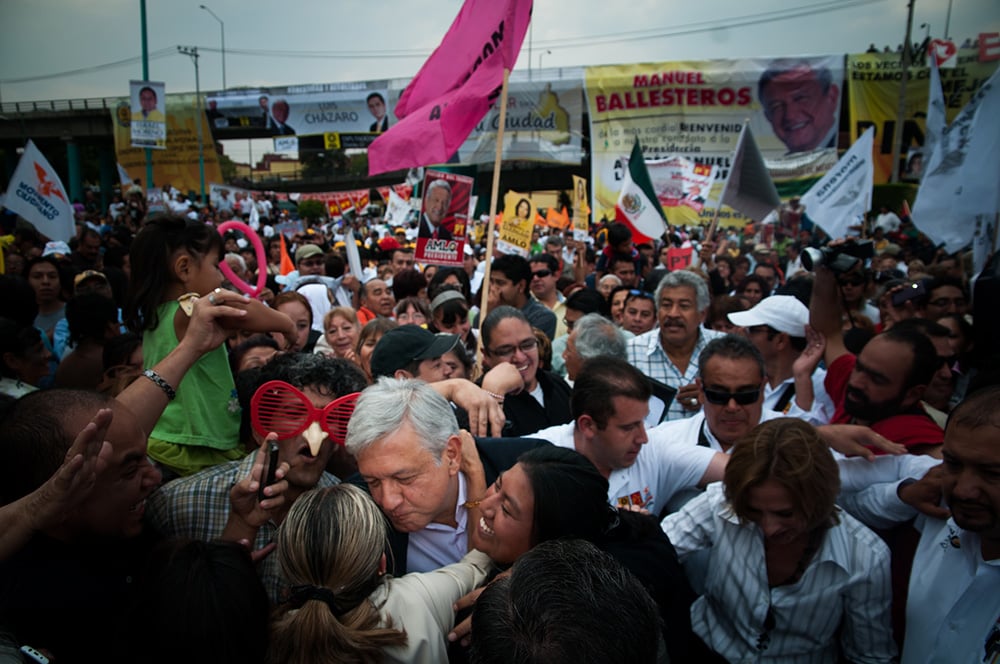
Shortly after he was sworn in, Mexico’s new President Andrés Manuel López Obrador (often known as AMLO) took a couple of steps to seal off the old political order and begin a new, more democratic era.
But it’s uncertain whether the transition will be permanent, or just another failure of Latin American democracy.
First, AMLO turned Los Pinos — the presidential estate and residence for over 80 years — into a museum, open to the public. While he continues living in his own house, his fellow citizens can marvel at the opulence enjoyed by previous presidents. Second, he ordered a free, open-air movie presentation on the grounds of Los Pinos: Roma, the acclaimed Alfonso Cuarón movie about a Mixtec maid working for an upper-middle-class family in 1970s Mexico City.
It wasn’t just a local-boy-makes-good celebration of Cuarón; the movie is a brilliant portrait of the old racist, sexist, violent-macho Mexico that López Obrador intends to transform.
It’s easy to see populist parallels with Trump. López Obrador expresses solidarity with the poor, and especially the rural, Indigenous poor. Temperamentally, he and Trump seem to get along. (A former president, Vicente Fox, has been firing off obscene tweets at Trump ever since he proposed building a wall on the Mexican border. Fox is now tweeting his horror at López Obrador’s policies.)
But López Obrador is far more sophisticated than Trump. While he established his leftist credentials as Mexico City’s activist mayor, and he has long criticized the two major Mexican parties as reactionary, López Obrador has expressed his support for the free market and his first budget seems designed to reassure anxious American investors.
Still, AMLO’s program seems intended to overthrow institutions and norms that have been established not just since the Revolution of 1910, but the coup that established Porfirio Díaz as Mexico’s dictator in 1876. Díaz created the “Porfiriate” — a regime favouring large landowners and foreign investors, who exploited Indigenous and mestizos — mixed race Mexicans — alike while advised by the foreign-educated technocrats known as the “científicos.” While the revolution overthrew Díaz and the científicos, the old ruling class soon absorbed the revolutionaries.
So it’s no surprise that one of AMLO’s books is titled Neoporfirismo: Hoy como ayer (in English, Neoporfirism: Today Like Yesterday). In it, he argues that the regime never really changed: big money hired technocrats to run the country and used military and paramilitary violence to suppress peasants and workers. (Roma depicts the “Halconazo” of 1971, when an elite, U.S.-trained military unit slaughtered 120 student protestors in the streets and even invaded a hospital to finish off the wounded. Bad as it was, that was a pale echo of the Tlatelolco Massacre of 1968, when the army killed far more on the eve of the Mexico City Olympics.)
Neoporfirism today is complicated by the drug cartels, which have injected yet more violence into the country. Mexico’s last president, Enrique Peña Nieto, failed to suppress the cartels, or to do much for Mexico’s social problems.
Now it’s López Obrador’s turn, and he too could be defeated by his own country’s social and political pathologies. But it won’t be for incompetence, or lack of vision.
On the American front, AMLO is playing Trump with a very sound offer: instead of demanding the Americans take the thousands of Central Americans fleeing drought and violence, he’s suggesting investment in their home countries that will create jobs to keep them there. Meanwhile, migrants in transit through Mexico could be induced to stay put with still more American money. (This almost looks like the cartels’ unrefusable offer of “plomo o plato,” a bullet or money, to encourage discreet official U.S. support.)
López Obrador is also using China the way Middle East Arab nations used to use the Soviet Union — as a bogeyman. The Chinese are big investors in Latin America, and could invest even more. Still more American investment in the region might be needed to slow Chinese influence.
Domestically, López Obrador is calling for measures that are wildly radical even by Canadian standards. He wants to ditch the old Mexican health-care system within two years, replacing it with a new system that will provide not only free health care but free pharmaceuticals as well. And he wants to launch the program in six southern states that are among the poorest in the country.
He plans to start no fewer than 100 new universities in a country that saw its first university founded in 1551. But he also has the chutzpah to tell the prestigious National Autonomous University of Mexico to “do more with less” — advice that used to drive me crazy when it came from B.C. Socreds about our own post-secondary system.
Unsurprisingly, López Obrador is capping his cabinet ministers’ pay and his own. But he’s also building inflation plus three per cent into the salaries of civil servants earning less than 10,000 pesos a month, about $666 Canadian.
Andrés Manuel López Obrador is clearly building a strong new base among workers, farmers and students. He is like no president Mexico has seen in a century and a half, and he’s a smart politician. As a Canadian who grew up in Mexico 60 years ago under the old regime, I wish him well.
But I also remember that presidents like him were overthrown by the U.S. in Guatemala in 1954, and Chile in 1972. Cuba survived more from American incompetence than Fidel Castro’s political skill. The Americans supported dictators like Panama’s Noriega and the Dominican Republic’s Trujillo until they didn’t. Left-populists Oscar Chávez and his successor Nicolás Maduro have ruined Venezuela.
Mexico’s sheer size and population shield it from crude Yankee interventions, but López Obrador faces internal enemies who would be happy to finish him off without a reward from the C.I.A. Brazil’s right wing staged a slow coup against the leftist governments of Lula and Dilma Rousseff, and a full-blown fascist, Jair Bolsonaro, is about to become president.
In Latin America’s present climate, AMLO can expect very rough weather in his six-year term. But the alternatives are all likely to be much worse. ![[Tyee]](/design-article.thetyee.ca/ui/img/yellowblob.png)
Read more: Politics





Tyee Commenting Guidelines
Comments that violate guidelines risk being deleted, and violations may result in a temporary or permanent user ban. Maintain the spirit of good conversation to stay in the discussion.
*Please note The Tyee is not a forum for spreading misinformation about COVID-19, denying its existence or minimizing its risk to public health.
Do:
Do not: