

 SHARE:
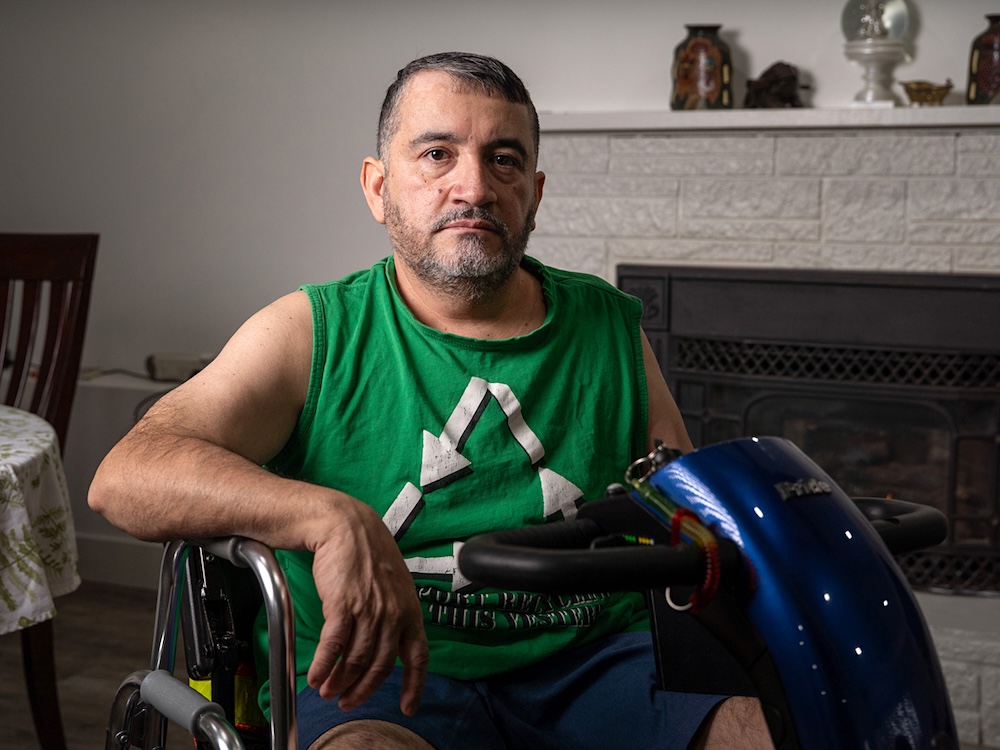
A 53-year-old Surrey resident could be billed close to $400,000 because he has cancer but doesn’t qualify for the provincial Medical Services Plan.
When Francisco Barahona was diagnosed with multiple myeloma in 2023, he’d lived in Canada for about 12 years but did not have an immigration status that would grant him permanent MSP coverage.
He had been accessing MSP temporarily through his work permit when he was diagnosed. Once he got sick he was no longer able to work and lost his coverage.
Barahona was told that without MSP coverage he wouldn’t be able to access treatment from BC Cancer. Without treatment, his health deteriorated and his bones started to weaken and spontaneously shatter after being hollowed out by the cancer.
Since his diagnosis he has broken his arm, his femur, his tibia, his coccyx and a vertebra in his mid-back.
After The Tyee reported on Barahona’s story in February, BC Cancer agreed to treat him.
Because Barahona was caught without status he was also in the process of being deported, but his deportation date has been delayed for at least six months while he undergoes treatment, although that may not be enough time to cure his cancer.
As of early May, Barahona is facing upwards of $393,624.20 in medical bills.
Now, the Sanctuary Health collective, a grassroots organization that helps people access health care, regardless of immigration status or documentation, is organizing a rally in support of Barahona. The rally will begin at 5 p.m. on Wednesday, May 13, at the corner of 10th Avenue and Heather Street in Vancouver. The rally will circle around the block past BC Cancer and end with a vigil at 10th and Heather.
Barahona previously told The Tyee he was billed $80,000 for a hospital stay last fall at Langley Memorial, where he underwent surgery to repair a shattered leg bone. He was asked to pay a $5,000 deposit to start his treatment with BC Cancer.
Barahona underwent five days of radiation in March. Now he needs chemotherapy. He says his oncology doctor told him that without chemotherapy the cancer will progress and his pain will get worse.
The Tyee was shown an emailed estimate for Barahona’s chemotherapy drugs that says it will cost $270,538.70 for six rounds of treatment.
That figure does not include additional fees for “clinic times, physician visits, radiation therapy, etc.,” the email added.
Cassandra Argueta, Barahona’s niece, says the estimated quote for BC Cancer for clinic times, physician visits and radiation therapy is an additional $38,086.
This estimate does not include the additional cost of blood work, X-rays, pain medication or other treatment-related expenses.
“I [don’t] have that money,” Barahona said softly.
Argueta, who has been helping her uncle navigate the health-care system as a translator, said a payment or payment plan will need to be discussed in order for the provincial pharmacy to provide BC Cancer with the chemotherapy drugs.
“At this point, with that totalling price for the drugs, we don’t think a payment plan would even be something easily accessible,” she said. “It would be basically paying a mortgage monthly.”
Argueta said the family is currently waiting to hear back from the Provincial Health Services Authority on what a payment plan could possibly look like.
“It seems like he could be stuck in limbo again if that payment plan is not easily accessible,” she added.
When Barahona was admitted to BC Cancer he was asked to sign forms acknowledging that a $5,000 deposit would need to be paid.
“That was the only cost that was provided at that time that we were aware of,” Argueta said.
Barahona will have to pay for his health-care costs out of pocket. A crowdfunding campaign organized by the Migrant Workers Centre was able to raise over $10,000, but that has been dwarfed by Barahona’s medical bills.
Barahona said his level of pain is “hard” to deal with, especially at night. He said he has intense pain in his legs — stretching from his hip to his ankle — and pain in his head, although he’s not sure if his headache is caused by the radiation therapy or the cancer.
“I am feeling tired and sad,” he said. “I don’t sleep because the pain is more bad at night.”
Barahona has been prescribed hydromorphone for the pain but says it’s not enough to let him sleep.
Applying for immigration status
Yanni Nicolidakis-Mustafa, an immigration lawyer with Edelmann & Co. Law Offices who has been working to help Barahona get status, previously told The Tyee he has applied for a temporary resident permit for Barahona, which will hopefully be issued two to five months from now.
If Barahona is granted status, even temporarily, he could get MSP coverage to help pay for his cancer treatment.
The cost of his chemotherapy drugs could also drop dramatically, said Byron Cruz, a longtime advocate for migrant workers and a member of the Sanctuary Health collective.
Cruz has been advocating for Barahona in health-care settings, helping get him admitted to hospital care despite not having insurance coverage.
Barahona is being billed as a “non-resident” despite having lived in Canada for 15 years, Cruz said.
“I am afraid for him,” Cruz said. “His pain is unbearable.”
In an email to The Tyee, the Ministry of Health said only patients with legal immigration status are considered residents. It does not matter how long a person has lived in B.C., it added.
And only residents qualify for MSP coverage under the Medicare Protection Act, the email continued.
However, the Health Ministry added that its “clinical teams and Provincial Health Services Authority revenue services are working closely with this patient and their family on a payment plan that would enable them to start treatment. No one is denied life-saving care if they can’t afford treatment.”
When cost is a barrier, “BC Cancer clinical teams may provide alternative treatment options,” the ministry said, adding, “PHSA revenue services will work with the patient and their family to create a payment plan that fits their financial situation.”
Uninsured patients pay more
Dr. Mei-ling Wiedmeyer, a family physician and clinical assistant professor in the University of British Columbia’s department of family practice who works at a clinic with migrants, says uninsured people tend to pay more for health care in Canada.
When a health-care provider sees a patient who is covered by MSP, the fees for service are set and they have to bill MSP those set fees, Wiedmeyer said. But there isn’t a similar legislated set fee structure for uninsured patients, so health-care providers can choose what to bill them.
“They could choose to charge the same thing to the patient that they charge to MSP, but they don’t,” she said. “It’s typically way more.”
If Canada truly had a universal health-care system, then people could access care based on need, not on the ability to pay, she said.
People not covered by MSP may have private insurance or coverage under the Interim Federal Health Program; however, B.C. health-care providers can be hesitant to bill anything but MSP and tend to still ask patients to pay up front, Wiedmeyer said.
When patients don’t know if they will have to pay out of pocket, or how much they might have to pay, they can put off accessing heath care, she added.
This is just one of the many barriers people with precarious immigration status face when accessing health care.
People with precarious immigration status, like other marginalized communities, are struggling with affordability and paying for housing, food, transit and medications, Wiedmeyer said.
On top of that, the health-care industry is bad at communicating with people in any language except English. Even though translation services are available, Wiedmeyer said she’s had patients come back from appointments with specialists or lab technicians with a note saying the patient couldn’t speak English so they weren’t helped.
When people face barriers to health care, it’s common for a once treatable condition to become chronic.
When people have access to health care, a doctor can notice early symptoms or screening can catch cancers early, she said. Without this access, cancer is found once it is more advanced and complicated to treat.
“That is both scarier and more life-threatening for people and also requires more resources on the part of the system to manage,” she said.
Denying people health care because they do or don’t have immigration status — which is ultimately just a “piece of paper”— is the act of choosing who is human, and deserves care, and who is less than, she said.
When someone’s humanity is denied, they are put in a more precarious position where they can be extorted or forced into accepting work that pays less or is less safe, she said.
It doesn’t have to be this way, Wiedmeyer said.
Canada could learn from the U.S. Medicaid system, which allows low-income people to access health insurance, or from Spain, which is “regularizing” people without status.
B.C. could also legislate the same billing rate for patients with MSP coverage and those without, with additional options for low-income people such as payment plans or waiving the fees, she said.
The province could also work with insurance companies to create a private plan that low-income people could buy into when needed, Wiedmeyer said. It could also eliminate the three-month waiting period for new residents to access MSP. ![[Tyee]](/design-article.thetyee.ca/ui/img/yellowblob.png)
Read more: Health, Rights + Justice





Tyee Commenting Guidelines
Please note that email notifications for replies are not currently working due to a software issue which may be resolved in a future update.
Comments that violate guidelines risk being deleted, and violations may result in a temporary or permanent user ban. Maintain the spirit of good conversation to stay in the discussion and be patient with moderators. Comments are reviewed regularly but not in real time.
Do:
Do not: