


 SHARE:
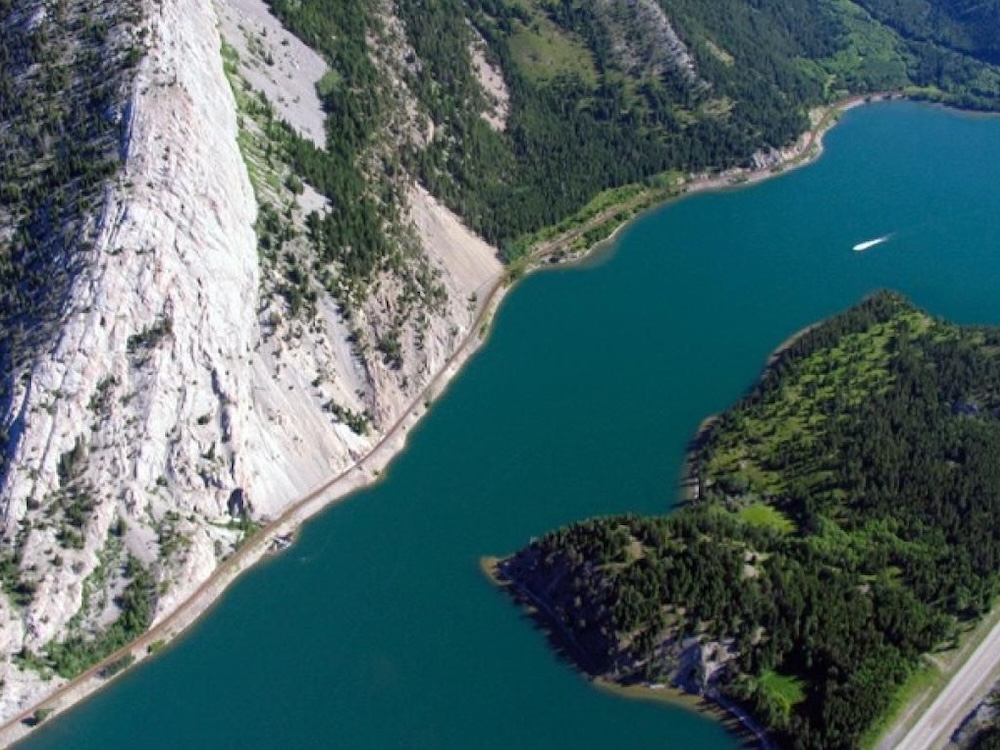
A member of the Piikani First Nation has presented a legal demand letter to the Alberta and federal governments to stop selenium pollution leaching from a closed coal mine owned by Australian speculators in the Crowsnest Pass.
The letter gives the Alberta Environment, Environment Canada and Evolve Power (formerly Montem Resources) until April 30 to respond to its demands for a clean-up of selenium pollution in Crowsnest Lake, a managed recreational fishery.
Two studies funded by the Alberta government and authored by provincial aquatic scientist Colin Cooke recently found extensive contamination in the deep Rocky Mountain lake from mines closed 40 years ago.
Those studies, published in 2024 and 2025, revealed that tissue taken from brown trout, lake trout and mountain white fish netted in Crowsnest Lake contained selenium concentrations that exceeded provincial and federal guidelines. Crowsnest Lake receives runoff from the Tent Mountain coal mine that the province partly certified as reclaimed in the 1980s.
Fish selenium levels rivalled those downstream of active mountaintop removal coal mining operations in the United States and Canada. The study added that any further development “may well push the Crowsnest fishery beyond sustainability.”
Selenium, which leaches from exposed waste rock piles, gradually accumulates in the tissues of organisms and becomes increasingly concentrated as it moves up the food chain, leading to deformities and reproductive failure in exposed fish.
According to the legal demand letter selenium pollution has eclipsed the constitutional rights of Trevor Bastien, a member of the Piikani First Nation, “to fish for sustenance.” Bastien, the son of the late Harley Bastien, a fish conservationist in southern Alberta, engaged Ackroyd LLP, an Edmonton firm, to undertake legal actions to protect the Piikani Nation’s traditional right to harvest fish in the Crowsnest and Oldman River systems.
“The high selenium levels in Crowsnest Lake emanating from the legacy Tent Mountain Coal Mine waste rock has had significant adverse effect on the Piikani fishery which is ultimately impacting Mr. Bastien’s cultural and indigenous rights,” notes the letter.
The legal document asks that Environment Canada require Evolve Power to “cease or control” the continuous release of selenium from its coal properties and that Alberta Environment direct the company to “properly reclaim its Tent Mountain site and implement a comprehensive selenium management plan to prevent the further contamination or release of selenium into Crowsnest Lake.”
The letter adds that if governments and the company fail to address ongoing selenium pollution in the lake, Bastien will begin “legal proceedings seeking an Order from a Justice of the Court of King’s Bench of Alberta for mandatory injunctive relief “ against all parties “to undertake the accelerated reclamation of the contaminated Crowsnest Lake and river by a specified date given the excessive levels of selenium as noted in Cooke’s study of May 2025.”
Dave Thomas, a spokesperson for Crowsnest Headwaters, a citizen’s group dedicated to the protection of the headwaters of the Oldman River from coal mining, described the legal action as unprecedented and necessary given the Alberta’s government continued support for coal mining in the Rocky Mountains.
"The Alberta government and its industry captured energy regulator have demonstrated time and again that they are in the pockets of the Australian coal companies and do not care one whit about what Albertan’s think of coal mining in the Rocky Mountains,” said Thomas. “The provincial regulatory process is captured beyond redemption.”
"Consequently, we are partnering with Trevor Bastien and a group of community Elders to elevate the matter of selenium poisoning to adjudication under federal law and federal courts which are beyond the reach of the Danielle Smith regime.”
Bastien’s legal challenge is the latest development in a fight to protect the eastern slopes of the Alberta Rockies, a critical watershed for the prairies, from coal mining and other industrial projects
Alberta musician Corb Lund, who lives downstream of the proposed Northback project, has spearheaded a movement to collect 178,000 signatures on a petition that calls for legislation to ban all new coal exploration and coal mining in the eastern slopes.
The prohibition would include Northback Holdings’ open pit Grassy Mountain Project owned by Australian billionaire Gina Rinehart and Valory Resources’ underground Blackstone Project which, because of its scale, could directly affect groundwater in central Alberta, according to opponents.
Selenium pollution is a contentious issue as the coal industry contends that contamination can be minimized with unproven technologies.
The mines of Elk Valley Resources (Glencore) continue to contaminate waterways in British Columbia with toxic levels of selenium despite spending more than a billion dollars on mitigation measures. Last year the company was fined $3.6 million for failing to curb nitrate and selenium pollution.
And when the Alberta Energy Regulator asked Montem Resources (now Evolve Power) in 2021 to improve selenium monitoring and uphold the law as it proposed to reopen the Tent Mountain open pit mine, the firm’s CEO refused and threatened to sue individual members of the agency.
At one contentious meeting the executive compared dealing with the regulator to being examined by a “meddling” proctologist.
Documents obtained by The Tyee last year show that Peter Doyle, then CEO of Montem Resources, fought a request to establish monitoring for the toxic pollutants at Tent Mountain, entering into a two-year-long dispute process with the regulator. ![[Tyee]](/design-article.thetyee.ca/ui/img/yellowblob.png)
Read more: Environment










Tyee Commenting Guidelines
Please note that email notifications for replies are not currently working due to a software issue which may be resolved in a future update.
Comments that violate guidelines risk being deleted, and violations may result in a temporary or permanent user ban. Maintain the spirit of good conversation to stay in the discussion and be patient with moderators. Comments are reviewed regularly but not in real time.
Do:
Do not: