


 SHARE:
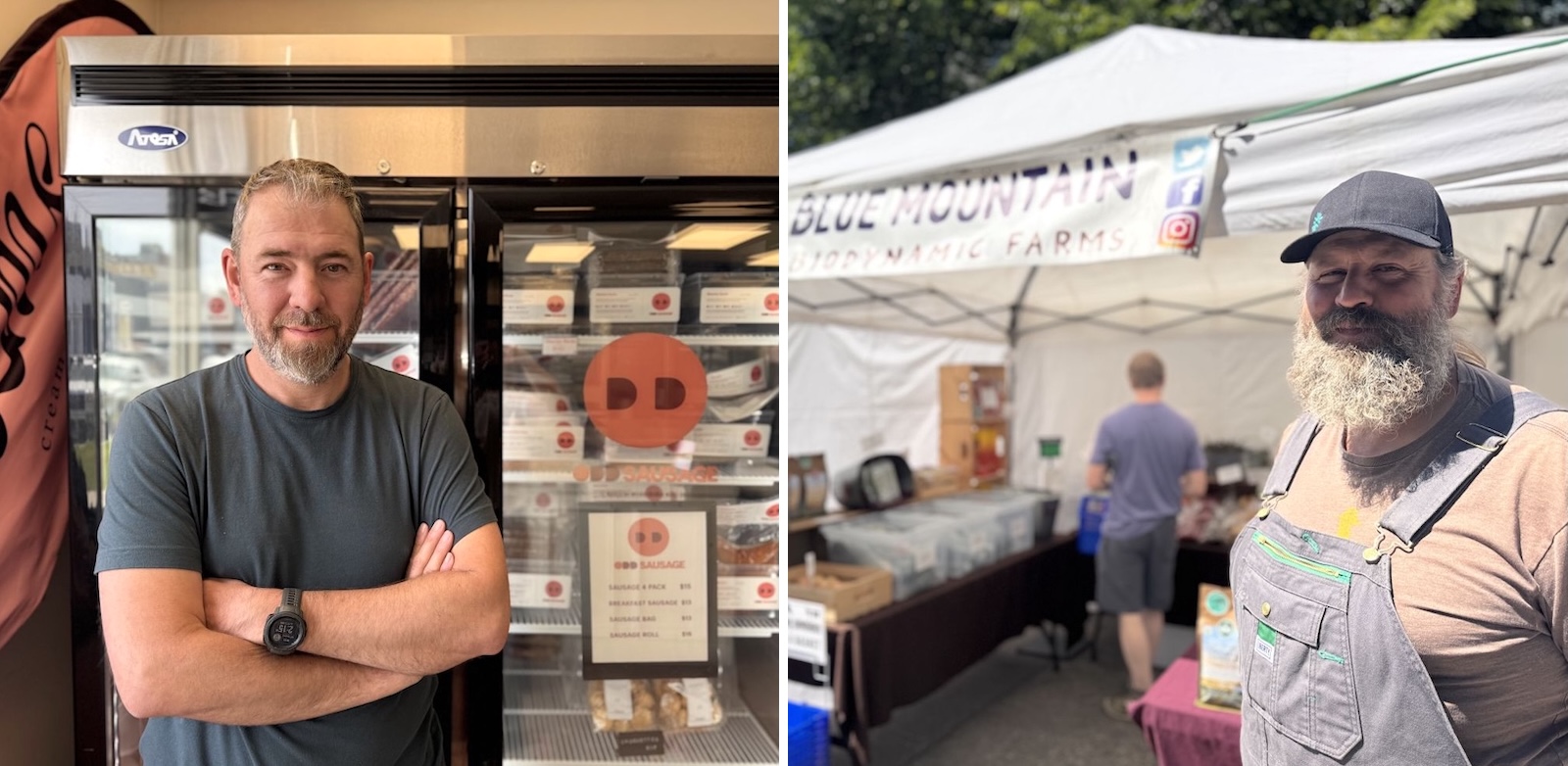
For years, Ezequiel Alberti and his partner stopped by Blush Lane market every week to buy groceries. Like many of the organic outlet’s customers, Alberti sought to shop locally grown, ethically produced food to nourish his small family.
Alberti, who moved to Calgary from Buenos Aires in 2015, felt so aligned with Blush Lane’s commitment to high quality standards that, when he launched his own sausage-making company five years ago, selling his product at Blush Lane seemed like a natural fit.
“At Odd Sausage we use only free-range animals that are butchered in the farms where they are raised, fed only fruit and vegetables,” Alberti said. “When shoppers buy our chorizo sausage, they’re supporting Alberta producers and their families, because we also buy from local suppliers.”
Blush Lane’s parent company is the British Columbia-based online grocery shop and delivery service Spud. Starting in late 2023, Odd Sausage supplied Spud and Blush Lane with products.
But last winter, the relationship took an unexpected turn.
After fulfilling a series of orders in October and November, Alberti didn’t receive payment from Spud within the 15-day term of the invoices. Surprised, Alberti emailed Blush Lane’s accounting department, but when he didn’t receive a response, he began to worry.
“There was no communication about there being delays in payment processing, nor how long it would take for us to get paid,” Alberti said. “So, we couldn’t plan ahead.”
Then Alberti learned a troublesome fact.
Three years earlier, Spud had filed for creditor protection, leaving more than 1,000 vendors in the lurch. After acting as interim lender for Spud, Third Eye Capital, a private equity firm, took ownership of the grocer’s brands, installed a professional management team and quietly relaunched Spud in the spring of 2023.
Although Blush Lane finally settled its bill with Odd Sausage in May, Alberti ended his business relationship with the organic market. He deemed the risk of another delay too high.
Alberti’s experience reveals a structural issue becoming more evident as grocery prices rise and margins for smaller wholesalers shrink. Dependent upon a handful of retailers, the local food system is fragile.
“If small producers disappear, communities lose local food resilience,” Alberti said. “And the market becomes dominated by large industrial suppliers.”
In an emailed statement, a representative of Third Eye Capital told The Tyee that local and regional suppliers remain important partners of Spud and Blush Lane.
“We understand that payment timing can carry particular weight for smaller vendors, and the company is committed to building constructive, sustainable supplier relationships while continuing to serve customers across Alberta and British Columbia.”

FOLLOW THE EXAMPLES
Alberti’s desire to shore up local food markets is echoed in a recent policy brief put forward by Food Secure Canada, a Montreal-based non-profit working to advance food security and food sovereignty.
Food Secure Canada supports an idea that’s been floated by both New York City Mayor Zohran Mamdani and NDP Leader Avi Lewis: a public grocer.
Proponents of a grocery store alternative that’s owned and operated by governments often point to benefits such as significantly lower grocery prices, as well as improved stability for local food producers, who’d no longer rely on a handful of profit-driven retailers.
South of the border, the U.S. military already runs its own grocery system, the Defense Commissary Agency. Because these stores operate on a cost-recovery basis, grocery prices are roughly 24 per cent lower than in a typical supermarket. In an April presentation, food policy expert Errol Schweizer suggested that introducing a similar model in Canada could save families up to $10,000 a year.
Mexico has public grocers too. SuperISSSTE and Tiendas del Bienestar offer local producers the stability they need to thrive, while selling grocery staples 15 per cent below the canasta básica, an economic measure that accounts for the cost of food an adult individual needs to access essential nutrients.
What would it take to foster similar approaches in Canada?
Food Secure Canada estimates that introducing a public grocer, supported by regional distribution hubs, could help reduce grocery prices by at least 30 per cent in urban areas. To achieve this, the federal government would spend $350 million to get the initiative off the ground and invest $290 million in annual operating costs for 50 stores across the country.
That’s small potatoes compared with, say, the Department of National Defence’s $50-billion projected spending for the 2026-27 period, say advocates.
Establishing public grocer support in Canada could be especially beneficial in Alberta, a province whose local food system is more vulnerable than in other regions.
LOCAL CONNECTIONS
The Prairie province’s fickle climate, combined with limited water availability, a short growing season and the rising cost of land, makes growing food for domestic consumption a challenge few farmers are willing to tackle. Instead, Alberta farmers dedicate their land to more profitable endeavours, such as growing commodity crops for export and cattle ranching.
While agri-food businesses thrive in the Prairie province, the large majority of fruits, vegetables, grains and legumes Albertans need to sustain a healthy diet are trucked in from other province or abroad.
It’s no coincidence that the grocery bills of Albertans are among the highest in Canada. In 2024, over a third of the province’s population was food insecure; that is, they didn’t earn enough income to sustain a healthy diet.
To help mitigate the impact of rising food prices on students, the University of Calgary launched a campus food hub in 2024.
Enabled by charitable donations and university funding, the food hub offers reasonably priced produce, as well as prepared meals. However, buying from a local supplier isn’t always an option for the organization.
“When local food makes up such a small part of our food supply, as is the case of Alberta, local food tends to be more expensive,” Kate Stenson, the campus food hub co-ordinator, told The Tyee.
In the absence of a strong local food system, food availability in Alberta depends on an increasingly unstable supply chain controlled by global corporations and foreign governments.
“To have food sovereignty,” Stenson said, “you must have local food producers.”

BOOSTING SOVEREIGNTY
Food sovereignty is top of mind for Rebecca MacLeod.
Seeking to reduce her carbon footprint, MacLeod strives to buy food grown and produced locally, but a mirage abundance at the grocery store conceals the fact that affordable local options are few and far between.
“Only a small percentage of the population can access the food they feel totally aligned with, in terms of values,” she said.
In 2016, a market study found that higher-income households were the most likely demographic to regularly buy local food in Alberta.
To raise awareness of the importance of having autonomy over the food Albertans consume, the Edmontonian launched New Grocery Movement in 2020.
“We want people to imagine what our food system would look like if it was built on a foundation of food security, food sovereignty and food justice,” MacLeod said. “The more control and agency that we have in our ability to source and access food, the more resilient we are.”
But because a handful of retailers control the market, the food growers and producers needed to sustain the local food system struggle to stay afloat in Alberta.
Alberta farmer Kris Vester is well aware of the perils brought on by market concentration.
“If your business is all centred on one or two buyers buying 80 per cent of your product paying you every month, so that you can stay in business, that’s a lot of risk exposure,” he told The Tyee.
Vester and his wife Tamara operate Blue Mountain, a biodynamic farm north of Calgary, near Carstairs. Before 2020, when the farm still relied on wholesalers and grocers, late payments, ranging from a couple of months to an entire year, were the norm.
“The larger the company, the more likely they were to not pay on time,” Vester said, noting that as the presence of financial firms in the grocery sector grows, so does the drive for profit.
“Investor owners want to take as much wealth out of the business when times are good, but that doesn’t leave them in a position to carry on covering their labilities if times get tough.”
The farmer’s observation seems accurate. In 2023, the Broadbent Institute identified financialization in the grocery industry as one of the drivers of food price inflation in Canada.
For Vester, removing the middleman has been key to his farm’s resilience.
In the wake of COVID, the biodynamic farmer launched an online market that delivers Blue Mountain’s produce, eggs and sausages, alongside an array of products from other local producers, to Calgary shoppers.
“Direct-to-consumer sale allows us to take the full margin on what we produce ourselves,” Vester said. “And we get paid immediately.”
While this arrangement gives the farmers much-needed stability, it isn’t conducive to growth. Uncertainty limits their capacity to access capital and make Blue Mountain’s operation more efficient, Vester said. “Investment would allow us to put more infrastructure in place.”
RESISTING MONOPOLIES
Recognizing that market concentration undermines food sovereignty, Agriculture and Agri-Food Canada, a federal agency tasked with promoting growth, innovation and sustainability in the agri-food sector, released Canada’s first national food security strategy on June 11.
The strategy intends to invest $3.2 billion over the next decade to increase the country’s capacity to produce and process food locally, curbing Canada’s reliance on foreign jurisdictions. To increase competition in the retail and distribution spaces, the document earmarks $1 billion in funding to establish food hubs and terminals, much like the Ontario Food Terminal in Etobicoke, across Canada.
“To protect our sovereignty, and truly take control of our future, we have to take control of our food system,” Prime Minister Mark Carney said during the June 11 press conference in Etobicoke.
But simply enabling more competition is unlikely to address the power disparities that exist between retailers and producers, said Aaron Vansintjan, policy lead at Food Secure Canada.
Unless the drive for ever-growing profit is tempered in the food industry, the business practices undermining the viability of local producers and farmers are likely to continue. “Because the retail environment rewards those who have cornered a market,” Vansintjan said, “smaller players are forced to engage in the same practices big retailers do.”
For this reason, Vansintjan believes that creating a publicly owned alternative, based on equitable practices, is an essential step to address the challenges local food growers and producers face across Canada, and to bolster food sovereignty and security.
“When you have a public grocer and distributor that is able to set prices and prioritize local procurement, food producers are able to invest in infrastructure — buy a cold storage truck, build a warehouse or invest in food processing,” Vansintjan said.
“Having a strong local food system allows us to have sovereignty and strength in the face of global crises.” ![[Tyee]](/design-article.thetyee.ca/ui/img/yellowblob.png)









Tyee Commenting Guidelines
Please note that email notifications for replies are not currently working due to a software issue which may be resolved in a future update.
Comments that violate guidelines risk being deleted, and violations may result in a temporary or permanent user ban. Maintain the spirit of good conversation to stay in the discussion and be patient with moderators. Comments are reviewed regularly but not in real time.
Do:
Do not: