



 SHARE:

B.C.’s provincial government has begun using artificial intelligence in an effort to streamline its response to freedom of information requests, The Tyee has learned.
The province’s Ministry of Citizens’ Services confirmed that it has been using AI tools for specific tasks in an attempt to respond more efficiently to requests made under the province’s Freedom of Information and Protection of Privacy Act, also known as FOIPPA. The legislation provides a framework for the public to request internal documents from the province’s public bodies.
The government’s use of AI in responding to freedom of information, or FOI, requests is part of ongoing work to “modernize” the system and improve response times by creating “efficiencies and streamlining the process,” the ministry said in an email.
Currently, the tools are being tested for tasks like reviewing handwritten documents and removing specific types of personal information, such as names, addresses and phone numbers. However, the company contracted to develop the system has publicly stated that plans to expand AI use in FOI processing are in the works.
“Freedom of information requests today are more complex and resource-intensive than ever, and we need to ensure the system keeps pace,” Minister of Citizens’ Services Diana Gibson said in a statement sent to The Tyee.
“This work is about making the FOI process more transparent, more responsive and easier to navigate for everyone, while maintaining strong protections for privacy and public trust.”
The ministry said that staff use only government-approved enterprise AI tools that are subject to strict privacy and security requirements. But some experts expressed concern that governments appear to be forging ahead with plans to incorporate AI into the FOI process with little public consultation or transparency.
“I find it really concerning that the B.C. government is pursuing this,” said Evan Light, an associate professor in the University of Toronto’s faculty of information.
While the experts acknowledged that using AI could improve the FOI system when it comes to response times and consistency in how documents are redacted, some fear it could be used to strip services from the public sector rather than improve them. They also pointed out that it can be difficult to remove any personal information fed to AI.
“Once information is ingested by an AI, it’s not just held by an individual or a government; our control of it is not there anymore,” Light said. “Personal information should be just between you and the government, rather than you and the government and Microsoft.”
The Ministry of Citizens’ Services confirmed that AI tools are used to process personal information but said they are used “strictly in accordance with all privacy and security requirements.”
“These tools operate in a secure, closed government environment, isolated from the public internet and fully protected by privacy and security protocols,” a spokesperson wrote, adding that personal information is not used to train AI models.
The ministry said freedom of information requests are becoming larger, more complex and significantly more resource-intensive. As a result, public bodies face increasing administrative pressures to maintain timely and equitable access, according to a statement provided to The Tyee.
The ministry said efforts to modernize its FOI systems will help analysts respond sooner as staff manage larger and more complex responses to requests.
That work includes launching a new app analysts use to process FOIs. It is expected to be completed later this month. The B.C. government hired Victoria-based technology company AOT Technologies to help create a new, modernized system to process freedom of information requests.
The ministry said the system aims to delete duplicate requests and streamline the request process, helping analysts respond to requests faster.
Public institutions have a legal duty to respond to requests for information made through B.C.’s Freedom of Information and Protection of Privacy Act within a timely manner.
But the existing FOI request system has been plagued with delays and increased fees for processing requests.
In 2021, the provincial government implemented a $10 filing fee for each request. The government said the fee was meant to speed up response times by reducing the number of requests.
But in the years that followed, the province has become less likely — not more — to meet its legislated deadlines, according to the government’s most recent report on the administration of the Freedom of Information and Protection of Privacy Act. That’s despite the overall number of FOI requests plummeting since the fee was implemented.
Despite receiving significantly fewer requests, the province has been collecting substantially more in processing fees, which are applied to more time-consuming requests. The government collected $70,000 in processing fees last year, a significant increase from $54,000 the year prior.
It blamed the increase on a greater volume and complexity of FOI requests. The average page count of an FOI response rose 86 per cent over the past five years, according to the province’s most recent figures.
Experts have blamed a drop in the number of requests on longer wait times, the government’s broad use of redactions to withhold information and escalating costs, which they said are becoming a barrier to accessing information.
The University of Toronto’s Light said the current backlog of requests highlights major staffing issues in Canada’s freedom of information offices.
While the current system is often slow, a human is responsible for reviewing each request and ensuring people’s personal information stays secure, Light said. He said letting an artificial intelligence program help with those sensitive decisions makes it unclear who’s responsible for mistakes.
Mike Larsen, the president of the BC Freedom of Information and Privacy Association and a criminology instructor at Kwantlen Polytechnic University, told The Tyee that government narratives around “cutting red tape” and downsizing the public service are driving demand for AI — including when it comes to processing FOI requests.
“I foresee a scenario, within five years, where all public bodies in Canada have integrated artificial intelligence in a very fundamental way into the processing of any access requests,” Larsen said.
Larsen added that while it’s not surprising that public bodies are looking at AI to streamline FOIs, “there isn’t a formal policy framework for this, federally or provincially.” At the provincial level, he said, there has been no public consultation or any announced policy framework for incorporating AI into the public service.
He said the extent to which the government is currently using AI to process requests is unclear and expressed concern about the “danger of black-boxed processes.” Because the public is entitled to file a complaint with B.C.’s Office of the Information and Privacy Commissioner if they have concerns about an FOI response, a public body’s decision-making must be reviewable, he said.
“At the end of the day, the head of a public body is legally responsible for the administration of the FOIPPA within that public body,” Larsen said. “There is no rule that allows anyone to offload that to a machine.”
In a statement, B.C.’s Ministry of Citizens’ Services said public servants currently use AI-enabled tools for limited tasks, such as searching older documents and locating personal information. It said that the tools are used to support the staff processing requests and are “never used to make decisions about redactions or any other FOI outcomes.”
“The decision of what is redacted is always made by our experienced FOIPPA experts,” a spokesperson wrote, adding that experienced staff are “responsible for all determinations, including redactions.”
The B.C. government permits public service employees to use generative AI under a usage policy that allows staff to process confidential information using Microsoft’s Copilot Chat, a tool with enhanced security features that is designed for organization use.
The policy prohibits staff from entering confidential or personal information into publicly available tools like ChatGPT.
When asked whether the ministry discloses the use of AI in FOI processing if directly asked by the person making the request, a spokesperson indicated that it would not.
“AI-enabled tools are used only to support analysts and are not used to make decisions about redactions or any other FOI outcomes. As a result, the ministry does not provide notifications to applicants about AI use,” the ministry wrote.
It said that if someone making an FOI request specifically asked about AI use, “the ministry would provide general information about how AI-enabled tools are used within FOI Operations” but would not provide “case-by-case” disclosure.
B.C.’s procurement database shows the province has awarded contracts to AOT Technologies to help modernize its freedom of information services. The company is headquartered in Victoria but has offices in the United States and India.
The company was awarded $5.7 million for the project, with the funds paid out over the course of several years starting in 2022.
AOT Technologies did not respond to requests for comment.
Last August, AOT Technologies employee Abin Antony described the project in a blog post on the company’s website.
He wrote that the company had rolled out its modernization project to 24 provincial ministries and migrated “legacy FOI data” to the new system by January 2024.
“The next challenge was addressing one of the most labour-intensive stages of FOI processing — document redaction,” he wrote. “Manual redaction was time-consuming, costly, and prone to bottlenecks. The ministry required a solution that could balance speed, accuracy, and scalability while being compliant with privacy laws.”
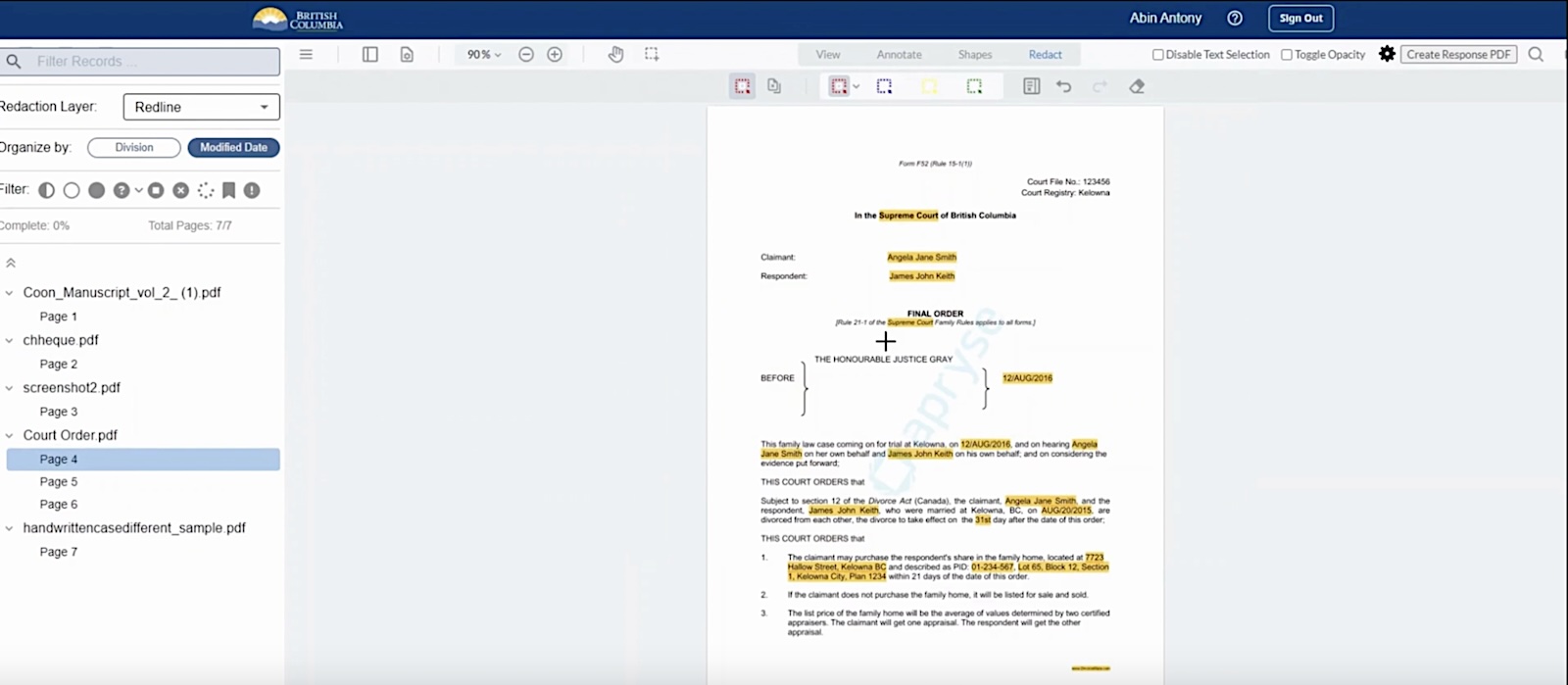
The company developed a tool that would help analysts redact personal information from documents before release. It uses Microsoft’s Azure AI to scan documents and identify information — like names, addresses and phone numbers — that analysts often redact for privacy reasons.
Antony estimated that the tools could shorten response times by up to a week.
“With AI-powered redaction in operation, the Ministry is looking into further capabilities to enhance FOI processes,” Antony wrote. That includes using it to redact non-personal information and redirect requests to other public bodies.
Jennifer King, the privacy and data policy fellow at Stanford University’s Institute for Human-Centered Artificial Intelligence, researches the privacy risks associated with generative AI tools.
She said in cases where the government is paying to use an enterprise product like Azure AI for use in a specific tool, it’s unlikely that any training data is being sent back to a tech company.
“If the tool is training on your data, it's local. It's not sent back to the mother ship,” King said. “The enterprise space is the one area where there may actually be real privacy protection, ironically.”
She said her research suggests that in the United States, Azure AI tools developed for businesses are not shipping data back to Microsoft.
“That's expressly what you would be concerned about: that Microsoft in this case is taking all the public records that the tool feeds into it and ships that data back to the main training data pool,” she said. “Surprisingly, I don't think that might be happening.”
In the case of AOT’s redaction tool for the B.C. government, King said data security depends on whether government contracts block the company from taking personal information.
“As always, the devil's in the details,” King said. “We should be concerned about these things and not give it all away to the tech company.”
The Tyee asked to view contracts between AOT and the B.C. government. The Ministry of Citizens’ Services told The Tyee to submit an FOI request.
Jason Woywada, executive director of the BC Freedom of Information and Privacy Association, said federal and provincial laws protecting private business information could also provide cover for public bodies who use third-party tools by shielding them from public scrutiny. He said that provides governments with an incentive to hire out AI tools rather than developing them in-house.
Woywada added that the U.S.-based reference model for AI use developed by Mitre, a non-profit providing technical expertise to government, provides “the clearest framework we’ve seen” for implementing AI use.
“It was the first time we encountered a document that clearly articulated how and when to use artificial intelligence in the processing of access to information requests in a U.S. context that could then be imported into Canada,” he said.
But in B.C., there’s been no public consultation or an announced policy framework for incorporating AI into the public service, said Larsen, also with the BC Freedom of Information and Privacy Association.
In a 2023 joint statement, B.C.’s Office of the Information and Privacy Commissioner, Office of the Ombudsperson and Office of the Human Rights Commissioner called on the province to expand its consultation on draft principles for the responsible use of AI, saying that consultation had been restricted to public service employees. It also called on the government “to ensure clear legislation is in place to protect the interest of British Columbians when AI is used.”
But it’s unclear if any consultation has followed.
In a statement, B.C.’s Office of the Information and Privacy Commissioner said it is not permitted to comment on any consultations involving the office, but provided The Tyee with suggested guidance for public bodies considering AI tools for FOI requests.
That guidance included meaningful human oversight, transparency around how a requester’s information is handled and that applicants “have a clear path to human review and the ability to challenge decisions” if AI is used in any part of responding to a request.
B.C. information and privacy commissioner Michael Harvey has also recommended that public and private sector privacy laws be amended to require public bodies to notify individuals when automated decision-making systems are used in processes that affect them, the office said.
The B.C. government isn’t the only public body turning to AI to speed up freedom of information requests. The government of Canada has also developed its own tools to process requests made under the federal Access to Information Act.
Some federal government departments use an AI tool to help analysts process Access to Information and Privacy requests faster, according to an internal report by Shared Services Canada. That’s the agency that provides information technology services to the federal government.
The report, obtained under the Access to Information Act, outlines how the agency and other federal government departments used artificial intelligence tools.
Shared Services Canada developed CANChat, a multilingual chatbot designed to be an alternative to programs like ChatGPT for government workers, and SSC Assistant, a tool that helps agency employees find information on the internet and within the agency’s intranet.
The agency also developed a tool to help process Access to Information and Privacy requests that automatically eliminated duplicate records and indexed information.
The report said the tool will “save time and ensure analysts stay focused on higher value work,” allowing requesters to receive their responses faster. It added the agency no longer used the tool due to “incompatibility with a new platform,” but other departments continue to use the tool.
Ottawa is also developing its own AI-powered redaction tools. As first reported by the Ottawa Citizen, Transport Canada, the Department of National Defence, and Public Services and Procurement Canada are all designing tools to help identify and redact sensitive information from documents before release.
Experts told The Tyee that the federal government’s work has gone ahead with little public consultation or oversight from advocacy groups. In response to what they described as brief and inadequate consultation last fall, a group of experts, academics and advocates formed the People’s Consultation on AI, a grassroots initiative aimed at providing policy guidance to the federal government.
The BC Freedom of Information and Privacy Association contributed a 20-page report this week warning that the algorithms behind AI tools can be altered when tech companies “put their finger on the scale” to influence their outcomes. In one extreme example, AI platform Grok began spewing racist and antisemitic comments last year after changes by owner Elon Musk.
The University of Toronto’s Light said that if these tools are successful, he expects governments at all levels in Canada will start turning to artificial intelligence to handle these types of information requests.
“This sort of stuff tends to spread pretty quickly in Canada,” Light said. “Once it becomes normalized in one spot, then other governments pick up on it.”
He said it’s true that Canada’s freedom of information offices do have serious backlogs and delays.
But instead of turning to poorly understood software to ease the burden of sensitive redaction work, Light urged governments to consider training and hiring more humans.
“The issue is that there aren't that many people that do freedom of information work,” he said. “If government treated it like a professional pursuit, which it is, and invested real money in training and in people, then they'd wind up with systems that were sustainable.” ![[Tyee]](/design-article.thetyee.ca/ui/img/yellowblob.png)
Read more: BC Politics, Science + Tech












Tyee Commenting Guidelines
Please note that email notifications for replies are not currently working due to a software issue which may be resolved in a future update.
Comments that violate guidelines risk being deleted, and violations may result in a temporary or permanent user ban. Maintain the spirit of good conversation to stay in the discussion and be patient with moderators. Comments are reviewed regularly but not in real time.
Do:
Do not: