


 SHARE:
In many ways, Cassiar was an idyllic place to grow up.
At the remote northern B.C. mining town, the jobs paid well, the cost of living was low and you could put money away.
There were summer barbecues, baseball games and tennis matches. In winter, residents curled, played hockey and carved turns at the small ski hill. Every Christmas, Cassiar Asbestos Corp., the company that owned the town and nearby mine, threw a party.
While some employees stayed only a short time at the mine, which operated from 1953 to 1992, others raised families in the isolated community 80 kilometres from the Yukon border. Today, the townsite is abandoned and most of its buildings have been removed.
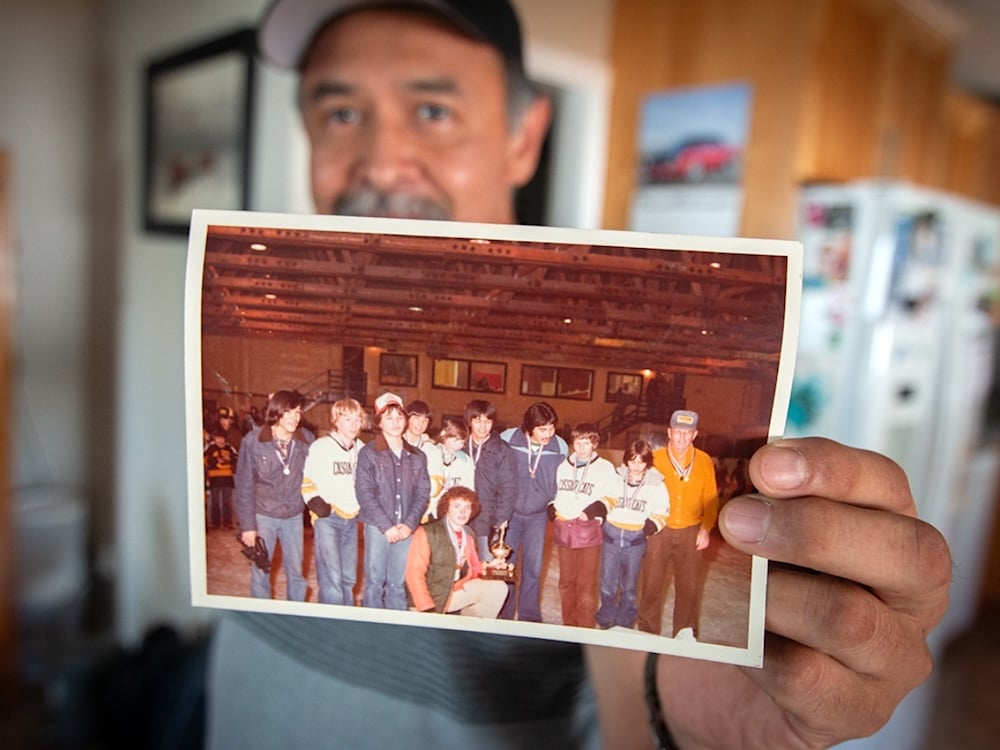
“It was a town,” says Floyd Joseph, who was born in Cassiar and spent 30 years there, working in mill maintenance and as a heavy-duty mechanic. “We played sports — baseball, everything — not realizing that asbestos was bad for you.”
But awareness about the threat of asbestos steadily grew over the mine’s 40 years of operation.
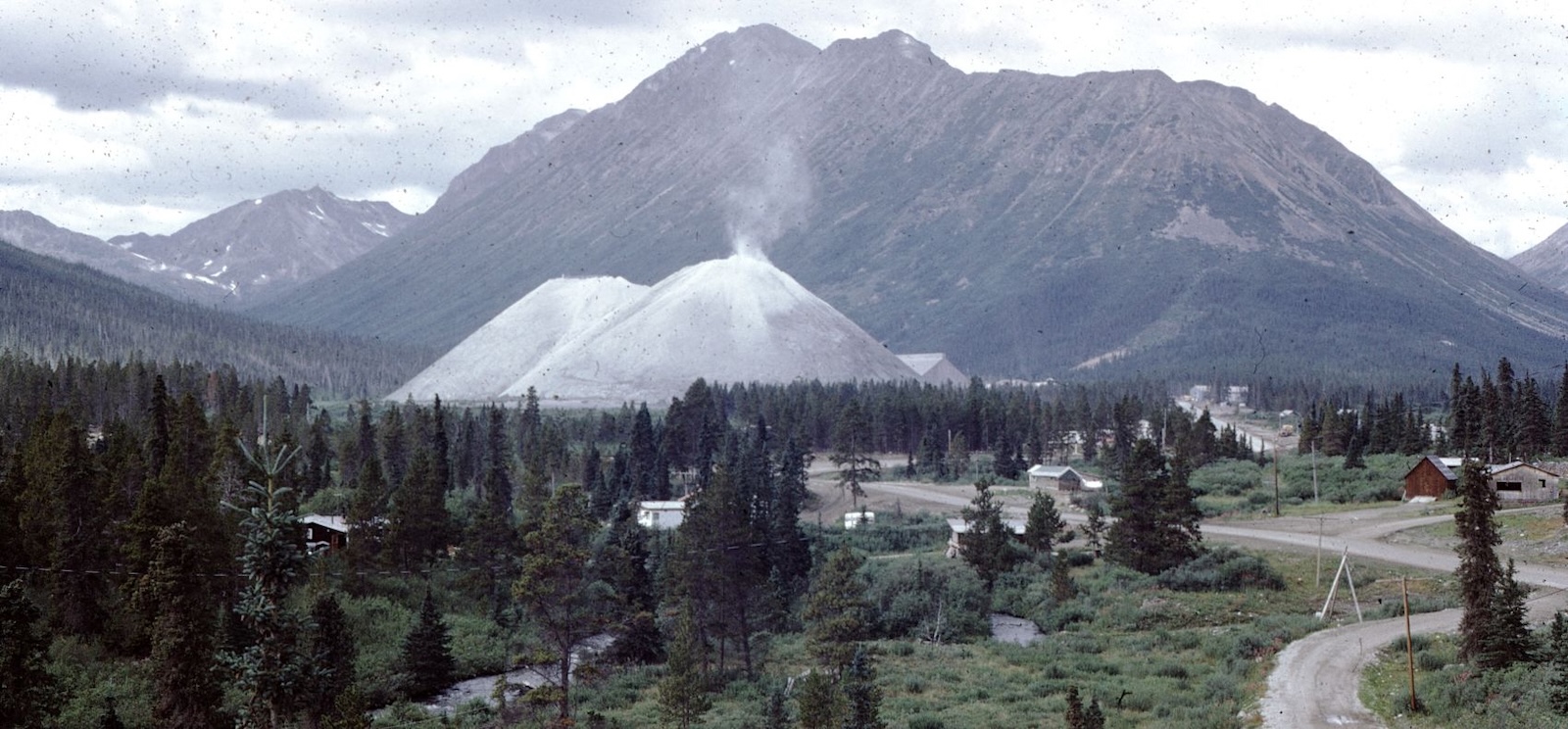
As more asbestos was mined, a tailings pile east of town also grew, rising to almost 100 metres — taller than Toronto’s Rogers Centre and with a footprint six times as large. When the wind blew west, it carried the asbestos into town. Green dust settled over everything.
In summer, bouncing soccer balls would release plumes of dust into the air. In winter, it collected in layers on the snow. Children playing in the snow cautioned each other to “eat between the green” to avoid ingesting it, Joseph remembers.
“People didn’t realize how dangerous it was,” he says. “It wasn’t known until after [the mine] shut down. Then everybody found out how bad it was.”
More than 30 years after the mine closed, some former residents say they were not warned about the health risks posed by asbestos, the fire-resistant “magical mineral” once used in everything from textiles to insulation to vehicle brakes.
Some have been diagnosed with cancer that they believe was caused by asbestos exposure. But conclusively linking the disease to their time at Cassiar has proven difficult, putting compensation out of reach.
Advocates say it’s time for B.C. to take a closer look at the legacy left by Cassiar, including tracking the health of its former residents and ensuring better supports.
“It’s sort of like Cassiar has been forgotten,” says Lee Loftus, the former vice-chair of WorkSafeBC and an occupational safety advocate. “I think that’s sad in the story of asbestos disease in British Columbia. There’s no reason to forget that tragedy — because it was a tragedy.”

Cassiar asbestos played a role in ‘opening’ the north
Although more than a dozen asbestos mines operated in Eastern Canada, Cassiar was one of just two in the West — the other western mine, Clinton Creek, was also owned by Cassiar Asbestos Corp. It was smaller and operated in the Yukon in the 1960s and ’70s.
The Cassiar mine could produce more than 100,000 tonnes of chrysotile, also known as “white asbestos,” in a single year. One company report claimed that the long, slender strands mined at Cassiar were among the highest quality in the world and equal only to another location in Zimbabwe.
According to a 1964 feature in Western Miner, Cassiar’s contribution to the provincial and national economies was a “material factor in opening the north-central portion of British Columbia and adjoining parts of the Yukon Territory.”
Its asbestos was trucked to Whitehorse and then sent west by train to the seaport in Skagway, Alaska, from which it was shipped to Cassiar’s loading docks in North Vancouver. From there, it was sent all over the world — to the U.S. and dozens of countries in Asia, Europe, Australia and South America.
A socio-economic impact report from the mid-1980s found that Cassiar was contributing 1,500 direct and indirect jobs to Canada’s workforce. In 1983, the mine and its workers paid more than $7 million in taxes, or nearly $20 million in today’s dollars.
But Cassiar’s economic contribution came at a cost.
At any given time, the town had a population of about 1,500 residents, roughly half of them directly employed by the mine. Over its lifetime, more than 50,000 people cycled through the community. They were all exposed, in varying degrees, to asbestos.
If the dust appeared thick at the townsite, it was much worse inside the buildings where the asbestos was processed.
Joseph worked in the mill and the dryer room, where asbestos was separated from the ore, puffed up and packaged for shipping. The long, sock-like tubes that were supposed to filter the air were frequently torn. The conveyors would clog up with dust. It was his job to clean up.
At times, the air hung so heavy with asbestos, you could barely see, he says.
“We had a mask on, but still it’s dusty,” Joseph says, remembering the fine layer of asbestos dust that would cling to his skin. “You could feel it all in your face.”
‘This can’t be right’
John Rogers worked at Cassiar for a year in the late 1960s, living in the bunkhouse and saving money for university. Even as the health effects from asbestos were becoming increasingly known, Rogers remembers company messaging that declared the asbestos mined at Cassiar had “different fibres” that weren’t harmful.
“There was certainly an attitude that there was no risk,” he says. “People were actually eating their lunches sitting on [asbestos] bales, with fibres in the air.
“I thought, ‘This can’t be right.’”
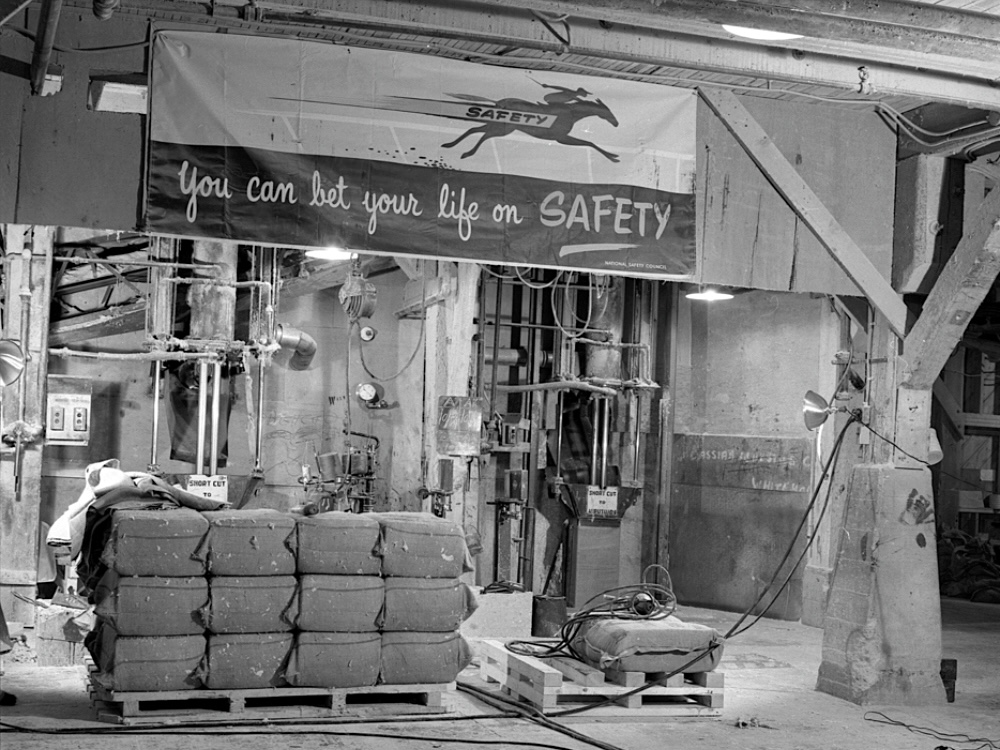
Rogers, who went on to become a labour lawyer working with unions, had a “crisis of principle.” He thought the working conditions should be reported, but his job was part of a college program in which students would educate workers and it was suggested that speaking up could put the program's future in Cassiar at risk.
So Rogers decided to leave. Fifty-five years later, he would like to see the provincial government take a closer look at the health outcomes of those who lived and worked at Cassiar.
“We’ve got a government now that should be prepared to look at it, because it’s known,” he says. “It is not hypothetical that asbestos causes fatalities.”
A growing consensus of asbestos’s deadly risk
Even before Cassiar opened in 1953, studies were linking asbestos fibres to lung disease and cancer.
In the United States, asbestos giant Johns-Manville — whose Canadian subsidiary operated several mines in Eastern Canada — had quietly settled claims with workers going back to the 1930s.
A 1973 landmark case against Johns-Manville and other asbestos manufacturers held the companies liable for not warning employees about the harms posed by asbestos.
The U.S. Court of Appeals determined that warnings Johns-Manville and others began placing on their products in the 1960s — that “inhalation of asbestos in excessive quantities over long periods of time may be harmful” — didn’t adequately disclose the risks.
The court also pointed out that the dangers of inhaling asbestos were “common knowledge” going back to the 1930s — evidenced by Johns-Manville’s own history of settling claims with its workers.
The companies had a duty to warn their employees, the court confirmed.
The decision opened the floodgate to litigation against asbestos companies. In 1982, faced with thousands of lawsuits, Johns-Manville declared bankruptcy. It pooled its assets into a trust fund to settle outstanding claims. The Manville Trust is one of dozens that remain active in the United States today.
Meanwhile, the company restructured, slightly rebranded itself and continues to manufacture insulation and building materials as Johns Manville.
Company downplayed risks, years after US court decision
Throughout the 1970s, concerns about the risk of asbestos exposure at Cassiar continued to grow.
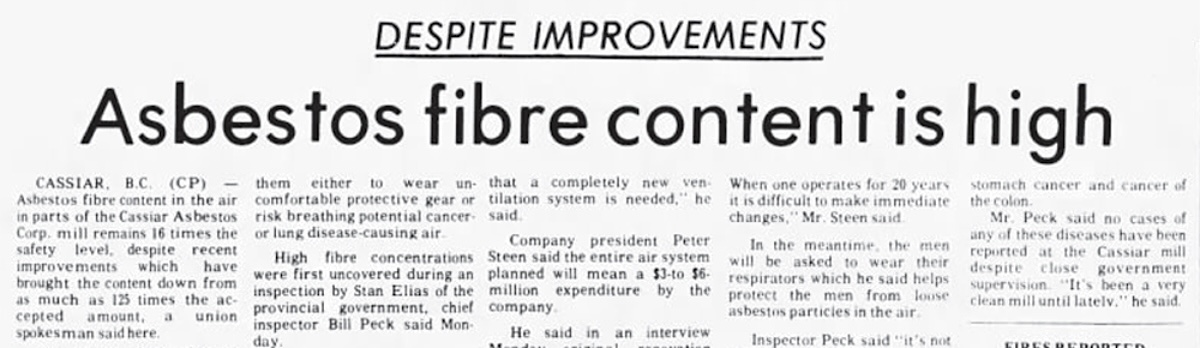
In May 1975, the media reported that asbestos fibres in the air inside the mill were 125 times the legal limit. In the B.C. legislature, George Scott Wallace, an Oak Bay MLA who was also a physician, pressed the government to act.
That fall, Cassiar workers walked off the job. The United Steelworkers union said the company wasn’t complying with provincial air quality regulations and that government tests showed “levels of toxic asbestos fibres in the air that workers breathe are far in excess of safe levels.”
The company called the strike illegal. The Labour Relations Board ordered employees back to work.
The morning after the ruling, the union launched Cassiar’s “first annual soccer tournament.”
“The tournament took place on the main road in front of the mine administration building, effectively blocking traffic,” Suzanne Leblanc writes in the book Cassiar: A Jewel in the Wilderness. “The Labour Board ruled that this was simply another form of picketing and ordered the union to cease and desist.”
The mining company continually struggled to bring its air quality issues under control. In 1977, it brought in a new chief environmental engineer.
Melvin S. Taylor had grown up in Asbestos, Quebec, home to Canada’s longest-running asbestos mine, and had previously worked for Johns-Manville. In a 1978 report, Taylor echoed many of the same arguments that had been used by Johns-Manville and rejected by the U.S. courts five years earlier.
“Until the late 1960s, little was known about the effects of asbestos on the respiratory system,” Taylor wrote. He described exposure as a “possible hazard” and said that “excessive inhalation of asbestos fibre over extended periods of time may be detrimental to health.”
“Cassiar’s environmental and health record has been very good,” he wrote. “In over 25 years of asbestos mining and milling operations at Cassiar, B.C., there has not been one reported case of an asbestos-related disease.”
But that wasn’t true, according to one former resident.
Julie’s family moved to Cassiar in the late 1950s, when she was 10 years old. The Tyee has agreed to withhold her identity to protect her personal health information.
Julie’s father held several prominent positions in the community and also spent a summer working in the mill. After more than a decade in the town, the family left in 1971. Within a year of their departure, her father died of mesothelioma, a rare cancer most often caused by asbestos.
When Cassiar’s mine manager phoned to check on the family after his death, her mom didn’t understand the reason for his call, Julie says. It was only then that the family linked their time at the mine to his cancer.
Julie says the realization came as a surprise.
“Never once did I ever, ever hear that asbestos was bad for you or caused cancer,” Julie says. “I often think, ‘Well, maybe I would have had my dad longer if we hadn't gone [to Cassiar],’ you know? He was only 50 years old.”
Julie’s sister died of lung cancer 25 years later, at age 47. The doctors told her it was “probably the environment she grew up in,” Julie says. Her mother also developed cancerous lesions in her throat that doctors believed were linked to asbestos exposure, but she successfully fought the disease and lived to old age.
Julie has been diagnosed with cancer twice. Chemotherapy has left her largely confined to a wheelchair. She didn’t claim workers’ compensation, which would have helped with costly therapies and travel for treatment.
Instead, those costs “came out of our pocket,” she says.
Julie has fond memories of growing up in Cassiar — the childhood home where no one locked their doors, there was little crime and everyone had what they needed. But 55 years after leaving, all but one of her childhood friends have died of cancer, she says.
Worker loses compensation over smoking habit
By the late 1970s, the mining company had upgraded its filtration system and was monitoring dust levels and employee health.
Studies were linking the combined effects of asbestos and smoking to an increased likelihood of disease. The company launched a program to help staff kick the habit “in view of the mounting evidence linking cigarettes to respiratory diseases.”
It was around that time that Paul Brohman moved to Cassiar.
Brohman had lived in the town briefly in 1977 and returned in 1979, staying for a decade and becoming involved in the union and its safety committee.
“I personally had a lot of fun,” he says. “The work wasn't that much of a pain in the ass. My family was having fun. So, yeah, why wouldn’t you stay?”
Brohman recalls two cases of asbestos-related illness at Cassiar in the 1980s. In one case, the mill foreman was diagnosed with asbestosis, a chronic lung disease caused by asbestos exposure. He was moved to the warehouse, where he continued working.
Another man worked in the mill repairing the screens that were used to separate asbestos fibres from the ore.
“He drilled a hole in his respirator because he liked to have a cigarette,” Brohman remembers. “He told me, ‘I never inhale.’”
When the man developed a tumour in his lung, workers’ compensation denied his claim, saying that smoking had caused his illness. Brohman pushed back, helping the man to file an appeal that pointed out that pathology tests couldn’t confirm that smoking was to blame.
“There was no proof he was a smoker — apart from the fact that he had a cigarette in his mouth a lot,” he says.
Brohman wasn’t in Cassiar to hear the outcome. He left in 1989. But records show that the man he had vouched for remained at the mine until it closed three years later. He died at Vancouver General Hospital in 1997 from lung cancer and asbestosis. He was 66.
‘You’re fighting for your life’
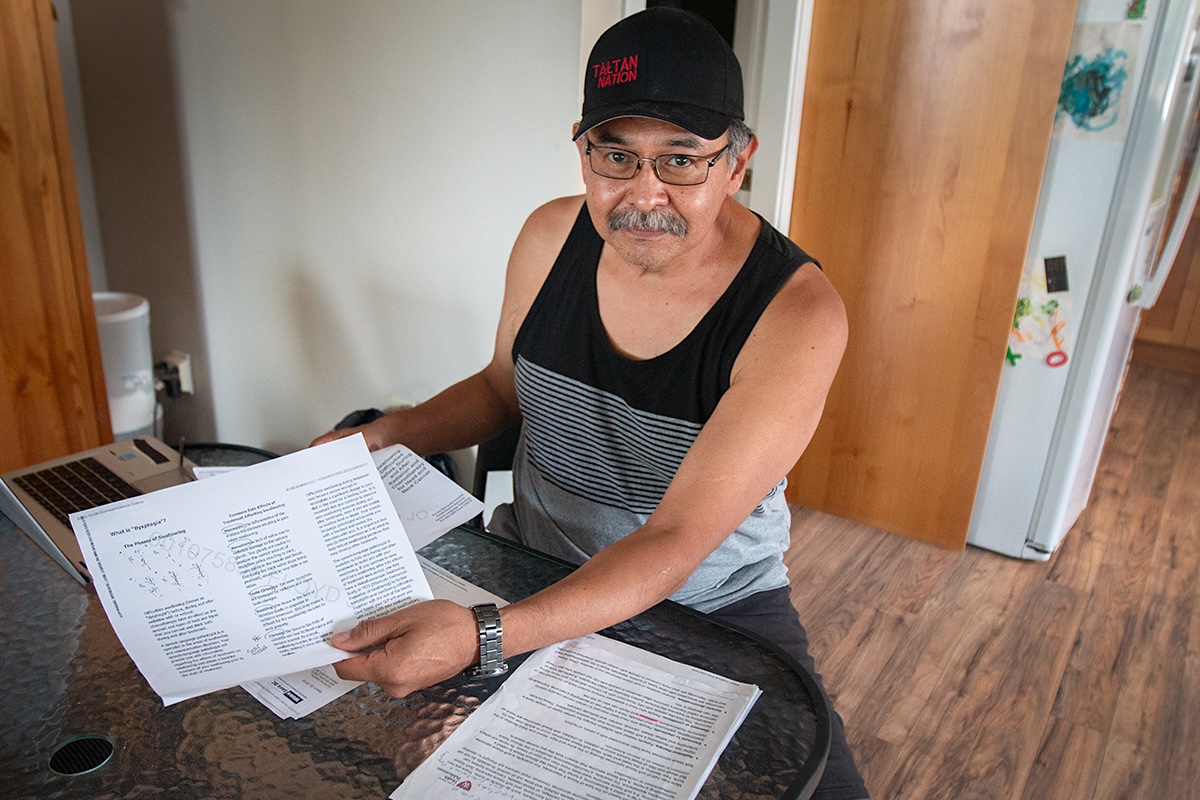
After Cassiar shut down, Floyd Joseph moved to Prince George, a thousand kilometres southeast of his childhood home. Today, he lives in a leafy subdivision on the city’s outskirts with his wife and three dogs.
Sitting at his kitchen table, Joseph thumbs through the paperwork from his cancer diagnosis a decade ago.
His first warning was a bump on his neck. In January 2015, he was diagnosed with a form of squamous cell carcinoma, a rare type of skin cancer that had spread to a salivary gland near his left ear.
While the cancer’s origin was unknown, doctors suspected it may have begun in his nose.
In a report dated Oct. 7, 2015, an oncologist noted that Joseph “does not have a history of smoking/drinking combination.” Joseph told The Tyee he has never been a smoker and that he gave up alcohol more than 20 years before the diagnosis.
“It does raise the possibility that his malignancy is related to occupational exposure,” the doctor wrote. “Of course, there is no direct evidence in the literature for this association, however, a lack of evidence is not evidence against it.”
One month later, a WorkSafeBC case manager wrote in Joseph’s file that his cancer was “strongly associated” with smoking and alcohol consumption. He added that he could “not find any reference to an association with exposure to asbestos.”
Joseph’s claim was denied. He didn’t have the strength to appeal.
“I’m trying to fight cancer, not fight WCB,” he says, referring to the Workers’ Compensation Board, known as WorkSafeBC. “Mentally, I could not do that. Most people can’t. It’s just too much trauma and too much hurting at that time to fight anybody. You’re fighting for your life with cancer. How could you fight somebody for money?”
A similar case suggests that, if Joseph had appealed, he might have been successful.
According to the decision by the Workers’ Compensation Appeal Tribunal, an unnamed worker who spent years at an “asbestos mine in northern British Columbia” during the 1980s was diagnosed with laryngeal cancer in 2011.
His claim for workers’ compensation was also denied.
The specialist who diagnosed the man’s cancer believed it might be related to asbestos exposure. But another doctor reviewing the case for WorkSafeBC provided a different opinion, writing that although there was “no evidence to suggest” that asbestos exposure had increased the worker’s risk of laryngeal cancer, there was also a “wealth of data” that his past smoking and alcohol consumption were factors. The doctor determined that the cancer was a “direct result” of smoking and drinking.
The worker appealed, arguing that the medical evidence supported a “conclusion that his laryngeal cancer is due to the nature of his employment.” He told the tribunal that his work exposed him to asbestos fibres and dust “on a continual basis” between 1980 and 1987.
The tribunal found that, on a balance of probabilities, the worker’s cancer was “due to the nature of his employment at the asbestos mine.” The appeal was allowed.
Workers’ compensation records for Cassiar are incomplete
Pat Byrne says a lack of upfront research when reviewing workers’ compensation claims is far too common.
Byrne is an occupational hygiene expert who spent more than a decade working for WorkSafeBC before moving on to the appeals division. He frequently had to trace a worker’s employment history in the final stages of the appeal — efforts that he says should have been made in the claim’s early stages.
“Part of my frustration when I was in the appeal division was that a lot of the frontline people making initial decisions, quite frankly, didn't do their homework,” he says. “The board's responsibility is to not just say to the worker, ‘Will you tell us where you were exposed?’ It's up to the board to investigate.”
He recommends that anyone filing a workers’ compensation claim research their entire employment history, including possible asbestos exposure, before filing a claim.
“Certainly, causation is a challenge,” he says. “There are some presumptions in the legislation about asbestos in terms of your exposure.”
While asbestos exposure has historically been connected primarily to asbestosis, lung cancer and mesothelioma, recent research has established links to other forms of cancer and challenged the role played by smoking.
Christopher McLeod, an associate professor at the University of British Columbia’s school of population and public health, says that dismissing a claim because asbestos exposure coincides with smoking represents “a misunderstanding of the science.”
“Sufficient asbestos exposure, regardless of whether you’re a smoker or non-smoker, should lead to the disease being recognized as asbestos-related,” he says.

And Paul Demers, a University of Toronto public health professor and a director at Ontario’s Occupational Cancer Research Centre, says there’s a “much higher risk” of cancer in smokers who have been exposed to asbestos compared with smokers who haven’t.
“It really isn't a legitimate reason to deny compensation,” he says.
The science is also beginning to recognize that asbestos may be linked to more types of cancers than previously acknowledged, McLeod says.
“The key thing is establishing the exposure,” he says.
According to B.C.’s Workers Compensation Act, diseases like asbestosis, lung cancer and gastrointestinal cancers should be presumed to have been caused by asbestos when there has been sufficient exposure. Cancers like those of the larynx and pharynx are covered when an exposed person has also been diagnosed with asbestosis.
The World Health Organization’s International Agency for Research on Cancer goes further, saying there is “sufficient evidence” that asbestos causes lung, larynx and ovary cancers and that it has “positive associations” with stomach, pharynx and colorectal cancers.
The government should consider lowering the standard of evidence in cases like Cassiar, where exposure is well established, McLeod says. He adds that it makes sense to err by compensating too many people rather than to risk denying compensation to some who may have been harmed by occupational exposure.
The Tyee made several requests to WorkSafeBC, but no one was made available for an interview.
We also requested data about work-related asbestos illness in the province. The board provided information showing it has accepted, on average, 55 asbestos-related claims every year over the past decade. Asbestos remains the leading cause of workplace illness and death in B.C.
WorkSafeBC says it does not have “any recent claims associated with the Cassiar mine.” In response to a freedom of information request, the board told The Tyee that it has only ever received two asbestos-related claims from Cassiar — both of them in the 1980s.
However, that figure does not align with expert accounts and information provided by former residents like Joseph, who showed The Tyee proof that he filed his compensation claim in 2015.
Lee Loftus, the former WorkSafeBC vice-chair, told The Tyee that he has helped about nine former Cassiar workers with their compensation claims — claims that he assumed were filed and accepted.
When asked about the discrepancy, WorkSafeBC said that older claims dating back to the 1950s “were converted from paper records and many of the details were not input into WorkSafeBC's electronic claims management systems.” It didn’t provide a reason why more recent claims did not appear in its search.
A spokesperson wrote that the long latency period between asbestos exposure and signs of illness may be “an additional factor in why there are fewer claims” than expected.
A decade after his cancer diagnosis, Joseph has had to fight to get his energy back. He eventually returned to work as a heavy-duty mechanic.
He told The Tyee that he has had many family members and friends from Cassiar diagnosed with cancers and other health effects associated with asbestos exposure. He knows of only one person who has filed a successful workers’ compensation claim.
“I’ve got friends that can barely walk up steps,” he says. “How can I stand up and fight for myself?”
This is the first in a two-part series about Cassiar. Watch for the second part later this week. ![[Tyee]](/design-article.thetyee.ca/ui/img/yellowblob.png)
Read more: Health, Rights + Justice, Labour + Industry










Notice about commenting changes
The Tyee’s commenting system will be moving to a new platform on Nov. 12. If you’re already a Tyee commenter you must register with the new system on or after Nov. 12 with your preferred username.More information can be found here.