


 SHARE:
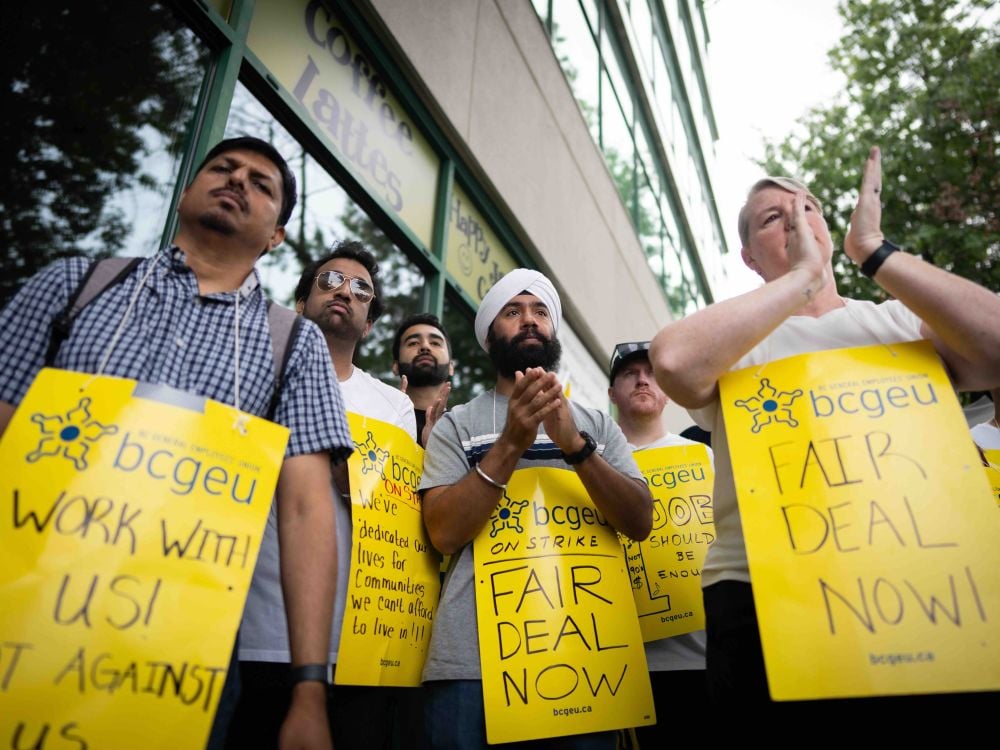
As the BC General Employees’ Union steps up strike action and the government and union wage a war of words, both sides are looking to win public support.
The job action by core government workers began Sept. 2 with about 2,000 workers at sites in Victoria, Surrey and Prince George walking off the job.
By Friday, about 4,000 workers were off the job at 22 sites across B.C. and more than 1,700 Liquor Distribution Branch workers have stopped working overtime.
Union president Paul Finch said the current job action mainly targets internal operations.
“So far, we have done our best to minimize disruptions to the public,” Finch said. “If the government doesn’t come back to the table, we’re not gonna be able to keep doing that. The time will come when we’re going to have to take out key services.”
Peggy Nash, executive director of the Canadian Centre for Policy Alternatives, said the union’s strike strategy will exert maximum pressure on the employer while retaining public support.
“They do want to demonstrate to the employer that they’re serious,” she said. “If you start with your biggest action first, it doesn’t give you a lot of room to move from there.”
Nash said starting with inward-facing job action before escalating can help maintain public support for the union.
The BCGEU said it received strong public support before job action began. It commissioned a poll by Leger that found 74 per cent support for the statement that it’s reasonable to consider a salary increase for frontline public service workers given the cost of living.
The poll also found that 73 per cent agreed that “any increases in public service worker pay must be balanced against the impact on taxpayers.”
Job action will test public opinion as it drags on, Nash said.
“There is a lot of public sympathy for working people,” Nash said. “There will be a struggle for hearts and minds to keep the public on-side. This initial start of a strike that does not inconvenience the public will be seen as a positive move.”
Finch said the union will continue to escalate action to bring the government back to the table but will respect essential service designations.
“We’re seeing overwhelming support from the public,” he said. “That’s not surprising. People understand the affordability crisis in this province.”
The BCGEU, representing 34,000 members working directly for the government, is joined on strike by the Professional Employee’s Association, the union for more than 1,800 licensed workers including engineers, foresters and geoscientists. About 400 members of that union walked off the job the same day as the BCGEU.
Union and government disagree on wage proposals
Finance Minister Brenda Bailey said in an email she’s encouraging both sides to find a way forward, adding the ministry “strongly believes the best deal will be reached at the bargaining table.”
Bailey added the government is willing to offer fair wages, but it’s facing challenging economic conditions. The province is projecting a $10.9 billion deficit for this fiscal year.
The BCGEU’s Finch said last week the union is seeking a two-year agreement with a four per cent general wage increase in the first year and a 4.2 per cent increase in the second, plus cost-of-living adjustments for certain workers.
The government released a document Monday costing the union’s proposals and said that the result would be a 15.75 per cent increase in compensation costs.
The province is offering a 3.5 per cent general wage increase over two years and an extra one per cent increase for lower-income and longer-service employees.
The province says that its offer equals a 4.5 per cent wage increase over two years for the average BCGEU worker.
While that falls below the expected Consumer Price Index rise of 4.8 per cent over the next two years, the province maintains it will mean the average BCGEU member’s wages will have increased slightly ahead of inflation.
But Finch said previous contracts also provided increases below the rate of inflation.
The B.C. Consumer Price Index shows inflation was approximately 13.9 per cent over the past three years.
The province asserts that between 2022 and 2025 the average BCGEU member gained a 14.25 per cent wage increase.
But Finch said the general wage increase in the last contract worked out to 13.75 per cent over three years.
“There was a suggestion that BCGEU members did better than inflation over the last agreement, and that’s completely untrue,” Finch said.
The job action sets the stage for more tough public sector negotiations in the coming months.
Unions representing 452,000 B.C. public sector workers are heading into bargaining this year, including the Hospital Employees’ Union, BC Teachers’ Federation and BC Nurses’ Union.
Last month the Hospital Employees’ Union and the government announced a framework agreement for a new contract. The government said the agreement “represents a major milestone in bargaining, as the parties have reached agreement on all of the compensation increases.”*
The BCGEU’s Finch criticized the HEU’s agreement as “below inflation” and said it “undermines the very fight that public service workers across B.C. are taking on together for fair wages and respect at the bargaining table.”
* Story updated on Sept. 16 at 7:14 p.m. to add information on the Hospital Employees’ Union framework settlement agreement. ![[Tyee]](/design-article.thetyee.ca/ui/img/yellowblob.png)







Tyee Commenting Guidelines
Please note that email notifications for replies are not currently working due to a software issue which may be resolved in a future update.
Comments that violate guidelines risk being deleted, and violations may result in a temporary or permanent user ban. Maintain the spirit of good conversation to stay in the discussion and be patient with moderators. Comments are reviewed regularly but not in real time.
Do:
Do not: