


 SHARE:
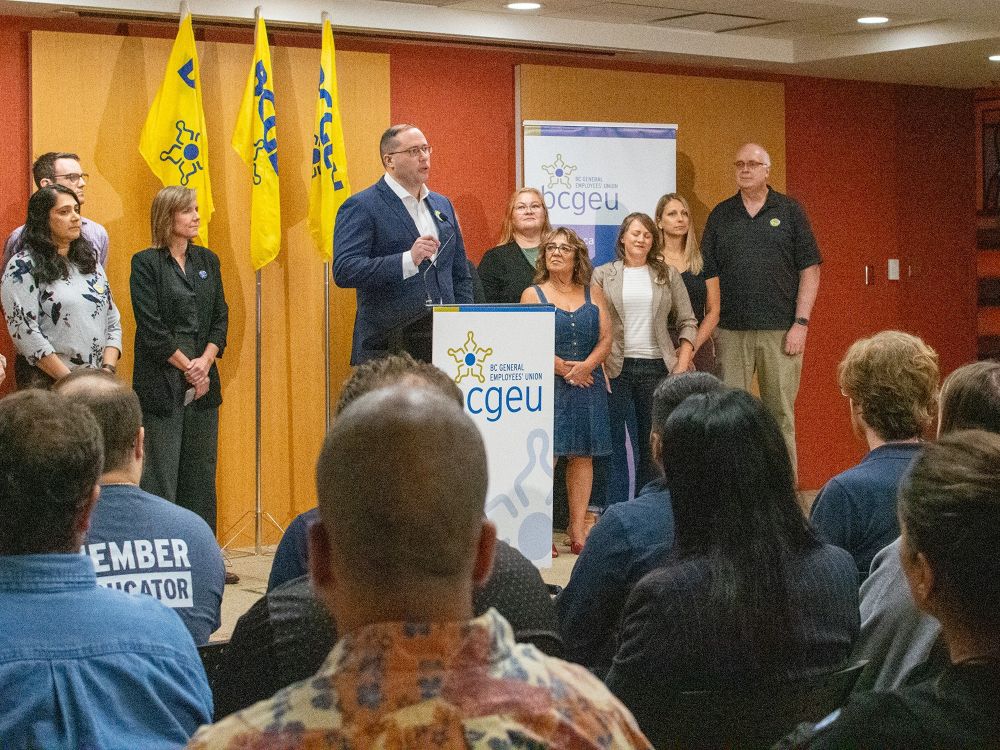
The BC General Employees’ Union issued strike notice today, meaning up to 34,000 provincial government workers could walk off the job as early as Tuesday.
BCGEU president Paul Finch said at a press conference that about 93 per cent of union members voted in favour of a strike.
Workers are seeking higher wages to address affordability issues, strong remote work provisions and a limit on non-union managers, he said.
“We believe our members are asking for a fair and reasonable deal here,” Finch said. “We want government to revise their mandate, come back to the table, and ensure we get a deal.”
Finch said the BCGEU is looking for a two-year agreement with a four per cent general wage increase in the first year and a 4.2 per cent increase in the second, plus cost-of-living adjustments for certain workers.
The bargaining unit includes direct government employees, including ministry staff, social workers, correctional officers and court workers.
But not all workers will be able to strike, as the BC Labour Relations Code requires employees “necessary or essential to prevent immediate and serious danger to the health, safety or welfare of the residents of British Columbia” to remain on the job.
Acting deputy premier Mike Farnworth said the government expected to meet with the union in September and hoped to continue negotiating.
“Negotiations take place at the bargaining table,” he said. “They’re not done by press conferences or in the public. The parties are meeting next week, and that’s where agreements are made, at the negotiating table.”
Contracts expire for unions representing about 452,000 B.C. public sector workers this year, including the Hospital Employees’ Union, BC Teachers’ Federation and BC Nurses’ Union.
Talks have been difficult as unions push for wages and benefits that meet the cost of living while the province aims to balance its budget.
But the Hospital Employees’ Union announced Thursday that it had agreed on “primary elements” of a tentative agreement for more than 67,500 hospital and long-term care workers.
The union did not disclose details, but HEU secretary business manager and lead negotiator Lynn Bueckert said it includes measures to address low wages and improve benefits for workers who care for seniors in long-term care and assisted living.
“This framework will help bring real economic improvements for health care workers so they can continue delivering the care we all need,” Bueckert said in a statement.
The union still needs to negotiate the final elements of a tentative deal. Bueckert added the HEU still stands in solidarity with the BCGEU and Professional Employees Association at their own bargaining tables.
Finch said the BCGEU is disappointed with the tentative deal.
“The agreement is below inflation and undermines the very fight that public service workers across B.C. are taking on together for fair wages and respect,” he said in a release Thursday.
“This announcement will not undercut the strength and solidarity of BCGEU members, and the wider labour movement currently engaged in bargaining.”
BCGEU negotiations broke down in July, largely over wages, and members took a strike vote between Aug. 11 and 29.
In June the government offered the BCGEU a two-year agreement with two options for the first year: either a one per cent increase plus a 30-cent-per-hour salary bump, or a 1.5 per cent increase.
The first-year option with the 30-cent-per-hour increase would provide a boost to lower-paid employees.
The government proposed a two per cent increase in the second year.
The Canadian Union of Public Employees said in June it received a similar offer, while the Hospital Employees’ union said that same month it was offered an increase of 3.5 per cent over two years.
BCGEU President Paul Finch said in a June video bargaining update the offer fell behind inflation and did not come close to the increases the union was seeking for members.
The B.C. budget forecasts consumer price inflation of 2.2 per cent in 2025 and 2.1 per cent in 2026.
The BCGEU said it received strong public support for its workers.* It commissioned a poll by Leger, which surveyed 1,004 British Columbians in August and found 74 per cent of respondents agree it’s reasonable to consider a salary increase for frontline public service workers, given the cost of living.
Of the respondents, 80 per cent agree that too much is spent on management and not enough is spent on frontline workers.
And of those who said they had an opinion, 37 per cent said they were likely to side with public service workers and 19 per cent said they would side with the government in the event of a labour dispute.
* Story updated on Sept. 2 at 9:00 a.m. An earlier version misnamed the union that commissioned a public opinion poll. ![[Tyee]](/design-article.thetyee.ca/ui/img/yellowblob.png)
Read more: Education











Tyee Commenting Guidelines
Please note that email notifications for replies are not currently working due to a software issue which may be resolved in a future update.
Comments that violate guidelines risk being deleted, and violations may result in a temporary or permanent user ban. Maintain the spirit of good conversation to stay in the discussion and be patient with moderators. Comments are reviewed regularly but not in real time.
Do:
Do not: