


 SHARE:
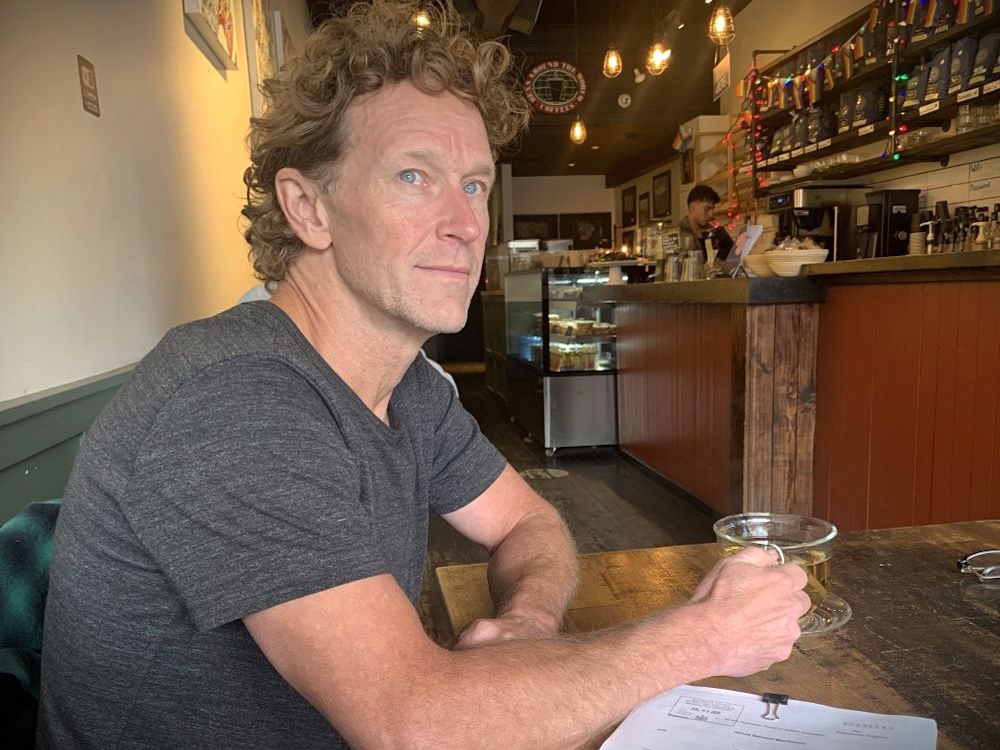
Vancouver writer J.B. MacKinnon is far from the only Canadian author whose work has been used to train AI systems without compensation or consent.
“I have yet to meet a Canadian author whose work wasn't used in that way,” said MacKinnon, the author of several noted books, including The Once and Future World, and co-author of the bestselling “buy local” bible The 100-Mile Diet. As CanLit’s foremost locavore, MacKinnon is perhaps the perfect plaintiff for a series of class-action lawsuits against the omnivorous tech giants feeding their large language models, or LLMs, a diet of CanCon protected by copyright.
MacKinnon is leading four separate class actions, all filed in B.C. Supreme Court in the last four months, alleging that tech giants Meta, Anthropic, Databricks and Nvidia repeatedly, wilfully and knowingly infringed on his and others’ intellectual property to train and develop their LLMs. Each is accused of relying on a pirated data set known as the Pile — an 800-gigabyte bundle of text that includes roughly 196,640 unlicensed books, many of which are the works of Canadian authors.
Nvidia, the largest company in the world by market capitalization, “made no effort to pay the owners of these copyrights to obtain or use their works,” the most recent claim alleges. It’s an outrage if true. Canadian authors often struggle to make ends meet. Meanwhile, the company allegedly built on theft of their creative output is valued at over US$4 trillion.
MacKinnon was floored.
“My impression ever since these cases were made public is that Canadian authors are thinking about this a lot,” he told The Tyee. “It's been quite the ripple of shock coming out as people go to those now fairly widely available databases and check to see if their copyrighted work was used to train large language models.”
South of the line, Meta and Anthropic have already won very similar lawsuits in the early rounds. Just last month, a judge in San Francisco ruled that Meta’s use of copyright-protected work falls under “fair use” in this instance. But these and other cases are still working their way through the U.S. court system.
That said, Canadian courts tend to be more protective of copyright. Given that, and the host of Canadian authors behind him, MacKinnon remains optimistic.
“I’m hearing from a lot of writers,” he said. “I don’t feel alone, let’s put it that way.”
This interview has been edited for length and clarity.
The Tyee: So these are just huge companies you're suing.
J.B. MacKinnon: The biggest.
I'm reluctant to ask Amazon for my money back when I buy a crappy product, or Apple when I forget to cancel a free trial. But you're after a lot more here. What makes you think that these tech giants won't just flick you into outer space?
I think I need a clarification on that question. What makes me think that I can win anything from them? Or what makes me think that I'm not gonna wake up in concrete shoes at the bottom of the sea?
Both, man. What makes you think that you can accomplish anything when, heck, the Canadian government is struggling to rein in these corporations right now. And aren't you terrified — as a person, just one man, who has a name, who can be found — to be going up against these titans?
As a representative plaintiff, I see myself as standing at the front of a very long line. A class-action suit, really, is representing a class. So I think every Canadian writer is already a part of this. In my mind, it’s all of us together.
I will say that waking up and having a legal document land in your inbox that says “J.B. MacKinnon versus Nvidia” is sobering. But I've tried not to think about it any further than: this is a fight worth having. I don't think that we're in a place where I'm such a threat that I’m concerned about my continued existence on the planet.
Much more concerning is the enormity of the tech firms’ power and their bottomless resources. I had the opportunity to speak with a couple of the lawyers that have run class-action suits of this type in the United States. They estimated that Big Tech was spending millions a day on their legal defence. Even though, on the face of it, just going and taking copyrighted materials off pirated sites in a way that appears, at least to us, to be knowing — that just seems so flat-out wrong that it's hard to imagine how they won't have to pay in some way. But they're enormously powerful and well-heeled, so who knows? I certainly don't think there's any reason to think that any part of this will be an easy battle.
From a storytelling standpoint, the face of the “buy local” movement going toe to toe with what may be proven the “steal from everyone, everywhere” movement is right out of a movie. How did you become the face of this AI copyright lawsuit?
Vancouver is home to some of the top class-action lawyers in Canada who are doing quite pioneering work in this area. One of them I know socially. He and I have spoken about AI issues in the past. When it came up on his radar, he started to look into whether a class-action suit in Canada might make sense. When he concluded that it would, he approached me to be the representative plaintiff.
A solid choice. The winner of the Green Prize for Sustainable Literature up against makers of energy-gobbling, massively unsustainable products. Clearly, your lawyer friend did his homework. I did not. Explain this lawsuit to me. What are you alleging?
We're alleging that several large tech firms used pirated copies of copyrighted works that they found on the internet as a foundational basis for training their large language models. So that's the first allegation. The second allegation is that they then took steps to cover up that fact, including by stripping off the copyright information from the copyrighted materials that they were using, in part, as we argue, so that the AIs themselves wouldn't know that they were learning from copyrighted works.
Further to that, based on research that was done for American class-action lawsuits as I understand it, there's also the allegation that they actually built in guardrails for the AIs so that they would be not forthcoming when faced with users’ questions about whether or not they were trained with copyrighted materials.
Boy, that’s a lot of subterfuge. Allegedly.
Those are the two aspects of the allegation. Embedded within that, though, is the larger question of choice. As writers, we ought to have been given the choice over whether or not our works would be used in this fashion, because there are so many moral and ethical questions associated with AI.
The counter-argument appears to be that these machines will transform and improve our world so significantly that the greater good outweighs your need or mine to get asked or paid for our work.
That argument came up in the U.S. class-action lawsuits. Down there, the question of whether AI technology is transformative can be determinative as to whether or not copyright was infringed. So in the U.S., if you're working on something that's so transformative that it can do great public good, then you're given some leeway to use copyrighted materials without permission. I think there's a lot to be questioned about that.

There's a sincere debate to be had about whether AI counts as a transformative technology. But beyond even that, was it essential to the transformative nature of this technology that it be brought to the public so swiftly that normal acknowledgment of copyright and moral rights be overlooked? I don't think there's any evidence to suggest that that's the case.
They were all merrily building their AIs until ChatGPT was made available to the public. Then they were all in a rush to get their product to market, and it appears that they started skipping over the right thing to do. Slowing down long enough to address the copyright issue would have had zero effect on how transformative this technology will or won't turn out to be.
Big Tech’s argument that they should be allowed to skirt or outright break the law because they're going to transform the world lands with a real thud when we’re already living in a world of their own making, and it sucks.
I think the recent lesson of Big Tech is that, if anything, they should be moving more slowly. We've seen what happens if something transformative, like social media, is brought into a culture without any pause for sober second thought about what some of the consequences might be. If we think about the capacity AI has just to displace people from their paid employment, just that alone, I think, should give us all at least enough pause to also address the question of copyright and choice in participation in the production of large language models.
Absolutely. The “move fast and break things” approach sounds fruitful until I or my colleagues are what gets broke. This is my livelihood! I had a full mental breakdown writing my memoir, and now it’s just food for the Harrison Mooney replacement machine? Outrageous. So I really appreciate what you’re doing here, not just for me but for all of the authors and artists that make up this country’s creative community.
In the materials that I've seen that were developed for these cases in the United States, these big firms considered high-quality, edited, fact-checked, published, copyrighted works as some of the very best material that they could train their AIs with. We weren't just one drop in the ocean. Canadian authors’ written works were really significant to the development of these LLMs.
What is your overall opinion of AI? I know some authors are finding ways to incorporate it into their craft. That scares the shit out of me, personally, but so does the thought of becoming a Luddite, left behind while everyone around me levels up creatively. Does the author of The 100-Mile Diet feel less pressure to keep up with global trends?
I’ve felt quite a bit of pressure to try and make heads or tails of AI, but more so in my role as an instructor of journalism. I haven't really used it in my work in any way that feels particularly meaningful, but I've experimented with it in order to get a sense of what it can and can't do. Like any tool, I think AI can be put to uses that will serve the public good. But there's one clear way that I think it will poorly serve the public, particularly writers: if you look at how social media has commodified attention, I think that AI poses the danger of commodifying and colonizing many more of our mental processes — not just attention, but critical thinking, memory, imagination.
It's a very easy tool to just cause you to stop thinking for yourself and get AI to do the work. For example, in writing, if I'm struggling to find a metaphor to represent an idea that I want to get across to the reader, and if that struggle goes on for more than five seconds, then I might be tempted to reach for AI, right, and get it to conjure up a metaphor for me. That's just one really simple example. But I think the process of doing that, of removing the difficult work, or some of the difficulty from imaginative work, is very dangerous. It really threatens to rob us of something that is at least as essential as our attention.
I think that is kind of my main stressor. It's the way that it devalues the labour as well as the product. The labour is the product!
We need to be very cautious about what we're giving up internally. The most Pollyanna-ish version I've seen of this threat is the idea that each one of us will ultimately be the conductor, the orchestra will be AI, and we will be saying, like, you do this, horns come in here, flute come in there, violins here. We'll just be prompting the AI to serve our imaginative purposes. That's kind of the rose-coloured glasses version of it.
The idea there is that it will liberate us from the intellectual and imaginative grunt work we don’t want to do. But I don't think there's any path to that place of being the conductor without passing through the grunt work. The capacity to become the conductor is formed from the bottom up, and I don't think we can afford to lose it.
Again, this is why it's great that you’re the face of this class action. Big Tech is pushing their top-down agenda. You’re out here fighting for the bottom-up approach. Forget “J.B. MacKinnon versus Nvidia.” This is locavore versus omnivore.
One thing that I've learned from trying to live more locally is that you always have to be careful about what is vanishing with efficiencies. So we're like, oh, we can produce more tomatoes, and we can have them in the winter, if we just fly them in. But as you move away from the local, you lose these subtle things like connection to the seasons, or awareness of what's happening to farmers and to farmland in your local area, or a direct personal relationship with the success or failure of local salmon stocks. All of these highly complex relational things are so easily lost to efficiencies.
When I think about the assault that AI can produce upon the dignity of work, I'm just appalled. Appalled at the number of people who could end up having their work debased or ending up out of work, and the incredible depth of ramifications that it could potentially have.
And I’m appalled at the idea of some robot replicating The 100-Mile Diet. Fresh cogs from the Okanagan. Motor oil and rivets from your local farmers market... you know, because robots, uh, they don't eat normal food like you and I... OK, maybe my worst joke.
This is actually a funny point.
You’re too kind.
Because it’s more than just copyright, right? Strictly speaking, copyright is for, you know, sort of a direct verbatim reproduction of somebody's work. But large language models were built on a substrate of copyrighted works. And when I think about it in that kind of physical sense, I think, OK, here you have these giant corporations, and they had certain things they needed to produce their AIs. They needed energy, so they went and they bought energy, or they lined up their energy supplies and paid for those. They needed microchips, so they lined up a supply and paid for those.
Then they needed this substrate of high-quality human expression and language. It looks to me like they just decided, well, we're not going to pay for that supply. When I think about it that way, it really makes the nature of the taking much more naked. ![[Tyee]](/design-article.thetyee.ca/ui/img/yellowblob.png)
Read more: Rights + Justice, Science + Tech









Tyee Commenting Guidelines
Please note that email notifications for replies are not currently working due to a software issue which may be resolved in a future update.
Comments that violate guidelines risk being deleted, and violations may result in a temporary or permanent user ban. Maintain the spirit of good conversation to stay in the discussion and be patient with moderators. Comments are reviewed regularly but not in real time.
Do:
Do not: