


 SHARE:

Once a week, Vancouverites wake up to the clattering sounds of garbage trucks moving through their alleyways and streets. Residents may take for granted their arrival, but the rubbish would pile up fast if the yellow-vested crews missed their rounds.
Demand for their line of work is growing. The city recently hired eight new drivers, rotated in two from other areas of the department, and intends to bring on more throughout the year.
“I’ll be honest with you. This job is not for everyone,” says Jose Machado, a sub-foreman for the city’s sanitation services. “We have to have fast and efficient people. With these trucks, the driver, he’s not driving on the left, he’s driving on the right side. He’s watching the mirror, and at the same time, he’s also using a joystick. So, he’s co-ordinating, and he’s also got to be aware of his surroundings. It’s a lot of work.”
The job often involves repetitive motions, which can lull drivers into not paying attention — a lapse that can have swift and serious consequences when operating large machinery. When Machado was a new driver, he says, he briefly became distracted when speaking with a resident he saw on a regular basis, and accidentally put his truck’s claw through a resident’s brown picket fence.
Workers from other city yards have been seriously injured or killed in vehicle collisions and workplace accidents. New collection workers receive safety training that includes guarding against contracting diseases, and they shadow a driving mentor who shows them how to do pre-trip checks on the trucks and helps with on-the-road training.
Once qualified, they are assigned to one of two types of vehicles. One, called an automatic, has a garbage claw that can be operated from the cab. The other, a semi-automatic, requires a crew member to jump up and down from the truck to feed the totes, or garbage bins, to the claw which then grabs on and empties the contents into the truck bed.
In the warmer months, thanks to fireworks and other special events, there’s even more stuff to gather up and dispose of, which can mean extra hours for Vancouver’s 70 sanitation collection workers.
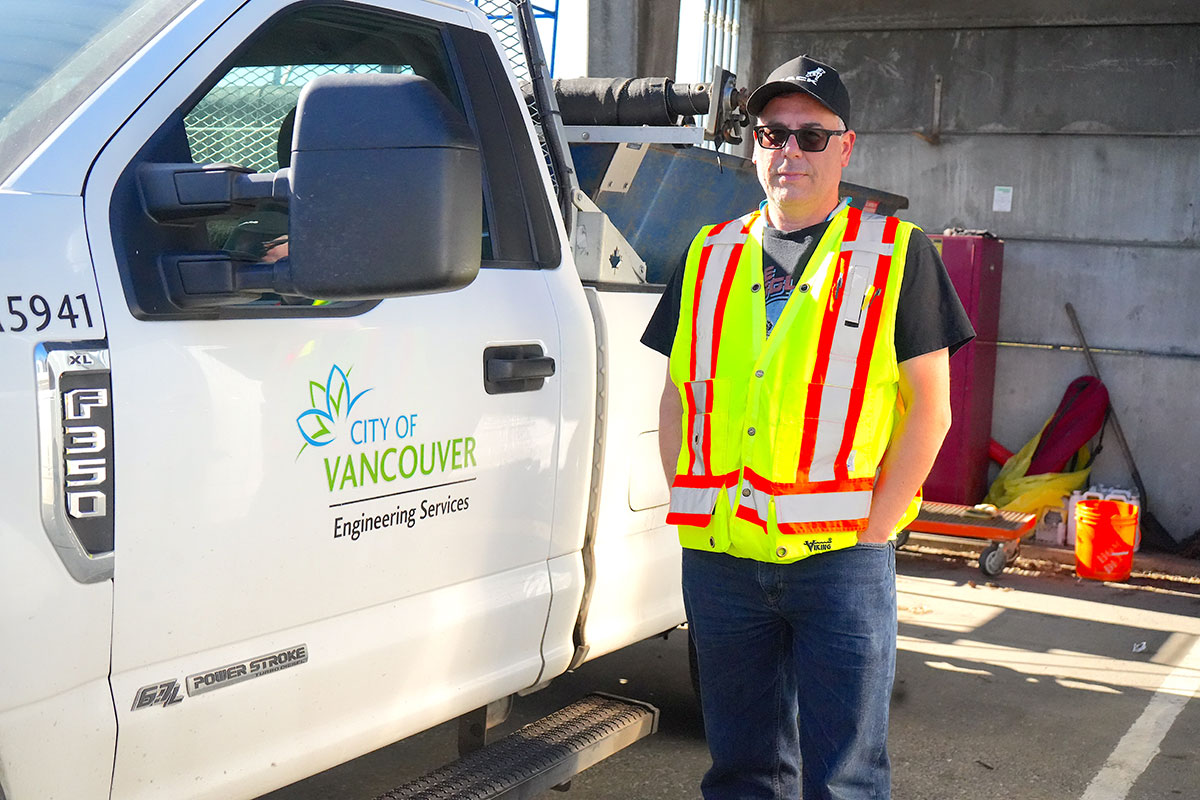
On a bright and early Wednesday morning, I walk up to a small white office building off the intersection of Manitoba and 70th Street, where I meet Machado. His job is to provide on-the-ground support for workers whose trucks have broken down or need assistance.
After donning bright yellow vests, Machado and I make our way to a large lot in the back of the building where the garbage and service trucks are parked. Machado shows me around the compound, which contains huge repair garages, old, out-of-service gas pump stations, and warehouses for the stacks of the city’s black trash bins.


This is Manitoba Yard Works, the operational hub for the City of Vancouver’s sanitation services. It’s where public garbage and green bin pickups are co-ordinated for the entire city, and where garbage and yard waste are contained in giant piles, waiting for trucks to transport them to the dump in Delta, B.C.
It’s also where collection workers inspect their trucks and line up every day at 7 a.m., seven days a week, 364 days a year — with Christmas the only day off — to run routes in designated quadrants of the city.
“Right now, we’re in a bit of a transition period while we’re ordering new trucks,” Machado says. “Because of COVID-19, everything got put on hold, but we were still working [using the same trucks]. Everyone was also at home and that meant more garbage as well.”
It takes a fleet of 45 vehicles to do black and green bin collection in Vancouver. The city also used to collect recycling through a public-private partnership, but contracted that service fully to private operators in 2014.
In total, approximately 200 staff — including collections, street cleaning and administration — run city sanitation services for a population of over 630,000 residents. Last year, they collected approximately 35,000 tonnes of residential garbage and approximately 47,000 tonnes of green waste — a total of 82,000 tonnes of garbage and green waste combined. That’s the weight of more than seven Eiffel Towers generated, one bin at a time, by Vancouverites annually.

Machado suggests we drive to chat with some workers as they make their rounds. Navigating without using a GPS, Machado knows how to find those he supervises just based on the name of the grocery store or intersection they tell him when he calls. We meet up with Steve Isovic, a collection worker who’s been on the job since 2012, as he completes his route.
“I really enjoy my job,” said Isovic. “Just listening to the news and hanging out with myself.”
Isovic occasionally gets out of his truck to paste stickers on the tops of garbage totes to inform their owners that the totes are too full, or that they’re less than three feet apart, which makes it hard for his truck’s claw to get a solid grip on the bin.
“If [the totes] are overflowing, some drivers just drive by,” said Isovic. “I never do because this is my beat. I want to take care of it.”
Next, we check in with Boris, who has been with the city for 30 years and prefers to just share his first name. Boris works the back end of a semi-automatic truck. Every couple of yards, the truck stops, and Boris hops down and wheels totes back and forth from the garbage claw’s fingers.
More senior workers like Boris are able to choose the routes, or beats. He describes a close relationship between himself and his driver. “Before we turn the corner, he sees trouble coming,” Boris says. “He pumps the air brakes, and he lets me know that there’s danger around the corner. He’s the guy keeping me safe.”
The risks can take a number of forms as trucks squeeze their way along tight, bumpy roads and dusty alleyways. Sometimes cyclists whiz by the trucks, unaware that collection workers may be getting off the vehicle at the very same moment.
The morning I ride along with Boris and Machado, we’re moving down a narrow street when we are interrupted by a driver rolling his car past on the sidewalk. Seemingly the motorist felt impatient about waiting for the garbage truck to do its collections and now he inched along, sandwiched between trees and front lawns as we all watched dumbfounded.
A bit later, a resident waves and thanks Boris as he drives by. “We get good people like that,” said Machado, gesturing to the friendly resident. “And then you’ve got that guy back there.”
Back at the operations hub, Machado gives me a final tour of the yard before heading back to the office.
Life holds some constants for Machado. He knows when he ends his shift at 7 p.m., he’ll be greeted at home by his wife and two dogs, Banjo and Ukee.
He also may safely assume that tomorrow, when he awakens at 4:30 a.m. to start his day, there will be plenty more garbage waiting. He and his colleagues will once again make sure it is removed.
“We had a guy who was retiring,” says Machado. “He said that the only thing that would stop us is a zombie apocalypse.” ![[Tyee]](/design-article.thetyee.ca/ui/img/yellowblob.png)
Read more: Municipal Politics, Environment, Urban Planning










Tyee Commenting Guidelines
Comments that violate guidelines risk being deleted, and violations may result in a temporary or permanent user ban. Maintain the spirit of good conversation to stay in the discussion and be patient with moderators. Comments are reviewed regularly but not in real time.
Do:
Do not: