

 SHARE:
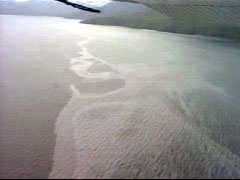
Three months after the oil spill in Robson Bight, the provincial and federal governments are scheduled to begin an underwater scan today of the sunken wreckage that released 10,000 litres of diesel oil into a marine reserve.
It will mark the first phase of an investigation to assess the risk to the ecosystem posed by the wreckage, which sits on the ocean floor 350 metres below the surface.
And with attention turning back to the area, more basic questions come to the fore: How did the oil end up in the waters of a protected whale habitat? Why did it take until the next day for a clean-up crew to arrive on site?
Lower standards for the marine transport of smaller amounts of oil by smaller vessels and the structure of B.C.'s spill response system appear to have played a part.
And although -- ironically -- the delay in getting clean-up crews to Robson Bight may not have made much difference because of the nature of the spill, in a future disaster such a delay could be serious.
Just before noon on Aug. 20, a barge full of logging equipment travelling south from Beaver Cove suddenly listed, sending almost all of its cargo crashing into the waters of the Robson Bight (Michael Bigg) Ecological Reserve.
The equipment included a fuel truck containing 10,000 litres of diesel, which promptly began to leak to the surface. More than 18 hours later, the first response vessel would arrive on site, by which time about 60 killer whales had already been exposed to the toxic fumes of the evaporating diesel.
Today, weather permitting, Nuytco Research Limited of Vancouver, which has been contracted by the B.C. Ministry of Environment and the Canadian Coast Guard, will begin to get a first look at that equipment and assess what hazard it may still present to the ecosystem.
In the first phase Nuytco will likely undertake sonar scans to locate the equipment, which is likely to take two to four days, according to the Living Oceans Society, one of the environmental groups that has pressed the provincial and federal governments to investigate since the spill. The second phase will include sending down a manned submersible to film the equipment, the society said.
The investigation may face delays because of the winter weather, but delays also marked the day the spill occurred.
On Aug. 20, the company responsible for cleaning up all spills along the B.C. coast, Burrard Clean Operations, first learned of the accident about an hour-and-a-half after it occurred, according to the company's general manager, Kevin Gardner.
The firm contacted the Coast Guard and learned that the agency was conferring with the polluter, Ted LeRoy Trucking, a logging company, he said.
Lower bar for smaller vessels
Federal rules require companies that cause a marine oil spill to pay for its clean-up. Further, companies transporting or receiving oil by water must also help fund the government's oil-spill preparedness.
On the West Coast, about 1,820 companies do this by paying an annual fee to Burrard Clean Operations. But membership in this group is mandatory only for bigger vessels -- tankers of 150 gross tonnage and above, and all ships of 400 gross tonnage and above. (A Vancouver SeaBus is about 500 gross tonnage.)
That leaves smaller vessels one step outside the spill response system. Ted LeRoy Trucking was not required to join Burrard Clean.
The logging company's older, un-inspected barge could also carry a fuel truck as deck cargo because non-tanker vessels face fewer restrictions for transporting oil than tankers. Non-tanker vessels can transport up to 100 tonnes of oil as deck cargo without needing to first pass an inspection and be certified, as is required for tankers.
Quicker Notification
On Aug. 20, Burnaby-based Burrard Clean was officially notified of the accident about three hours after it occurred, according to the company's general manager, Kevin Gardner.
Ted LeRoy Trucking requested help with the clean-up at 2:57 p.m., he said.
Burrard Clean then began to roll out its response.
To be fair, it likely took some time for the Coast Guard and the polluter to assess the spill and decide what type of response was required -- it wouldn't have helped to send the wrong clean-up equipment to the site.
But one other factor might have slowed the notification of Burrard Clean: Burrard Clean's Gardner said his company would have been notified of the spill more quickly if the polluter had been a member, simply because they would have had the necessary contact information at hand.
In Robson Bight, a lot of oil was coming to the surface that first day, according to Jim Borrowman, co-owner of Stubbs Island Whale Watching in nearby Telegraph Cove.
He ferried journalists to the site to film the two-kilometre-long fuel slick spreading from the world-famous orca habitat that first evening. He said that Department of Fisheries and Oceans enforcement staff were monitoring the area in a Zodiac, but that no response had been launched.
The response vessel was on its way, though. By 4:45 p.m., a contractor for Burrard Clean had loaded one of its response trailers in Campbell River onto the Sea Roamer landing barge and was getting ready to head to Robson Bight, about 125 kilometres to the north.
The crew arrived on site at 6:25 a.m. the next day, about 18-and-a-half hours after the fuel truck hit the water in Robson Bight.
Eighteen-and-a-half hours may be a long time, but Burrard Clean had achieved what it was supposed to do.
It's a long coastline
Transport Canada sets minimum response times for Burrard Clean, ranging from six hours to 72 hours, depending on the size of the spill and its location. For spills outside the Vancouver and Strait of Juan de Fuca regions, travel time is added on top of the minimum response time.
For a spill of less than 150 tonnes of oil outside the Vancouver and Strait of Juan de Fuca regions -- as was the case in Robson Bight -- Transport Canada requires Burrard Clean to arrive on site within six hours, plus travel time. The clock starts when Burrard Clean is officially notified about a spill; if travelling by water its response vessel must average six knots per hour (11.1 km/h).
In the Robson Bight case, Burrard Clean had a total of about 33 hours to get to the spill site.
Commenting on the response time, Victoria-based oil-spill specialist Gerald Graham said: "It looks bad, but the only way you can have a quicker response is if you have a [response] depot a lot closer to the spill, and with 28,000 kilometres of coastline in B.C., where are you going to put all these depots and how often are they going to be used?"
In the Robson Bight case, an earlier arrival by the response vessel may not have made a difference to the clean-up because of another variable -- the type of oil spilled. Diesel is light so it's difficult to pick up off the water. About half of it will evaporate within the first 24 hours, so part of the clean-up strategy can be to do nothing, although there is a cost: lighter oils are more water soluble and therefore more toxic in the short term.
Burrard Clean's Gardner said that in the Robson Bight case, the diesel had broken up and formed a sheen, so it was unrecoverable. The crew put out booms to protect sensitive areas, he said.
The spill spreads
Evaporation rates increase if a spill spreads rapidly in currents and is exposed to sun and wind, according to a paper by Jacqueline Michel, an oil response professional in Columbia, South Carolina.
And the Robson Bight spill did spread. By the second day the diesel had expanded into a slick about 14 kilometres long and 50 metres wide, according to reports. This was good for evaporation, but the trade-off was that a group of about 60 killer whales spent at least six hours in the large slick, breathing in its toxic fumes.
Lighter oils are more water soluble and therefore more toxic in the short term, and whale researchers worry that exposure to the diesel may have caused long-term damage to the orcas.
"It is believed that up to 25 percent of the entire northern resident whale population have inhaled diesel vapours which could cause lung lesions, pneumonia, and other potentially lethal health consequences," according to the Living Oceans Society.
Speaking earlier this month, Borrowman said he was still seeing small spots of oil near the spill site but that strong currents made it difficult to pinpoint the source. The Northern Resident orcas will remain in the area until about Christmas, he said, after which they'll leave for other waters. They will begin to return in June.
In the meantime, the B.C. Ministry of Environment and the Coast Guard are splitting the cost of the survey, which should finally determine whether the fuel truck and other machinery are the source of that oil, and whether they still pose a hazard to the orcas and other marine life.
(Note: To listen to an underwater recording of the Robson Bight accident go to the news archive section of orcalab.org and click on the Aug. 21 entry.)
Related Tyee stories:
- Oil: BC's Hydra-headed Headache
To prevent and respond to spills, our policies are a mess. - Oiling up the Coast
Harper shrugs off 35-year ban on risky tanker traffic. - Texada Gas Project Raises Safety Fears
Scared islanders mad at no-show politicians.
![[Tyee]](/design-article.thetyee.ca/ui/img/yellowblob.png)






Tyee Commenting Guidelines
Comments that violate guidelines risk being deleted, and violations may result in a temporary or permanent user ban. Maintain the spirit of good conversation to stay in the discussion.
*Please note The Tyee is not a forum for spreading misinformation about COVID-19, denying its existence or minimizing its risk to public health.
Do:
Do not: